


What Is an OPA? The Principles and Applications of Optical Parametric Amplification
An optical parametric amplifier (OPA) exploits second-order nonlinear optics to amplify a signal by three-wave mixing. No population inversion is needed, and the gain is instant and continuously tuneable in wavelength. This article covers the principle, the key parameters, the main types and the applications.
Contents
- 1. What Is an OPA? The Core Concept
- 2. How It Works: What Makes Parametric Amplification Possible
- 3. Key Parameters: Reading an OPA Specification
- 4. Main Types: Which Kinds of OPA Exist
- 5. Applications: Where OPAs Are Actually Used
- 6. Common Misconceptions: Four Widely Held Myths
1. The Core Concept: What Is an OPA?
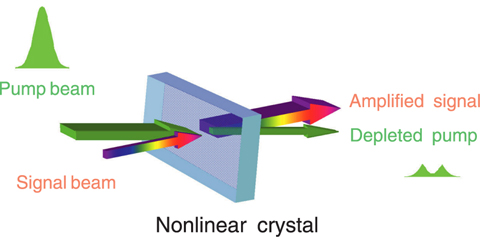
An optical parametric amplifier (OPA) is an optical amplifier based on second-order nonlinear optics (χ⁽²⁾). It works quite differently from a laser amplifier: no gain medium with population inversion is involved. Instead, a strong pump beam and the signal interact inside a nonlinear crystal, and the pump energy is transferred directly to the signal, amplifying it while a new beam — the idler — is generated at the same time.
The most distinctive advantage of an OPA is that its amplifying wavelength can be tuned continuously over a very wide range: change the pump wavelength or the phase-matching condition of the crystal, and a different wavelength is amplified. The gain response is also instantaneous, with no energy storage, so it can amplify ultrafast signals. This is why OPAs matter in ultrafast laser science, wavelength conversion and quantum optics.
An OPA is not a standalone box. It belongs to the same family as the optical parametric oscillator (OPO), difference-frequency generation (DFG) and optical parametric chirped-pulse amplification (OPCPA). An OPO resonates in a cavity and selects frequencies, so it delivers an oscillator output; an OPA has no cavity and only makes single or multiple single passes, which is why its gain bandwidth is wider and its tuning faster. DFG can be seen as the limiting case of a very weak signal, where the idler is the point; OPCPA transfers the stretch–amplify–compress logic of chirped-pulse amplification into the parametric process to push femtosecond pulses towards the petawatt level. In practice these are often chained together: an OPO or a fibre laser provides the seed, an OPA raises the energy, and DFG fills in the mid-infrared.
In device terms an OPA is an active component: it only works with an external pump, and once the pump is switched off the gain vanishes at once. Yet it differs fundamentally from erbium-doped fibre amplifiers and other devices built on population inversion — the gain comes not from stimulated emission of upper-state ions but from the coupling between pump and signal waves inside a nonlinear crystal. Two consequences follow directly. First, there is no millisecond-scale energy storage and release, so the gain follows the pump pulse and can be as fast as femtoseconds to picoseconds. Second, there is no amplified spontaneous emission accumulating through repeated amplification; the noise comes mainly from pump intensity noise and vacuum fluctuations.
2. How It Works: What Makes Parametric Amplification Possible
The physics of an OPA is best followed along two lines: the conservation of energy and momentum, which decides whether amplification happens at all and at which wavelength; and the phase relation between the three waves, which decides whether the gain is phase-sensitive or phase-insensitive. The four steps below tie the two together.
Step 1: Three-Wave Mixing, with Energy and Momentum Conserved Together
A pump beam (ωₚ, shorter wavelength) and a signal beam (ωₛ, longer wavelength) enter a second-order nonlinear crystal (BBO, LBO, KTP, PPLN and so on) together. Pump photons are annihilated and a signal photon plus an idler photon (ωᵢ) appear. The process obeys two conservation laws:
- Energy conservation: ωₚ = ωₛ + ωᵢ, equivalently 1/λₚ = 1/λₛ + 1/λᵢ. Once the pump wavelength is fixed, signal and idler wavelengths are complementary — tune the signal towards longer wavelengths and the idler must move towards shorter ones.
- Momentum conservation (phase matching): kₚ = kₛ + kᵢ, where k = 2πn/λ. Crystal dispersion makes the refractive index wavelength-dependent, so the equality only holds at a particular angle or temperature. In practice it is satisfied by rotating the crystal (angle phase matching) or by changing its temperature (temperature phase matching).
The idler is not a by-product; it is an inevitable outcome of the parametric process. Wherever the signal is amplified, an idler is generated, and the two exchange power. That also means the pump energy is split two ways, so conversion efficiency cannot be judged from the signal alone.
Step 2: The Tolerance of Phase Matching Sets the Bandwidth
Phase matching does not hold at a single wavelength only; it holds approximately over a band of wavelengths, and that band is the phase-matching bandwidth. It is set by the dispersion slope of the crystal, the crystal length and the matching type (type I or type II). A shorter crystal tolerates a larger mismatch and therefore gives more bandwidth; a longer crystal gives more gain but narrows the band. This is exactly why femtosecond parametric amplifiers use thin crystals, or chirped ones, to hold the full spectral width of the pulse while keeping the gain.
Step 3: Gain Grows Exponentially — and Instantly
When phase matching is satisfied the signal grows exponentially along the crystal, with a small-signal gain close to G ≈ exp(2ΓL), where Γ is proportional to the pump field amplitude and the effective nonlinear coefficient of the crystal, and L is the crystal length. Three factors set the gain directly: pump intensity, effective nonlinear coefficient deff, and crystal length.
The key point is that this gain has no storage stage. A laser amplifier must first pump ions into the upper level, storing energy for milliseconds, and then release it by stimulated emission. Parametric amplification needs no population inversion: the coupling between pump and signal is immediate, so the gain arrives with the pump pulse and disappears the moment the pulse is gone. That is why an OPA can keep up with femtosecond pulses, and why it is not limited by thermal lensing or thermal depolarisation the way a solid-state amplifier is — in the ideal case all the pump energy becomes signal and idler, and the crystal itself absorbs no light and does not heat up. In real systems the temperature rise comes mainly from parasitic absorption and residual loss in the crystal coatings.
Step 4: Phase-Insensitive and Phase-Sensitive Modes
The frequency relation between signal and idler determines the phase behaviour of the gain, and this is the most fundamental difference between an OPA and any laser amplifier:
- Non-degenerate mode (ωₛ ≠ ωᵢ): signal and idler have different frequencies, the gain is independent of the absolute phase of the signal, and the quantum limit of the noise figure is 3 dB. Most wavelength conversion and ultrafast pulse amplification works in this mode.
- Degenerate mode (ωₛ = ωᵢ = ωₚ/2): signal and idler coincide, the gain depends on the relative phase of signal and pump, and the noise figure can in theory fall below 3 dB, even approaching 0 dB. Squeezed light is generated in this mode, and quantum metrology — such as squeezed-light injection in gravitational-wave detection — relies on exactly this.
◆ An analogy
Parametric amplification is closer to three people skipping with a rope: the pump swings the rope, while signal and idler are the two carried along by it. Get the rhythm — the phase — right and both are lifted; lose it and the energy goes straight back, and nobody gets high. When the one swinging stops, the rope stops and the amplification is over: there is no strength stored up here, only a partnership in progress. A laser amplifier, by contrast, is more like filling a reservoir and then opening the sluice — filling takes time, and the outflow has inertia of its own.
Put the four steps together and the design freedom of an OPA comes down to three knobs: the pump wavelength sets where signal and idler sit; the crystal cut angle or temperature sets the phase-matching point, and hence the tuning range; crystal length and pump intensity set the trade-off between gain and bandwidth. Once these three are clear, the numbers in a specification stop being isolated entries.
3. Key Parameters: Reading an OPA Specification
An OPA datasheet is harder to read than a laser datasheet because several figures constrain one another. The table below lists the six parameters most worth confirming at selection, together with the physics behind each.
| Parameter | What it means | Why it matters |
|---|---|---|
| Small-signal gain | The gain when the input signal is very weak. It depends on pump intensity, crystal length and the effective nonlinear coefficient, and typically reaches tens of dB. | Sets the largest amplitude a weak signal can reach and is the core measure of amplifying capability; too little gain leaves the output too weak for the measurement that follows. |
| Gain bandwidth | The wavelength range over which the gain stays above a stated value. It is set jointly by the phase-matching condition and crystal dispersion, and can be hundreds of nanometres wide. | Decides how broad a spectrum the OPA can amplify at once, the core advantage for ultrashort pulses and widely tuneable sources; the wider the band, the shorter the pulse and the greater the tuning span it supports. |
| Tuning range | The range over which the output wavelength can be tuned continuously by changing the phase-matching condition (angle, temperature or crystal position), potentially from the visible to the mid-infrared. | One of the OPA’s most striking advantages, and the reason it is the first choice for widely tuneable sources; in spectroscopy and materials characterisation, where a specific wavelength is required, nothing else substitutes. |
| Conversion efficiency | The fraction of pump energy converted into signal and idler. It depends on phase-matching accuracy, pump intensity and crystal loss, and is typically 10%–40%. | Directly sets the energy efficiency and output power level; higher efficiency means a stronger signal for the same pump and a lower system cost. |
| Phase-matching bandwidth | The wavelength range over which effective phase matching is satisfied, set by crystal dispersion, crystal length and the matching type (type I / type II). | The physical basis of the gain bandwidth and the limit on how broad a spectrum the OPA can amplify; broadband phase matching is the key technique in femtosecond parametric amplification. |
| Idler characteristics | The idler emitted alongside the amplified signal, at the difference between pump and signal frequency (ω_i = ω_p − ω_s). Its wavelength can extend into the mid-infrared. | The idler can be used as an independent mid-infrared source, which greatly extends the OPA’s useful range; its presence also means pump energy is shared. |
These parameters are not independent; they constrain one another. Gain trades against conversion efficiency, bandwidth against phase-matching tolerance, tuning range against peak gain — high gain needs a strong pump but may introduce phase mismatch, while a broadband design gives comparatively lower gain. Judging a product on a single figure therefore tells you very little.
If these parameters are unfamiliar, the Soar Laser product pages document them in detail, and our engineers can help with selection directly.
4. Main Types: Which Kinds of OPA Exist?
An OPA has more classification axes than a laser, because its operating point is set by pump, crystal and matching method together. The four below are the ones that matter at selection.
By phase-matching method
Angle phase matching (critical phase matching)
Phase matching is achieved by rotating the crystal. The tuning range is wide, and this is the most common approach.
Temperature phase matching (non-critical phase matching)
Tuning is done by changing crystal temperature. Walk-off is small, so a larger beam divergence can be tolerated.
By degeneracy
Non-degenerate OPA
Signal and idler differ in frequency and the amplification is phase-insensitive. This is the most common form.
Degenerate OPA
Signal and idler share the same frequency, at half the pump frequency. Amplification is phase-sensitive and low-noise amplification becomes possible.
By crystal type
BBO crystal
Large nonlinear coefficient, wide transparency range and a high damage threshold; the most widely used OPA crystal.
LBO crystal
Wide transparency range and high damage threshold, used for high-power operation.
KTP crystal
High nonlinear coefficient, used in the near-infrared.
PPLN (periodically poled lithium niobate)
Quasi-phase matching with high nonlinear utilisation.
By mode of operation
Pulsed OPA
Pulse-pumped, with high gain; commonly used for ultrafast pulse amplification.
Continuous-wave OPA
CW-pumped, with lower gain but continuous operation.
Fibre optical parametric amplifier (FOPA)
Parametric amplification through third-order nonlinearity inside an optical fibre.
Combining these four axes defines the operating region of an OPA. A concrete trade-off: angle-matched BBO gives a very wide tuning range but pronounced walk-off, so beam quality varies with tuning angle; non-critically matched LBO has little walk-off and a high damage threshold, suiting high pulse energies, at the cost of tuning by precise temperature control and a slower response. For signal amplification in the conventional 1550 nm telecommunications band, EDFA and the Raman amplifier still hold a clear lead in cost and maturity; only when ultrafast pulse amplification, wide wavelength tuning, a mid-infrared source or squeezed light is needed does the OPA become the only option.
5. Applications: Where OPAs Are Actually Used
The application space of an OPA is far narrower than that of an EDFA, yet in a few directions it cannot be replaced. It appears mainly where a wavelength no conventional laser can deliver is needed, or where very short pulses must reach high energy — concentrated in research and high-end industry rather than in general-purpose production equipment.
- Ultrafast lasers and attosecond science: an OPA is one of the core tools of ultrafast optics. It can raise femtosecond pulses to high energy and, by tuning, produce ultrashort pulses at other wavelengths for attosecond pulse generation, ultrafast spectroscopy and similar frontier work.
- Wavelength conversion and tuneable sources: the tuning capability of an OPA reaches wavelengths conventional lasers cover poorly, such as parts of the mid-infrared and the visible, making it a common widely tuneable source in research.
- Quantum optics: parametric processes are the standard route to entangled photon pairs and squeezed states. A degenerate parametric amplifier can produce squeezed light below the standard quantum limit, which matters in quantum metrology and quantum communication.
- Mid-infrared generation: many mid-infrared wavelengths have no suitable laser medium, and difference-frequency generation in an OPA produces them efficiently.
- Optical communication: the fibre optical parametric amplifier (FOPA) has potential in optical communication for signal amplification, wavelength conversion and all-optical signal processing.
Representative applications in detail
Ultrafast lasers and attosecond science: OPCPA is now the mainstream route
A femtosecond seed from a Ti:sapphire or ytterbium laser is first stretched to the picosecond range, raised in energy by an OPA, and compressed back to femtoseconds — that is OPCPA. Compared with regenerative amplification, parametric gain is broader, so it supports few-cycle pulses; it deposits no heat, so average power can go higher; and it carries amplified spontaneous emission noise several orders of magnitude lower. Table-top systems above ten terawatts now essentially all take this route, and so do the driver sources used for attosecond pulse generation.
Wavelength conversion and tuneable sources: turning 800 nm into any wavelength
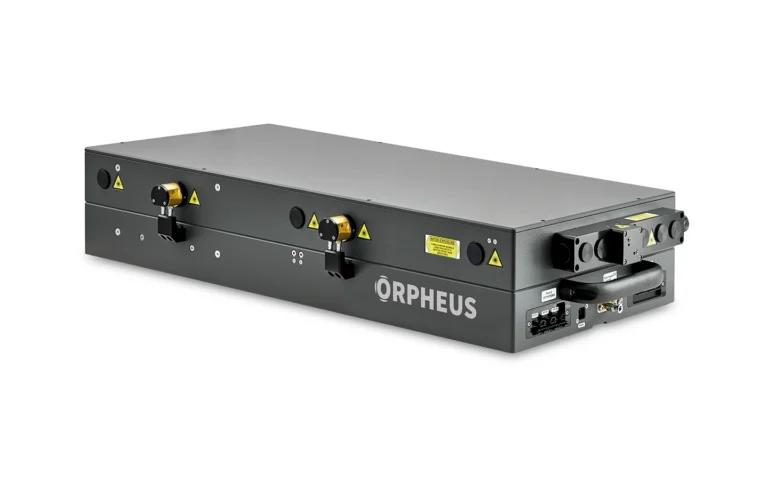
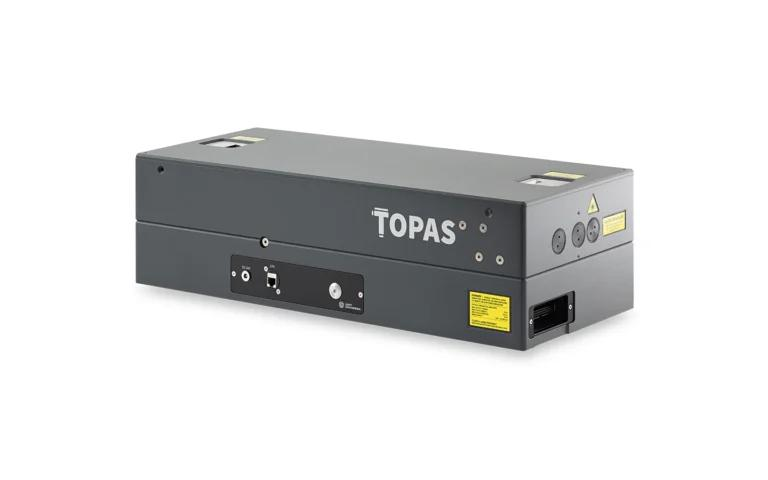
A Ti:sapphire amplifier is fixed at 800 nm, yet many experiments need continuous tuning from the visible to the mid-infrared. Split the 800 nm into two paths, use one as pump and one as signal — or generate a supercontinuum in a white-light crystal as the seed — and the OPA outputs tuneable femtosecond pulses from 500 nm to 20 μm. The commercial TOPAS and ORPHEUS systems are built on exactly this idea.
Quantum optics: the main source of squeezed states
A degenerate or near-degenerate parametric process squeezes the quantum fluctuations of the pump into one quadrature, producing light below the shot-noise limit. The Laser Interferometer Gravitational-Wave Observatory injected frequency-dependent squeezed light in its post-2019 upgrade, suppressing quantum noise at high frequencies and effectively extending its reach. Parametric processes are also the standard way to make entangled photon pairs; spontaneous parametric down-conversion remains the workhorse of quantum light sources.
Mid-infrared generation: difference frequency is easier than finding a gain medium
The 3–20 μm band lacks mature gain media comparable to erbium or ytterbium, so covering it with lasers directly is hard. Mix a strong near-infrared beam with a weak one and the output wavelength is set by the difference — a single crystal covers the whole mid-infrared. The OPA-plus-DFG combination is the most common mid-infrared source in gas sensing, trace spectroscopy and infrared countermeasures.
Optical communication: phase-sensitive amplification in FOPA
A fibre optical parametric amplifier obtains parametric gain through third-order nonlinearity (four-wave mixing) in highly nonlinear fibre. The gain band can span the whole telecommunications window, the response is fast, and wavelength conversion and all-optical regeneration come for free. A phase-sensitive FOPA can in theory amplify with a 0 dB noise figure, which is one route past the 3 dB quantum limit; loss in highly nonlinear fibre and pump cost have so far kept it from large-scale commercial use.
◆ Want to see more OPA applications in practice? Visit Soar Laser’s application notes, or contact our technical team for advice.
6. Common Misconceptions
An OPA differs so much from a laser amplifier in structure and operation that the misunderstandings cluster in a few places. These four are the ones we are asked about most.
Misconception 1: an OPA amplifies by stimulated emission, like any other optical amplifier
Not at all. An OPA works through second-order nonlinear optics (three-wave mixing); there is no population inversion and no stimulated emission, and energy passes directly from the pump to signal and idler. It is a nonlinear optical process, not a laser amplification process.
Misconception 2: an OPA can only amplify weak signals and cannot deliver high power
An OPA can combine high gain with high output energy, especially when pulsed. Optical parametric chirped-pulse amplification (OPCPA) takes femtosecond pulses to joule-level energy and petawatt peak power, and is one of the mainstream routes to ultra-intense ultrashort laser pulses today.
Misconception 3: the amplifying wavelength of an OPA is fixed
Quite the opposite — wavelength tuning is one of the OPA’s greatest strengths. By changing crystal angle or temperature the signal wavelength can be tuned continuously over a very wide range, from the visible to the mid-infrared. A conventional laser amplifier struggles to do this at all.
Misconception 4: an OPA generates a lot of heat, like a solid-state amplifier
In the ideal case the crystal absorbs no optical energy: the pump energy is converted entirely into signal and idler, so the crystal does not heat up. Parasitic absorption does produce a little heat in practice, but it is negligible compared with a laser amplifier. This is one reason OPAs suit high average power.
Misconceptions 1 and 4 are the easiest to mix up, because both treat an OPA as a laser amplifier with a different medium. Once you remember that the gain comes from the coupling of pump and signal inside the crystal, with no upper-state ions involved, both clear up on their own.
◆ Further reading
- What Is an Optical Amplifier? Amplifying a Weak Optical Signal Directly
- What Is a Raman Amplifier? The Optical Amplifier That Uses a Scattering Effect
- What Is Gain? How the Amplification Capability of an Optical Amplifier Is Measured
- What Is an EDFA? The Signal Refuelling Station of Fibre Communication
- What Is Gain Saturation? Why an Amplifier Cannot Amplify Indefinitely
Leave a Reply