


What Is a Fibre Laser? Why It Dominates the Industrial Laser Market
The fibre laser is the fastest-growing laser technology of the past two decades. It uses a single doped fibre as its gain medium while combining three advantages — high power, high efficiency and high beam quality — that traditional bulk solid-state lasers struggle to achieve all at once. From kilowatt-class metal cutting to precision micromachining, from communication amplification to medical aesthetics, fibre lasers have become the absolute mainstay of the industrial laser market. Based on authoritative content from the RP Photonics Encyclopedia, this article systematically explains the principles, types, advantages and challenges of fibre lasers.
Table of Contents
- I. What Is a Fibre Laser? — Definition and Basic Concepts
- II. Core Structure: Resonators, Double-Clad Fibre and Pumping Methods
- III. Main Types of Fibre Lasers
- IV. Why Are Fibre Lasers So Strong? — Four Core Advantages
- V. Challenges and Limits: What Are Nonlinear Effects?
- VI. Typical Applications
- VII. Common Misconceptions: 4 Ideas You May Have Got Wrong
- VIII. Recommended Reading
I. What Is a Fibre Laser? — Definition and Basic Concepts
A fibre laser is a special branch of solid-state lasers that uses rare-earth-doped active fibre as its gain medium. Rare-earth ions doped into the fibre core (such as erbium Er³⁺, ytterbium Yb³⁺, neodymium Nd³⁺ and thulium Tm³⁺) achieve population inversion under pump-light excitation and produce optical amplification through stimulated emission. The fibre’s waveguide structure confines light to the core to travel back and forth, forming laser oscillation [(RP Photonics)](https://www.rp-photonics.com/fiber_lasers.html).
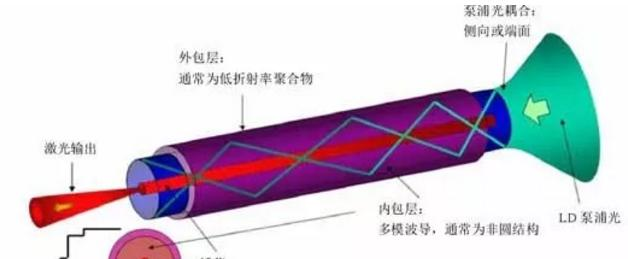
Figure 1: Schematic of a double-clad fibre laser — pump light (blue) propagates by total internal reflection in the inner cladding, while laser light (red) is generated and propagates in the core
Compared with bulk solid-state lasers, a fibre laser’s gain medium is a long fibre (usually several metres to tens of metres) rather than a crystal a few centimetres long. This “long and thin” structure brings several revolutionary changes: an extremely high surface-area-to-volume ratio (excellent heat dissipation), the waveguide effect inherently ensuring beam quality, and high gain efficiency (pump and laser light overlap over long distances). It is these properties that have let fibre lasers move from the lab into factories in just twenty years, becoming the mainstream of industrial lasers [(RP Photonics)](https://www.rp-photonics.com/fiber_lasers.html).
Note that fibre lasers are usually pumped with fibre-coupled laser diodes, so the vast majority are also a kind of diode-pumped solid-state laser (DPSS). An all-fibre setup contains no free-space optical components, making it compact, vibration-resistant and maintenance-free — one of the advantages industry values most [(RP Photonics)](https://www.rp-photonics.com/fiber_lasers.html).
II. Core Structure: Resonators, Double-Clad Fibre and Pumping Methods
1. Fibre Resonators
Fibre laser resonators can be implemented in several ways:
- Fibre Bragg gratings (FBGs): the most common scheme in commercial fibre lasers. Bragg gratings are written into the doped fibre (or spliced passive fibre) as cavity mirrors; the reflection wavelengths of the two gratings determine the laser wavelength.
- Fibre-end Fresnel reflection: the natural 4% reflection at a fibre end face is sometimes enough to serve as an output coupler, often used in simple experimental setups.
- Dielectric-coated mirrors: reflection after lens collimation, more power-tolerant, but requiring precise alignment.
- Fibre loop mirrors: built from a fibre coupler and a section of fibre, often used in ring resonators or special lasers.
- Ring resonators: light travels unidirectionally in a fibre loop with no standing-wave effect, suited to single-frequency lasers and some mode-locked lasers.
2. Double-Clad Fibre and Cladding Pumping
Double-clad fibre is the core invention enabling high-power fibre lasers. Its structure contains four layers:
- Core: silica glass doped with rare-earth ions, typically a few to tens of micrometres in diameter; laser light is generated and propagates here, generally single-mode.
- Inner cladding: pure silica or low-index doped glass, tens to hundreds of micrometres in diameter; pump light propagates here. Its shape is usually non-circular (D-shaped, hexagonal, etc.) to ensure the pump light fully crosses the core.
- Outer cladding: a low-refractive-index polymer that confines pump light in the inner cladding.
- Coating: the outermost protective layer.
The core idea of cladding pumping is: pump light travels in the thick inner cladding, laser light in the thin core. This allows high-power multimode pump light to be injected (without needing high brightness) while obtaining high-quality single-mode laser output in the core — effectively “converting” low-brightness pump light into high-brightness laser output. This is the fundamental reason fibre lasers achieve both high power and high beam quality [(RP Photonics)](https://www.rp-photonics.com/fiber_lasers.html).
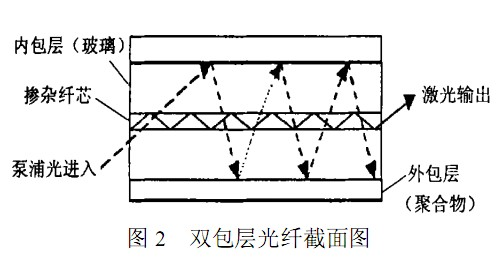
Figure 2: In a double-clad fibre, pump light (dashed line) propagates by total reflection in the inner cladding, partially absorbed each time it crosses the doped core, gradually converted into laser energy
3. Pumping Methods
Fibre laser pumping methods fall mainly into two categories:
| Pumping Method | Principle | Applicable Situations |
|---|---|---|
| End pumping | Pump light is coupled into the inner cladding from the fibre end face | Low to medium power, single-mode pumping, simple structure |
| Side pumping | Pump light is injected through V-grooves, tapered sections, etc. on the fibre side | High power, combining multiple pump sources, power scalable |
III. Main Types of Fibre Lasers
1. High-Power CW Fibre Lasers
This is the highest-volume category in the industrial market. Early fibre lasers output only a few milliwatts; today a single fibre can reach several kilowatts or more. Core technologies include double-clad fibre, large-mode-area (LMA) fibre, cladding pumping and pump combiners. High-power fibre lasers are widely used in material processing such as metal cutting, welding and cladding [(RP Photonics)](https://www.rp-photonics.com/fiber_lasers.html).
2. Q-Switched Fibre Lasers (Nanosecond Pulses)
Through active or passive Q-switching, fibre lasers can produce nanosecond pulses. Large-mode-area fibres can reach pulse energies in the millijoule range (tens of mJ in extreme cases), but are limited by saturation energy and damage threshold. All-fibre Q-switched fibre lasers usually have lower pulse energy. Because fibre lasers have very high gain, Q-switching often shows multi-peak temporal substructure, different from bulk lasers [(RP Photonics)](https://www.rp-photonics.com/fiber_lasers.html).
3. Mode-Locked Fibre Lasers (Ultrashort Pulses)
More complex resonator configurations are used for mode-locked fibre lasers (ultrafast fibre lasers), producing picosecond or femtosecond pulses. Active modulators or various saturable absorbers can be used. Artificial saturable absorbers can be realised by nonlinear polarisation rotation (NPR) or nonlinear optical loop mirrors (NALM). The classic “figure-eight laser” uses a nonlinear loop mirror for mode locking. The strong nonlinearity of fibre is both an advantage and a challenge — it helps start mode locking but can also degrade pulse quality (e.g. Kelly sidebands) [(RP Photonics)](https://www.rp-photonics.com/fiber_lasers.html).
4. Narrow-Linewidth / Single-Frequency Fibre Lasers
Using a short resonator (about 5 cm) and a narrow-band fibre Bragg grating (DBR or DFB structure), fibre lasers can operate in a single longitudinal mode, with linewidths as low as a few kilohertz or even below 1 kHz. Output power is usually a few to tens of milliwatts, up to about 1 W at most. If higher power is needed, a fibre amplifier can be connected afterward [(RP Photonics)](https://www.rp-photonics.com/fiber_lasers.html).
5. Upconversion Fibre Lasers
Taking advantage of the high pump intensity in fibre, upconversion lasing is possible — anti-Stokes laser output at a wavelength shorter than the pump. The most common are thulium-doped (Tm) ZBLAN fibre producing blue light and praseodymium-doped (Pr) fibre producing red, green and blue visible light. Because silica glass has high phonon energy, causing multi-phonon relaxation that shortens the intermediate-level lifetime, upconversion fibre lasers usually use low-phonon-energy fluoride glass fibres such as ZBLAN [(RP Photonics)](https://www.rp-photonics.com/fiber_lasers.html).
6. Raman Fibre Lasers
Based on the nonlinear Raman scattering effect in fibre, Raman fibre lasers use Raman gain rather than population inversion to generate laser light. Through cascaded Raman conversion, wavelength shifts of hundreds of nanometres from pump to output are possible. For example, 1 μm pumping can produce 1.4 μm laser light to pump a 1.5 μm erbium-doped fibre amplifier [(RP Photonics)](https://www.rp-photonics.com/fiber_lasers.html).
7. MOPA Architecture
Most commercial high-performance fibre laser systems use a MOPA (Master Oscillator Power Amplifier) architecture: a low-power seed source (master oscillator) first generates an optical signal with the desired temporal and spectral characteristics, which is then amplified by one or more stages of fibre amplifier. This architecture decouples “signal generation” from “power amplification,” greatly improving flexibility and controllability of performance [(RP Photonics)](https://www.rp-photonics.com/fiber_lasers.html).
IV. Why Are Fibre Lasers So Strong? — Four Core Advantages
1. High Beam Quality
The waveguide effect of fibre inherently ensures light propagates in the core in a specific mode. With single-mode fibre, output beam quality approaches the diffraction limit (M² ≈ 1), meaning the laser can be focused to an extremely small spot with very high power density — critical for processing applications such as cutting and welding. Even large-mode-area (LMA) fibre has far better beam quality than bulk solid-state lasers of the same power [(RP Photonics)](https://www.rp-photonics.com/fiber_lasers.html).
2. High Power Efficiency
The electrical-to-optical conversion efficiency of fibre lasers typically reaches 30%–40%, far higher than lamp-pumped solid-state lasers (2–5%) and better than most diode-pumped bulk lasers. High efficiency means lower energy consumption, smaller power supplies and weaker heat loads — real cost savings for industrial users [(RP Photonics)](https://www.rp-photonics.com/fiber_lasers.html).
3. High-Power Potential
Fibre has an extremely high surface-area-to-volume ratio and excellent heat dissipation. A thin fibre actually has a far larger cooling area than a crystal rod of the same volume. Combined with cladding pumping, which can inject large pump power, a single fibre can already deliver several kilowatts of continuous output, and beam combining can reach the hundred-kilowatt level [(RP Photonics)](https://www.rp-photonics.com/fiber_lasers.html).
4. Compact and Reliable
An all-fibre laser contains no free-space optical components, fearing neither vibration nor dust and requiring no maintenance. The fibre can be coiled, so the entire laser system can be made very compact. This is an important reason fibre lasers have entered industrial production lines at scale — factory environments are far harsher than labs, and reliability is a hard requirement [(RP Photonics)](https://www.rp-photonics.com/fiber_lasers.html).
V. Challenges and Limits: What Are Nonlinear Effects?
The advantages of fibre lasers come from their “long and thin” waveguide structure, but this also brings inherent challenges. Because the core is very thin (very high power density) and the fibre is very long (large interaction distance), nonlinear optical effects are often the performance ceiling.
Common Nonlinear Effects
- Stimulated Brillouin scattering (SBS): the main limiting factor for high-power single-frequency fibre lasers, causing backward scattering and limiting output power.
- Stimulated Raman scattering (SRS): appears in high-power pulsed or CW lasers, transferring energy from the signal light to the Stokes wavelength.
- Self-phase modulation (SPM): intensity-induced refractive-index change broadens the pulse spectrum, affecting mode-locked pulse quality.
- Kelly sidebands: common spectral sidebands in mode-locked fibre lasers, produced by the periodic interplay of dispersion and nonlinearity.
- Fibre fuse: at high power, cascaded optical damage can propagate along the fibre like a fuse.
Key insight
Fibre laser design is far more complex than bulk laser design. Because of the coupling of high gain, strong saturation, quasi-three-level behaviour and nonlinear effects, fibre laser behaviour usually cannot be described by simple analytical formulas and must rely on numerical simulation software for design and optimisation. This is why companies such as RP Photonics offer specialised fibre-laser simulation software [(RP Photonics)](https://www.rp-photonics.com/fiber_lasers.html).
VI. Typical Applications
1. Industrial Material Processing
This is the largest application market for fibre lasers. Kilowatt-class CW fibre lasers are used for thick-metal cutting and welding; nanosecond-pulse fibre lasers for precision marking, drilling and micromachining; ultrafast fibre lasers for cold processing (such as glass and wafer cutting). On production lines in automotive, aerospace and 3C electronics, fibre lasers have become standard equipment [(RP Photonics)](https://www.rp-photonics.com/fiber_lasers.html).
2. Optical Communication
The erbium-doped fibre amplifier (EDFA) is the core device of fibre-optic communication; without it there would be no Internet today. Although strictly speaking EDFAs are amplifiers rather than lasers, they are based on exactly the same fibre-gain principle. In addition, narrow-linewidth fibre lasers are key light sources for coherent communication and optical sensing.
3. Medicine and Aesthetics
The flexible delivery of fibre lasers (direct guidance through fibre) is especially suited to medical applications — the fibre can reach inside the body through an endoscope for surgery. Common applications include laser lithotripsy, ophthalmic surgery and laser aesthetics (hair removal, skin rejuvenation, spot removal). Thulium fibre lasers (2 μm) are increasingly popular in surgery because of good water absorption.
4. Research and Measurement
Ultrafast fibre lasers are used in spectroscopy, biomedical imaging (such as multiphoton microscopy) and materials science. Narrow-linewidth fibre lasers are used in precision measurement, optical sensing and quantum optics. High-power fibre lasers are also used in LiDAR and gravitational-wave detection.
5. Defence and Security
High-power fibre lasers are a popular route for directed-energy weapons — beam combining can reach extremely high power. Fibre lasers are also used in military applications such as laser rangefinding, target designation and infrared countermeasures.
VII. Common Misconceptions: 4 Ideas You May Have Got Wrong
Misconception 1: Fibre lasers are an independent category parallel to solid-state lasers
Correction: A fibre laser is essentially a branch of solid-state lasers — its gain medium (doped fibre) is also solid, and its working principle (stimulated emission, optical pumping) is exactly the same as bulk solid-state lasers. It is usually discussed separately only because the waveguide structure leads to very different performance characteristics. In the technical lineage: solid-state lasers → doped-insulator lasers → bulk lasers + fibre lasers [(RP Photonics)](https://www.rp-photonics.com/fiber_lasers.html).
Misconception 2: The higher the fibre laser power, the better, for any application
Correction: Power is only one of many fibre laser parameters. Different applications have different requirements for pulse width, wavelength, pulse energy, repetition rate and beam quality. For example, high-power CW fibre lasers suit thick-metal cutting, but precision marking needs nanosecond pulsed lasers, glass cutting needs femtosecond ultrafast lasers, and aesthetics needs specific wavelengths. Choose the wrong type and high power is useless [(RP Photonics)](https://www.rp-photonics.com/fiber_lasers.html).
Misconception 3: Fibre lasers cannot be Q-switched at all; Q-switching only works with bulk lasers
Correction: Fibre lasers can indeed be Q-switched, but pulse energy is limited by saturation energy (the fibre’s small mode-field area gives low saturation energy). Large-mode-area fibres can reach millijoule-level Q-switched pulses, but still fall short of bulk lasers (which can reach joules). In the nanosecond high-energy pulse field, bulk lasers still have the advantage [(RP Photonics)](https://www.rp-photonics.com/fiber_lasers.html).
Misconception 4: Fibre lasers are maintenance-free and never break
Correction: The all-fibre structure does greatly improve reliability, and pump diodes can last tens of thousands of hours, but “maintenance-free” does not mean “never fails.” The pump source, combiners and output heads of high-power fibre lasers can still fail. Moreover, at high power there is a risk of “fibre fuse” — once triggered, damage propagates along the fibre like a fuse, causing irreversible destruction. Regular maintenance and correct use are still necessary [(RP Photonics)](https://www.rp-photonics.com/fiber_lasers.html).
VIII. Recommended Reading
- What Is a Solid-State Laser? Classic and Timeless Laser Technology — the “big brother” of fibre lasers; a full view of bulk solid-state lasers
- What Is a Gain Medium? The Core Amplification Material in a Laser — understand the physics of fibre gain media in depth
- RP Photonics Encyclopedia: Fibre Lasers — the main reference for this article, the world’s most authoritative laser encyclopedia
Leave a Reply