


What Is a Solid-State Laser? Classic and Timeless Laser Technology
The solid-state laser is the most classic and most representative member of the laser family — the world’s first laser (the ruby laser) was a solid-state laser. More than sixty years later, solid-state lasers still hold a core position in research, industry and medicine. They use a crystal or glass as the gain medium, doped with rare-earth or transition-metal ions to achieve optical amplification. Based on authoritative content from the RP Photonics Encyclopedia, this article systematically covers the principles, characteristics, types and applications of solid-state lasers.
Table of Contents
- I. What Is a Solid-State Laser? — Definition and Basic Concepts
- II. Core Principles: Population Inversion and Stimulated Emission
- III. Pumping Methods: Lamp Pumping vs. Diode Pumping
- IV. Energy Storage and Pulse Generation
- V. Typical Solid-State Laser Types and Parameters
- VI. Typical Applications
- VII. Common Misconceptions: 4 Ideas You May Have Got Wrong
- VIII. Recommended Reading
I. What Is a Solid-State Laser? — Definition and Basic Concepts
A solid-state laser (SSL) is a device that generates laser light based on a solid-state gain medium (usually an ion-doped crystal or glass). A small amount of laser-active ions (such as neodymium Nd³⁺, ytterbium Yb³⁺ and titanium Ti³⁺) is doped into a transparent host material (such as YAG crystal or silicate glass); these ions achieve population inversion under pump-energy excitation and produce optical amplification through stimulated emission [(RP Photonics)](https://www.rp-photonics.com/solid_state_lasers.html).
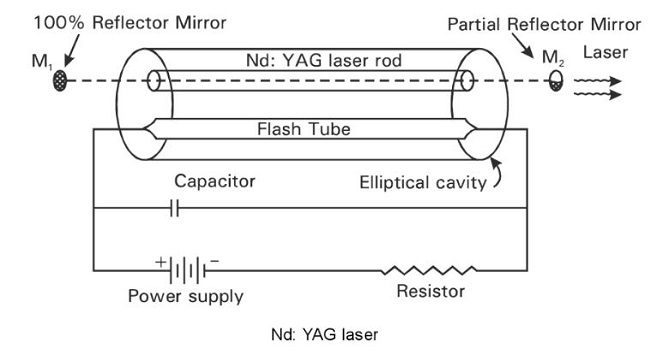
Figure 1: Schematic of a lamp-pumped Nd:YAG solid-state laser, showing the flash lamp, laser rod, resonator mirrors and power supply
It should be noted that the term “solid-state laser” often has both a narrow and a broad sense in practical use. Broadly, semiconductor lasers and fibre lasers are also “solid-state” — because their gain media are solid too. But in laser engineering, “solid-state laser” usually refers specifically to doped-insulator lasers — lasers using an insulating crystal or glass as host doped with rare-earth or transition-metal ions. Semiconductor lasers, though solid in state, work by a completely different mechanism (electrical injection, interband transitions) and are generally classified separately [(RP Photonics)](https://www.rp-photonics.com/solid_state_lasers.html).
Doped-ion solid-state lasers can be made as bulk lasers, fibre lasers or other waveguide lasers. Output power can range from a few milliwatts to several kilowatts or more (high-power versions). In 1960, the first laser demonstrated by Maiman — a pulsed ruby laser — was a solid-state laser. Although better-performing gain media have gradually replaced ruby, the solid-state laser retains its status as the “founder” of laser technology [(RP Photonics)](https://www.rp-photonics.com/solid_state_lasers.html).
II. Core Principles: Population Inversion and Stimulated Emission
The working principle of a solid-state laser can be understood through three core links: “absorption–relaxation–emission”:
1. Pump Absorption
Pump light (from a flash lamp or laser diode) illuminates the gain medium; doped ions absorb photon energy and jump from the ground state to a high-energy pump band. Since the host material is an insulator and cannot be excited directly by current, solid-state lasers almost always use optical pumping [(RP Photonics)](https://www.rp-photonics.com/solid_state_lasers.html).
2. Rapid Non-Radiative Relaxation
Ions excited to the high energy level are unstable and relax rapidly via non-radiative transitions (releasing energy as phonons, i.e. heat) to a metastable level — the upper laser level (ULL). This level has a long lifetime (microseconds to milliseconds), so ions can “accumulate” there, forming population inversion: more particles in the upper level than the lower [(RP Photonics)](https://www.rp-photonics.com/solid_state_lasers.html).
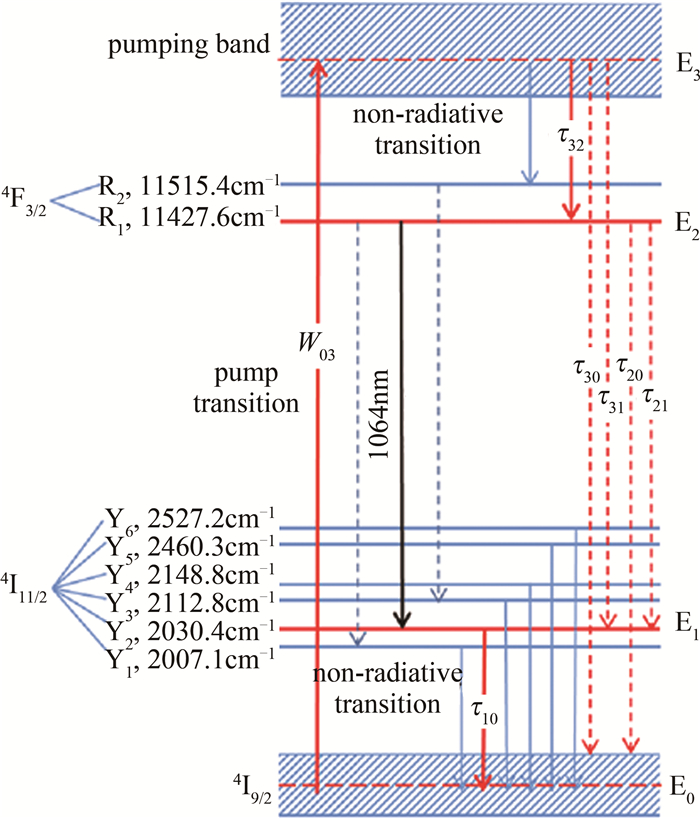
Figure 2: Energy-level diagram of the Nd³⁺ four-level laser system, showing the pump transition, non-radiative relaxation and 1064 nm stimulated-emission process
3. Stimulated Emission and Laser Oscillation
Once population inversion is established, an incoming photon triggers stimulated emission of upper-level particles, producing an identical photon — this is optical amplification. Placing the gain medium in an optical resonator made of two mirrors, light travels back and forth between them, being amplified repeatedly and finally forming a stable laser output [(RP Photonics)](https://www.rp-photonics.com/solid_state_lasers.html).
Key Formula: Laser Threshold Condition
For a laser to sustain oscillation, single-pass gain must equal single-pass loss:

where  is the threshold gain coefficient,
 is the gain-medium length,
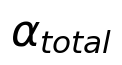 is the total internal loss, and
 and
 are the reflectivities of the rear and front cavity mirrors respectively.
III. Pumping Methods: Lamp Pumping vs. Diode Pumping
The pumping method of a solid-state laser directly determines its efficiency, lifetime, beam quality and cost. There are currently two main technical routes:
| Comparison Dimension | Lamp-Pumped | Diode-Pumped (DPSS / All-Solid-State) |
|---|---|---|
| Pump source | Xenon/krypton lamps (flash or arc lamps) | Laser diodes (LD) |
| Electro-optic efficiency | 2-5% | 20-40%+ |
| Lifetime | Hundreds of hours | Tens of thousands of hours |
| Thermal effects | Strong, significant thermal lensing | Weaker, good wavelength matching |
| Beam quality | Mediocre | Good, can approach diffraction limit |
| Cost | Cheap equipment, expensive consumables | More expensive equipment, low running cost |
| Typical applications | High-energy pulses, large-energy lasers | Industrial processing, research, medicine |
A diode-pumped solid-state laser (DPSS / DPSSL) is also called an all-solid-state laser and is the current mainstream technical direction. Its core advantage is that the emission wavelength of the laser diode can be precisely matched to the absorption peak of the doped ions, greatly reducing energy waste and heat load [(RP Photonics)](https://www.rp-photonics.com/diode_pumped_lasers.html).
Pumping geometry also matters: end pumping injects pump light from the crystal end face, with good overlap between pump and laser mode volumes and high beam quality, but limited power; side pumping injects from the crystal side, allowing higher pump power but slightly poorer beam quality [(RP Photonics)](https://www.rp-photonics.com/solid_state_lasers.html).
IV. Energy Storage and Pulse Generation
A unique advantage of solid-state lasers is excellent energy-storage capability. This is because the laser transitions of rare-earth or transition-metal ions are usually weakly allowed transitions (forbidden transitions) with very low oscillator strength, giving long upper-level lifetimes — from microseconds to milliseconds [(RP Photonics)](https://www.rp-photonics.com/solid_state_lasers.html).
For example: a laser crystal pumped at 10 W, with an upper-level lifetime of 1 ms, can store about 10 mJ of energy. If this energy is released in a 10 ns pulse, the peak power reaches 1 MW — five orders of magnitude above the average power! This is the basis of Q-switching technology [(RP Photonics)](https://www.rp-photonics.com/solid_state_lasers.html).
Q-Switching (Nanosecond Pulses)
The long upper-level lifetime makes solid-state lasers very suitable for Q-switching: first lower the resonator Q (increase loss) so energy is “stored” in the crystal; then abruptly raise Q, releasing the stored energy instantly as a nanosecond pulse with extremely high peak power. Bulk solid-state lasers can easily achieve millijoule-level pulse energy and megawatt-level peak power [(RP Photonics)](https://www.rp-photonics.com/solid_state_lasers.html).
Mode Locking (Femtosecond/Picosecond Pulses)
In mode-locking operation, solid-state lasers can generate ultrashort pulses with widths from picoseconds to femtoseconds. The shortest solid-state laser pulses to date are about 5 fs, achieved by titanium-sapphire (Ti:sapphire) lasers. Passively mode-locked solid-state lasers sometimes show Q-switching instabilities, but these can usually be suppressed with appropriate measures [(RP Photonics)](https://www.rp-photonics.com/solid_state_lasers.html).
V. Typical Solid-State Laser Types and Parameters
| Type | Gain Medium | Wavelength | Characteristics and Applications |
|---|---|---|---|
| Nd:YAG laser | Neodymium-doped yttrium aluminium garnet | 1064 nm (fundamental) | The most classic solid-state laser, high thermal conductivity, can be lamp- or diode-pumped, widely used in marking, welding, medicine and research |
| Nd:YVO₄ laser | Neodymium-doped yttrium vanadate | 1064 nm | High absorption coefficient, suited to end pumping, output at a few-watt level, often used in small DPSS lasers |
| Yb:YAG laser | Ytterbium-doped yttrium aluminium garnet | 1030 nm | High quantum efficiency (~91%), low heat load, suited to high-power thin-disk lasers |
| Ti:sapphire laser | Titanium-doped sapphire | 650–1100 nm (tunable) | Extremely broad gain bandwidth, the gold standard for femtosecond lasers, wide tuning range, first choice for research |
| Er:YAG laser | Erbium-doped yttrium aluminium garnet | 2940 nm | Mid-infrared band, very strong water absorption, widely used in dental and dermatological medicine |
| Thin-disk laser | Yb:YAG thin disk | ~1030 nm | High power + high beam quality, kilowatt-class output, high power efficiency, industrial cutting and welding |
| Fibre laser | Doped fibre | Multiple wavelengths | A special form of solid-state laser, high average power, high efficiency, high beam quality; see the fibre laser entry |
Wavelength tunability varies greatly among solid-state laser types. Most rare-earth-doped laser crystals (such as Nd:YAG and Nd:YVO₄) have a narrow gain bandwidth, about 1 nm or less, so their tuning range is limited. Glass hosts (especially rare-earth-doped glass) can tune over tens of nanometres, and transition-metal-doped crystals (such as Ti:sapphire, Cr:LiSAF and Cr:ZnSe) have even broader tuning ranges, belonging to vibronic lasers [(RP Photonics)](https://www.rp-photonics.com/solid_state_lasers.html).
VI. Typical Applications
1. Industrial Material Processing
High-power solid-state lasers (especially thin-disk and fibre lasers) are widely used for metal cutting, welding, marking, drilling and surface treatment. Kilowatt-class output combined with excellent beam quality enables high-precision, high-rate material processing, making them core equipment of intelligent manufacturing.
2. Medicine and Aesthetics
Nd:YAG lasers are used in laser aesthetics (hair removal, spot removal), ophthalmic surgery and dental treatment; Er:YAG lasers have unique advantages in dermatology and dentistry because the 2940 nm wavelength is very strongly absorbed by water; Q-switched Nd:YAG is used to treat pigmented skin conditions.
3. Scientific Research
Titanium-sapphire femtosecond lasers are core tools of ultrafast spectroscopy, attosecond science and nonlinear optics. Solid-state lasers of various wavelengths provide precise light sources for physics, chemistry and biology research. High-energy Q-switched solid-state lasers are used in laser-induced breakdown spectroscopy (LIBS) and laser rangefinding.
4. Defence and Security
High-energy solid-state lasers are used in laser weapons, LiDAR and target designation. Small passively Q-switched solid-state lasers are also used in laser rangefinders and guidance systems.
5. Nonlinear Frequency Conversion
Solid-state lasers often serve as pump sources, generating new wavelengths through nonlinear processes such as second-harmonic generation, sum-frequency generation and optical parametric oscillation (OPO). For example, a 1064 nm Nd:YAG laser is frequency-doubled to 532 nm green light, then doubled again to 266 nm ultraviolet.
VII. Common Misconceptions: 4 Ideas You May Have Got Wrong
Misconception 1: All solid-state lasers are called solid-state lasers
Correction: Although semiconductor and fibre lasers are both solid in physical state, in laser engineering “solid-state laser” usually refers specifically to doped-insulator lasers (crystal/glass + rare-earth/transition-metal ions). Semiconductor lasers work by electrical-injection interband transitions; fibre lasers, though similar in principle to solid-state lasers, are usually classified separately because of their unique waveguide structure. The three are parallel categories, not a containment relationship [(RP Photonics)](https://www.rp-photonics.com/solid_state_lasers.html).
Misconception 2: The higher the power, the better the beam quality
Correction: Quite the opposite — in solid-state lasers, power and beam quality are often a trade-off. As pump power rises, thermal lensing intensifies, and thermal gradients and stress in the gain medium degrade beam quality. High-power lasers often need special designs (such as thin-disk, fibre or slab structures) to ensure both high power and high beam quality [(RP Photonics)](https://www.rp-photonics.com/solid_state_lasers.html).
Misconception 3: Solid-state lasers are obsolete, fully replaced by fibre lasers
Correction: Fibre lasers have indeed captured a large share of industrial processing, but solid-state lasers remain irreplaceable in many areas: high-energy pulses (lamp-pumped), ultrashort pulses (Ti:sapphire), UV/deep-UV output, high-energy research lasers — all are the domain of bulk solid-state lasers. Moreover, fibre lasers are essentially a special form of solid-state laser [(RP Photonics)](https://www.rp-photonics.com/fiber_lasers_versus_bulk_lasers.html).
Misconception 4: DPSS lasers are always better than lamp-pumped ones
Correction: Diode pumping does have advantages in efficiency, lifetime and beam quality, but lamp pumping has its irreplaceable side — it can produce extremely high pulse energy (hundreds or even thousands of joules), with low equipment and consumable cost. In applications needing high-energy pulses (such as laser targeting and inertial-confinement fusion), lamp pumping remains the first choice [(RP Photonics)](https://www.rp-photonics.com/lamp_pumped_lasers.html).
VIII. Recommended Reading
- What Is a Fibre Laser? Why It Dominates the Industrial Laser Market — a special branch of solid-state lasers, the king of the industrial market
- What Is Pumping? How to “Fuel” a Laser — understand the physics and technical details of optical pumping in depth
- RP Photonics Encyclopedia: Solid-state Lasers — the main reference for this article, the world’s most authoritative laser encyclopedia
Leave a Reply