


What Is Laser Marking? How to Engrave Permanent Marks on Materials
Laser marking is an important concept in laser technology, widely used in industrial manufacturing, scientific research and healthcare. This article systematically introduces the core concepts, working principles, key parameters, main types and typical applications of laser marking, helping readers build a complete knowledge framework.
Table of Contents
- 1. What Is Laser Marking? Understanding the Core Concepts
- 2. Working Principle: How Is Laser Marking Achieved?
- 3. Key Parameters: Understanding the Performance Indicators of Laser Marking
- 4. Main Types: What Kinds of Laser Marking Exist?
- 5. Applications: Where Is Laser Marking Used?
- 6. Common Misconceptions: Pitfalls to Avoid
1. Core Concepts: What Is Laser Marking?
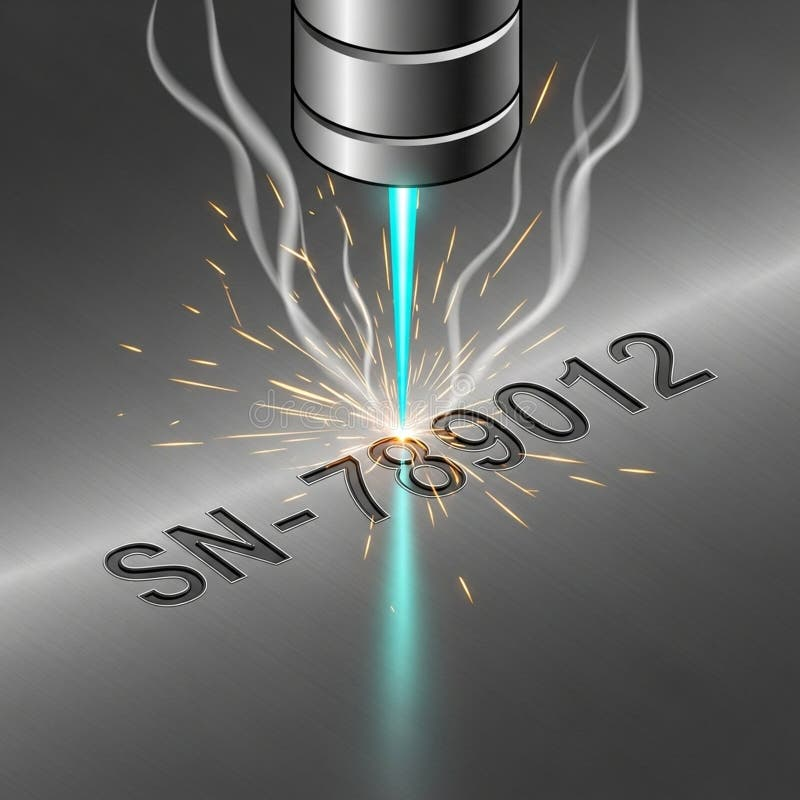
Laser marking is a laser-processing technology that uses a laser beam to form permanent marks on the surface of an object, and is one of the largest and most widely applied areas of laser material processing. It marks information such as text, patterns, barcodes and QR codes by changing the optical appearance of the material surface. Compared with traditional marking methods such as ink printing and mechanical stamping, laser marking has significant advantages of permanence, non-contact, no pollution, high speed, high precision and no consumables, so it is extremely widely used in industrial production. Laser etching (engraving) is a subcategory of laser marking, forming marks with a stronger sense of relief by removing material to a certain depth.
2. Working Principle: How Is Laser Marking Achieved?
The basic principle of laser marking is to focus the laser beam onto the material surface and change the surface’s optical properties through laser-material interaction, forming a visible mark. Depending on the marking mechanism, the physical process differs: laser engraving removes the surface material by ablation, forming a mark with depth; surface-coating removal knocks off the surface oxide layer, plating or paint, revealing the different colour of the base material; surface modification causes chemical changes on the surface through heating, such as oxidative coloring of metal surfaces, carbonation blackening or foaming discoloration of plastics. There is also a special kind of internal marking, which uses the nonlinear effects of ultrashort-pulse lasers to form tiny altered points inside transparent materials (such as glass), achieving three-dimensional internal engraving.
💡 An analogy
Laser marking is like using a never-wearing light pen to engrave characters on all kinds of materials—it does not need to touch the material, does not wear or fade like ink printing, and needs no mold; patterns and text can be changed at any time. It is a flexible, permanent and environmentally friendly marking method.
In summary, laser marking involves the intersection of optics, materials science and precision manufacturing. Mastering its basic principles and key parameters is the foundation for properly selecting and using related products.
3. Key Parameters: Understanding the Performance Indicators of Laser Marking
Understanding laser marking requires mastering the following key parameters, which directly determine product performance and application scenarios:
| Parameter Name | Meaning | Why It Matters |
|---|---|---|
| Laser Wavelength | Different materials absorb different wavelengths very differently; non-metals commonly use the 10.6 μm of CO₂ lasers, metals around the near-infrared 1.06 μm. | Different materials absorb different wavelengths with different efficiency; wavelength choice directly affects the marking result |
| Average Output Power | Generally 10–100 W; higher power gives faster processing but also needs adjustment according to material and effect. | Directly affects laser performance and the choice of application scenarios |
| Pulse Width and Repetition Rate | Q-switched lasers typically have nanosecond pulse widths, with frequencies from a few kilohertz to hundreds of kilohertz, affecting marking quality and speed. | Nanosecond pulses suit most marking; picosecond and femtosecond enable cold marking with no thermal effect |
| Beam Quality | Determines the focused spot size and marking precision; high-quality beams enable finer marks. | Directly affects laser performance and the choice of application scenarios |
| Marking Speed | Usually measured in mm/s or characters per second, related to laser power, repetition rate and the complexity of the marked content. | Affects production efficiency, usually measured in mm/s or characters per second |
| Marking Area | The area that the scanning-galvanometer system can mark, commonly such as 100×100 mm, 300×300 mm. | Directly affects laser performance and the choice of application scenarios |
The above parameters are interrelated and mutually constrained. In actual selection, a comprehensive trade-off among performance, cost, reliability and other aspects is needed according to specific application requirements.
For more product parameters or selection advice, please contact the Soar Laser technical team.
4. Main Types: What Kinds of Laser Marking Exist?
Laser marking can be classified in many ways, and different dimensions help us understand its characteristics from different angles. The following introduces the common classification methods one by one:
By Mechanism
Laser Engraving
Removes the surface layer by material ablation, with a certain depth and a strong texture.
Laser Annealing / Oxidation Marking
Heats the metal surface to form an oxide film producing different colours, with no material removal.
Foaming Marking
Plastic foams and swells when heated, becoming lighter in colour, forming a light-colored mark.
Carbonization Marking
Plastic or paper carbonizes and turns black when heated, giving high contrast.
Coating-Removal Marking
Knocks off surface materials such as anodized layers, paint or plating.
By Laser Type
CO₂ Laser Marking
Suitable for non-metals such as plastic, wood, paper, leather and acrylic.
Fibre Laser Marking
Suitable for metals and some plastics; currently the mainstream of industrial marking.
UV Laser Marking
Short-wavelength cold processing with minimal thermal effect, suitable for fine marking of PCBs, glass and ceramics.
Green Laser Marking
Used for highly reflective metals (such as gold and copper) and special materials.
Different types of laser marking have their own characteristics and suitable scenarios. Actual selection requires comprehensive consideration of specific application needs, performance requirements and budget constraints. If in doubt, you can contact the Soar Laser technical team for professional selection advice.
5. Applications: Where Is Laser Marking Used?
Laser marking has a very wide range of applications, covering industrial manufacturing, scientific research, healthcare, communications and information, and many other fields. The following introduces several main aspects:
- Laser marking has penetrated almost every industrial sector. The electronics industry uses it to mark serial numbers and QR codes on chips, PCBs and connectors for product traceability
- the automotive industry marks VIN codes, production dates and quality-traceability codes on parts
- the medical-device industry makes permanent marks on surgical instruments and implants
- the food and beverage industry marks production dates and anti-counterfeiting codes on packaging. In addition, hardware tools, sanitary ware, eyewear and watches, jewelry and mobile-phone accessories also make extensive use of laser marking. With the development of the industrial internet and smart manufacturing, laser marking, as a key link in whole-life-cycle product traceability, is growing in importance.
Typical Application Scenarios in Detail
Scenario 1: Electronic Components
marking models, parameters and QR codes on chips, resistors, capacitors and PCBs for traceability and quality management.
Scenario 2: Automotive Parts
engine parts, chassis components and interior parts need permanent identification; laser marking is wear-resistant, clear and environmentally friendly, meeting TS16949 requirements.
Scenario 3: Medical Devices and Pharmaceuticals
surgical instruments, implants and pharmaceutical packaging need unique identification (UDI); laser marking enables permanent traceability without affecting product performance.
Scenario 4: Food and Packaging
marking production dates, batch numbers and QR codes on food packaging and beverage bottles; fast and pollution-free, it is standard equipment for high-speed online production lines.
6. Common Misconceptions
Many people have somewhat plausible but mistaken notions about laser marking. See whether you fall into any of the following misconceptions:
Misconception 1: All materials can be marked with the same laser marking machine.
different materials need different laser wavelengths: metals need fibre or semiconductor lasers, wood and plastic need CO₂ lasers, glass and some special materials need UV lasers; one machine cannot handle all materials
Misconception 2: The deeper the mark, the better.
marking depth is not necessarily better when deeper; excessive depth affects surface quality and product strength and reduces processing speed. Most industrial marking only needs a surface colour change to achieve identification
Misconception 3: All laser marking is ‘permanent’ and cannot be erased.
although laser marking is more durable than ink printing, some types of marking (such as surface oxidation coloring) may fade or be polished off under certain conditions; ‘permanent’ is relative
Misconception 4: Laser marking is just engraving characters, and deeper means clearer.
laser marking has multiple mechanisms: surface colour change, melting, vaporization, oxidation and so on. Not all marking needs deep engraving. For example, marking anodized aluminium is achieved by changing the surface colour, with almost no depth; overly deep etching instead leads to rough surfaces and irregular edges, affecting appearance and wear resistance.
The above are several common misconceptions about laser marking. In practical applications, comprehensive judgment is needed based on specific product parameters and use conditions. If in doubt, it is recommended to consult a professional technician.
Leave a Reply