


What Is Laser 3D Printing? The Core Technology of Additive Manufacturing
Laser 3D printing is an important concept in laser technology, widely used in industrial manufacturing, scientific research and healthcare. This article systematically introduces the core concepts, working principles, key parameters, main types and typical applications of laser 3D printing, helping readers build a complete knowledge framework.
Table of Contents
- 1. What Is Laser 3D Printing? Understanding the Core Concepts
- 2. Working Principle: How Is Laser 3D Printing Achieved?
- 3. Key Parameters: Understanding the Performance Indicators of Laser 3D Printing
- 4. Main Types: What Kinds of Laser 3D Printing Exist?
- 5. Applications: Where Is Laser 3D Printing Used?
- 6. Common Misconceptions: Pitfalls to Avoid
1. Core Concepts: What Is Laser 3D Printing?
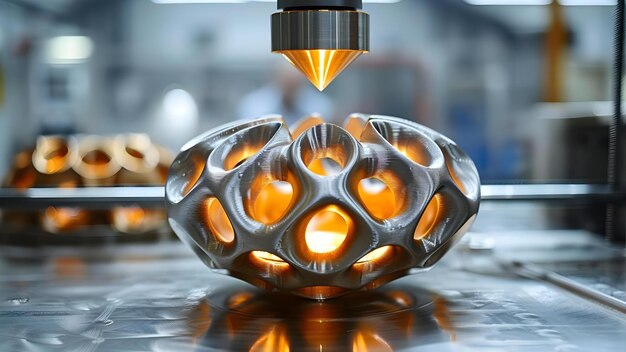
Laser additive manufacturing, also commonly called laser 3D printing, is an advanced manufacturing technology that uses a laser as the energy source to build three-dimensional solid parts by adding material layer by layer. Unlike traditional ‘subtractive’ machining (turning, milling, planning, grinding), additive manufacturing is an ‘additive’ process that builds up from nothing layer by layer, so it can create complex structures impossible with traditional methods. Thanks to its highly concentrated energy and strong controllability, the laser has become one of the most important energy sources in additive manufacturing. This technology is profoundly changing the manufacturing models of aerospace, medical, mold-making and other industries.
2. Working Principle: How Is Laser 3D Printing Achieved?
The basic process of laser additive manufacturing is: first a computer generates a 3D digital model of the part, then the model is sliced into a series of thin layers, and the laser selectively melts or solidifies the raw material according to the cross-sectional outline of each layer; once one layer is complete, a new layer is added, repeating until the whole part is finished. The specific principle differs depending on the form of raw material and the solidification mechanism: for metal powder, the laser either completely melts the powder particles (selective laser melting) or only sinters their surfaces (selective laser sintering), and the melted or sintered region solidifies into a solid layer; for liquid photosensitive resin, the laser triggers a photopolymerization reaction that cures the liquid resin into shape; for coaxial powder or wire feeding, the laser melts the material at the deposition point and stacks it onto the previous layer.
💡 An analogy
Laser 3D printing is like using a laser as a pen and powder as ink to draw a three-dimensional object layer by layer. Traditional machining removes excess material from a block (subtractive manufacturing), while 3D printing stacks material layer by layer (additive manufacturing), enabling complex structures that traditional methods cannot make.
In summary, laser 3D printing involves the intersection of optics, materials science and precision manufacturing. Mastering its basic principles and key parameters is the foundation for properly selecting and using related products.
3. Key Parameters: Understanding the Performance Indicators of Laser 3D Printing
Understanding laser 3D printing requires mastering the following key parameters, which directly determine product performance and application scenarios:
| Parameter Name | Meaning | Why It Matters |
|---|---|---|
| Laser Power | Affects melt-pool size and printing speed; metal printing usually requires hundreds of watts to several kilowatts. | Affects scanning speed and melt-pool size; higher power gives higher forming efficiency but must match the material properties |
| Scanning Speed | The moving speed of the laser beam, which together with power determines the energy input per unit length (linear energy density). | Works with power to determine energy density, directly affecting densification and forming quality |
| Layer Thickness | The thickness of each powder or liquid-material layer, usually 20–100 microns; thinner layers give a better surface but slower printing. | The smaller the layer height, the better the surface quality but the longer the print time; a balance between precision and efficiency is needed |
| Spot Diameter | Determines the minimum feature size and surface finish of the print. | Affects forming accuracy and surface roughness; a smaller spot gives higher precision but lower efficiency |
| Build Size (Build Volume) | The maximum part size the equipment can print, an important indicator for choosing equipment. | Directly affects laser performance and the choice of application scenarios |
| Powder Characteristics | Including particle-size distribution, sphericity and flowability, which greatly affect print quality and densification. | Directly affects laser performance and the choice of application scenarios |
The above parameters are interrelated and mutually constrained. In actual selection, a comprehensive trade-off among performance, cost, reliability and other aspects is needed according to specific application requirements.
For more product parameters or selection advice, please contact the Soar Laser technical team.
4. Main Types: What Kinds of Laser 3D Printing Exist?
Laser 3D printing can be classified in many ways, and different dimensions help us understand its characteristics from different angles. The following introduces the common classification methods one by one:
Selective Laser Melting (SLM) / Direct Metal Laser Sintering (DMLS)
Metal powder-bed process in which the laser completely melts the powder particles, approaching 100% density; the mainstream technology for metal 3D printing.
Selective Laser Sintering (SLS)
The powder is only partially melted (sintered), with higher porosity; mostly used for polymers and some metals.
Stereolithography (SLA)
Uses an ultraviolet laser to trigger polymerization of liquid photosensitive resin; high precision and good surface quality, mainly for resin materials.
Laser Metal Deposition (LMD) / Laser Engineered Net Shaping (LENS)
Coaxial powder or wire feeding, with the laser melting and depositing material at the deposition point; suitable for large parts and repair/remanufacturing.
Multiphoton 3D Printing
Uses the multiphoton-absorption effect of femtosecond lasers to achieve true three-dimensional nano/micro-scale printing in photosensitive materials, with resolution down to the sub-micron level.
Different types of laser 3D printing have their own characteristics and suitable scenarios. Actual selection requires comprehensive consideration of specific application needs, performance requirements and budget constraints. If in doubt, you can contact the Soar Laser technical team for professional selection advice.
5. Applications: Where Is Laser 3D Printing Used?
Laser 3D printing has a very wide range of applications, covering industrial manufacturing, scientific research, healthcare, communications and information, and many other fields. The following introduces several main aspects:
- The applications of laser additive manufacturing are rapidly shifting from prototyping to end-part production. Aerospace uses it to make titanium-alloy structural parts, engine blades and lightweight brackets, reducing both weight and assembly steps
- medicine uses 3D printing to make personalized implants (such as artificial bones and dental implants) and surgical guides for precision medicine
- the mold industry uses conformal cooling-channel designs to greatly improve injection-molding efficiency
- the automotive industry uses it to make tooling fixtures and small batches of customized parts. In addition, it is widely used in jewelry, education and research, and creative design. For products with complex structures, small batches and a high degree of customization, laser additive manufacturing has irreplaceable advantages.
Typical Application Scenarios in Detail
Scenario 1: Aerospace
used to manufacture aero-engine parts with complex structures and lightweight components, shortening development cycles, reducing costs and improving performance.
Scenario 2: Medical Devices
making personalized implants (such as artificial joints and dental implants), surgical guides and medical models, precisely matching individual patient needs.
Scenario 3: Automotive Manufacturing
used for rapid prototyping of automotive samples, tooling fixtures and small-batch production of complex parts, greatly shortening product development cycles.
Scenario 4: Molds and Casting
directly manufacturing mold inserts and conformal cooling channels to improve mold performance and service life, and enabling rapid production of wax patterns and sand molds.
6. Common Misconceptions
Many people have somewhat plausible but mistaken notions about laser 3D printing. See whether you fall into any of the following misconceptions:
Misconception 1: 3D printing can replace all traditional manufacturing.
in fact, 3D printing is still far inferior to traditional processes in mass production, material variety and cost efficiency; it is better suited to complex structures, small batches and customization, and is a supplement to rather than a replacement for traditional manufacturing
Misconception 2: A printed part is a ‘finished product.’
most metal 3D-printed parts need subsequent steps such as support removal, heat treatment, machining and surface treatment before they meet service requirements; it is not ‘print and done’
Misconception 3: 3D-printed material properties are inferior to traditional manufacturing.
although early 3D-printed parts did have lower mechanical properties, today’s mature SLM-process metal parts can reach or even exceed castings in density and mechanical properties, and some processes rival forgings
Misconception 4: 3D printing can print any shape.
although 3D printing offers high freedom, there are still design constraints: overhanging structures need supports, thin-wall dimensions are limited, and some geometries (such as deep holes and internal threads) are difficult to post-process. Moreover, printed parts usually need post-processing such as support removal, heat treatment and machining to reach final precision and performance.
The above are several common misconceptions about laser 3D printing. In practical applications, comprehensive judgment is needed based on specific product parameters and use conditions. If in doubt, it is recommended to consult a professional technician.
Leave a Reply