


The M² factor is the internationally accepted measure of beam quality—it describes in a single number how far a real beam departs from an ideal Gaussian beam, with M² closer to 1 meaning better quality. This article covers the principles, key parameters, measurement methods and typical applications.
Table of Contents
- 1. What Is the M² Factor? Understanding the Core Concepts
- 2. Working Principle: How Is the M² Factor Defined?
- 3. Key Parameters: Understanding M² Performance Indicators
- 4. Main Types: What Kinds of M² Exist?
- 5. Applications: Where Is the M² Factor Relevant?
- 6. Common Misconceptions: Pitfalls to Avoid
1. Core Concepts: What Is the M² Factor?
< The M² factor, also called the beam propagation factor or beam quality factor, is the internationally accepted quantitative measure of laser beam quality. Physically, it is the ratio of a real laser beam’s beam-parameter product (the product of waist radius and divergence angle) to that of an ideal diffraction-limited Gaussian beam at the same wavelength. M² is dimensionless: M² = 1 represents a perfect diffraction-limited beam, and larger values mean poorer beam quality.
The M² factor is a dimensionless number measuring how far a real beam departs from an ideal Gaussian beam—it is not a device and generates no light, but an international metric for evaluating beam quality and predicting focusability.
2. Working Principle: How Is the M² Factor Defined?
Understanding the M² factor can be broken down into several key steps or mechanisms. Let us look at them one by one:
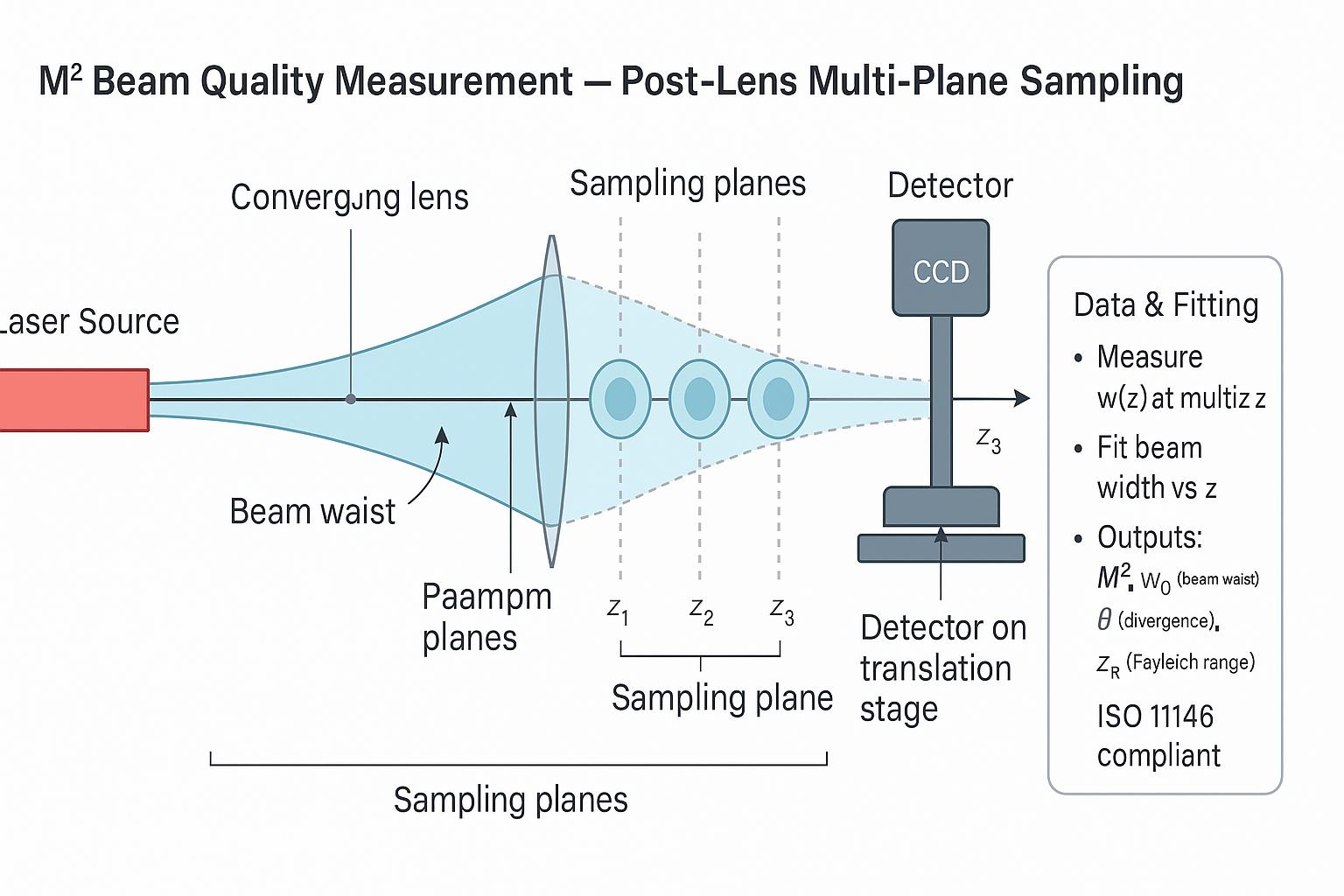
The M² factor is based on a key physical law: for an ideal Gaussian beam, the product of waist radius w₀ and far-field half-angle θ is a constant equal to λ/π (depending only on wavelength). A real beam, due to wavefront distortion, multimode excitation and other causes, has this product larger by a factor M², i.e. θ = M² × λ/(πw₀). In measurement, per ISO 11146 the beam radius is measured at multiple positions along propagation (using the second-moment D4σ method), then a hyperbolic fit yields M², waist position, Rayleigh range and other parameters.
3. Key Parameters: Understanding M² Performance Indicators
| Parameter Name | Meaning | Why It Matters |
|---|---|---|
| M² Value | The core metric—1 is best, with no theoretical upper limit | The core quantitative beam-quality metric: M² = 1 is an ideal fundamental Gaussian beam; larger values mean poorer quality and a larger focused spot. |
| D4σ Beam Width | A second-moment-based beam-diameter definition required by the ISO standard | A beam width defined by the second moment, the measurement basis specified by ISO 11146, ensuring accuracy and repeatability. |
| Caustic Curve | The curve of beam radius versus propagation distance, used to fit M² | The curve of beam width versus distance; a hyperbolic fit yields M², waist position and Rayleigh range. |
| Rayleigh Range | Related to waist radius and M²: z_R = πw₀²/(M²λ) | Distance from the waist to where the beam area doubles; determines depth of focus—an important parameter in laser processing and focusing-system design. |
| Number of Measurement Points | ISO 11146 requires at least 10 points, distributed on both sides of the waist and in the far field | ISO 11146 requires at least 10 points covering near and far field; the number and placement of points directly affect M² accuracy. |
These parameters are not isolated; they are interrelated and mutually constrained. For example, there is often a trade-off between M² measurement accuracy and distance/cost—measuring M² precisely for a high-quality beam usually requires a longer measurement distance and more accurate equipment. So to evaluate quality, you must consider the parameters together rather than one alone.
If you are not familiar with these parameters, that is fine—Soar Laser’s product pages have detailed descriptions, and you can also consult our technical engineers directly to help you select.
4. Main Types: What Kinds of M² Exist?
The M² factor can be classified in several ways, and different dimensions help us understand it from different angles. The common classification methods are introduced below:
By Type
M² in x and y Directions
For an astigmatic beam (e.g. a semiconductor laser), horizontal and vertical M² may differ
Measured M² vs Nominal M²
Manufacturer values are typically typical; actual values may vary with operating conditions
Integrated M²
An overall evaluation of the whole beam cross-section—the most commonly used metric
Note
The M² factor itself has no ‘types’; what differ are measurement methods and applicable beam shapes (circular, elliptical, astigmatic, etc.)
Different M² values have their own implications; there is no absolute ‘best,’ only ‘most suitable.’ Selection should consider your specific application, power requirements, budget and other factors. For example, for high-power industrial applications fibre lasers may be more suitable; for research with ultrashort-pulse needs, Ti:sapphire may be preferable.
5. Applications: Where Is the M² Factor Relevant?
The M² factor has a very wide range of applications, from industrial manufacturing to healthcare, from communication networks to scientific research—almost everywhere lasers are used. A few fields are briefly described below:
- Laser Factory Acceptance: M² is one of the core performance indicators of a laser
- Laser Processing Selection: choose a laser with suitable M² for the process (cutting/welding/marking)
- Fibre Coupling Efficiency Estimation: M² determines the minimum couplable fibre core diameter
- Optical System Design: compute focused-spot size, working distance, Rayleigh range and other key parameters
- Laser System Quality Monitoring: monitor M² online to detect performance degradation early
Typical Application Scenarios in Detail
Scenario 1: Laser Factory Acceptance
In factory acceptance testing, M² is a core performance metric measured by the caustic method per ISO 11146 to ensure nameplate values match reality.
Scenario 2: Laser Processing Selection
For laser-processing selection, M² determines the minimum focusable spot and working distance—key for cutting, welding and drilling.
Scenario 3: Fibre Coupling Efficiency Estimation
In research, M² evaluates how mode-locking and amplification affect beam quality, guiding cavity design and compensation.
Scenario 4: Optical System Design
In fibre coupling and communication, M² governs how tightly a beam can be focused into the fibre mode field, directly affecting coupling efficiency.
Scenario 5: Laser System Quality Monitoring
In laser safety and standards, M² supports consistent beam-width definitions and measurement methods so results from different devices are comparable.
👉 Want to learn more about practical applications of the M² factor? Please visit Soar Laser’s application-case page, or contact our technical team directly for professional advice.
6. Common Misconceptions
Many people have somewhat plausible but mistaken notions about the M² factor. See whether you fall into any of the following:
Misconception 1: ‘Lower M² means higher laser power.’
M² and power are independent parameters; high-power lasers often have larger M²
Misconception 2: ‘M² can be less than 1.’
by diffraction theory M² cannot be below 1; claims of M² < 1 are measurement errors
Misconception 3: ‘Knowing M² lets you calculate the focused spot.’
you also need the incident beam diameter, focusing lens focal length and other parameters
Misconception 4: ‘M² measurement is independent of the device.’
different methods and beam-width definitions (D4σ vs 1/e²) give different M² values; measure per ISO 11146
Misconception 5: ‘The M² from one device is an absolutely accurate value.’
M² measurement depends on beam-width definition, aperture clipping and fitting method, so different devices give systematically different values; high-accuracy work should follow ISO 11146 and include uncertainty evaluation
Of course, there are far more misconceptions about the M² factor than these. Laser technology develops rapidly, with new materials and processes constantly emerging, so some previous ‘common knowledge’ may already be outdated. If you have other questions, please leave a comment and we will answer them one by one.
Leave a Reply