


The beam waist is where a laser beam is narrowest—it determines how small a spot the beam can be focused to and is the starting point for laser processing and focusing applications. This article covers the principles, key parameters, main types and typical applications.
Table of Contents
- 1. What Is the Beam Waist? Understanding the Core Concepts
- 2. Working Principle: How Is the Beam Waist Formed?
- 3. Key Parameters: Understanding Beam Waist Performance Indicators
- 4. Main Types: What Kinds of Beam Waist Exist?
- 5. Applications: Where Is the Beam Waist Relevant?
- 6. Common Misconceptions: Pitfalls to Avoid
1. Core Concepts: What Is the Beam Waist?
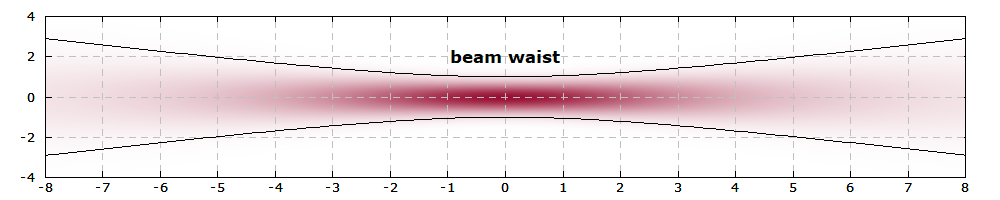
< The beam waist is the position along a laser beam’s propagation where the radius is smallest—the narrowest point, also called the focus. For a Gaussian beam the wavefront at the waist is perfectly planar and the radius reaches its minimum w₀. The waist is not merely a geometric concept: it determines the divergence angle, Rayleigh range and a series of other important parameters, serving as the core reference point for focusing, collimation and coupling in laser applications.
The beam waist is where the beam itself is narrowest, the result of diffraction and focusing rather than an active device—set by wavelength, beam quality and the focusing optics, it directly determines energy density and depth of focus at the focal point.
2. Working Principle: How Is the Beam Waist Formed?
Understanding the beam waist can be broken down into several key steps or mechanisms. Let us look at them one by one:
According to Gaussian beam propagation theory, the beam radius w(z) varies with distance z along a hyperbola. At z = 0 (the waist) the radius is minimal at w₀; away from the waist the beam diverges and the radius grows approximately linearly. The waist radius w₀ and far-field divergence θ constrain each other: smaller w₀ means larger θ—a basic law of diffraction. For an ideal Gaussian beam, w₀ × θ = λ/π; for a real beam with degraded quality the product becomes M² × λ/π. A lens can change the waist size and location but cannot change the beam-parameter product (M² stays the same).
3. Key Parameters: Understanding Beam Waist Performance Indicators
| Parameter Name | Meaning | Why It Matters |
|---|---|---|
| Waist Radius w₀ | The beam radius at the waist—the most core parameter | The radius at the narrowest point, directly determining the minimum focused-spot size and achievable power density; the core metric of a focusing system. |
| Waist Position z₀ | The exact coordinate of the waist on the optical axis | The exact axial position of the waist determines where the workpiece or work plane should sit, affecting processing and coupling efficiency. |
| Rayleigh Range z_R | Distance from the waist to where the beam area doubles: z_R = πw₀²/(M²λ), characterising collimation distance | Distance from the waist to where the radius grows by √2; determines depth of focus—a larger focus depth eases processing and alignment. |
| Far-Field Divergence Angle θ | θ = M²λ/(πw₀), inversely proportional to waist radius | The divergence angle far from the waist, inversely proportional to waist radius—a key parameter for evaluating propagation and focusing performance. |
| Confocal Parameter b | Equal to twice the Rayleigh range, i.e. the sum of the Rayleigh ranges on both sides | Twice the Rayleigh range, representing the span over which the beam is approximately collimated; an important parameter for designing beam expanders and telescopes. |
These parameters are not isolated; they are interrelated and mutually constrained. For example, there is a trade-off between waist radius and Rayleigh range—a smaller waist means a shorter Rayleigh range and faster divergence, and vice versa. So to evaluate quality, you must consider the parameters together rather than one alone.
If you are not familiar with these parameters, that is fine—Soar Laser’s product pages have detailed descriptions, and you can also consult our technical engineers directly to help you select.
4. Main Types: What Kinds of Beam Waist Exist?
Beam waists can be classified in several ways, and different dimensions help us understand them from different angles. The common classification methods are introduced below:
By Type
Real Waist
The actual minimum spot formed when a beam converges in free space, e.g. the focus formed by a focusing lens in laser processing
Virtual Waist
A waist location inferred backward from a diverging beam, which the beam never actually passes through (e.g. the diverging output of a laser)
Waist of an Astigmatic Beam
For an astigmatic beam (e.g. a diode bar), the horizontal and vertical waists may not coincide
Waist of a Multimode Beam
A multimode beam also has a waist, usually based on a second-moment definition, with M² greater than 1
Different beam waists have their own advantages and disadvantages; there is no absolute ‘best,’ only ‘most suitable.’ Selection should consider your specific application, power requirements, budget and other factors. For example, for high-power industrial applications fibre lasers may be more suitable; for research with ultrashort-pulse needs, Ti:sapphire may be preferable.
5. Applications: Where Is the Beam Waist Relevant?
The beam waist has a very wide range of applications, from industrial manufacturing to healthcare, from communication networks to scientific research—almost everywhere lasers are used. A few fields are briefly described below:
- Laser Cutting / Welding: waist position and size determine the focus location and energy density
- Laser Marking: the waist must be precisely aligned to the workpiece surface for the best marking
- Fibre Coupling: match the waist to the fibre end face for the highest coupling efficiency
- Lidar/Ranging: waist diameter and divergence jointly set the spot size at distance
- Laser Resonator Design: waist size and position are basic parameters of cavity design
Typical Application Scenarios in Detail
Scenario 1: Laser Cutting / Welding
In laser cutting and welding, the waist position and size determine the focus and energy density; placing the waist precisely on the workpiece is key to a quality cut.
Scenario 2: Laser Marking
For fibre coupling, the waist must match the fibre mode field; positional offset or size mismatch sharply reduces coupling efficiency.
Scenario 3: Fibre Coupling
In microscopy and lithography, the waist sets the smallest spot and resolution, constrained jointly by the diffraction limit and beam quality.
Scenario 4: Lidar / Ranging
In resonator design, waist position and Rayleigh range determine mode distribution and stability—core parameters of laser design.
Scenario 5: Laser Resonator Design
In ultrafast applications, the waist affects focused intensity and nonlinear effects and must be optimised together with pulse width and peak power.
👉 Want to learn more about practical applications of the beam waist? Please visit Soar Laser’s application-case page, or contact our technical team directly for professional advice.
6. Common Misconceptions
Many people have somewhat plausible but mistaken notions about the beam waist. See whether you fall into any of the following:
Misconception 1: ‘The waist is where intensity is highest.’
true for a Gaussian beam, but for aberrated or multimode beams the intensity peak need not coincide with the waist (the second-moment minimum)
Misconception 2: ‘The lens focus is the waist.’
only when the incident light is collimated is the waist at the lens focus; a diverging or converging input shifts the waist
Misconception 3: ‘A smaller waist always gives higher machining precision.’
too small a waist shortens the Rayleigh range and focus depth, demanding extremely tight workpiece positioning tolerance
Misconception 4: ‘A lens can focus a beam to any size.’
limited by diffraction and beam quality, the minimum waist has a theoretical floor and cannot be arbitrarily small
Misconception 5: ‘A thinner beam waist is always better.’
a thinner waist shortens the Rayleigh range and working distance, so spot size and depth of focus must be balanced for the application
Of course, there are far more misconceptions about the beam waist than these. Laser technology develops rapidly, with new materials and processes constantly emerging, so some previous ‘common knowledge’ may already be outdated. If you have other questions, please leave a comment and we will answer them one by one.
Leave a Reply