


Beam divergence is a core parameter describing how fast a laser beam spreads with distance—it determines how far the light reaches and how concentrated its energy remains. This article covers the principles, key parameters, main types and typical applications.
Table of Contents
- 1. What Is Beam Divergence? Understanding the Core Concepts
- 2. Working Principle: How Is Beam Divergence Determined?
- 3. Key Parameters: Understanding Beam Divergence Performance Indicators
- 4. Main Types: What Kinds of Beam Divergence Exist?
- 5. Applications: Where Is Beam Divergence Relevant?
- 6. Common Misconceptions: Pitfalls to Avoid
1. Core Concepts: What Is Beam Divergence?
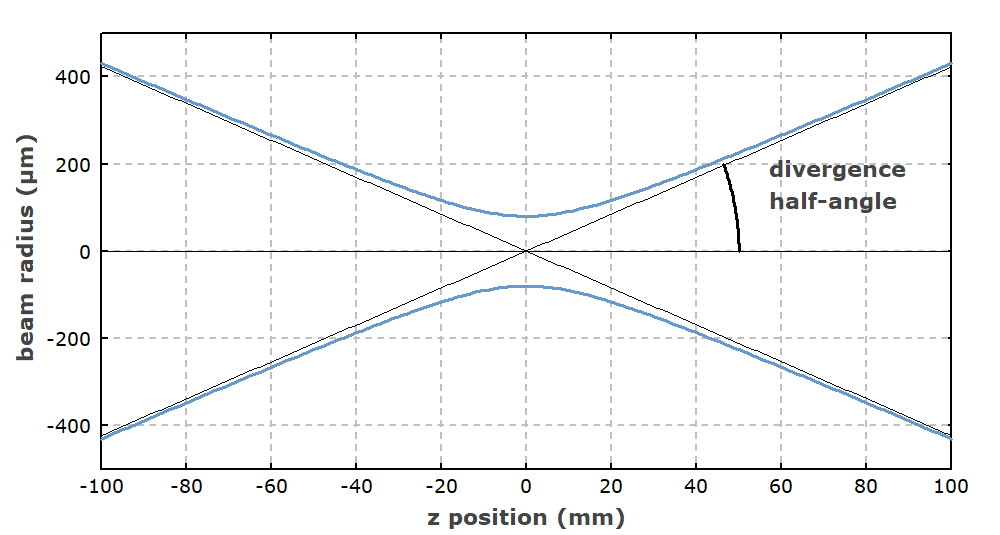
< Beam divergence describes the rate at which a laser beam’s radius grows with distance in the far field—how fast the beam ‘spreads.’ It is the core measure of a laser’s directionality: the smaller the divergence, the better the directionality and the more slowly the spot grows with distance. Divergence is not a local property at a single point but an overall characteristic of the whole beam.
Beam divergence is not a local property at one point but a global parameter describing how fast the whole beam spreads in the far field—set jointly by wavelength and waist, reflecting laser directionality and unrelated to whether optics ‘actively’ do anything.
2. Working Principle: How Is Beam Divergence Determined?
Understanding beam divergence can be broken down into several key steps or mechanisms. Let us look at them one by one:
Because of the wave nature of light, any beam propagating in free space naturally spreads—the diffraction effect. For an ideal diffraction-limited Gaussian beam, the far-field half-angle is θ = λ/(πw₀), so divergence is proportional to wavelength and inversely proportional to waist radius—the more tightly a beam is focused, the faster it diverges afterward. For a real beam, θ = M² × λ/(πw₀); a larger M² gives larger divergence. Divergence is usually expressed as a half-angle (rad or mrad), but some sources use the full angle (twice the half-angle), so care is needed.
3. Key Parameters: Understanding Beam Divergence Performance Indicators
| Parameter Name | Meaning | Why It Matters |
|---|---|---|
| Divergence Half-Angle | The most common definition—the derivative of beam radius with respect to propagation distance (far field), usually in mrad or degrees | The most common divergence definition, used to compute far-field spot size and set focusing-system parameters; an indirect reflection of beam quality. |
| Divergence Full-Angle | Equal to twice the half-angle; used in some manufacturers’ datasheets | A definition used by some vendors and standards; pay attention to conversion with the half-angle to avoid design and selection errors. |
| FWHM Divergence Angle | Divergence defined by full width at half maximum, common for semiconductor-laser specs | The angle at which intensity falls to half its maximum; has a fixed conversion to 1/e² divergence, so measurement differences must be noted. |
| Fast-Axis / Slow-Axis Divergence | Astigmatic beams from diode lasers have very different divergence in the two axes | The divergences in two orthogonal directions of an asymmetric beam such as a diode laser differ greatly and need separate collimation design. |
| Numerical Aperture (NA) | Common in fibre optics, closely related to divergence: NA = sin(θ) | A light-gathering parameter common in fibre and optical systems, directly related to divergence and governing coupling efficiency and propagation modes. |
These parameters are not isolated; they are interrelated and mutually constrained. For example, there is a trade-off between divergence angle and beam waist radius—a smaller waist means a larger far-field divergence angle, and vice versa. So to evaluate quality, you must consider the parameters together rather than one alone.
If you are not familiar with these parameters, that is fine—Soar Laser’s product pages have detailed descriptions, and you can also consult our technical engineers directly to help you select.
4. Main Types: What Kinds of Beam Divergence Exist?
Beam divergence can be classified in several ways, and different dimensions help us understand it from different angles. The common classification methods are introduced below:
By Type
Low Divergence (Collimated Beam)
Divergence on the order of mrad or less, e.g. a collimated single-mode laser beam
Moderate Divergence
Tens to hundreds of mrad, e.g. fibre-output beams or uncollimated laser diodes
Large Divergence
Several radians, e.g. multimode fibre output or the fast axis of diode bars
Note
Divergence itself is not divided into ‘types’ but is a continuously varying parameter; values for different lasers can differ by several orders of magnitude
Different beam divergences have their own advantages and disadvantages; there is no absolute ‘best,’ only ‘most suitable.’ Selection should consider your specific application, power requirements, budget and other factors. For example, for high-power industrial applications fibre lasers may be more suitable; for research with ultrashort-pulse needs, Ti:sapphire may be preferable.
5. Applications: Where Is Beam Divergence Relevant?
Beam divergence has a very wide range of applications, from industrial manufacturing to healthcare, from communication networks to scientific research—almost everywhere lasers are used. A few fields are briefly described below:
- Laser Ranging / Lidar: divergence directly sets the spot size and energy density on a distant target
- Laser Communication: free-space optical links need small divergence to reach long distances with good efficiency
- Laser Marking / Cutting: a focusing lens converges the collimated beam; divergence sets the smallest achievable spot
- Fibre Coupling: the beam’s divergence must be smaller than the fibre’s NA for efficient coupling
- Laser Pointers: require tight divergence so the spot stays small and bright at distance
Typical Application Scenarios in Detail
Scenario 1: Laser Ranging / Lidar
In laser ranging and lidar, divergence determines spot size and energy density at a distant target; a smaller angle keeps energy concentrated and extends effective range.
Scenario 2: Laser Communication
In optical communication and fibre coupling, divergence decides how efficiently a beam enters a fibre or component, directly affecting coupling efficiency and link loss.
Scenario 3: Laser Marking / Cutting
In laser processing, divergence affects working distance and depth of focus; a smaller angle sustains high energy density over longer distances for consistent results.
Scenario 4: Fibre Coupling
In beam shaping and expansion, a beam expander enlarges the diameter to reduce far-field divergence, but beam quality itself is unchanged—a trade-off to consider.
Scenario 5: Laser Pointers
In research and metrology, divergence is a basic far-field parameter; measurement must state the beam-width definition (1/e², FWHM or D4σ).
👉 Want to learn more about practical applications of beam divergence? Please visit Soar Laser’s application-case page, or contact our technical team directly for professional advice.
6. Common Misconceptions
Many people have somewhat plausible but mistaken notions about beam divergence. See whether you fall into any of the following:
Misconception 1: ‘Divergence is unrelated to waist radius.’
quite the opposite—the two trade off against each other, with their product set by beam quality
Misconception 2: ‘A beam expander reduces divergence without changing anything else.’
an expander enlarges the beam diameter and thereby reduces divergence, but beam quality is unchanged
Misconception 3: ‘Large divergence always means poor beam quality.’
not necessarily—large divergence can come from a tiny waist (diffraction) rather than poor quality; judge quality by M² or BPP
Misconception 4: ‘Half-angle and full-angle are just a factor of two.’
although the full angle is usually twice the half-angle, conversion between beam-width definitions (1/e², FWHM) is more complex and not a simple ×2
Misconception 5: ‘A smaller divergence angle always means better beam quality.’
divergence must be judged together with waist size via M²; a small angle alone can come from a large waist and does not mean high quality
Of course, there are far more misconceptions about beam divergence than these. Laser technology develops rapidly, with new materials and processes constantly emerging, so some previous ‘common knowledge’ may already be outdated. If you have other questions, please leave a comment and we will answer them one by one.
Leave a Reply