


Dispersion is an important concept in laser technology—understanding its principles, key parameters and applications is essential for correct component selection and system design. This article explains it clearly, from principles and key parameters to main types and typical applications.
Table of Contents
- 1. What Is Dispersion? Understanding the Core Concepts
- 2. Working Principle: How Does Dispersion Work?
- 3. Key Parameters: Understanding Dispersion Performance Indicators
- 4. Main Types: What Kinds of Dispersion Exist?
- 5. Applications: Where Is Dispersion Relevant?
- 6. Common Misconceptions: Pitfalls to Avoid
1. Core Concepts: What Is Dispersion?
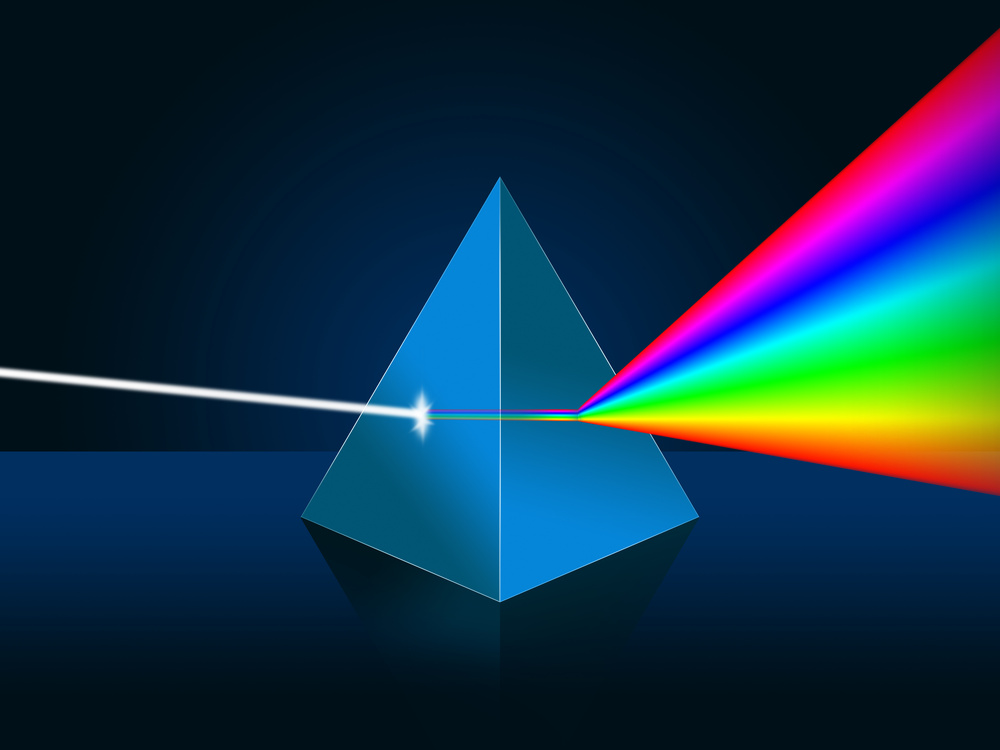
< Dispersion (short for chromatic dispersion) is the phenomenon in which the phase velocity and group velocity of light vary with frequency (or wavelength). In simple terms, different colours of light travel at different speeds in a transparent medium. The root cause lies in the interaction between light and the medium’s electrons—electric fields at different frequencies drive the electrons differently, causing the refractive index to vary with frequency. A rainbow is the most intuitive natural example of dispersion. In ultrafast optics, dispersion is a key factor determining how ultrashort pulses propagate.
Dispersion is the phenomenon in which light of different wavelengths travels at different speeds or refracts at different angles in a medium—it is not a component but an inherent property of materials, producing useful effects such as prism splitting while also causing pulse broadening and imaging chromatic aberration.
2. Working Principle: How Does Dispersion Work?
Understanding how dispersion works can be broken down into several key steps or mechanisms. Let us look at them one by one:
In any transparent medium, the refractive index n varies with the optical frequency ω. When a light pulse propagates, because it has some spectral width, its frequency components travel at different group velocities, changing the pulse’s temporal shape. Normal dispersion (refractive index increasing with frequency) means blue light travels slower than red, so the pulse has red at the leading edge and blue at the trailing edge, forming an “up-chirp.” Anomalous dispersion does the opposite, forming a “down-chirp.” For an unchirped input pulse, dispersion always broadens the pulse—the shorter the pulse, the more sensitive it is to dispersion.
3. Key Parameters: Understanding Dispersion Performance Indicators
| Parameter Name | Meaning | Why It Matters |
|---|---|---|
| Group Velocity Dispersion (GVD) | Group delay dispersion per unit length, in s²/m. | Describes how quickly group velocity changes with frequency; the main cause of pulse broadening and the most central dispersion parameter in ultrafast systems. |
| Group Delay Dispersion (GDD) | Total dispersion of an entire optical component, in s². | The group-delay difference per unit bandwidth; the most commonly used parameter in dispersion-compensation design, directly corresponding to the amount of pulse broadening. |
| Dispersion Parameter D | Commonly used in fibre communications, in ps/(nm·km). | The dispersion unit commonly used in fibres, describing the group-delay difference per unit length per unit wavelength difference—convenient for engineering calculations. |
| Zero-Dispersion Wavelength | The wavelength where second-order dispersion is zero, about 1310 nm for silica fibre. | The point where dispersion changes from positive to negative—a key operating point for soliton formation, supercontinuum generation and related effects. |
| Higher-Order Dispersion | Third-order dispersion (TOD) and above, causing pulse-shape distortion. | Third-order and higher dispersion components, which cannot be ignored in ultrashort-pulse (<100 fs) systems because they distort pulse shape. |
These parameters are not isolated; they are interrelated and mutually constrained. In dispersion management there is a trade-off among compensation amount, bandwidth and pulse shape: over- or under-compensation broadens or distorts the pulse, so design must be tailored to wavelength and pulse width.
If you are not familiar with these parameters, that is fine—Soar Laser’s product pages have detailed descriptions, and you can also consult our technical engineers directly to help you select.
4. Main Types: What Kinds of Dispersion Exist?
Dispersion can be classified in several ways, and different dimensions help us understand it from different angles. The common classification methods are introduced below:
By Type
Material Dispersion
The medium’s own refractive index varying with frequency—the most fundamental source of dispersion.
Waveguide Dispersion
Equivalent dispersion caused by the mode-field distribution in a waveguide varying with wavelength, controllable through waveguide design.
Normal Dispersion
Group velocity decreases with increasing frequency; most transparent materials are in the normal-dispersion regime in the visible.
Anomalous Dispersion
Group velocity increases with increasing frequency; silica enters the anomalous-dispersion regime above 1.3 μm. Solitons can only form in the anomalous-dispersion regime.
Different types of dispersion have their own advantages and disadvantages; there is no absolute “best,” only “most suitable.” Selection should consider your specific application, power requirements, budget and other factors. For example, for high-power industrial applications fibre lasers may be more suitable; for research with ultrashort-pulse needs, Ti:sapphire may be preferable.
5. Applications: Where Is Dispersion Relevant?
Dispersion has a very wide range of applications, from industrial manufacturing to healthcare, from communication networks to scientific research—almost anywhere lasers are used. A few fields are briefly described below:
- Dispersion is both a challenge and a tool in optics. In fibre communications, dispersion is the main factor limiting transmission distance and bandwidth. In ultrafast laser systems, dispersion management is a core technique: prism pairs, chirped mirrors and grating pairs precisely control the dispersion amount, both to compensate material dispersion and maintain femtosecond pulses, and to deliberately introduce large dispersion in CPA systems to stretch/compress pulses. Combined with nonlinearity, dispersion can form solitons and parabolic pulses.
Typical Application Scenarios in Detail
Scenario 1: dispersion is both a challenge and a tool in optics; in fibre communications it is the main factor limiting transmission distance and bandwidth, and in ultrafast laser systems dispersion management is a core technique
prism pairs, chirped mirrors and grating pairs precisely control the dispersion amount, both to compensate material dispersion and maintain femtosecond pulses, and to deliberately introduce large dispersion in CPA systems to stretch/compress pulses. Combined with nonlinearity, dispersion can form solitons and parabolic pulses.
👉 Want to learn more about practical applications of dispersion? Please visit Soar Laser’s application-case page, or contact our technical team directly for professional advice.
6. Common Misconceptions
Many people have somewhat plausible but mistaken notions about dispersion. See whether you fall into any of the following:
Misconception 1: ‘Only white light exhibits dispersion.’
dispersion is essentially that different frequencies travel at different speeds, which applies to any light with bandwidth; ultrashort pulses have extremely broad bandwidths and are therefore more strongly affected
Misconception 2: ‘Dispersion is always harmful.’
dispersion broadens pulses but is also the basis of important techniques such as solitons and CPA; the key is precise control and management of dispersion
Misconception 3: ‘GVD alone fully describes dispersion.’
second-order dispersion usually dominates in long pulses, but femtosecond pulses have very broad spectra, so third-order and higher dispersion significantly affect pulse shape
Misconception 4: ‘Dispersion depends only on the type of material.’
dispersion depends on material, thickness and wavelength together; the same glass can have very different GVD across bands, so a femtosecond system must calculate and compensate dispersion at the actual operating wavelength
Of course, there are far more misconceptions about dispersion than these. Laser technology develops rapidly, with new materials and processes constantly emerging, so some previous “common knowledge” may already be outdated. If you have other questions, please leave a comment and we will answer them one by one.
Leave a Reply