


Gain Media Explained: Amplification Materials from Crystals to Fibres
Table of Contents
- 1. What Is a Gain Medium? Understanding the Core Concepts
- 2. Working Principle: How Does a Gain Medium Work?
- 3. Key Parameters: Understanding Gain Medium Performance Indicators
- 4. Main Types: What Kinds of Gain Media Exist?
- 5. Applications: Where Are Gain Media Relevant?
- 6. Common Misconceptions
1. Core Concepts: What Is a Gain Medium?
A gain medium, also called active laser medium, is the core material in a laser that can amplify optical power. Its essential role is: under external energy input, it strengthens an input optical signal through stimulated emission, compensating the various losses in the laser resonator and ultimately producing laser output.
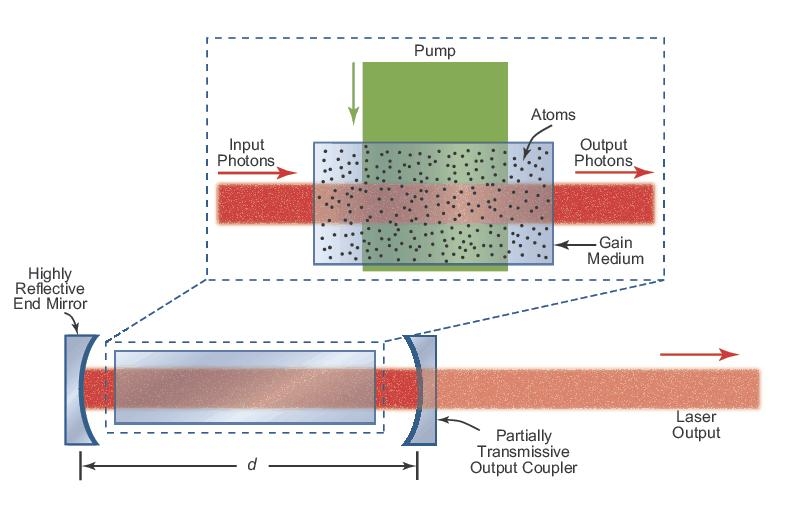
Simply put, the gain medium is the laser’s “engine”—without it, light bouncing back and forth in the resonator would only grow weaker and no laser oscillation could form. Besides lasers, gain media are widely used in optical amplifiers to boost weak optical signals.
2. Working Principle: How Does a Gain Medium Work?
The core mechanism by which a gain medium amplifies light is stimulated emission. The specific process has three steps:
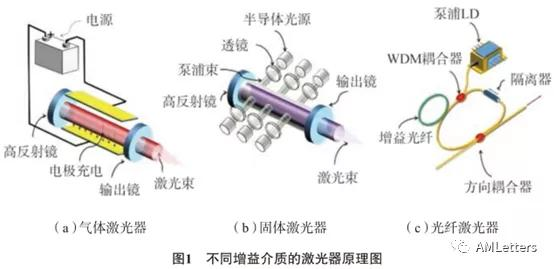
1. Pumping injects energy: the gain medium needs energy from outside, a process called “pumping.” There are two main pumping methods—electrical pumping (passing a current) and optical pumping (illuminating with another, shorter-wavelength beam). Pump energy excites atoms, ions or electrons in the medium to higher levels.
2. Population inversion: when enough particles are excited to higher levels, forming an abnormal distribution with “more particles in high levels than low levels,” population inversion is reached. This is the prerequisite for optical amplification—only then can stimulated emission exceed stimulated absorption and yield net gain.
3. Stimulated-emission amplification: when an incident optical signal passes through the inverted gain medium, each incident photon “triggers” a high-level particle to drop to a lower level, releasing an identical photon. In this way the light intensity keeps growing.
While amplifying light, a gain medium also produces some negative effects, chiefly gain saturation (gain dropping at high power) and thermal effects (part of the pump energy becomes heat, causing thermal lensing and degrading beam quality).
3. Key Parameters: Understanding Gain Medium Performance Indicators
The core parameters are described below:
| Parameter Name | Meaning |
|---|---|
| Emission Wavelength | Which wavelength band the gain medium can amplify—determined by its energy-level structure, directly dictating the laser’s application direction. |
| Gain Bandwidth | The width of the gain spectrum. A broader bandwidth means a wider tuning range and easier generation of ultrashort pulses. |
| Stimulated-Emission Cross Section | Measures how strongly a single particle produces stimulated emission; a larger cross section means higher gain per unit length and lower threshold. |
| Upper-Level Lifetime | How long particles stay in the excited high level. A long lifetime favors energy storage (e.g. Q-switched lasers); a short one suits high-speed modulation. |
| Quantum Efficiency | The fraction of pump energy converted to laser energy—the higher, the more efficient. |
| Thermal Conductivity | The material’s ability to conduct heat, critical for high-power lasers, directly affecting thermal lensing and device reliability. |
| Optical Damage Threshold | The maximum optical power density the material can withstand, setting the upper limit on output power. |
4. Main Types: What Kinds of Gain Media Exist?
Gain media come in many varieties; by physical form and working mechanism they fall into the following major categories:
| Type | Typical Representative | Pumping Method | Features |
|---|---|---|---|
| Laser crystals | Nd:YAG, Yb:YAG, Ti:sapphire | Optical pumping | Good thermal conductivity, large cross section, relatively narrow bandwidth |
| Laser glasses | Neodymium glass, ytterbium glass | Optical pumping | Broad bandwidth, poor thermal conductivity, suited to high energy |
| Gain fibres | Yb-doped fibre, Er-doped fibre | Optical pumping | Good heat dissipation, high beam quality, strong power scalability |
| Semiconductor gain media | GaAs, InGaAs, GaN | Electrical pumping | High efficiency, compact, directly modulatable |
| Dye gain media | Rhodamine, coumarin and other organic dyes | Optical pumping | Extremely broad bandwidth, tunable wavelength, short lifetime |
| Gas gain media | CO₂, He-Ne, excimer gases | Electrical-discharge pumping | Good beam quality, wide power range |
| Ceramic gain media | Rare-earth-doped ceramics | Optical pumping | Between crystal and glass, can be made large |
There are also more special types, such as chemical gain media, nuclear-pumped media and the undulators in free-electron lasers.
5. Applications: Where Are Gain Media Relevant?
Main application areas:
- Industrial processing: high-power Yb-doped fibre lasers for metal cutting and welding; CO₂ gas lasers for non-metal processing; Nd:YAG solid-state lasers for marking and drilling.
- Communications: the erbium-doped fibre amplifier (EDFA) is the core device of optical fibre communications, directly amplifying signals in the 1550 nm band.
- Medicine and aesthetics: Nd:YAG lasers for ophthalmic surgery and skin treatment; pulsed dye lasers for vascular skin disease; Er:YAG lasers for dentistry and skin resurfacing.
- Research and measurement: Ti:sapphire and dye lasers for spectroscopy, where broad gain bandwidth enables wavelength tuning and ultrashort pulses.
- Pump sources: semiconductor lasers (laser diodes) are themselves the most important pump source—nearly all fibre lasers and most solid-state lasers rely on them.
- Defence and sensing: gas lasers such as CO₂ are used for LiDAR; excimer lasers for photolithography.
6. Common Misconceptions
Here are a few common misconceptions:
Misconception 1: ‘The higher the gain, the better the medium.’
in fact gain is only one of many parameters. High-gain media often have narrow bandwidth, severe thermal effects or short upper-level lifetimes, and may not suit a specific application. Selecting a gain medium requires considering wavelength, power, efficiency, beam quality and reliability together
Misconception 2: ‘All gain media work on the same principle.’
although most gain media rely on stimulated emission, the specific mechanisms differ greatly: semiconductors use interband transitions, rare-earth ions transitions within the 4f shell, dyes molecular vibronic levels, gases atomic or molecular levels, and quantum-cascade lasers intersubband transitions—their physics is completely different
Misconception 3: ‘Gain media only amplify light and consume no energy.’
quite the opposite: the energy used to amplify light comes from the pump source, and a considerable part is dissipated as heat. No matter how high the quantum efficiency, a medium cannot convert pump energy to laser energy 100%
Misconception 4: ‘The range of gain media is already complete, with no new materials to come.’
in fact research on new gain media never stops. Recent examples such as ceramic laser media, two-dimensional-material gain media and perovskite gain media keep expanding the boundaries of laser technology
Leave a Reply