


What Is an Optical Prism? Dispersion and Beam Deflection Explained
You likely saw a prism splitting light in a middle-school physics class, but optical prisms are far more than just “splitting light”—they deflect beams, erect images, compensate dispersion and shape beams, making them among the most fundamental and versatile components in laser and optical systems. This article takes you from principles to selection; but how is the critical angle for total internal reflection calculated? What does angular dispersion depend on? How does a prism polariser work? What are the uses of different prisms? From total internal reflection to the angular-dispersion formula, from prism polarisers to a type quick-reference, this article gives you a thorough understanding—so you can explain prisms to others yourself.
Table of Contents
- 1. What Is an Optical Prism? Understanding the Core Concepts
- 2. Working Principle: How Do Optical Prisms Work?
- 3. Key Parameters: Understanding Optical Prism Performance Indicators
- 4. Main Types: What Kinds of Optical Prisms Exist?
- 5. Applications: Where Are Optical Prisms Relevant?
- 6. Common Misconceptions: Pitfalls to Avoid
Reference
1. Core Concepts: What Is an Optical Prism?
An optical prism is a polyhedral optical element made of transparent material (usually optical glass or crystal) that changes the propagation direction, dispersion characteristics or imaging orientation of light through refraction or reflection. Prisms play the role of a “multifunction tool” in optical systems—they can split white light, deflect a beam, rotate an image, displace a beam and shape a beam. Compared with assemblies of several mirrors, a prism is more robust and easier to align.
Compared with ordinary optical components or light sources, the distinctive thing about an optical prism is its specific purpose—it does not merely let light pass passively; in the system it actively performs functions such as deflecting, splitting or polarising light. This is why prisms enable things ordinary components cannot.
2. Working Principle: How Do Optical Prisms Work?
Understanding how optical prisms work can be broken down into several key steps or mechanisms. Many people find laser principles mysterious, but if you follow this line of reasoning, it is actually not hard at all. Let us look at them one by one:
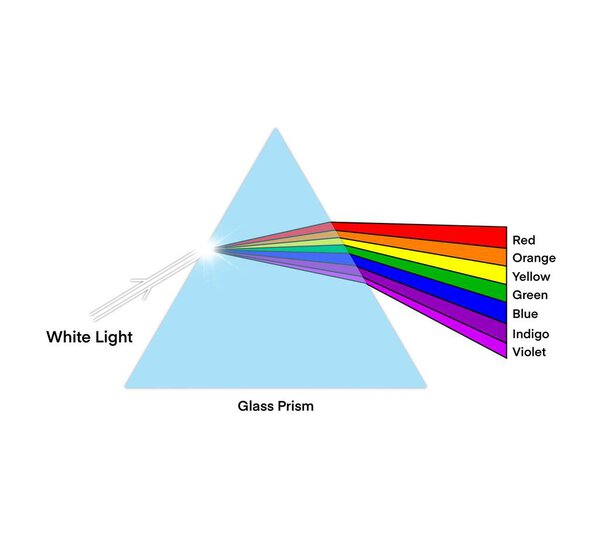
The functions of a prism are based on two basic physical effects: refraction and total internal reflection. When light passes from one medium into another of different refractive index, its propagation direction changes (refraction), and because different wavelengths have different refractive indices, dispersion occurs—the principle of a prism splitting light. When light travels from a denser to a rarer medium and the incidence angle exceeds the critical angle, total internal reflection occurs and almost all the light is reflected back, far more efficiently than an ordinary mirror. Reflective prisms use total internal reflection or surface coatings to deflect beams. Prisms of different shapes achieve different functions by controlling the angles of their faces and the number of internal reflections.
3. Key Parameters: Understanding Optical Prism Performance Indicators
To understand optical prisms, concepts and principles alone are not enough—you must also grasp the key parameters. Many people faced with a list of parameters do not know where to start. There is no need to worry: the table below organises the core parameters clearly:
| Parameter Name | Meaning | Selection Significance |
|---|---|---|
| Material | Determines refractive index, dispersion, transmission range and mechanical/chemical properties | Determines refractive index, dispersion capability and transmission band, directly affecting the prism’s function and applicable scenarios |
| Angular Tolerance | Angular precision between working faces, affecting deflection-angle accuracy | Affects the accuracy of beam deflection; roof-angle error also causes polarisation-state and wavefront distortion |
| Surface Figure Accuracy | Flatness of working faces, affecting wavefront quality and imaging sharpness | Directly affects the wavefront quality of the outgoing beam and imaging resolution |
| Surface Quality | Scratches, digs and similar defect metrics | Scratches and digs cause scattering loss and may trigger damage at high power |
| Coating | Input/output faces usually anti-reflection coated; reflecting faces sometimes mirror coated | AR coating reduces interface reflection loss; reflective coating raises reflection efficiency—the choice depends on prism type |
| Clear Aperture | Effective beam-size range the prism can handle | Determines the beam diameter that can be handled; too small an aperture causes diffraction effects |
| Laser Damage Threshold | A key metric for high-power laser applications | A key safety metric for high-power lasers; cemented prisms have a far lower damage threshold than monolithic ones |
5. Prism Types Supplement: What Kinds of Optical Prisms Exist?
By main function: dispersive prisms (equilateral triangular prisms, for splitting light), reflective/deflecting prisms (right-angle, penta, roof prisms, etc., for beam deflection and image erection), retroreflectors/corner-cube prisms (return light exactly along the incoming path, insensitive to orientation), anamorphic prisms (change beam size in one direction), Dove prisms (rotate images) and polarising prisms (Glan-Taylor, Wollaston, etc., for polarisation splitting).
6. Applications: Where Are Optical Prisms Relevant?
Optical prisms have a very wide range of applications, from industrial manufacturing to healthcare, from communication networks to scientific research—almost anywhere lasers are used. A few fields are briefly described below:
- Spectral analysis: dispersive prisms are the core splitting element of spectrometers
- Imaging systems: prism image-erecting systems in binoculars and camera viewfinders
- Laser beam deflection: prisms replacing mirror sets to reduce alignment and improve stability
- Beam shaping: anamorphic prism pairs shape elliptical beams into circular ones, common with laser diodes
- Dispersion compensation: prism pairs provide adjustable dispersion in ultrafast lasers for pulse compression
- Precision measurement: corner-cube prisms as cooperative targets for laser rangefinding and interferometry
4. Core Principles in Depth
4.1 Critical Angle for Total Internal Reflection
Reflective prisms (such as right-angle and penta prisms) work by total internal reflection (TIR). When light travels from a denser medium (refractive index n₁) toward a rarer medium (refractive index n₂, e.g. air n₂ = 1), if the incidence angle exceeds the critical angle, the light is completely reflected back into the denser medium with no refracted light.
θc = arcsin(n₂/n₁)
For a glass (n ≈ 1.5) to air interface, the critical angle is about 41.8°. Thus the 45° incidence at the hypotenuse of a right-angle prism exceeds the critical angle and total reflection occurs—this is why a right-angle prism can serve as a mirror.
💡 Common misconception: many people assume a prism’s hypotenuse always produces total reflection, which is not true—total reflection occurs only when the incidence angle exceeds the critical angle. If the prism material’s refractive index is too low or the incidence angle is wrong, light transmits through the hypotenuse (“light leakage”) and reflection efficiency drops sharply. When using reflective prisms, always confirm that the material’s refractive index and the beam path satisfy the total-reflection condition.
4.2 Dispersive Prisms and Angular Dispersion
A dispersive prism uses the different refractive indices of different wavelengths in the medium (dispersion) to deflect them by different angles, spreading polychromatic light into a spectrum. The most typical is the equilateral triangular prism.
A prism’s angular dispersion expresses the change in deviation angle per unit wavelength difference. Near the minimum deviation angle, the angular-dispersion formula is:
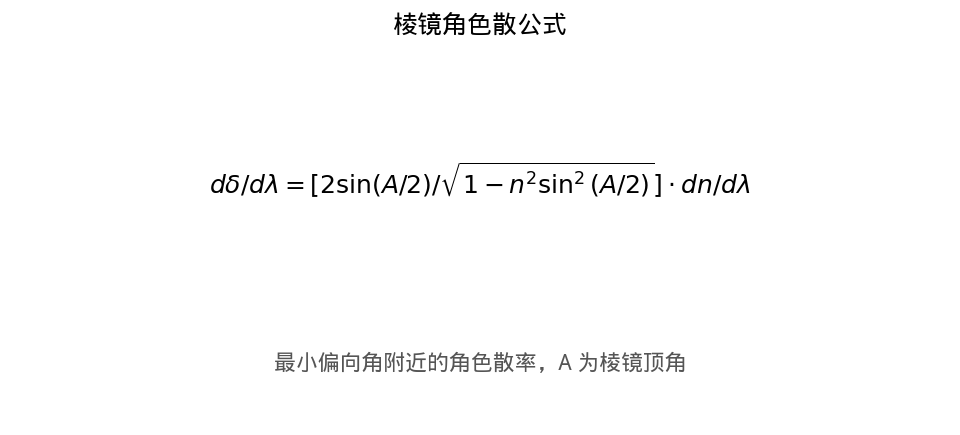
Figure 1: the angular-dispersion formula of a prism near minimum deviation. A is the prism apex angle and dn/dλ is the material’s dispersion rate.
From the formula we can see that angular dispersion depends on two factors:
- Prism apex angle A: the larger the apex angle, the greater the dispersion. But the apex angle is limited by the total-reflection condition and generally does not exceed 60° (equilateral prism).
- Material dispersion rate dn/dλ: the faster the refractive index changes with wavelength, the greater the dispersion. Flint glass has a far higher dispersion rate than crown glass, so dispersive prisms are usually made of flint glass.
4.3 Prism Polarisers
Prisms made of birefringent crystals (such as calcite) can split polarisation. The most common are:
- Glan-Taylor prism: two calcite prisms with an air-gap design. The o-ray undergoes total internal reflection at the hypotenuse while the e-ray transmits. Extinction ratio as high as 10⁵–10⁶:1, high damage threshold, the most commonly used high-performance polariser.
- Wollaston prism: two calcite prisms with mutually perpendicular optical axes. The o- and e-rays refract at the interface and emerge as two linearly polarised beams with a large included angle. Used for polarisation detection and in interferometers.
- Nicol prism: a classic polarising prism historically, but now replaced by Glan-type prisms due to large astigmatism and a displaced transmitted beam.
4.4 Common Prism Types and Uses
| Prism Type | Basic Function | Typical Application |
|---|---|---|
| Right-angle prism | 90° beam deflection (TIR), or 180° retroreflection | Beam folding, telescopes, rangefinders |
| Penta prism | Precise 90° deflection, independent of incidence angle | Levels, rangefinders, optical instruments |
| Equilateral triangular prism | Dispersive splitting | Spectrometers, monochromators |
| Roof prism | 90° deflection + image erection | Binoculars, sighting scopes |
| Dove prism | Image rotation | Optical instruments, image rotators |
| Glan polarising prism | Polarising/analyzing | Laser systems, polarisation detection |
| PBS prism | Polarisation splitting | Optical isolators, interferometers |
7. Common Misconceptions
Many people have somewhat plausible but mistaken notions about optical prisms. See whether you fall into any of the following:
Misconception 1
all prisms are used to split light. Many prisms (such as right-angle and penta prisms) change beam direction or correct images and have nothing to do with dispersion.
Misconception 2
the more dispersion the better. Dispersive prisms need large dispersion for resolution, but in imaging systems dispersion is a defect to be corrected.
Misconception 3
prisms are always better than mirror sets. Though stable and easy to align, a prism introduces absorption and chromatic aberration as light passes through the bulk glass and may produce thermal lensing at high power.
Misconception 4: A prism’s hypotenuse always produces total reflection
No. Total reflection requires the incidence angle to exceed the critical angle (depending on the refractive-index ratio of the two media). If the prism material’s refractive index is too low or the incidence angle is wrong, light transmits through the hypotenuse (“light leakage”). When using reflective prisms, always confirm the total-reflection condition is met.
Misconception 5: Roof prisms have no wavefront distortion
No. If the roof angle (the angle between the two reflecting faces) has an error, it changes the polarisation state and degrades beam quality—one beam splits into two (“double image”). High-precision roof prisms typically require roof-angle tolerance on the order of arcseconds.
Misconception 6: Cemented prisms can be used at high power
No. The cement layer of a cemented prism is easily damaged by high-power laser light—the cement’s absorption coefficient is far larger than glass, so at high power it heats up rapidly, deforms or even cracks. High-power systems must use prisms with optical contact or an air-gap design.
Of course, there are far more misconceptions about optical prisms than these. Laser technology develops rapidly, with new materials and processes constantly emerging, so some previous “common knowledge” may already be outdated. If you have other questions, please leave a comment and we will answer them one by one.
Leave a Reply