


What Is an Optical Resonator? How Do Two Mirrors Trap Light?
You may have heard the saying: “a laser is just a gain medium placed between two mirrors.” Simple as it is, this captures the core structure of a laser — the optical resonator. Can two mirrors really trap light? Why are some resonators stable and others unstable? How does a resonator select frequencies? Based on authoritative content from the RP Photonics Encyclopedia, this article systematically explains the principles, types, mode characteristics and design considerations of optical resonators.
Table of Contents
- I. What Is an Optical Resonator? — The “Echo Wall” for Light
- II. Core Principles: Resonance and Modes
- III. Types of Resonators: Stable vs. Unstable
- IV. Linear vs. Ring Resonators
- V. Key Parameters: Q Factor, Finesse and Free Spectral Range
- VI. Typical Applications
- VII. Common Misconceptions: 4 Ideas You May Have Got Wrong
- VIII. Recommended Reading
I. What Is an Optical Resonator? — The “Echo Wall” for Light
An optical resonator, also called an optical cavity, is an optical structure in which a light beam can travel back and forth and form a resonance. The simplest resonator is two opposing mirrors — light reflects back and forth between them, and if the phase change after one round trip is an integer multiple of 2π, constructive interference occurs, forming a stable oscillation. This is like the Echo Wall at the Temple of Heaven, where sound reflects along the wall and creates special acoustic effects; an optical resonator is the “echo wall” for light [(RP Photonics)](https://www.rp-photonics.com/optical_resonators.html).
The heart of an optical resonator is resonance: only light at specific frequencies satisfying the phase-matching condition can build up continuously in the cavity and form a stable oscillation. Light at other frequencies rapidly decays through destructive interference. This frequency-selective property, combined with the amplification of the gain medium, constitutes the basic principle of a laser [(RP Photonics)](https://www.rp-photonics.com/optical_resonators.html).
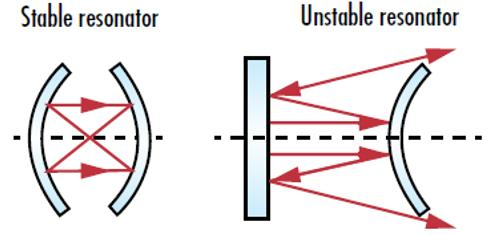
Figure 1: Comparison of light paths in a stable resonator (left) and an unstable resonator (right). In a stable resonator, rays remain confined within the cavity; in an unstable resonator, rays gradually escape
Resonators are used not only in lasers but also in many other important applications:
- Laser resonators: provide optical feedback, select modes and determine the output beam characteristics
- Optical filters (Fabry-Pérot etalons): select specific wavelengths of light to pass
- Enhancement cavities: used to enhance nonlinear optical effects (such as second-harmonic generation and OPOs)
- Precision measurement: gravitational-wave detection (LIGO) uses giant resonators to measure extremely small distance changes
- Optical frequency combs: the resonators of mode-locked lasers produce equally spaced frequency comb lines
Beyond the basics: optical resonators are not limited to the “two mirrors” form. Others include:
- Fibre-grating resonators: two fibre Bragg gratings (FBGs) act as the cavity mirrors, with gain fibre in between (DBR fibre lasers)
- Distributed-feedback (DFB) resonators: the entire grating is the resonator, with a phase-shift point in the middle
- Ring resonators: light travels unidirectionally along a closed ring path, with no standing wave; commonly used in single-frequency and mode-locked fibre lasers
- Microring resonators: micrometre-scale ring waveguides with extremely high Q values, used in integrated photonics
The Two Core Functions of a Resonator
An optical resonator has two irreplaceable functions in a laser:
- Provide optical feedback: light reflects back and forth in the cavity, passing through the gain medium many times to be amplified and form a sustained oscillation. Without feedback, the gain medium emits only spontaneous radiation (fluorescence), not laser light.
- Mode selection: only frequencies satisfying the resonance condition (cavity length = an integer multiple of half the wavelength) can exist stably in the cavity. The resonator naturally selects specific frequencies and spatial modes, one source of laser monochromaticity and directionality.
II. Core Principles: Resonance and Modes
Resonance Condition
After one round trip in the resonator, the phase change of the light must be an integer multiple of 2π:
Key Formula: Resonator Resonance Condition
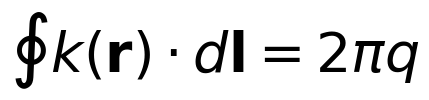
where k is the wave vector and q is an integer (the longitudinal mode index). For a simple linear resonator (length L, refractive index n), this simplifies to:
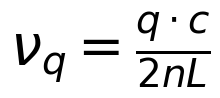
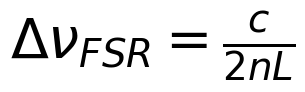
That is, only light with frequency νq can resonate. The spacing between adjacent resonant frequencies is called the free spectral range (Free Spectral Range, FSR):
What Is a Mode?
A mode of a resonator is a self-consistent electromagnetic field distribution that can exist in the cavity — that is, after one round trip, both its spatial and phase distributions remain unchanged (the amplitude may decrease due to loss). Modes fall into two categories:
- Longitudinal modes: different resonant frequencies corresponding to different q values. Longitudinal modes describe the standing-wave pattern of light along the propagation direction.
- Transverse modes: different transverse field distributions corresponding to different transverse mode patterns (such as TEM₀₀, TEM₀₁ and other Hermite-Gaussian modes). Transverse modes describe the distribution of light over the cross-section perpendicular to the propagation direction.
Each complete mode is uniquely identified by three quantum numbers (m, n, q), written TEMmnq. Different modes have different resonant frequencies — not only do longitudinal mode frequencies differ, but different transverse modes also have different frequencies (due to the Gouy phase shift) [(RP Photonics)](https://www.rp-photonics.com/resonator_modes.html).
A More Precise Formula for Mode Frequencies
Taking the Gouy phase shift into account, the mode-frequency formula for a stable resonator is:

where Δν is the longitudinal mode spacing (FSR) and δν is the transverse mode frequency spacing, which is related to the single-pass Gouy phase shift φG:
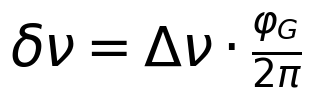
The magnitude of the Gouy phase shift depends on the resonator design — it is largest for a confocal resonator and approaches zero at the edge of stability of a stable resonator (near-planar-concave/planar-convex cavities) [(RP Photonics)](https://www.rp-photonics.com/resonator_modes.html).
III. Types of Resonators: Stable vs. Unstable
Stability Criterion
The most important classification criterion for an optical resonator is stability. A resonator is stable when paraxial rays, after many round trips, never stray far from the optical axis — they remain “confined” within the cavity. The stability criterion is expressed using the g parameter:
Key Formula: Resonator Stability Criterion
Define the g parameter of each mirror:
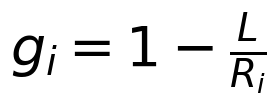
where Ri is the radius of curvature of the i-th mirror and L is the cavity length. The stability condition is:
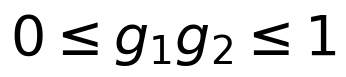
When g₁·g₂ is between 0 and 1, the resonator is stable; at exactly 0 or 1 it is marginally stable (critical); below 0 or above 1 it is unstable.
Stable Resonators
The defining feature of a stable resonator is that rays are repeatedly refocused and never escape the cavity. The Gaussian beam is the eigenmode of a stable resonator — the beam travels back and forth between the two mirrors, with its spot size varying with position and reaching a minimum at the beam waist.
The advantages of stable resonators are: a clear mode structure (Gaussian modes), low loss and easy single-mode operation. The vast majority of low- to medium-power lasers use stable resonators.
Common stable resonator designs include:
- Symmetric confocal resonator: two concave mirrors, both with a radius of curvature equal to the cavity length, their foci coinciding at the cavity centre. The most “stable” of stable resonators.
- Plano-concave resonator: one plane mirror plus one concave mirror, simple in structure and a common choice for many small lasers.
- Concave-concave resonator: two concave mirrors, with flexible parameter choices.
- Ring resonator: a ring-shaped optical path made of several mirrors, which may be stable or near-stable.
Critical Resonators
A critical resonator lies at the boundary between stable and unstable resonators — the edge state that satisfies the stability condition. Typical critical resonators include:
- Symmetric confocal resonator: two concave mirrors with radii equal to the cavity length; in fact the most stable of stable resonators (sometimes classified separately as critical).
- Plane-parallel resonator: two plane mirrors exactly parallel, requiring extremely precise alignment.
- Concentric resonator: two concave mirrors whose centres of curvature coincide at the same point inside the cavity.
Critical resonators have large mode volumes but are hard to align; a slight deviation turns them into an unstable resonator with a dramatic increase in loss. Plane-parallel resonators were common in early ruby lasers but are now less used in practice [(RP Photonics · Optical Resonators)](https://www.rp-photonics.com/optical_resonators.html).
Unstable Resonators
In an unstable resonator, rays spread outward during round trips and eventually escape past the mirror edges — and this is precisely the output-coupling mechanism of an unstable resonator! The output is a hollow, ring-shaped beam that “leaks” from the mirror edges [(RP Photonics)](https://www.rp-photonics.com/optical_resonators.html).
An unstable resonator may sound “bad,” but it has unique advantages: a large mode volume — making full use of a large-volume gain medium — while the output beam has a small divergence angle (close to the diffraction limit). Therefore high-power, high-energy lasers (such as military lasers and giant neodymium-glass lasers) often use unstable resonators.
The disadvantages of unstable resonators are: a complex mode structure that cannot be described by a simple Gaussian mode and requires numerical calculation; a ring-shaped output beam with a dark region in the centre; and relatively high cavity loss, requiring a high-gain medium.
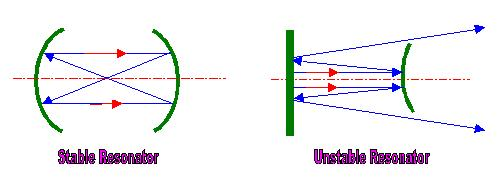
Figure 2: Schematic comparison of light-path characteristics in a stable resonator (left) and an unstable resonator (right)
IV. Linear vs. Ring Resonators
Linear Resonators (Standing-Wave Resonators)
A linear resonator (Linear Resonator / Standing-wave Resonator) consists of two end mirrors, with light reflecting back and forth between them to form a standing wave. The linear resonator is the most common laser resonator structure because it is the simplest and easiest to align.
An important characteristic of a linear resonator is the standing-wave effect: light propagating in two directions superposes to form a standing wave, with the intensity distributed periodically along the cavity axis (antinodes and nodes). This causes spatial hole burning — gain is consumed more at the antinodes while remaining at the nodes. Spatial hole burning allows multiple longitudinal modes to oscillate simultaneously (because different longitudinal modes have different standing-wave patterns and thus “see” different gain distributions), which is unfavorable for single-frequency operation [(RP Photonics)](https://www.rp-photonics.com/optical_resonators.html).
Ring Resonators (Travelling-Wave Resonators)
In a ring resonator (Ring Resonator / Travelling-wave Resonator), light travels along a closed ring path with no standing wave (only a unidirectional travelling wave). Ring resonators are usually made of three or more mirrors.
The advantages of ring resonators are:
- No spatial hole burning (because light travels in one direction and gain is consumed uniformly), making single-frequency operation easier
- Unidirectional operation can be achieved, eliminating interaction between counter-propagating light
- Suited to certain special applications (such as ring dye lasers and some mode-locked lasers)
The disadvantages are: a more complex structure requiring more mirrors and alignment degrees of freedom; and the need for an optical isolator or circulator to ensure unidirectional operation (otherwise lasing occurs in both directions).
V. Key Parameters: Q Factor, Finesse and Free Spectral Range
| Parameter | Meaning | Formula / Description |
|---|---|---|
| Free Spectral Range (FSR) | The frequency spacing between adjacent longitudinal modes | Δν = c/(2nL) |
| Q factor (quality factor) | The ratio of stored energy to energy lost per cycle in the resonator | Q = 2πν·(stored energy / power loss) = ν/δν (where δν is the cavity linewidth, i.e. the full width at half maximum of the cavity spectrum) |
| Finesse (F) | The ratio of FSR to linewidth, a measure of frequency-selecting ability | F = FSR / linewidth |
| Photon lifetime | The time for light in the cavity to decay to 1/e | τph = Q / (2πν) |
| Mode volume | The spatial volume occupied by the cavity mode | Affects gain, nonlinear effects, etc. |
Q factor and finesse are both measures of how “good” a resonator is — higher values mean lower loss, stronger frequency selection and sharper resonance peaks. High-finesse resonators (such as F-P etalons) can serve as extremely narrow-band optical filters; ultra-high-Q resonators (such as microsphere and microring cavities) can be used for extremely low-threshold lasers and ultrasensitive sensing.
VI. Typical Applications
1. The Heart of a Laser
Without a resonator there is no laser. The resonator determines the laser’s output characteristics: output power, beam quality (transverse modes), spectral characteristics (longitudinal modes) and pulse characteristics (Q-switching / mode locking). Designing the laser resonator is one of the core tasks of laser design.
3. Precision Measurement and Sensing
High-Q optical resonators are powerful tools for precision measurement. LIGO (the gravitational-wave detector) uses 4-kilometre giant Fabry-Pérot interferometers to measure distance changes smaller than the diameter of a proton. Fibre ring resonators, microsphere cavities and microdisk cavities are used for highly sensitive sensing of temperature, pressure and biomolecules.
4. Nonlinear Optics Enhancement
Enhancement cavities can boost laser power by tens to hundreds of times — incoming light reflects back and forth in the cavity and the power builds up continuously. This is very useful for high-order nonlinear processes such as second-harmonic generation and optical parametric oscillation, enabling efficient frequency conversion at lower input power.
5. Optical Filtering and Wavelength Division Multiplexing
An F-P etalon (essentially a short resonator) is the most commonly used narrow-band optical filter. In wavelength-division-multiplexing (WDM) optical communication systems, resonator-based filters are used to select specific wavelength channels.
VII. Common Misconceptions: 4 Ideas You May Have Got Wrong
Misconception 1: An unstable resonator is unstable and prone to breaking
Correction: The “unstable” in “unstable resonator” does not refer to mechanical or structural instability, but to instability in the geometrical-optics sense — paraxial rays progressively stray from the optical axis during round trips and eventually escape the cavity. Unstable resonators are in fact an important resonator type for high-power lasers; their output-coupling mechanism (escaping from the mirror edges) is unique and useful, and a well-designed unstable resonator performs very well [(RP Photonics)](https://www.rp-photonics.com/optical_resonators.html).
Misconception 2: The more stable a resonator, the better, and the closer to confocal the better
Correction: Stability is a range (g₁g₂ between 0 and 1), and more stable is not always better. The centre of the stable region (confocal) has the smallest mode volume and is not optimal for thermal insensitivity; practical designs often choose a position away from the marginal stability point but not exactly confocal, to balance mode volume, alignment sensitivity, thermal stability and other factors. Moreover, some applications (such as large-mode-volume lasers) deliberately operate near the edge of the stable region [(RP Photonics)](https://www.rp-photonics.com/optical_resonators.html).
Misconception 3: All resonator modes are perfect Gaussian beams
Correction: Only a stable resonator with spherical mirrors, and containing a homogeneous medium inside the cavity, has Hermite-Gaussian (or Laguerre-Gaussian) modes. If gain guiding, thermal lensing, nonlinear effects, aberrations and so on are present in the cavity, the modes deviate from a Gaussian distribution. The modes of unstable resonators are entirely different — they are not Gaussian modes and must be calculated numerically [(RP Photonics)](https://www.rp-photonics.com/optical_resonators.html).
Misconception 4: The higher the Q factor, the better the resonator
Correction: A high Q factor means low loss and strong frequency selection, but it also means a long photon lifetime and slow response speed. Different applications have different needs: narrow-linewidth lasers need high-Q cavities; Q-switched lasers, by contrast, need a controllably varied Q value; and for ultrafast lasers a too-high cavity Q is unfavorable for pulse formation. Moreover, Q is not the only metric — mode volume, stability, tuning range and so on are equally important [(RP Photonics)](https://www.rp-photonics.com/optical_resonators.html).
Misconception 5: Just placing two mirrors makes a laser resonator
Correction: That is far from enough. To form a resonator that can generate laser light, three conditions must be met simultaneously:
- Geometric stability condition: not just any two mirrors facing each other make a stable resonator — the g₁·g₂ parameter condition must be satisfied (g = 1 – L/R), otherwise light continually escapes
- Gain exceeds loss: the gain in the cavity must compensate all losses (output coupling, scattering, absorption, diffraction, etc.), i.e. reach the “threshold condition,” otherwise light weakens with each round trip and cannot oscillate
- Frequency resonance condition: the cavity length must equal an integer multiple of half the wavelength; only frequencies satisfying the resonance condition can exist stably in the cavity
So a laser resonator is a precision optical system, not something you can build by casually setting up two mirrors [(RP Photonics · Optical Resonators)](https://www.rp-photonics.com/optical_resonators.html).
VIII. Recommended Reading
- Optical Resonators Explained (Engineering Edition) — stability criteria, g-parameter diagrams, cavity design and mode-selection methods; essential advanced reading
- Fabry-Pérot Resonator Topic — finesse, resolving power and frequency-selection applications of F-P interferometers / etalons
- What Is a Laser Mode? What Do Transverse and Longitudinal Modes Mean? — the direct product of the resonator; understand modes in depth
- Optical Mirrors — the core components of a resonator: high-reflectivity mirrors and output couplers
- What Is Q-Switching? How to Make Laser Pulses Instantly More Powerful — the art of changing the resonator Q factor
- RP Photonics Encyclopedia: Optical Resonators — the main reference for this article, the world’s most authoritative laser encyclopedia
Leave a Reply