


What Is a Gain Medium? Where Does Laser Energy Come From
You may know that a laser needs a “glowing crystal,” but why can it amplify light? What physics lies behind names like Nd:YAG, Yb:YAG and Ti:sapphire? Why are some gain media suited to high power and others to ultrashort pulses? Based on authoritative content from the RP Photonics Encyclopedia, this article systematically explains how gain media work, their main types, key physical effects and selection criteria.
Table of Contents
- I. What Is a Gain Medium? — The Laser’s “Fuel”
- II. Core Principles: Stimulated Emission and Population Inversion
- III. Six Major Types of Gain Media
- IV. Key Physical Effects: Gain Saturation and Thermal Effects
- V. Key Parameter Comparison Table
- VI. Typical Applications
- VII. Common Misconceptions: 4 Ideas You May Have Got Wrong
- VIII. Recommended Reading
I. What Is a Gain Medium? — The Laser’s “Fuel”
A laser gain medium, also called an active laser medium, is a material that can amplify optical power through stimulated emission. It is an indispensable core component of any laser — in a laser it compensates for resonator losses; in an optical amplifier it amplifies the incoming optical signal. The word “gain” refers to the degree of amplification [(RP Photonics)](https://www.rp-photonics.com/gain_media.html).
A gain medium does not create optical amplification out of nothing — it must obtain energy from an external source, a process called pumping. Pumping can be electrical (current injection), optical (illumination by another light source), chemical, nuclear, and so on. Pumping excites the atoms, ions or molecules in the gain medium to higher energy levels, creating the conditions for stimulated emission [(RP Photonics)](https://www.rp-photonics.com/gain_media.html).
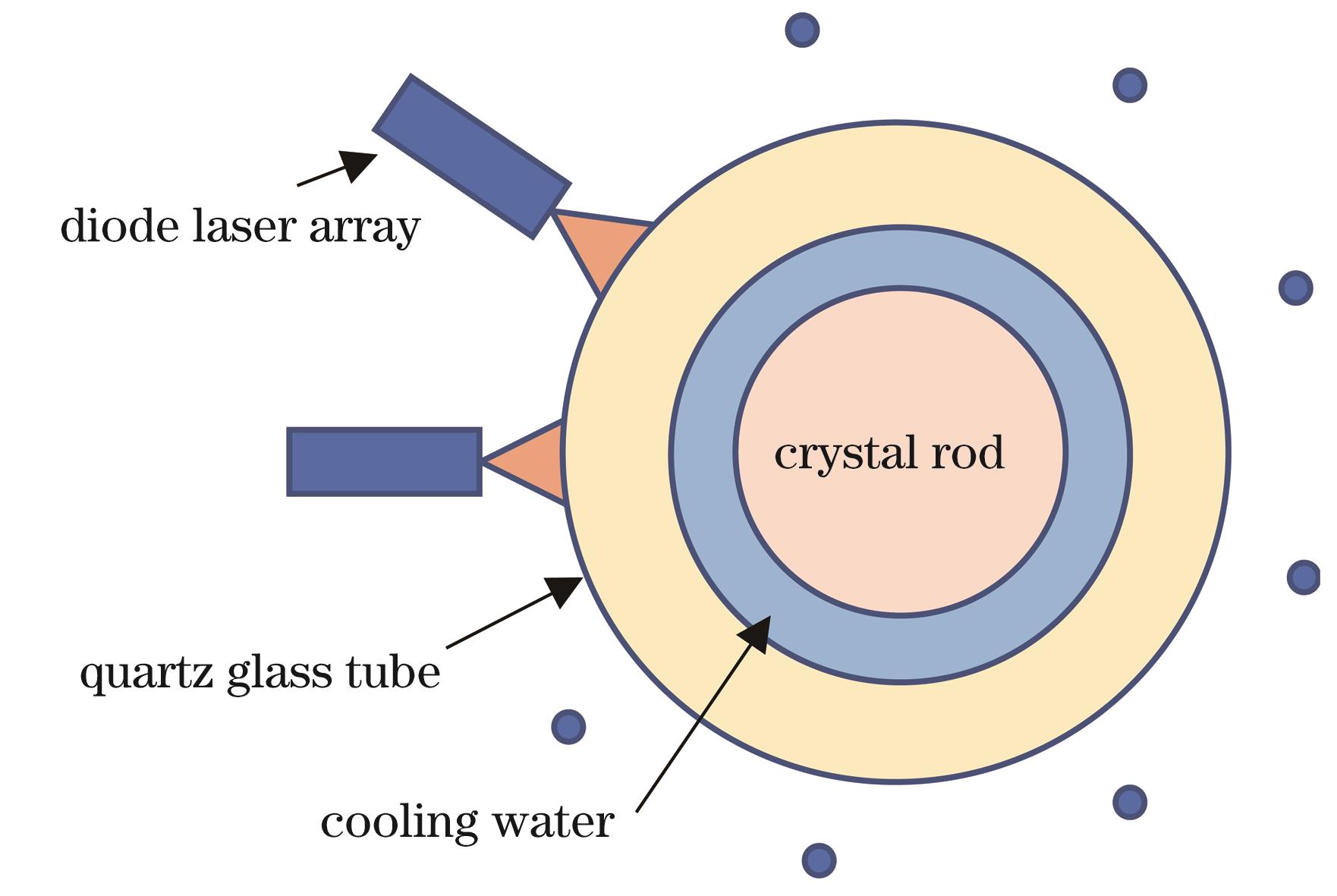
Figure 1: A typical laser gain crystal (an Nd:YAG rod), one of the most commonly used gain media in solid-state lasers
Gain media are enormously diverse — from semiconductor chips to glass fibres, from dye solutions to high-pressure gases, from chemical fuels to free-electron beams. Different gain media determine a laser’s wavelength range, power level, pulse characteristics, efficiency and beam quality. Choosing the right gain medium is the first and most critical step in laser design.
II. Core Principles: Stimulated Emission and Population Inversion
Stimulated Emission
The physical mechanism by which a gain medium amplifies light is, in the vast majority of cases, stimulated emission: when a photon strikes an atom (or ion, or molecule) already in an excited state, it “triggers” that atom to transition from a higher to a lower energy level, simultaneously releasing a new photon identical to the incoming one (same frequency, phase, direction and polarisation). Thus one photon goes in and two come out — the light is amplified [(RP Photonics)](https://www.rp-photonics.com/gain_media.html).
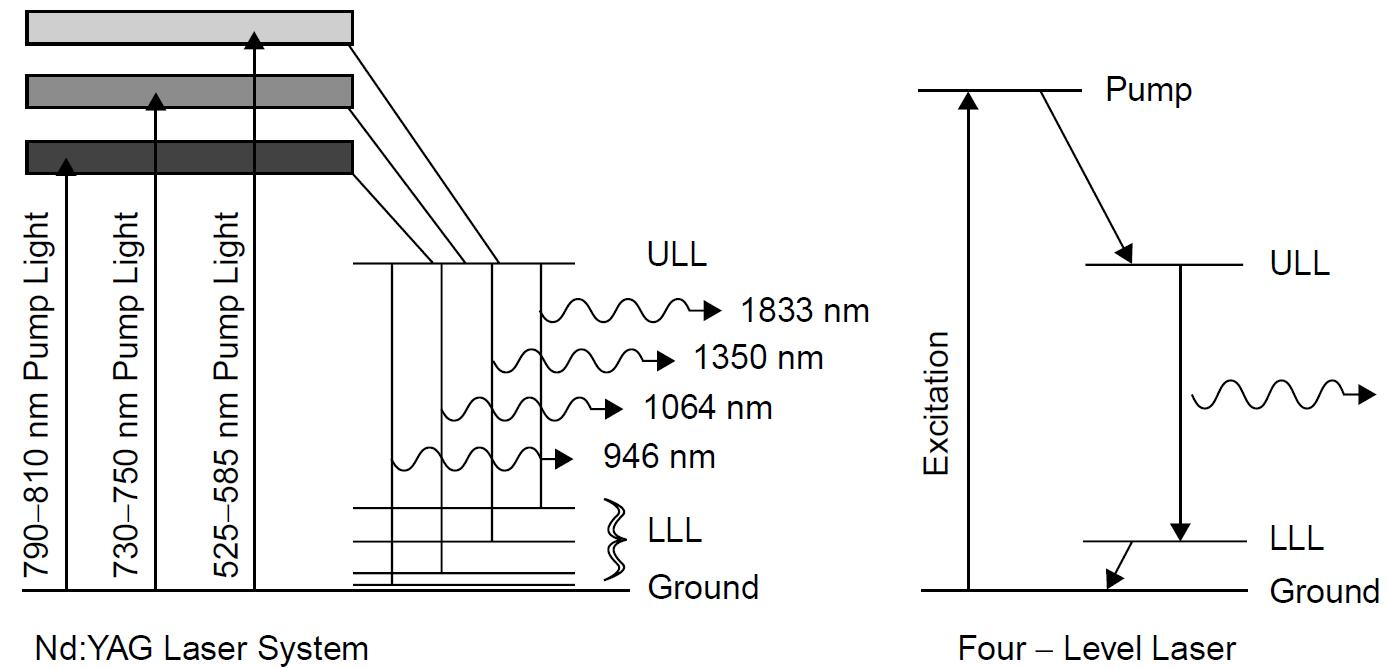
Figure 2: Schematic of the energy-level structure of a gain medium, illustrating pumping, stimulated emission and population inversion
Population Inversion
However, when light enters a medium, there is not only stimulated emission (producing new photons) but also stimulated absorption — atoms in lower energy levels absorb photons and are excited to higher levels, consuming photons. Which process dominates, stimulated emission or stimulated absorption, depends on the population distribution between the upper and lower levels:
- If the lower-level population > the upper-level population (thermal equilibrium): absorption > stimulated emission, and the light is attenuated
- If the upper-level population > the lower-level population (population inversion): stimulated emission > absorption, and the light is amplified
Population inversion is a necessary condition for achieving optical amplification. In thermal equilibrium, the population is always greater in the lower level than the upper (Boltzmann distribution), so pumping must “move” particles up to the higher level to create an inverted distribution.
Three-Level vs. Four-Level Systems
Depending on their energy-level structure, gain media can be classified as:
- Three-level system: the lower laser level is the ground state. To achieve inversion, more than half the ground-state particles must be excited to the upper level, so the threshold pump power is high. Example: the ruby laser (Cr:Al₂O₃).
- Four-level system: the lower laser level is an excited state whose particles relax rapidly to the ground state, so the lower level is nearly empty and inversion is easy to achieve, with a very low threshold. Example: most transitions of Nd:YAG (1064 nm).
- Quasi-three-level system: the lower laser level is not the ground state but lies close to it, and at room temperature has some population, placing it between three-level and four-level systems. Examples: Yb:YAG, Er:YAG, and the 980 nm pumping scheme of erbium-doped fibre amplifiers (EDFAs) (redistribution of population among the ⁴I₁₅/₂ ground-state Stark sublevels causes quasi-three-level behaviour).
Key Formula: Small-Signal Gain Coefficient
The small-signal gain coefficient of a gain medium (the amplification factor per unit length) is:

where σe is the stimulated-emission cross section, σa is the absorption cross section, and N₂ and N₁ are the population densities of the upper and lower levels respectively. For a four-level system, N₁ ≈ 0, simplifying to:
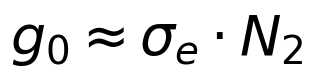
The gain coefficient is proportional to the upper-level population and also to the stimulated-emission cross section.
III. Six Major Types of Gain Media
| Type | Representative Materials | Pumping Method | Typical Applications |
|---|---|---|---|
| Laser crystals | Nd:YAG, Yb:YAG, Ti:sapphire, Nd:YVO₄ | Optical pumping (LD or lamp) | Solid-state lasers, ultrafast lasers |
| Laser glasses | Neodymium glass, ytterbium glass, erbium glass | Optical pumping (LD or lamp) | High-energy pulse lasers, fibre lasers |
| Semiconductors | GaAs, InGaAs, GaN, quantum wells | Electrical pumping (current injection) | Laser diodes, optical communication, pump sources |
| Fibre gain media | Erbium-doped fibre, ytterbium-doped double-clad fibre | Optical pumping (LD) | Fibre lasers, fibre amplifiers |
| Gases | CO₂, He-Ne, excimers (ArF/KrF) | Electrical pumping (discharge) | Cutting, marking, lithography, medicine |
| Dyes | Rhodamine, coumarin and other organic dye solutions | Optical pumping | Widely tunable lasers, spectroscopy |
1. Laser Crystals
Laser crystals are made by doping a small amount of laser-active ions into a transparent crystal host (such as YAG, YVO₄ or sapphire) — mostly trivalent rare-earth ions such as Nd³⁺, Yb³⁺ and Er³⁺, sometimes transition-metal ions such as Ti³⁺ and Cr³⁺. The advantages of crystals are high thermal conductivity, good optical quality, large laser cross sections and high efficiency. Nd:YAG is the most classic laser crystal, emitting at 1064 nm; Ti:sapphire is the first choice for ultrafast lasers because of its extremely broad gain bandwidth (about 650–1100 nm) [(RP Photonics)](https://www.rp-photonics.com/gain_media.html).
2. Laser Glasses
Unlike crystals, glass has an amorphous structure, so the local environment of the dopant ions is not uniform, resulting in a broader gain bandwidth. The advantages of glass are: large gain bandwidth (suited to ultrashort pulses and wide tuning), the ability to be made in large sizes (suited to high-energy pulses), and lower cost. The disadvantages are: poor thermal conductivity (limiting high-power continuous operation) and smaller laser cross sections (higher thresholds). Neodymium glass is the gain medium of giant pulse lasers such as the National Ignition Facility (NIF) [(RP Photonics)](https://www.rp-photonics.com/gain_media.html).
3. Semiconductor Gain Media
Semiconductor gain media work differently from those described above — they use the recombination of conduction-band electrons and valence-band holes in a semiconductor material to generate light, with no need to dope “laser-active ions.” Direct-bandgap semiconductors (such as GaAs, InGaAs and GaN) are the most widely used. The great advantages of semiconductor lasers are electrical pumping, high efficiency, small size and low cost, making them the mainstay in optical communication, data storage and pump sources [(RP Photonics)](https://www.rp-photonics.com/gain_media.html).
4. Fibre Gain Media
A fibre gain medium is a special optical fibre with laser-active ions doped into its core. The waveguide structure of the fibre ensures good beam quality, while the large surface-area-to-volume ratio helps dissipate heat. The invention of double-clad fibre allowed high-power pump light to propagate in the inner cladding and be gradually absorbed by the core, enabling fibre lasers at the kilowatt and even tens-of-kilowatts level [(RP Photonics)](https://www.rp-photonics.com/gain_media.html).
IV. Key Physical Effects: Gain Saturation and Thermal Effects
Gain Saturation
When the input optical power is very high, the gain decreases — this is gain saturation. The reason is simple: stimulated emission depletes the upper-level population faster than pumping replenishes it, so the upper-level population falls and the gain naturally drops. Gain saturation is not a “bad thing” — it is the key mechanism by which a laser achieves stable operation: when the gain saturates to exactly equal the losses, the laser power stabilizes (gain clamping) [(RP Photonics)](https://www.rp-photonics.com/gain_media.html).
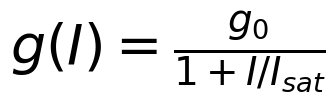
An important parameter describing gain saturation is the saturation intensity (Saturation Intensity, Isat): when the optical intensity equals the saturation intensity, the gain falls to half the small-signal gain. The formula for the saturation intensity is:

where hν is the photon energy, σ is the stimulated-emission cross section and τ is the upper-level lifetime. The saturation intensity depends on the intrinsic properties of the gain-medium material and varies greatly between different gain media. The variation of gain with optical intensity follows:
Thermal Effects
The energy of the pump light cannot all be converted into laser energy — some is always dissipated as heat in the gain medium. This heat produces:
- Thermal lensing: a temperature gradient creates a refractive-index gradient, so the gain medium itself becomes a lens, changing the resonator stability and beam quality
- Thermally induced birefringence and depolarization loss: thermal stress induces birefringence, causing changes in polarisation state and losses
- Thermal fracture: in severe cases the thermal stress exceeds the material strength and the gain medium cracks
Thermal effects are one of the main limiting factors in high-power lasers. Thermal conductivity varies greatly between gain media — YAG crystal conducts heat far better than glass, so high-power continuous-wave lasers mostly use crystalline gain media [(RP Photonics)](https://www.rp-photonics.com/gain_media.html).
V. Key Gain-Medium Parameter Comparison
| Parameter | Meaning | Importance |
|---|---|---|
| Emission wavelength | The centre wavelength of the laser transition | Determines the application area (material processing, medicine, communication, etc.) |
| Gain bandwidth | The width of the gain curve | Broad bandwidth suits ultrashort pulses and wavelength tuning |
| Stimulated-emission cross section σe | The stimulated-emission probability of a single ion | Large cross section = low threshold, high gain |
| Upper-level lifetime τ | The spontaneous-emission lifetime of the excited state | Long lifetime suits Q-switching (large energy storage), short lifetime suits high-speed modulation |
| σ·τ product | Stimulated-emission cross section × upper-level lifetime | A comprehensive measure of gain capability; a larger value means a lower threshold |
| Quantum efficiency | The fraction of pump photons converted into laser photons | Determines efficiency and heat load |
| Thermal conductivity | The material’s ability to conduct heat | A key limiting factor in high-power lasers |
| Optical damage threshold | The maximum optical intensity the material can withstand | A key limit on pulse-energy amplification |
VI. Typical Applications
1. Material Processing
The high-power lasers used for industrial cutting, welding and marking (fibre lasers, CO₂ lasers and semiconductor lasers) all rely on their corresponding gain media — ytterbium-doped double-clad fibre, CO₂ gas, and GaAs semiconductor quantum wells respectively. When choosing a gain medium, efficiency, thermal conductivity and power scalability are the primary considerations.
2. Ultrafast Lasers and Precision Measurement
Femtosecond lasers need an extremely broad gain bandwidth — Ti:sapphire (titanium-doped sapphire) is the classic choice, with a gain bandwidth reaching hundreds of nanometres. Yb-doped materials (such as Yb:KGW and Yb:CALGO) are also widely used because of their broad bandwidth and high efficiency.
3. Optical Communication
Erbium-doped fibre amplifiers (EDFAs) in fibre-optic communication systems use erbium-doped fibre as the gain medium, operating in the 1550 nm communication window. Semiconductor optical amplifiers (SOAs) use semiconductor materials such as InGaAsP. The choice of gain medium determines the amplification bandwidth, noise figure and output power.
4. Medicine and Cosmetics
Different laser wavelengths correspond to different medical applications: Er:YAG (2940 nm) for dentistry and skin resurfacing, Nd:YAG (1064 nm) for hair removal and vascular treatment, excimer (193 nm) for ophthalmic myopia surgery, and CO₂ (10.6 μm) for soft-tissue cutting.
VII. Common Misconceptions: 4 Ideas You May Have Got Wrong
Misconception 1: The more “powerful” the gain medium, the better the laser
Correction: There is no “best” gain medium, only the one best suited to a particular application. There are trade-offs between parameters: those with a small quantum defect tend to be quasi-three-level systems (high threshold); those with broad gain bandwidth usually have small laser cross sections and poor thermal conductivity; high doping concentration favors short-length absorption but can cause concentration quenching and upconversion losses. Choosing a gain medium is an art of trade-offs [(RP Photonics)](https://www.rp-photonics.com/gain_media.html).
Misconception 2: All gain media amplify via stimulated emission
Correction: The vast majority do, but there are exceptions. For example, Raman amplifiers use stimulated Raman scattering (a pump photon is converted into a signal photon plus a phonon), not stimulated emission. Optical parametric amplifiers (OPAs) use second-order nonlinear optical effects and likewise do not involve population inversion. Strictly speaking these “amplifiers” are not called lasers, but they can amplify light all the same [(RP Photonics)](https://www.rp-photonics.com/gain_media.html).
Misconception 3: Crystals are always better than glass
Correction: Crystals do have high thermal conductivity and large laser cross sections, but glass has irreplaceable advantages — broader gain bandwidth (suited to ultrashort pulses), the ability to be made larger (suited to high-energy pulses), and lower cost. Giant neodymium-glass lasers can reach megajoule-level single-pulse energy, something crystal lasers cannot achieve. Which to choose depends on the specific requirements [(RP Photonics)](https://www.rp-photonics.com/gain_media.html).
Misconception 4: The higher the doping concentration, the greater the gain
Correction: Doping concentration does affect gain, but higher is not always better. Excessive concentration leads to concentration quenching — dopant ions lie too close together, causing energy upconversion and cross-relaxation that waste the energy. In addition, high concentration can cause clustering, further reducing efficiency and damage threshold. Every gain medium has an optimal doping-concentration range [(RP Photonics)](https://www.rp-photonics.com/gain_media.html).
VIII. Recommended Reading
- What Is a Solid-State Laser? Classic and Timeless Laser Technology — a typical application of crystalline gain media
- What Is a Fibre Laser? Why It Dominates the Industrial Laser Market — how fibre gain media work
- RP Photonics Encyclopedia: Laser Gain Media — the main reference for this article, the world’s most authoritative laser encyclopedia
Leave a Reply