


How Does a Laser Work? Understanding How Laser Light Is Generated
You encounter lasers every day — the VCSEL in phone face recognition, the scanner gun at the supermarket, the optical signals in fibre-optic communication, laser surgery in hospitals. But what exactly is a laser? What is hidden behind the five letters “LASER”? Why can laser light be focused to an extremely small spot, reach such high power, and be so pure in colour? Based on authoritative content from the RP Photonics Encyclopedia, this article explains the basic principles of lasers — from stimulated emission to optical resonators, from population inversion to laser classification.
Table of Contents
- I. What Is a Laser? — The Secret Behind Five Letters
- II. Core Principles: Stimulated Emission and Population Inversion
- III. The Three Essential Components of a Laser
- IV. The Unique Properties of Laser Light
- V. Main Types of Lasers
- VI. Typical Applications
- VII. Common Misconceptions: 4 Ideas You May Have Got Wrong
- VIII. Recommended Reading
I. What Is a Laser? — The Secret Behind Five Letters
LASER is an acronym for Light Amplification by Stimulated Emission of Radiation, which translates as “light amplification by stimulated emission of radiation.” The name was coined in 1957 by laser pioneer Gordon Gould. As the name implies, the core of a laser is the use of the physical effect of stimulated emission to amplify light RP Photonics.
Although LASER originally described an operating principle, today the word is used more to refer to the light source operating on laser principles — what we commonly call a “laser.” The first laser was the ruby laser built by Theodore Maiman in 1960; the same year, the helium-neon (He-Ne) gas laser was also successfully developed. Laser diodes did not appear until 1962, achieved independently by Robert Hall (infrared) and Nick Holonyak (visible light) and others. In just over sixty years, the laser has gone from the laboratory into every aspect of our lives RP Photonics.
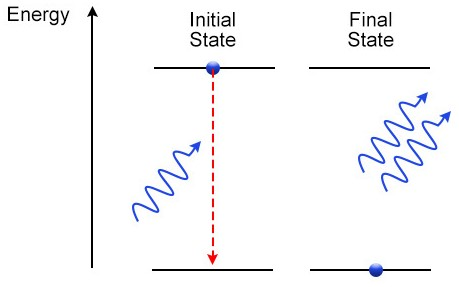
Figure 1: Schematic of stimulated emission — an incoming photon triggers an excited atom to release an identical new photon, amplifying the light
Lasers are so important and useful because they possess unique properties that ordinary light sources (such as incandescent lamps, LEDs and fluorescent lamps) cannot match: high directionality, extremely high brightness, very narrow spectral linewidth, and the ability to generate extremely short pulses. These properties all ultimately arise from the coherence of laser light — both spatial and temporal coherence RP Photonics.
II. Core Principles: Stimulated Emission and Population Inversion
Three Fundamental Light–Matter Interactions
The generation of laser light involves three basic processes of light–matter interaction, which coexist and compete with one another:
| Process | Physical Description | Change in Photon Number | Characteristics |
|---|---|---|---|
| Stimulated absorption | An atom in a lower energy level absorbs a photon and jumps to a higher level | Decreases by 1 | Requires an external photon to trigger; dominant at thermal equilibrium |
| Spontaneous emission | An atom in a higher energy level spontaneously drops back to a lower level, releasing a photon | Increases by 1 | Occurs randomly; the photon’s direction, phase and polarisation are all random; the source of ordinary light |
| Stimulated emission | An atom in a higher energy level is triggered by an incoming photon, drops to a lower level, and releases an identical photon | Increases by 1 (net amplification) | Requires an incoming photon to trigger; the new photon is identical to the incoming one (frequency, phase, direction, polarisation); the core of laser light |
Among these, stimulated emission is the core of the laser — one photon goes in, two identical photons come out. These two photons then go on to stimulate other atoms, producing more identical photons… and the light is amplified in an avalanche. Moreover, since all the photons are “identical,” laser coherence is excellent RP Photonics.
In ordinary light sources (incandescent lamps, the sun, LEDs), spontaneous emission dominates; in a laser, through population inversion and resonator feedback, stimulated emission is made the dominant process RP Photonics (stimulated emission).
Population Inversion: The Prerequisite for Amplification
But stimulated emission does not naturally gain the upper hand. In thermal equilibrium, the vast majority of atoms are in the lower energy level — far more than in the upper level. When light enters under these conditions, stimulated absorption (which consumes photons) far exceeds stimulated emission (which produces photons), and the light becomes weaker.
For light to be amplified, there must be more atoms in the upper energy level than in the lower — this is called population inversion. Population inversion is not a state that exists naturally; external energy input (pumping) is required to “force” atoms up to the higher level. Pumping can be electrical, optical, chemical, and so on RP Photonics.
Key Formula: Laser Threshold Condition
For a laser to sustain oscillation, the gain must at least equal the loss:

where gth is the threshold gain coefficient, L is the length of the gain medium, αtot is the total internal loss, and R₁ and R₂ are the reflectivities of the two cavity mirrors.
When the pump power reaches the threshold pump power, the small-signal gain just equals the total losses and lasing begins. Above threshold, the gain is clamped at the threshold gain level (gain saturation), and the excess pump energy is converted into laser output.
III. The Three Essential Components of a Laser
Every laser must have all three of the following elements — none can be missing:
Three essentials of a laser:
- Gain medium: the material that provides optical amplification, determining the wavelength and power range
- Pump source: supplies energy to achieve population inversion (the prerequisite for amplification)
- Optical resonator: provides positive feedback and mode selection, allowing light to oscillate
Population inversion alone ≠ a laser — a resonator is still needed to provide positive feedback so that light is amplified back and forth and forms an oscillation.
These three parts are described below:
1. Gain Medium
The gain medium is the material that provides optical amplification — it can be a crystal, glass, semiconductor, gas, dye solution, and so on. It converts pump energy into laser energy through stimulated emission. The gain medium determines fundamental characteristics such as the laser’s wavelength, power range and efficiency.
2. Pump Source
The pump source supplies energy to the gain medium, creating population inversion. Common pumping methods include:
- Optical pumping: illuminating the gain medium with another light source (a laser diode, flash lamp, or another laser). Solid-state lasers and fibre lasers both use optical pumping.
- Electrical pumping: achieving population inversion through current injection. Semiconductor lasers and gas lasers (discharge excitation) fall into this category.
- Chemical pumping: using the energy released by chemical reactions. Chemical lasers can reach very high powers.
3. Optical Resonator
A gain medium and a pump are not enough — the amplification of light in a single pass through the gain medium is limited, and spontaneously emitted light goes in all directions. A resonator (usually two opposing mirrors) makes light reflect back and forth through the gain medium, being amplified repeatedly while also selecting direction and frequency. One of the mirrors is partially transmissive, and the laser light exits from there RP Photonics.
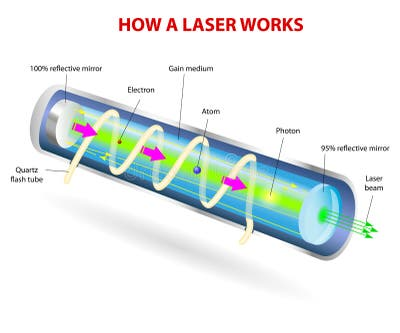
Figure 2: Schematic of how a laser works — the coordinated operation of the three components: gain medium, pump source and resonator
IV. The Unique Properties of Laser Light
The Four Core Properties of Laser Light
Compared with ordinary light sources, laser light has four unique properties, all stemming from the essence of stimulated emission producing “identical photons”:
- Good directionality: the laser beam has an extremely small divergence angle (typically on the order of milliradians), is nearly collimated, can travel long distances without significant spreading, and can be focused to a diffraction-limited spot. Origin: spatial coherence + resonator mode selection.
- Good monochromaticity: the laser’s spectral linewidth is extremely narrow and its colour very “pure.” Ordinary light sources have broad spectra (white light is a continuous spectrum), whereas single-frequency lasers can have linewidths narrower than 1 Hz. Origin: the resonator’s frequency-selecting effect.
- Good coherence: includes temporal coherence (long coherence length) and spatial coherence (in phase across the cross-section). This is the foundation for laser interference, holography and coherent communication. Origin: stimulated emission + resonator.
- High brightness: extremely high optical power per unit area and per unit solid angle, because the energy can be concentrated into a very small space and a very narrow spectral range. Laser brightness can be many orders of magnitude higher than that of the sun.
| Property | Physical Essence | Practical Significance |
|---|---|---|
| High directionality (low divergence) | Spatial coherence + resonator mode selection | Long-distance propagation, focusable to a very small spot |
| High monochromaticity (narrow linewidth) | Temporal coherence + resonator frequency selection | Spectroscopy, optical communication, precision measurement |
| High brightness | Energy highly concentrated in space and time | Material processing, nuclear fusion, medicine |
| High coherence | Stimulated emission produces identical photons | Interferometry, holography, optical communication |
| Ultrashort pulses possible | Mode locking + broad gain bandwidth | Femtosecond science, precision machining, medicine |
Spatial Coherence and Directionality
The light from an ordinary source (such as a light bulb) is emitted independently and randomly by countless atoms, with differing phases and directions — this is incoherent light. In a laser, by contrast, the emission of all atoms is “coordinated and directed” by the light already present in the cavity (stimulated emission), so all the photons share the same direction and phase. This spatial uniformity is called spatial coherence; it results in a very small beam divergence angle and the ability to focus to a diffraction-limited spot, achieving extremely high optical intensity RP Photonics.
Temporal Coherence and Monochromaticity
The frequency (colour) of laser light can be extremely pure — a single-frequency laser can have a linewidth narrower than 1 Hz, while the central optical frequency is about 10¹⁴ Hz, giving a relative linewidth on the order of 10⁻¹⁴. This purity in frequency is called temporal coherence. The resonator’s frequency selection and the gain saturation mechanism together ensure that only light of a single frequency can oscillate continuously in the cavity RP Photonics.
Pulse Characteristics
Lasers can not only emit continuously but also generate extremely short pulses. Q-switching produces nanosecond pulses, while mode locking produces femtosecond (10⁻¹⁵ s) or even attosecond (10⁻¹⁸ s) ultrashort pulses. The shorter the pulse, the higher the peak power — the peak power of femtosecond lasers can reach the terawatt or even petawatt level, unattainable with continuous light RP Photonics.
V. Main Types of Lasers
1. Solid-State Lasers (Solid-state Lasers)
These use doped crystals or glass as the gain medium, usually with optical pumping (laser diodes or flash lamps). Examples: Nd:YAG lasers (1064 nm), Ti:sapphire femtosecond lasers, Yb:YAG thin-disk lasers. Features: good beam quality and a wide power range, from milliwatts to kilowatts or even tens of kilowatts RP Photonics.
2. Semiconductor Lasers
These use semiconductor materials (GaAs, InGaAs, GaN, etc.) as the gain medium, pumped by current injection. Examples: laser diodes (LD), VCSELs, quantum cascade lasers. Features: small size, high efficiency, low cost, widely used in communication, storage, pump sources and consumer electronics. They are the laser type produced in the largest volume RP Photonics.
3. Fibre Lasers
These use doped optical fibre as the gain medium, pumped by laser diodes. Examples: ytterbium-doped fibre lasers (near 1064 nm), erbium-doped fibre lasers (1550 nm). Features: good beam quality, good heat dissipation, high power (up to the tens-of-kilowatts level) and simple maintenance — the fastest-growing laser type in industrial processing in recent years RP Photonics.
4. Gas Lasers
These use a gas or gas mixture as the gain medium, pumped by electric discharge. Examples: CO₂ lasers (10.6 μm, industrial cutting and welding), He-Ne lasers (632.8 nm, research and calibration), excimer lasers (ultraviolet, lithography and ophthalmology). Features: a wide wavelength range, covering everything from deep ultraviolet to far infrared RP Photonics.
5. Other Types
There are also more specialised lasers: dye lasers (widely tunable), chemical lasers (extremely high power), free-electron lasers (continuously tunable wavelength), X-ray lasers, and so on. Each has its own unique application areas RP Photonics.
VI. Typical Applications
1. Material Processing
Laser cutting, welding, marking, drilling, 3D printing… manufacturing is the largest application market for lasers. High-power fibre lasers and CO₂ lasers handle the majority of industrial processing tasks. The non-contact, high-precision and high-speed nature of lasers makes them an indispensable tool in modern manufacturing.
2. Optical Communication and Data Storage
Fibre-optic communication is the foundation of the Internet — the optical signals for long-distance transmission come from semiconductor lasers and are amplified along the way by erbium-doped fibre amplifiers (EDFAs). Blue laser diodes are the core of Blu-ray drives, greatly increasing the storage capacity of optical discs.
3. Medicine and Healthcare
Ophthalmic surgery (excimer-laser vision correction), cosmetic treatments (hair removal, spot removal), surgical procedures (laser scalpel), dental treatment… lasers are used increasingly widely in medicine. Lasers of different wavelengths interact with biological tissue in different ways, corresponding to different therapeutic needs.
4. Precision Measurement and Research
Laser interferometry (LIGO gravitational-wave detection), LiDAR, laser cooling and atomic clocks, spectroscopy, ultrafast science… lasers are an indispensable tool in modern scientific research. Optical clocks have already reached an accuracy of better than one second over 13.8 billion years.
VII. Common Misconceptions: 4 Ideas You May Have Got Wrong
Misconception 1: A laser is just “very bright light,” much the same as an LED
Correction: The essential difference between a laser and an ordinary light source is not brightness but coherence. An LED can be very bright too, but its light arises from spontaneous emission — the phase and direction of each photon are random, making it incoherent light. Laser light arises from stimulated emission, with all photons highly synchronised and possessing excellent spatial and temporal coherence. It is precisely because of this coherence that a laser can be focused to an extremely small spot, travel a long way without spreading, and produce interference effects RP Photonics.
Misconception 2: All lasers are red
Correction: A laser can be any colour — from deep ultraviolet (193 nm excimer laser) through the visible range (red, green, blue) to the mid-infrared (10.6 μm CO₂ laser) and even the terahertz band. The colour of a laser depends on the energy-level structure of the gain medium; different materials have different emission wavelengths. Infrared and ultraviolet lasers are invisible to the human eye, but they are lasers all the same RP Photonics.
Misconception 3: Everything called a “laser” is a true laser
Correction: Some devices described as “laser sources” are not strictly lasers. For example, optical parametric oscillators (OPOs) work through nonlinear effects rather than stimulated emission; some X-ray lasers are superradiant sources (with no resonator); Raman lasers are based on stimulated Raman scattering. All of them can produce laser-like beams, but their operating principles differ. Of course, in everyday usage there is no need to be so pedantic RP Photonics.
Misconception 4: The higher the laser power, the more dangerous it is
Correction: The danger of a laser depends not only on power, but also on wavelength, pulse duration, beam divergence angle and whether it is visible. For example, a 1 mW visible laser shone directly into the eye may cause retinal damage (because the eye focuses the light onto the retina), whereas a 1 W far-infrared laser may merely warm the skin. Invisible infrared/ultraviolet lasers are actually more dangerous — because you cannot see them, you do not instinctively blink or look away. Laser safety has dedicated classification standards (Class 1 to Class 4), not a simple division by power RP Photonics.
VIII. Recommended Reading
- What Is a Gain Medium? Where Does Laser Energy Come From — one of the three essential components of a laser; understand the amplification principle in depth
- What Is an Optical Resonator? How Do Two Mirrors Trap Light — one of the three essential components of a laser; understand modes and frequency selection
- RP Photonics Encyclopedia: Lasers — the main reference for this article, the world’s most authoritative laser encyclopedia
Leave a Reply