


What Is a Semiconductor Laser? The Small, Powerful Laser Chip
A semiconductor laser (Laser Diode, LD) is a laser that uses a semiconductor material as its gain medium, and is the smallest, most efficient and lowest-cost class of all lasers. From phone Face ID to fibre-optic communication, from laser pointers to industrial pump sources, it is a foundational optoelectronic device underpinning the modern information society. This article takes you from principles to applications for a thorough understanding of semiconductor lasers.
Table of Contents
- I. What Is a Semiconductor Laser? — Core Concepts
- II. How It Works: How a Semiconductor Laser Is Realised
- III. Key Parameters: Understanding Performance Metrics
- IV. Main Types: What Kinds Exist?
- V. Applications: Where Are They Used?
- VI. Common Misconceptions: Pitfalls to Avoid
- VII. References
I. Core Concept: What Is a Semiconductor Laser?
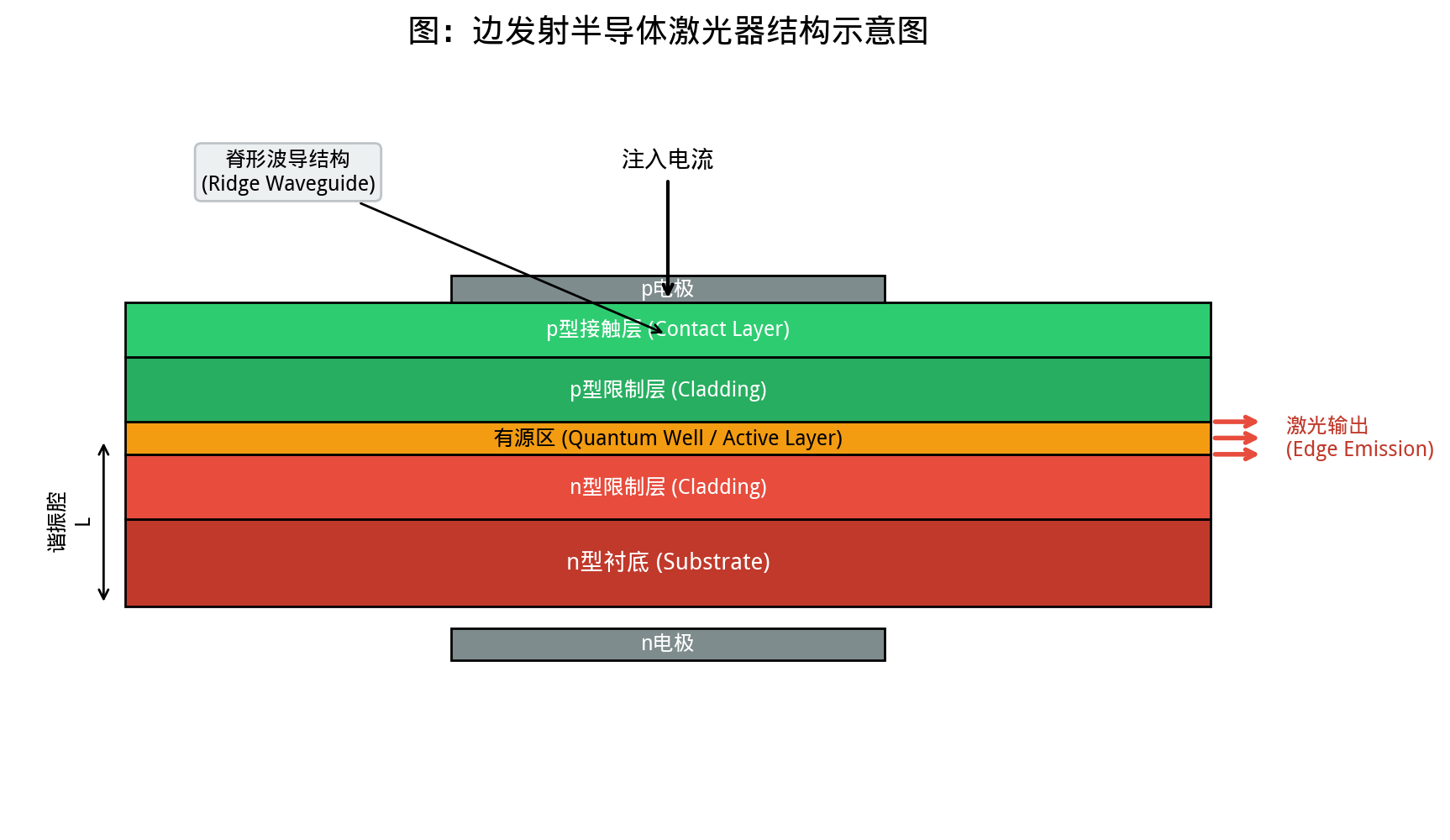
A semiconductor laser, also called a laser diode (LD), is a laser using a semiconductor material as its gain medium. It works by injecting current into a semiconductor PN junction, causing conduction-band electrons to recombine with valence-band holes and releasing photons through stimulated emission to achieve optical amplification.
Semiconductor lasers are the smallest, most efficient and lowest-cost class of all lasers, and also the most widely used — from milliwatt laser pointers to kilowatt industrial pump stacks, from consumer electronics to defence and communication, almost every laser field depends on them.
II. How It Works: How a Semiconductor Laser Is Realised
To understand how a semiconductor laser works, break it down into several key mechanisms:
1. Band Structure and Stimulated Emission
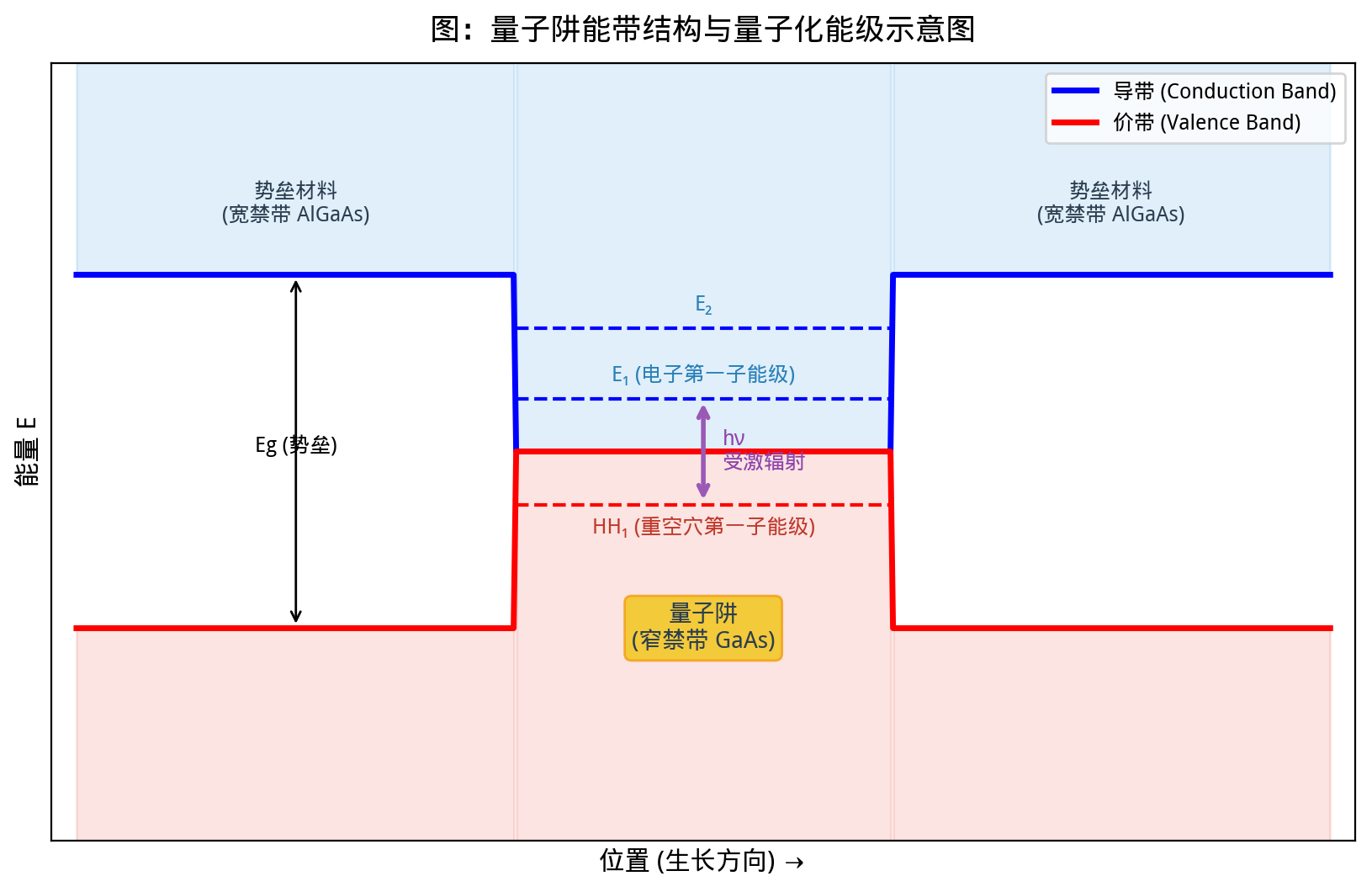
The energy states of electrons in a semiconductor form a valence band (low energy, filled with electrons) and a conduction band (high energy, few electrons), separated by a bandgap. When current is injected forward, large numbers of electrons enter the conduction band, leaving many holes in the valence band. When an electron drops from the conduction band to the valence band and recombines with a hole, it releases a photon with energy equal to the bandgap — this is stimulated emission in a semiconductor.
2. Population Inversion
Population inversion in a semiconductor means that within a certain energy range, the occupation probability of electrons in the conduction band exceeds that in the valence band. Only when this condition is met can light be amplified. Achieving inversion requires injecting a sufficiently large current — there is a threshold current.
3. Direct vs. Indirect Bandgap
Only direct-bandgap semiconductors (GaAs, InP, GaN) emit light efficiently — electron-hole recombination needs no phonon participation, so radiative recombination efficiency is high. Indirect-bandgap materials (such as silicon) need phonons for recombination, giving extremely low efficiency and making lasers hard to build.
4. Optical Resonator
The resonator of a semiconductor laser is usually formed naturally by crystal cleavage planes — the smooth end faces cleaved along specific crystal planes act as mirrors (Fresnel reflectivity about 30%), forming a Fabry-Pérot (FP) cavity. There are also DFB (distributed feedback), DBR (distributed Bragg reflector) and VCSEL (vertical-cavity surface-emitting) structures (see the classification in Section IV).
5. Fast Axis and Slow Axis — A Unique Feature of Semiconductor Lasers
The output spot of an edge-emitting semiconductor laser has a very important characteristic: the beam properties along the fast axis (perpendicular to the PN junction) and the slow axis (parallel to the PN junction) differ enormously.
- Fast axis: the emitting region is extremely thin (on the order of 0.1 μm), diffraction is very strong, and the divergence angle is large (about 30°–40° FWHM), usually near the diffraction limit and in the fundamental mode.
- Slow axis: the emitting region is wider (a few μm to hundreds of μm), the divergence angle is small (about 10° or less), and high-power devices are usually multimode with poor beam quality.
The asymmetry between the two axes produces an elliptical spot and astigmatism — the beam waists of the two axes are not in the same plane. The vast majority of applications require optical elements such as cylindrical lenses for beam shaping to circularize and collimate the elliptical spot. This is one of the biggest differences between semiconductor lasers and other laser types.
III. Key Parameters: Understanding Performance Metrics
Reading a semiconductor laser’s parameter table is the first step in selection. The table below organises the core parameters:
| Parameter | Meaning | Typical Value | Description |
|---|---|---|---|
| Threshold current (Ith) | The minimum injection current to start lasing | Single-mode a few mA ~ broad-area hundreds of mA | Lower threshold means less power consumption, less heat and lower drive-circuit cost; a core quality metric |
| Output power | Output optical power in CW operation | Single emitter mW to a few W; bars ~hundreds of W; stacks kW level | Determines suitable applications — low power for communication/sensing, high power for pumping and direct processing |
| Centre wavelength | The centre wavelength of emission, set by bandgap and operating temperature | 650 nm to 10 μm (depends on material) | Wavelength determines application — 1550 nm for communication, 9xx nm for pumping, blue/green for display |
| Spectral linewidth | The width of the emission spectrum | FP cavity: a few nm; DFB: MHz level; VCSEL: ~0.1 nm | Linewidth determines coherence and monochromaticity — communication needs narrow linewidth, pump sources are insensitive |
| Slope efficiency | The slope of output power vs. current above threshold, in W/A | 0.3–1.0 W/A (single emitter) | Higher slope efficiency means higher conversion efficiency and more output at the same current |
| Wall-plug efficiency (WPE) | Output optical power / input electrical power | High-quality devices reach 50%–70% | Determines overall system efficiency and cooling needs; in high-power pumping WPE is a core metric |
| Modulation bandwidth | The highest frequency at which intensity modulation is possible | Ordinary LD: a few GHz; high-speed DFB: tens of GHz | Determines communication rate — higher bandwidth means faster data; a key parameter for optical communication devices |
| Beam quality (M²) | How close the beam is to an ideal Gaussian beam | Single-mode: ~1.1; broad-area multimode: >10 | Determines focusability and propagation; good beam quality suits fibre coupling and precision machining |
These parameters are not isolated — they are interrelated and constrain one another. For example, pushing power higher often degrades beam quality; narrowing linewidth can limit modulation bandwidth. Evaluating a semiconductor laser requires considering the specific application comprehensively.
IV. Main Types: What Kinds of Semiconductor Lasers Exist?
Semiconductor lasers can be classified in many ways; different dimensions help us understand their characteristics from different angles.
By Light-Output Configuration
Edge-emitting (EEL)
Light exits from a cleaved side face, including FP laser diodes, DFB/DBR lasers, broad-area lasers, bars and stacks
Surface-emitting
Light exits vertically from the chip surface, including VCSEL (vertical-cavity surface-emitting, electrically injected) and VECSEL (vertical-external-cavity surface-emitting, optically pumped)
By Resonator Structure
This is the most important classification dimension for understanding semiconductor lasers:
FP Lasers
Fabry-Pérot cavity, with two cleaved faces as mirrors. Simplest structure and lowest cost, but broad linewidth (a few nm) and poor coherence, many unstable modes and strong temperature sensitivity. Mainly used in short-distance communication, pump sources and laser printing where wavelength precision is not critical.
DFB Lasers
Distributed feedback, with a periodic grating etched in the active region selecting modes via Bragg reflection. Single longitudinal mode, narrow linewidth (MHz level), good wavelength stability. The core light source for long-haul fibre communication and high-speed optical modules.
DBR Lasers
Distributed Bragg reflector, with gratings at the two ends of the active region acting as mirrors (no grating in the active region itself). Also single-longitudinal-mode and narrow-linewidth like DFB, but with a slightly different structure and better tuning characteristics.
VCSEL
Vertical-Cavity Surface-Emitting Laser — two distributed Bragg reflectors (DBRs) form a vertical resonator, with light exiting from the top surface. Good beam quality (circular spot), low threshold, capable of 2D array integration, low cost. Widely used in data-centre optical interconnects, phone Face ID 3D sensing and laser mice.
VECSEL
Vertical-External-Cavity Surface-Emitting Laser — the “optically pumped + external cavity” version of a VCSEL. The gain medium is a semiconductor quantum-well wafer, with a DBR mirror on one side and an external mirror forming the cavity on the other. Combining the wavelength flexibility of semiconductors with the good beam quality of solid-state lasers, it reaches a few to tens of watts, used in laser display and spectroscopy.
By Material System
Different semiconductor material systems determine a laser’s operating wavelength range:
| Material System | Wavelength Range | Representative Uses |
|---|---|---|
| GaAs-based (gallium arsenide) | 650 ~ 1100 nm | 650 nm red laser pointers/optical drives; 780 nm CD pickup; 808/915/976 nm pump sources (fibre/solid-state lasers); 1064 nm direct emission |
| InP-based (indium phosphide) | 1300 ~ 1650 nm | 1310/1550 nm communication DFB/EML lasers; core light sources of optical modules; EDFA pumping |
| GaN-based (gallium nitride) | 375 ~ 550 nm | 405 nm Blu-ray/3D printing; 450 nm blue laser display/projection; 520 nm green; UV LEDs/LDs |
| Lead-salt types (PbS/PbSe/PbTe) | 3–30 μm (mid-infrared) | Mid-IR gas sensing, environmental monitoring, spectral analysis; usually need cryogenic cooling |
| QCL quantum cascade | 3–300 μm (mid-IR to terahertz) | Based on intersubband transitions, not bandgap-dependent; used in environmental gas detection, IR countermeasures and terahertz imaging |
Different semiconductor laser types have their own strengths and weaknesses — there is no absolute “best,” only “most suitable.” Selection should consider your specific application, power needs, budget and other factors comprehensively.
V. Applications: Where Are Semiconductor Lasers Used?
Semiconductor lasers are the most widely used lasers, penetrating almost every corner of laser technology. A few of the most core applications are described below:
1. Optical Communication and Data Centres
Optical communication is one of the largest and most important application areas for semiconductor lasers. DFB lasers and EMLs (electro-absorption modulated lasers) are the core light sources of fibre communication systems, operating in the 1310 nm and 1550 nm windows at single-channel rates from 10G to 100G and beyond. Inside data centres, VCSEL arrays are used heavily for short-reach optical interconnects (850 nm multimode) — low power, low cost and high density.
It can be said that without semiconductor lasers there would be no modern Internet — nearly all global data transmission relies on fibre communication, and at both ends of every fibre sits a semiconductor laser chip.
2. Pump Sources
High-power semiconductor lasers are the “fuel” of solid-state and fibre lasers — they use LD light to pump the gain medium. 915 nm and 976 nm GaAs-based LDs are the standard pump sources for ytterbium-doped fibre lasers; single emitters output a few watts, and bars and stacks reach kilowatt or even tens-of-kilowatts pump power.
The wall-plug efficiency of pumping semiconductor lasers directly determines the efficiency of the whole laser system, so all major manufacturers keep improving WPE; mass-produced devices have now exceeded 60%.
3. LiDAR and Rangefinding
Semiconductor lasers are the core light sources of LiDAR and laser rangefinders. 905 nm and 1550 nm are the two mainstream automotive LiDAR bands: 905 nm uses low-cost silicon detectors but eye-safety power is limited; 1550 nm has a higher eye-safety threshold, allowing greater power and longer detection range.
Laser rangefinders commonly use 905 nm or 1064 nm pulsed LDs with the time-of-flight (ToF) principle to measure distance, from handheld rangefinders to drone altitude holding.
4. Industrial Processing (Direct Diode Lasers)
Traditionally semiconductor lasers were thought to have poor beam quality and be unsuitable for direct processing. But in recent years, with advances in beam shaping and beam combining, direct diode lasers (DDLs) can achieve kilowatt-class output with reasonably good beam quality, used in metal welding, cladding and surface heat treatment.
Compared with fibre and CO₂ lasers, direct diode lasers offer extremely high electro-optic efficiency (over 50%), compact structure and low maintenance cost, making them competitive in applications not requiring the very highest beam quality.
5. Consumer Electronics
Consumer electronics is the most “down-to-earth” application of semiconductor lasers. VCSELs are the core of phone 3D sensing (Face ID) — projecting tens of thousands of infrared beams onto the face and using an infrared camera to receive the reflection, computing 3D depth information. Blue/red LDs are used in Blu-ray players, laser projection and laser TV displays.
In addition, laser pointers, barcode scanners, laser mice and beauty devices all contain semiconductor lasers. This field is characterised by huge production volumes, cost sensitivity and extremely high reliability requirements.
6. Medicine and Biology
Semiconductor lasers are widely used in medicine. 808 nm/980 nm LDs are used for laser therapy and soft-tissue surgery; 1470 nm for prostate surgery and varicose vein treatment; 635 nm red light for photodynamic therapy (PDT) of tumors.
In bio-detection, semiconductor lasers are important light sources in flow cytometers, confocal microscopes and PCR machines. Their small size, low power consumption and long lifetime make them especially suited to integration in medical devices.
VI. Common Misconceptions
Many people have plausible-sounding but wrong ideas about semiconductor lasers. See if any of these misconceptions catch you out:
Misconception 1: Semiconductor lasers are just laser pointers, with tiny power
The power range is enormous — from milliwatt laser pointers, to a few watts per emitter, tens of watts per bar, hundreds of watts to kilowatt-level industrial pump stacks.
Misconception 2: FP semiconductor lasers have very good coherence
Quite the opposite. Ordinary FP-cavity semiconductor lasers operate in multiple longitudinal modes with broad linewidth (usually a few nm) and very poor coherence, with coherence lengths of only millimetres or less. Applications needing good coherence (such as interferometry and coherent communication) must use single-longitudinal-mode lasers such as DFB or DBR.
Misconception 3: Semiconductor lasers output a circular spot
No. The raw output of an edge-emitting semiconductor laser is an elliptical spot, with a large fast-axis divergence and small slow-axis divergence, the two axes asymmetric and astigmatic. Most applications need optical elements such as cylindrical lenses for beam shaping and collimation. VCSEL output spots, by contrast, are circular.
Misconception 4: Temperature and current only affect power, not wavelength
Very wrong. The output wavelength of a semiconductor laser depends strongly on temperature and injection current: for every 1°C rise, the wavelength typically red-shifts 0.2–0.3 nm; increasing current also red-shifts the wavelength and raises power. In addition, high temperature accelerates aging and shortens lifetime. Precision applications require good temperature control.
Misconception 5: Semiconductor lasers can use Q-switching to produce high-energy pulses
No. The upper-level lifetime of semiconductors is very short (nanosecond scale), so energy storage is poor and Q-switching is unsuitable. Short pulses are usually produced by gain switching or mode locking.
Misconception 6: Semiconductor lasers all have good beam quality
It depends on the type. Low-power single-mode FP/DFB and VCSELs have good beam quality, but high-power broad-area lasers, bars and stacks have very poor beam quality — highly multimode along the slow axis, with M² values reaching tens or even hundreds.
VII. References
- RP Photonics Encyclopedia – Laser Diodes
- RP Photonics Encyclopedia – DFB Lasers
- RP Photonics Encyclopedia – VCSELs
- RP Photonics Encyclopedia – Quantum Cascade Lasers
- Sadao S. Nakamura, “Semiconductor Lasers”, 2nd Edition, Springer
- L. A. Coldren et al., “Diode Lasers and Photonic Integrated Circuits”, Wiley
VIII. Recommended Reading
- Narrow-linewidth fibre lasers: principles, linewidth metrics, classification and 6 common misconceptions
- Single-frequency fibre lasers: principles and applications | Narrow-linewidth laser technology guide
- Ultrafast lasers: principles and applications | Femtosecond and picosecond laser selection guide
- Laser Coherence and Coherence Length
- What Is a Gain Medium? The Core Amplification Material in a Laser
- Back to Laser Encyclopedia Home
Leave a Reply