


What Is Gain Saturation? Why an Amplifier Cannot Amplify Indefinitely
Gain saturation is an inherent property of every optical amplifier: once the input signal power is high enough, the population inversion in the gain medium is heavily depleted and the effective gain falls. Understanding it matters for amplifier selection, system design and power budgeting. This article covers the physical mechanism, the key parameters, the classification and the engineering significance of gain saturation.
Table of contents
- 1. What is gain saturation? Getting the core concept straight
- 2. Working principle: how does gain saturation arise
- 3. Key parameters: reading the specifications of gain saturation
- 4. Main types: what kinds of gain saturation are there
- 5. Applications: where does gain saturation matter
- 6. Common misconceptions: points easily confused
1. Core concept: what is gain saturation?
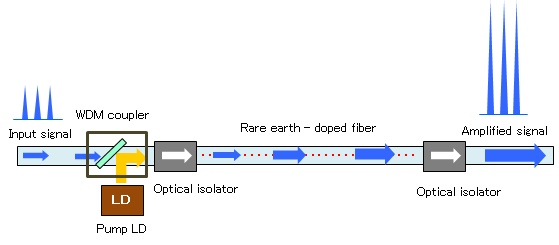
Gain saturation is the fall in the gain of an optical amplifier that occurs once the power or the energy of the input signal becomes large enough. In simple terms, the amplification capability is not unlimited — the stronger the signal, the lower the gain. Every optical amplifier shows this, because no amplifier can inject unlimited energy into a signal.
Saturation is not a defect but a basic physical property of an amplifier. Understanding it is essential to choosing and using an optical amplifier correctly: it sets the maximum output power, the energy that can be extracted in pulse amplification and the gain uniformity across multiple wavelengths.
Gain saturation determines how much output power can be reached, how much pulse energy can be extracted and whether several wavelength channels keep the same power. It is not a defect to be avoided but a boundary that power budgeting and system design have to take into account.
At bottom, saturation is energy conservation: a given inverted population can only be spent once, and once spent it has to wait for the pump to restore it. That gives an amplifier two operating limits — for continuous operation the saturated output power, for pulsed operation the saturation energy. Beyond either of them the gain is compressed, and the waveform and the signal-to-noise ratio degrade with it.
2. Working principle: how does gain saturation arise?
Gain saturation takes two forms, steady-state and dynamic, with different mathematics and different engineering figures: the steady state is described by the saturated output power, the dynamic case by the saturation energy.
Steady-state saturation: continuous light and long pulses
When the signal is continuously present, the gain settles at a value below the small-signal gain. The higher the input power, the lower that settled value — which is where the rule “the higher the output power, the lower the gain” comes from.
Dynamic saturation: short pulses
When the pulse is short enough that the upper level cannot be replenished in time, the gain is consumed progressively as the pulse passes, so the leading edge of the pulse sees a higher gain than the trailing edge. The rate of change of the gain is set jointly by the pumping rate and the rate at which the signal consumes the inversion.
The physics of gain saturation is simply that the signal consumes the inverted population of the gain medium:
- The small-signal regime: when the input signal is very weak, the number of inverted particles it consumes is negligible compared with the total, so the inversion is essentially undisturbed and the gain stays at its maximum, the small-signal gain.
- The onset of saturation: as the input power rises, stimulated emission speeds up and consumes more and more of the inversion. Once the pump can no longer replenish the depleted particles quickly enough, the upper-level population falls and the gain coefficient drops — that is gain saturation.
- Steady-state saturation (continuous light): with continuous light or long pulses the gain reaches a stable saturated value. The basic rule is that the higher the output power, the lower the gain. When the gain has fallen to half the small-signal value, the corresponding output power is called the saturated output power.
- Transient saturation (pulsed operation): with short pulses the gain is consumed continuously while the pulse passes, a phenomenon called dynamic gain saturation or gain extraction. After the pulse the gain recovers gradually, over a time set by the upper-level lifetime of the gain medium.
◆ The saturated output power formula
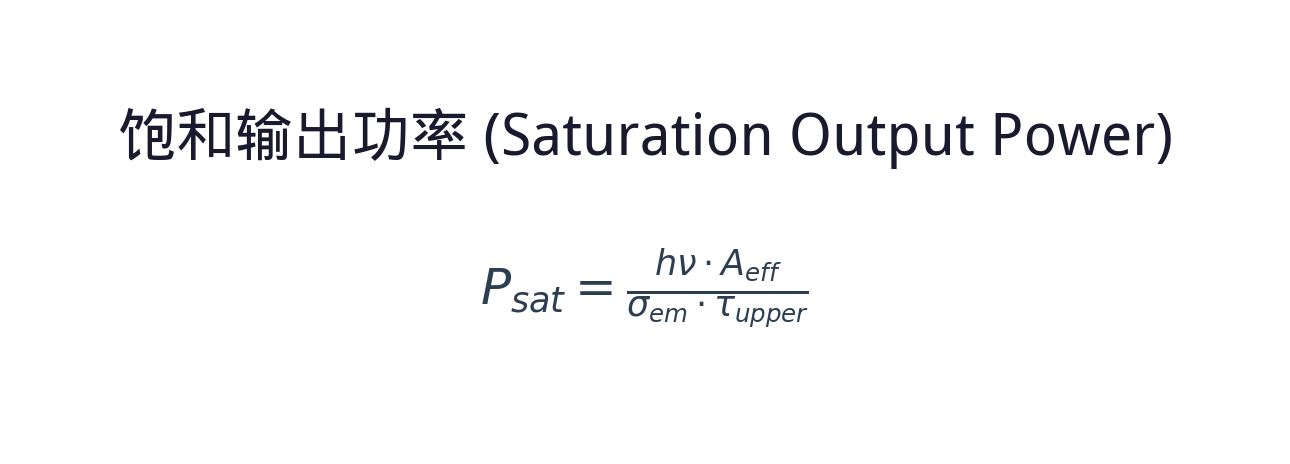
The saturation power Psat is proportional to the photon energy hν and to the effective mode area Aeff, and inversely proportional to the stimulated-emission cross-section σem and the upper-level lifetime τupper.
This explains why a fibre amplifier (long lifetime, small mode area) has a moderate saturation power, while a semiconductor amplifier (short lifetime) saturates at a much lower power.
The dynamic equation of gain saturation can be written as follows (small-gain approximation):
The saturation behaviour differs widely between amplifier types, and the root cause is the upper-level lifetime:
| Amplifier type | Upper-level lifetime | Energy storage | Saturation behaviour |
|---|---|---|---|
| Rare-earth-doped fibre amplifier | Milliseconds | Strong | A large saturation energy, so nanosecond and picosecond pulses hardly deplete the stored energy; for continuous light the limit is the saturated output power |
| Semiconductor optical amplifier (SOA) | Nanoseconds | Weak | The gain follows the data stream bit by bit and both saturates and recovers quickly, producing a pattern effect at high speed |
| Raman / parametric amplifier | None (instantaneous) | None | There is no stored energy to extract; the gain builds and vanishes with the pump, and saturation is set directly by the pump intensity |
◆ An analogy
If an optical transmission system is a marathon relay race, gain saturation is the “refuelling station” along the route — it does not change the direction of the run (the propagation direction of the light), but it tops up the energy of the tired runners (the attenuated optical signal) so that they can finish the course. The quality of the refuelling station (the noise figure and the gain of the amplifier) determines the final result.
In one sentence, the logic of gain saturation is this: the available gain is the pumping rate minus the rate at which the signal consumes the inversion, and the amplifier settles at the saturation point where the two balance. A medium with a long upper-level lifetime refills slowly but stores a great deal; a medium with a short lifetime refills quickly but stores little — and that is the fundamental reason why saturation behaviour differs so much between amplifiers.
These parameters pull against one another: large energy storage implies a long lifetime, and a long lifetime implies slow recovery; fast recovery can follow a high-speed data stream but stores little energy and cannot deliver high peak powers; and a device with a high saturation power usually needs a larger mode area, which costs pump efficiency. Selection is essentially a matter of picking whichever of these conflicting figures matters most for the application at hand.
3. Key parameters: reading the specifications of gain saturation
In practice a few key parameters decide whether a device is suitable. The table below sets out the core specifications of gain saturation and what each one means:
| Parameter | Meaning | Practical significance |
|---|---|---|
| Saturated output power Psat | The output power at which the gain has fallen to half the small-signal value under continuous steady-state operation | The central figure for the power capability of an amplifier and the limit on what a power amplifier can deliver; beyond it the gain enters deep compression |
| Saturation energy Esat | In pulsed operation, the pulse energy that reduces the gain to 1/e (about 37 %) of its initial value | Sets the energy-extraction efficiency of a pulse amplifier and is a key figure in ultrafast amplifier and pulse-system design |
| Gain recovery time | The time needed for the gain to recover to the small-signal value after saturation, usually equal or close to the upper-level lifetime of the gain medium | Sets how fast the amplifier responds to power fluctuations; milliseconds for a fibre amplifier, nanoseconds for an SOA — an enormous difference |
| Saturation depth | How far the gain has fallen from its initial small-signal value, usually in dB; a 3 dB compression means the gain has halved | Reflects the operating state of the amplifier; a power amplifier normally runs in deep saturation (more than 10 dB of compression) for maximum efficiency |
| Small-signal gain | The maximum gain, reached when the input signal is extremely weak and the gain is not yet saturated | The upper limit of the gain, used for weak-signal duties such as preamplification; together with the saturation power it sets the dynamic range |
| Pump efficiency | The small-signal gain produced per unit of pump power (dB/mW), reflecting how efficiently pump energy becomes gain | Affects the power consumption and the cost of the amplifier; the higher the efficiency, the less pump power a given gain requires |
These parameters involve an inherent trade-off: a high-energy-storage medium such as erbium-doped fibre recovers slowly but stores a great deal, while a fast-recovery medium such as a semiconductor responds quickly but stores little. No single figure can therefore be used to judge an amplifier; the noise and the waveform at that power matter just as much.
If some of these parameters are unfamiliar, the Soar Laser product pages carry detailed specifications, and our technical engineers can advise on selection directly.
4. Main types: what kinds of gain saturation are there?
Gain saturation can be classified along several dimensions, each of which offers a different physical picture. Here are three ways: by operating state, by spatial extent and by cause.
By operating state
Steady-state gain saturation
With continuous light or long pulses the gain settles at a stable reduced level
Transient gain saturation
With a short pulse the gain varies dynamically as the pulse passes, falling and then recovering
By spatial extent
Homogeneous saturation
Every particle in the gain medium responds to every wavelength alike, so saturation at one wavelength reduces the gain at all of them. Most laser media are homogeneously broadened.
Inhomogeneous saturation
Different groups of particles respond to different wavelengths, so saturation at one wavelength affects mainly the gain near that wavelength. Certain glass media at low temperature behave this way.
By cause
Signal saturation
Gain saturation caused by the signal light itself
ASE saturation
Amplified spontaneous emission also consumes the inversion and saturates the gain. In a high-gain amplifier ASE can saturate the gain markedly even with no input signal.
Cross-saturation
A signal at one wavelength lowers the gain at another, through gain sharing in a homogeneously broadened medium.
Each type has its own advantages and drawbacks, and there is no absolute “best”, only what “fits”. A high-power continuous-wave application should use an amplifier with a high saturation power, such as an ytterbium-doped fibre amplifier; high-speed optical signal processing needs an SOA with a short recovery time; and pulse-energy extraction depends on the saturation energy and the storage capability. The choice has to follow the signal type (continuous or pulsed) and the power level.
5. Applications: where does gain saturation matter?
In engineering, gain saturation bears on three problems: power amplification, pulse-energy extraction and power equalisation across wavelengths. By main field it divides into the following categories:
- Power amplifier design: a power amplifier normally runs in deep saturation to obtain the highest output power and energy conversion efficiency. The saturated output power is the central figure at selection.
- Ultrashort pulse amplification: in femtosecond and picosecond amplification both the energy extracted and the change in pulse shape are closely tied to gain saturation. Saturation also causes gain narrowing — the centre of the pulse spectrum receives more gain, so the spectrum becomes narrower.
- WDM optical communication systems: in a wavelength division multiplexed system a power change in one channel shifts the gain of the others through cross-saturation, which unbalances the channel powers. The gain equalisation and automatic power control of an EDFA (erbium-doped fibre amplifier) exist precisely to counter this.
- Gain-switched lasers: the dynamics of saturation and recovery are used deliberately, with the pump current modulated to produce pulsed output.
- Optical signal processing: the fast gain saturation of a semiconductor amplifier enables optical switching, wavelength conversion and signal regeneration.
Typical application scenarios
Scenario 1: power amplifier design
A power amplifier normally runs in deep saturation to obtain the highest output power and energy conversion efficiency. The saturated output power is the central figure at selection.
Scenario 2: ultrashort pulse amplification
In femtosecond and picosecond amplification both the energy extracted and the change in pulse shape are closely tied to gain saturation. Saturation also causes gain narrowing — the centre of the pulse spectrum receives more gain, so the spectrum becomes narrower.
Scenario 3: WDM optical communication systems
In a wavelength division multiplexed system a power change in one channel shifts the gain of the others through cross-saturation, which unbalances the channel powers. The gain equalisation and automatic power control of an EDFA exist precisely to counter this.
Scenario 4: gain-switched lasers
The dynamics of saturation and recovery are used deliberately, with the pump current modulated to produce pulsed output. The pulse width is then set by the recovery time of the gain, which is why gain-switched diode lasers readily produce picosecond pulses.
Scenario 5: optical signal processing
The fast gain saturation of a semiconductor amplifier enables optical switching, wavelength conversion and signal regeneration: one beam saturates the gain and thereby imprints its information on another.
◆ Want to see more real application cases involving gain saturation? Visit the application case page of Soar Laser, or contact our technical team directly for professional advice.
6. Common misconceptions
Several fairly widespread but inaccurate beliefs circulate about gain saturation, and they need to be cleared up one by one:
Misconception 1: gain saturation is a fault to be avoided
Saturation is a normal physical phenomenon and is often exactly what is wanted. A power amplifier only reaches its maximum output by running saturated, and an ultrashort pulse amplifier relies on saturation to extract the stored energy efficiently. Only a small-signal amplifier such as a preamplifier needs to stay out of saturation in order to remain linear.
Misconception 2: the saturated output power is the maximum output power of the amplifier
The saturated output power is defined as the output at which the gain has halved; it is not the maximum output. Raising the input further still raises the output, albeit ever more slowly, and in principle the maximum approaches the pump power multiplied by the efficiency. In practice, however, the saturated output power is the figure quoted for an amplifier.
Misconception 3: all amplifiers saturate in much the same way
Saturation behaviour differs enormously between amplifier types. A fibre amplifier has a long upper-level lifetime and can store a great deal of energy, so for nanosecond or picosecond pulses it is effectively a fully stored-energy amplifier; a semiconductor amplifier has a carrier lifetime of only nanoseconds and saturates fast enough on a high-speed signal to produce a pattern effect; and a parametric amplifier stores no energy at all and saturates quite differently.
Misconception 4: only the signal light causes gain saturation
Besides the signal, amplified spontaneous emission also consumes the inversion and saturates the gain. With high gain and a low input, ASE can be strong enough to become the dominant cause of saturation — which is why the gain of some amplifiers does not rise indefinitely even with no input at all.
The misconceptions about gain saturation go well beyond these. Large-mode-area fibre, new gain media and new gain-equalisation schemes keep improving, so earlier rules of thumb may no longer hold. If you have other questions, leave a comment and we will answer them one by one.
◆ Recommended reading
- What Is Gain? How the Amplification Capability of an Optical Amplifier Is Measured
- What Is an EDFA? The Signal Refuelling Station of Fibre Communication
- What Is ASE? Where the Noise Light in an Amplifier Comes From
- What Is a Noise Figure? Why an Amplifier Adds Noise
- What Is an Optical Amplifier? Amplifying a Weak Optical Signal Directly
Leave a Reply