


What Is ASE? Where the Noise Light in an Amplifier Comes From
Amplified spontaneous emission (ASE) is the main source of noise in an optical amplifier: photons emitted spontaneously in the gain medium are amplified continuously by that same medium. ASE both limits the maximum gain of an amplifier and degrades the output signal-to-noise ratio, and it is at the same time the working basis of superluminescent sources. This article covers the principle, the characteristics, the parameters and the applications of ASE.
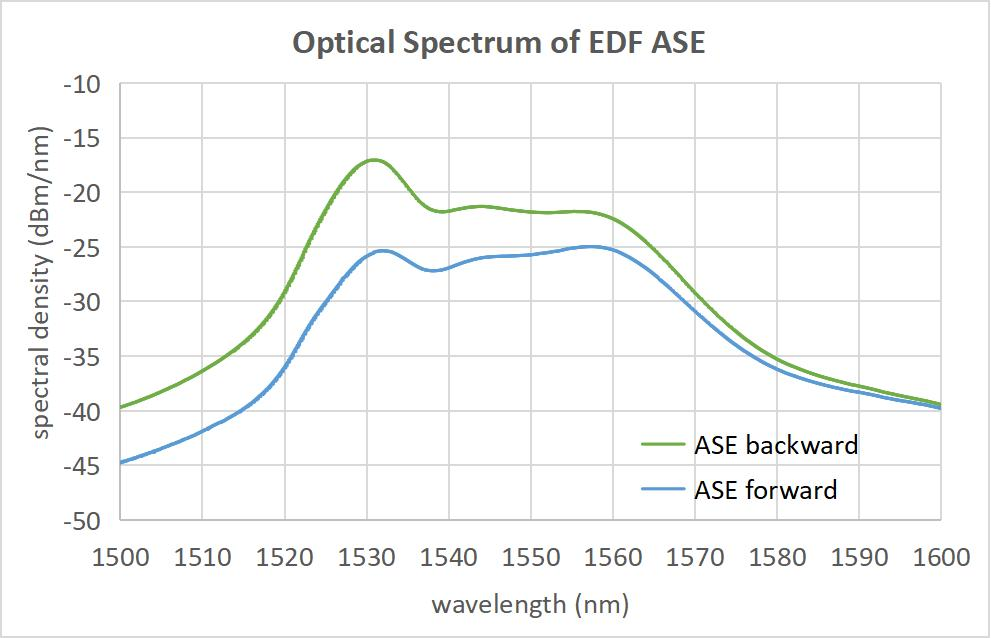
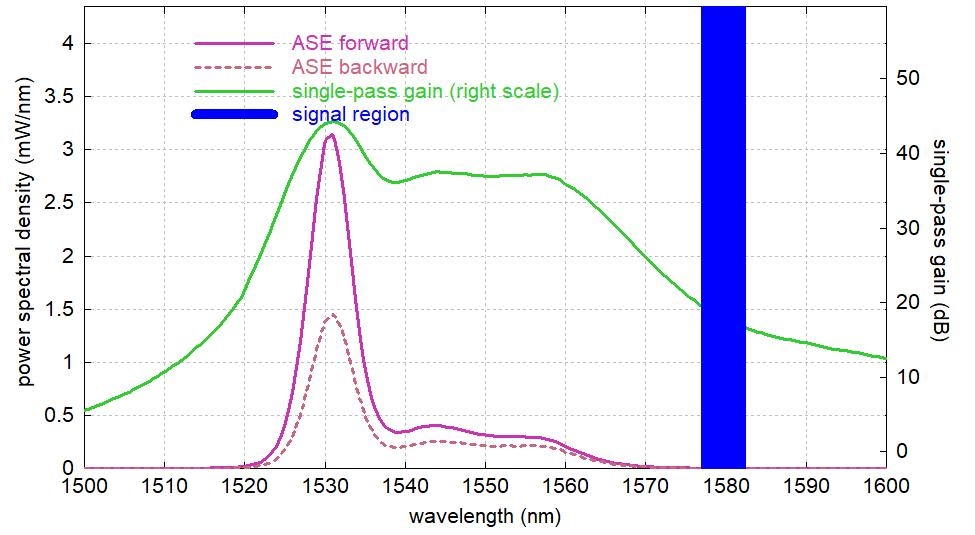
Table of contents
- 1. What is ASE? Getting the core concept straight
- 2. Working principle: how is ASE produced
- 3. Key parameters: reading the specifications of ASE
- 4. Main types: what kinds of ASE are there
- 5. Applications: where is ASE used
- 6. Common misconceptions: points easily confused
1. Core concept: what is ASE?
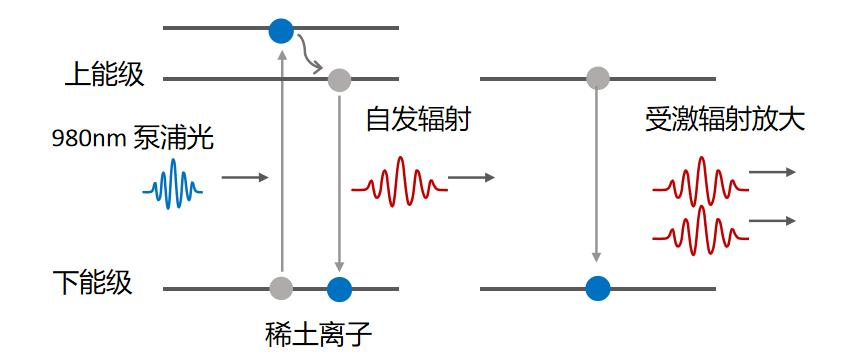
Amplified spontaneous emission (ASE) is a particular kind of light emission in an optical amplifier. In simple terms, the random photons produced by spontaneous emission inside the gain medium are amplified continuously by that same medium as they travel towards the two ends, and the result is an optical output with a certain power and spectral character — that is ASE.
ASE is one of the main sources of noise in an optical amplifier. It is a by-product of the gain itself and at the same time the factor that limits the maximum gain and the performance of the amplifier. Understanding how ASE arises, what it looks like and how it affects a system is essential to designing and using an optical amplifier.
ASE directly sets the noise figure of the amplifier, the optical signal-to-noise ratio of the system and the maximum usable gain; in long-haul communication, laser systems and optical sensing it is often the real bottleneck. Only by understanding where ASE comes from and how it accumulates can figures such as the noise figure be read properly — and can it be understood why a superluminescent source can work on ASE at all.
ASE has one easily overlooked property: it exists independently of the signal. As soon as the amplifier is pumped, ASE appears at the output even with nothing at the input. The noise floor of an amplifier is therefore set by the device rather than by the signal, which is exactly why the noise figure of a preamplifier matters more than its gain.
2. Working principle: how is ASE produced?
ASE arises in two steps, and understanding those two steps accounts for all of it:
1. Spontaneous emission: a particle in an excited state falls spontaneously to a lower level and releases a photon. The process is random — the direction, phase and polarisation of the emitted photon are all random. Spontaneous emission is inherent to every laser and every amplifier.
2. Amplification: if the gain medium provides enough gain, those spontaneously emitted photons that travel along the axis of the medium are amplified by stimulated emission exactly as a signal would be. Because spontaneous emission goes in all directions, only the fraction travelling along the axis (or along the waveguide) is amplified effectively, and it emerges from the two ends of the medium.
ASE has four features worth remembering, and together they explain why it is both a nuisance and a usable source:
- It travels both ways: ASE propagates towards both ends of the amplifier. What emerges from the input is backward ASE and what emerges from the output is forward ASE. The two can differ substantially in strength because the gain is not distributed uniformly along the fibre; backward ASE is normally absorbed by the input isolator, while forward ASE sits directly on top of the signal as noise.
- It is broadband: ASE covers the whole gain bandwidth, and its spectrum essentially reproduces the shape of the gain spectrum, narrowing slightly at high gain because the peak is amplified more. The bandwidth of ASE is therefore never smaller than that of the signal, and out-of-band noise can only be removed by a filter placed after the amplifier.
- It is partly coherent: a broad spectrum means poor temporal coherence, with a coherence length of only micrometres; in a single-mode fibre or waveguide, however, ASE occupies a single spatial mode, so its spatial coherence can approach that of a laser. This combination — incoherent in time, coherent in space — is what allows ASE to be turned into a focusable broadband source.
- It needs no input: ASE requires no input signal at all; as soon as the pump is on and the gain is positive, it appears by itself. Precisely because it is always present, the gain cannot rise indefinitely — the higher the gain, the stronger the ASE, and the more inversion it consumes, until the gain is clamped at an upper limit.
In a fibre amplifier ASE is one layer more complicated: the gain is spread over tens of metres of fibre, ASE is amplified continuously as it travels forward, and part of it is reflected back into the gain region by Rayleigh scattering and amplified again. This distributed feedback lets ASE build up at both ends, and it is one reason a high-gain EDFA can break into parasitic oscillation and why the usable gain is limited to roughly 40–50 dB.
◆ An analogy
Turn up the volume on a public-address amplifier and the background hiss rises with it: even with nobody speaking into the microphone, the speaker emits a rushing sound. ASE is that hiss in an optical amplifier — the higher the gain, the louder it becomes, and once the hiss is as loud as the voice, turning the knob further achieves nothing. The figure that measures how much signal-to-noise ratio is left is the noise figure (NF) of the amplifier.
In one sentence, the logic of ASE is this: spontaneous emission provides the seed and stimulated amplification grows it into a broadband beam. To the signal it is noise, to the system it is a loss — yet raise the gain high enough, add a suitable filter, and the same light becomes a superluminescent source. Harm and use differ only in how it is applied.
These features are interlinked: the higher the gain the stronger the ASE, the broader the spectrum the lower the power density at any one wavelength, and the split between forward and backward ASE changes with the pumping arrangement. Designing a low-noise amplifier is therefore a matter of finding the balance between gain, bandwidth and ASE at which the system still works.
3. Key parameters: reading the specifications of ASE
To judge how much ASE matters in a given system, a few parameters are enough. The table below sets out the core specifications of ASE and what each one means:
| Parameter | Meaning | Practical significance |
|---|---|---|
| ASE power | The total ASE optical power at the amplifier output, including both the forward and the backward direction | ASE power consumes energy from the gain medium and lowers the effective signal gain; at high gain, ASE can even become the dominant output |
| ASE spectrum | The wavelength distribution of ASE, whose shape depends on the gain spectrum and the length of the gain medium and which normally spans the whole gain bandwidth | The ASE spectrum reflects the shape of the gain spectrum indirectly and is an important means of measuring gain; its width directly affects the output signal-to-noise ratio |
| ASE bandwidth | The spectral width of ASE, normally close to the gain bandwidth; at high gain the spectrum can narrow because the peak of the gain is amplified more | Sets the spectral characteristics of a superluminescent source (SLS) and is a core figure in fibre-optic gyroscopes and OCT |
| Temporal coherence | ASE has very poor temporal coherence and a very short coherence length (of the order of micrometres), because it consists of a great many frequency components with random phase | Low temporal coherence makes ASE suitable as a low-coherence source (OCT, fibre-optic gyroscopes), but as noise it degrades the signal quality |
| Spatial coherence | ASE generated in a single-mode fibre or waveguide has high spatial coherence and can be focused to a diffraction-limited spot | Spatial coherence sets how focusable the ASE is; the spatial coherence of single-mode ASE approaches that of a laser, which is an important property of superluminescent sources |
These parameters are interlinked: the higher the gain the greater the ASE power but possibly the narrower the spectrum, and the choice of pumping direction markedly changes the forward/backward asymmetry. Judging the noise behaviour of an amplifier therefore takes more than the single figure of ASE power.
If some of these parameters are unfamiliar, the Soar Laser product pages carry detailed specifications, and our technical engineers can advise on selection directly.
4. Main types: what kinds of ASE are there?
ASE can be classified along several dimensions, each of which corresponds to a different physical and practical view. Here are four ways: by propagation direction, by mode, by generation mechanism and by spectral behaviour.
By propagation direction
Forward ASE
ASE travelling in the same direction as the signal, emerging from the output end
Backward ASE
ASE travelling opposite to the signal, emerging from the input end
Forward/backward asymmetry
The two can differ in power and spectrum because the gain is not distributed uniformly along the fibre; with co-pumping, the backward ASE is often stronger at some wavelengths
By mode
Single-mode ASE
ASE generated in a single-mode fibre or waveguide, with a pure spatial mode and high spatial coherence
Multi-mode ASE
ASE generated in a multimode gain medium, containing several spatial modes and showing poor spatial coherence
By generation mechanism
Spontaneous-emission ASE
Produced by pure spontaneous emission followed by amplification; the most common form
Superluminescence
When the gain is high enough, spontaneous emission is amplified in a single pass to a substantial level and a superluminescent output results. Superluminescent sources (SLS / ASE sources) work on exactly this principle, combining a broad spectrum and low temporal coherence with high spatial coherence. Note that superluminescence differs from superfluorescence, a collective quantum effect of spontaneous emission with a distinct physical mechanism
By spectral behaviour
Broadband ASE
Unfiltered ASE with a very broad spectrum
Narrowband ASE
ASE after an optical filter, with a narrower linewidth
Each type has its own advantages and drawbacks, and there is no absolute “best”, only what “fits”. A superluminescent source for a fibre-optic gyroscope calls for a high-gain, wideband fibre amplifier structure; a low-noise preamplifier calls for an optimised pumping direction and gain level to press the ASE down. Different applications take opposite attitudes to ASE — sometimes exploiting it, sometimes suppressing it.
5. Applications: where is ASE used?
In engineering ASE has two faces: in most situations it must be suppressed, in a few it is exploited. By main field it divides into the following categories:
- Noise analysis of optical amplifiers: ASE is the main source of noise in an optical amplifier and directly affects its noise figure and the optical signal-to-noise ratio (OSNR) of the system. In long-haul optical communication the accumulation of ASE is one of the key limits on transmission distance.
- Superluminescent sources (SLS): the strong ASE of a high-gain fibre amplifier can be turned into a superluminescent source. With a broad spectrum and low temporal coherence, such a source is ideal for fibre-optic gyroscopes (FOG) and optical coherence tomography (OCT).
- Gain measurement: the ASE spectrum reflects the gain distribution of the medium, so measuring it gives the gain spectrum indirectly.
- White-light sources: the ASE of certain ultra-broadband gain media can serve as a broadband or white-light source for spectroscopy and sensing.
- Amplifier performance monitoring: changes in ASE power and spectrum reflect the state of the amplifier — pump power drift, ageing of the gain medium — and can be used for online monitoring.
Typical application scenarios
Scenario 1: noise analysis of optical amplifiers
ASE is the main source of noise in an optical amplifier and directly affects its noise figure and the OSNR of the system. In long-haul optical communication the accumulation of ASE is one of the key limits on transmission distance.
Scenario 2: superluminescent sources (SLS)
The strong ASE of a high-gain fibre amplifier can be turned into a superluminescent source. With a broad spectrum and low temporal coherence, such a source is ideal for fibre-optic gyroscopes and OCT.
Scenario 3: gain measurement
The ASE spectrum reflects the gain distribution of the medium, so measuring it gives the gain spectrum indirectly — a convenient way of characterising a fibre or an amplifier without a tunable source.
Scenario 4: white-light sources
The ASE of certain ultra-broadband gain media can serve as a broadband or white-light source for spectroscopy and sensing, where a smooth, ripple-free spectrum matters more than power.
Scenario 5: amplifier performance monitoring
Changes in ASE power and spectrum reflect the state of the amplifier — pump power drift, ageing of the gain medium — and can be used for online monitoring without interrupting traffic.
◆ Want to see more real application cases involving ASE? Visit the application case page of Soar Laser, or contact our technical team directly for professional advice.
6. Common misconceptions
Several fairly widespread but inaccurate beliefs circulate about ASE, and they need to be cleared up one by one:
Misconception 1: ASE is noise and therefore useless
ASE is the main source of amplifier noise, but it has real applications of its own. A superluminescent source works on ASE and is widely used in fibre-optic gyroscopes, optical coherence tomography and fibre sensing, where a broad spectrum and low temporal coherence are precisely the advantage.
Misconception 2: ASE appears only when there is an input signal
ASE needs no input signal: as long as the gain medium is pumped and the gain is positive, spontaneous emission is amplified into ASE. Even with nothing at the input, ASE appears at the output. In fact, ASE is the visible signature that the amplifier has gain at all.
Misconception 3: forward ASE and backward ASE are the same
Because the inversion is not distributed uniformly — the gain differs at the two ends and in the middle — forward and backward ASE can differ markedly in power and spectrum. In a co-pumped fibre amplifier, for instance, the backward ASE can be stronger at some wavelengths, because the far end (the signal output) has low gain and seeds the backward ASE while amplifying it only weakly.
Misconception 4: ASE has such poor spatial coherence that it cannot be focused
The temporal coherence of ASE is indeed poor because its spectrum is broad, but its spatial coherence need not be. ASE generated in a single-mode fibre propagates in a single spatial mode and is highly spatially coherent, so it can be focused like a laser to a diffraction-limited spot. Temporal and spatial coherence must not be confused.
The misconceptions about ASE go well beyond these. New gain fibres, filtering schemes and pump arrangements keep appearing, so earlier rules of thumb may no longer hold. If you have other questions, leave a comment and we will answer them one by one.
◆ Recommended reading
- What Is a Noise Figure? Why an Amplifier Adds Noise
- What Is an EDFA? The Signal Refuelling Station of Fibre Communication
- What Is Gain? How the Amplification Capability of an Optical Amplifier Is Measured
- What Is Gain Saturation? Why an Amplifier Cannot Amplify Indefinitely
- What Is an Optical Amplifier? Amplifying a Weak Optical Signal Directly
Leave a Reply