


What Is Second-Harmonic Generation (SHG)? How Infrared Laser Light Turns Green
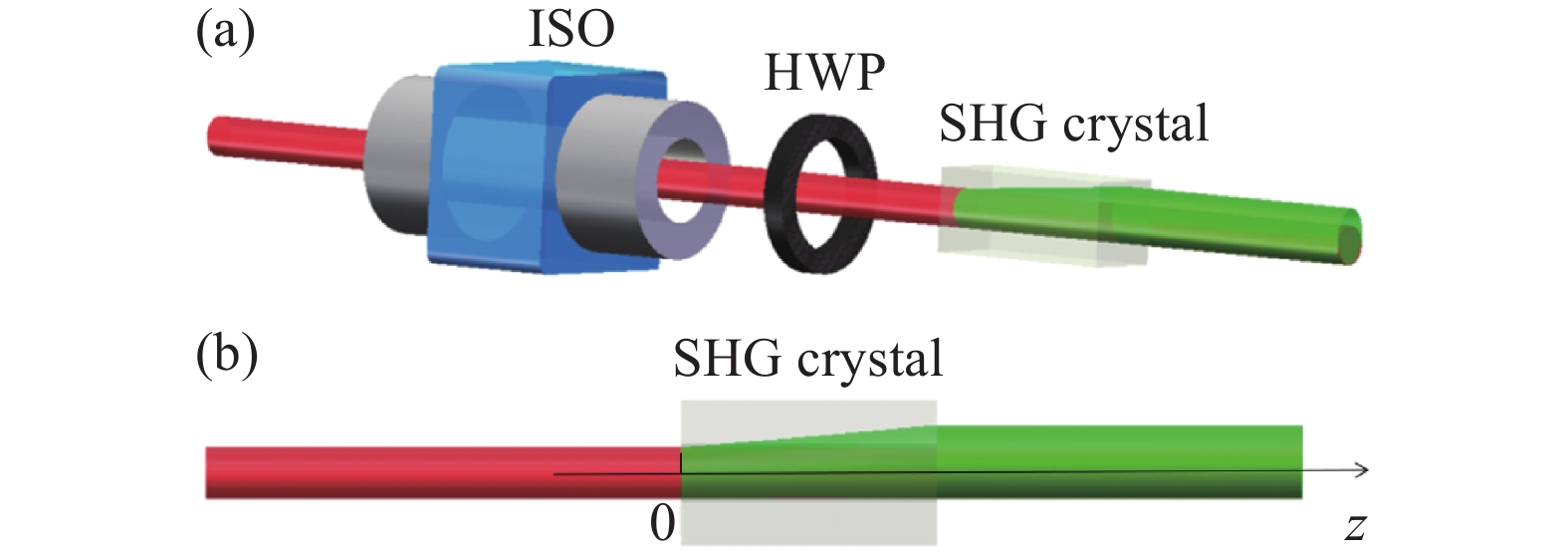
Second-harmonic generation (SHG, commonly called frequency doubling) is the most practical of the second-order nonlinear effects: 1064 nm infrared enters a nonlinear crystal and 532 nm green comes out. Energy conservation is satisfied automatically; what caps the efficiency is phase matching. This article covers the mechanism, seven key parameters, three ways of classifying the devices and six application areas.
Contents
- 1. What Is Second-Harmonic Generation? The Core Concept
- 2. How It Works: What Makes SHG Possible
- 3. Key Parameters: Reading an SHG Device Specification
- 4. Main Types: Which Kinds of SHG Set-up Exist
- 5. Applications: Where SHG Is Actually Used
- 6. Common Misconceptions: Four Widely Held Myths
1. The Core Concept: What Is Second-Harmonic Generation?
Second-harmonic generation (SHG), usually called frequency doubling in everyday use, is one of the most common and most practical nonlinear optical effects. Pump light at frequency ω passes through a nonlinear crystal and a second harmonic at 2ω emerges — the wavelength is exactly halved. A 1064 nm infrared laser becomes 532 nm green after the doubling crystal, which is how a green laser works.
Doubling is a second-order nonlinear (χ⁽²⁾) effect and can only occur in crystals that lack inversion symmetry. The usual doubling crystals are KTP (potassium titanyl phosphate), LBO (lithium triborate), BBO (beta barium borate) and LiNbO₃ (lithium niobate). Given the right phase-matching conditions, these crystals convert fundamental light to the harmonic efficiently. To date the most mature route from infrared to visible and ultraviolet is still doubling plus sum-frequency generation, and the green and UV light used in industrial processing, medicine, research and displays comes almost entirely from this step.
2. How It Works: What Makes SHG Possible
The clearest view is through nonlinear polarisation. When a second-order crystal is driven by a field at ω, its polarisation carries not only the linear component at the driving frequency but also a component at 2ω. That 2ω-oscillating polarisation wave acts as a built-in radiator, and the wave it emits is the second harmonic.
In photon language, two fundamental photons merge into one photon of twice the energy. Two conservation conditions have to hold at once, and they are far from equally difficult.
Energy conservation: two ω photons carry exactly the energy of one 2ω photon, 2ℏω = ℏ(2ω). This holds automatically and needs no design at all.
Momentum conservation (phase matching): photon momentum in the crystal is proportional to the wave vector k, so 2k₁ = k₂ is required. The trouble is dispersion: the refractive index changes with wavelength, and in general k₂ ≠ 2k₁. Once the match is lost, harmonics generated at different points along the crystal fall out of step, and after a certain distance they begin to interfere destructively — which is why having a nonlinear coefficient and having conversion efficiency are two different things.
There are two families of remedy. Birefringent phase matching exploits the birefringence of the crystal so that fundamental and harmonic travel on different polarisations whose refractive indices satisfy the condition; if the two fundamental photons share a polarisation it is type I matching, if their polarisations are perpendicular it is type II. Quasi-phase matching (QPM) does not remove the mismatch at all: it flips the domain orientation of the crystal once every coherence length (as in periodically poled lithium niobate, PPLN), so the phase error turns around just as it would begin to cancel, and the contribution keeps accumulating across the whole crystal.
◆ An analogy
Doubling is like two people pushing a revolving door together: the door speeds up only when both push at the same point in its rotation; if one is half a step early and the other half a step late, the two pushes cancel. The longer the crystal, the tighter that “at the same time” requirement becomes — which is exactly why femtosecond doubling needs a very thin crystal: the two pulses drift apart as they travel.
3. Key Parameters: Reading an SHG Device Specification
An SHG device has fewer parameters than a laser, but every one maps onto efficiency, beam quality or damage risk. These seven have to be confirmed before anything else:
| Parameter | What it means | Why it matters |
|---|---|---|
| Conversion efficiency | The ratio of harmonic output power to fundamental input power, and the core figure of merit for a doubler. Single-pass efficiency typically runs from a few per cent to a few tens of per cent; intracavity or resonant doubling goes higher. | Sets output power and overall system efficiency directly. Intracavity doubling can exceed 50% while single-pass external cavity doubling is usually 10%–30%; low efficiency means the fundamental is largely wasted and a bigger pump laser is needed. |
| Effective nonlinear coefficient d_eff | The nonlinear strength the crystal actually delivers under a given phase-matching condition, in pm/V. The larger d_eff, the higher the efficiency. KTP gives about 3–4 pm/V and LiNbO₃ about 15 pm/V when d₃₃ is used. | Sets the real strength and efficiency of the conversion. d_eff already folds the intrinsic coefficient together with the geometric factor of the phase-matching configuration, so at equal conditions a larger d_eff means higher efficiency. |
| Phase-matching temperature or angle | The crystal temperature or incidence angle at which phase matching is achieved; every crystal and wavelength combination has its own condition. | It is the precondition for efficient operation. Drift in temperature or angle drops the efficiency sharply, which is what sets the temperature stability and alignment tolerance the system must hold. |
| Phase-matching bandwidth | The wavelength or temperature range over which efficiency stays high around the optimum. It is inversely proportional to crystal length — a longer crystal gives a narrower band. | Sets how forgiving the device is about wavelength, temperature and angle. A wide band is more stable and easier to align, and is a prerequisite for ultrashort pulses and tuneable lasers. |
| Walk-off angle | Under critical phase matching, birefringence makes the Poynting vector of the extraordinary wave diverge from its wave vector by the walk-off angle, which limits the effective interaction length. | Bears directly on effective length, efficiency and beam quality. Severe walk-off separates the beams in space and distorts the spot, so high-power designs should prefer a matching scheme with little walk-off. |
| Damage threshold | The maximum intensity the crystal can take, usually quoted in J/cm² or GW/cm² for pulses and W/cm² for continuous light. High-power work calls for a high-threshold crystal such as LBO. | Sets the maximum operating power and the service life. Exceeding the threshold causes irreversible damage, so for high power the crystal shortlist is ordered by threshold first and efficiency second. |
| Group-velocity mismatch | For ultrashort pulses the fundamental and the harmonic travel at different group velocities, so the two pulses drift apart in time and the effective interaction length is cut short. | It is the main reason femtosecond doubling is inefficient. The larger the group-velocity difference, the sooner the pulses separate, the shorter the effective length and the lower the efficiency — which is where thin and chirped crystals earn their place. |
4. Main Types: Which Kinds of SHG Set-up Exist
There are three axes: optical layout, which sets the efficiency ceiling; phase-matching method, which sets tuning and walk-off; and pump type, which sets pulsed against continuous. Real devices cross all three.
By optical layout
- Single-pass doubling: the pump passes through the nonlinear crystal once. The simplest arrangement, with comparatively low efficiency, suited to high-peak-power pulsed lasers.
- Intracavity doubling: the nonlinear crystal sits inside the laser resonator and exploits the high circulating power there. This is the usual approach for continuous-wave green lasers: high efficiency, but cavity design and thermal management are more demanding.
- Resonant doubling (external-cavity enhancement): the crystal sits in a separate external cavity whose resonance builds the circulating fundamental power by a factor of tens before doubling. Suited to low-power continuous pumping, and in principle it can approach 100% conversion.
By phase-matching method
- Critical phase matching (angle matching): matching is reached by rotating the crystal. Simple and easy to tune, but walk-off is present and the alignment is angle-sensitive.
- Non-critical phase matching (temperature matching): the beam travels along the principal axis and matching is reached by changing temperature. There is no walk-off, so a long crystal can be used for high efficiency, at the cost of working only at specific wavelength and temperature combinations and needing precise temperature control.
- Quasi-phase matching (QPM): the domain structure is periodically inverted to compensate the mismatch. This can use the crystal’s largest nonlinear coefficient and allows flexible wavelength design, but poling is difficult and the period tolerance is tight.
By pump type
- Pulsed doubling: the high peak power of a pulsed laser drives efficient conversion; this is the most common arrangement, and nanosecond pulses suit it particularly well.
- Continuous-wave doubling: the power density of continuous light is low, single-pass efficiency is limited, and intracavity or external-cavity enhancement is normally needed to reach a useful figure.
5. Applications: Where SHG Is Actually Used
The six directions below cover almost all practical use. The first two make new wavelengths; the other four put green and ultraviolet light to work.
- Visible lasers: the textbook case is the green laser. A 1064 nm Nd:YAG or Nd:YVO₄ laser doubled gives 532 nm, widely used in laser displays, stage lighting, aiming and research. Blue is usually obtained by doubling a 9xx nm diode laser, or by sum-frequency mixing 1064 nm with 13xx nm.
- Ultraviolet sources: produced by doubling plus multistage conversion. Doubling 532 nm green again gives 266 nm deep ultraviolet, while 355 nm comes from third-harmonic generation of 1064 nm (doubling followed by sum-frequency mixing), used for marking, micromachining and lithography. The short wavelength and small focal spot are an advantage precision machining cannot do without.
- Laser displays and entertainment: red, green and blue can all be obtained by nonlinear frequency conversion, which is one of the core technologies behind laser television, laser projection and stage lighting.
- Scientific research: spectroscopy, quantum optics and nonlinear microscopy often need a specific wavelength for which no direct gain medium exists; doubling combined with sum- and difference-frequency generation fills the gap flexibly.
- Medical applications: 532 nm green light matters in ophthalmology (retinal photocoagulation) and dermatology (vascular lesions); ultraviolet is used for corneal ablation and similar procedures, replacing part of what excimer lasers used to do.
- Lidar and sensing: wavelengths needed for particular measurements can be reached by doubling, for atmospheric sounding, environmental monitoring and differential absorption measurement.
6. Common Misconceptions
Most selection mistakes with doublers come from treating one figure as the whole story. These four are the ones we are asked about most:
Misconception 1: the higher the conversion efficiency the better, and the more advanced the device
Efficiency has to be judged inside the system. Chasing high conversion usually means a longer crystal and tighter phase-matching conditions, and what comes with that may be poorer beam quality, greater temperature sensitivity and higher cost. Real design balances efficiency, beam quality, stability and cost rather than pushing one number to its maximum.
Misconception 2: with a good enough crystal, any wavelength can be doubled efficiently
Whether efficient doubling is possible depends first on whether that crystal can phase match at the target wavelength. Every crystal has a range it can match; outside that range no nonlinear coefficient, however large, will buy efficiency. The first step in choosing a crystal is the phase-matching curve, not a d_eff league table.
Misconception 3: the harmonic has the same polarisation as the fundamental
Not necessarily; it depends on the matching type. In type I matching the harmonic is polarised perpendicular to the fundamental; in type II the two fundamental photons are perpendicular to each other and the harmonic is polarised parallel to one of them. The exact relation follows from the crystal and the matching scheme, and it is not something to assume when specifying polarisation optics downstream.
Misconception 4: femtosecond pulses have higher peak power, so they must double more efficiently than nanosecond pulses
Not necessarily. The peak power is indeed high, but the spectrum is broad and group-velocity mismatch is severe, so the fundamental and harmonic pulses separate quickly inside the crystal and the effective interaction length collapses to tens of micrometres. That forces a very thin crystal, and efficiency can end up below that of a long pulse. A nanosecond pulse has lower peak power but can use a crystal millimetres long or more, and its overall efficiency is not necessarily worse.
Leave a Reply