


What Is Self-Phase Modulation (SPM)? How Light Shifts Its Own Frequency
Self-phase modulation (SPM) is the optical Kerr effect seen along the time axis: an intense pulse is uneven in intensity over time, so the refractive index of the medium becomes uneven in time too, and the pulse ends up imposing a time-varying phase on itself. Once the phase varies, the instantaneous frequency varies with it — red-shifted at the leading edge, blue-shifted at the trailing edge — and the spectrum is pushed wider. It barely touches the temporal shape of the pulse, yet can widen the spectrum several-fold or more, which makes it the first step in pulse compression and supercontinuum generation and an unavoidable factor in high-power narrow-linewidth systems.
Contents
- 1. What Is Self-Phase Modulation? The Core Concept
- 2. How It Works: How a Pulse Modulates Its Own Phase
- 3. Key Parameters: Reading an SPM Specification
- 4. Main Types: Which Kinds of SPM Exist
- 5. Applications: Where SPM Is Actually Used
- 6. Common Misconceptions: Four Widely Held Myths
1. The Core Concept: What Is Self-Phase Modulation?
Self-phase modulation (SPM) is the optical Kerr effect expressed along the time axis: as an intense pulse propagates through a medium, its own intensity varies with time, the refractive index varies with it, and the pulse’s phase is modulated by the pulse itself. Put another way — different parts of the pulse (peak and wings) see different refractive indices, accumulate different phase delays, and the pulse acquires a phase that varies in time.
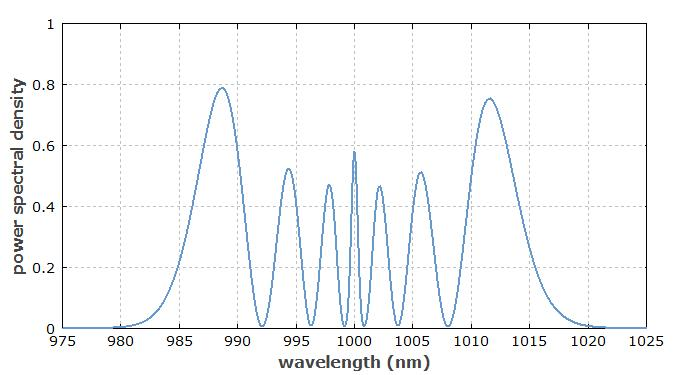
SPM is one of the most important and most fundamental nonlinear effects in optical fibre. Its most direct consequence is spectral broadening: a phase that varies in time means an instantaneous frequency that varies in time (in other words, chirp), and the spectrum is pushed wider. When dispersion is weak, an SPM-dominated spectrum also grows a characteristic oscillatory structure — those light and dark fringes are not noise but interference between the leading and trailing edges of the pulse at particular frequencies.
The interplay of SPM and dispersion is the core of fibre nonlinear optics. Which of the two dominates, and whether they push in the same direction, decides whether a pulse broadens, compresses or holds its shape — soliton formation, pulse compression and supercontinuum generation all grow out of that one balance.
2. How It Works: How a Pulse Modulates Its Own Phase
The physical origin: the refractive index follows the intensity
The root of SPM is the optical Kerr effect: the refractive index varies with intensity, Δn = n₂I, where n₂ is the nonlinear refractive index and I the intensity. The phase delay is φ = (2π/λ)·n·L, so if the refractive index varies in time the phase delay varies in time — that is the whole meaning of “modulating itself”.
For a Gaussian pulse the intensity peaks in the middle and falls off at the edges, so the nonlinear phase delay also peaks in the middle and falls off at the edges, tracing an inverted bell.
Where the chirp comes from: the time derivative of phase is a frequency shift
The instantaneous frequency shift is minus the time derivative of the phase, δω = −dφ/dt. Applied to a Gaussian pulse, this gives three regimes:
- Leading edge: the intensity rises with time, dI/dt > 0, so dφ/dt > 0 and δω < 0 — the frequency drops, shifting towards longer wavelengths (red shift).
- Trailing edge: the intensity falls with time, dI/dt < 0, so dφ/dt < 0 and δω > 0 — the frequency rises, shifting towards shorter wavelengths (blue shift).
- Middle of the pulse: the intensity varies almost linearly, so the chirp is almost linear too — a positive chirp, frequency rising with time.
An initially unchirped pulse therefore leaves SPM with an approximately linear positive chirp: lower frequencies in the first half, higher in the second. Because the two edges behave differently, the broadened spectrum is usually asymmetric — relatively steep on the red side, where the maximum red shift is bounded, and showing oscillatory structure on the blue side.
How far it broadens: watch the peak nonlinear phase shift
The amount of broadening is set by the peak nonlinear phase shift φ_max. As a rule of thumb the spectrum begins to broaden noticeably at about 1 radian and shows clear oscillatory structure beyond π. Since φ_max = γ·P₀·L_eff, with γ the fibre nonlinear coefficient (about 1.3 /(W·km) for standard single-mode fibre) and P₀ the peak power, a standard single-mode fibre (mode area about 80 μm²) needs roughly 2.4 kW of peak power to accumulate π radians in one metre. Continuous light will never get there; a femtosecond pulse gets there easily. That is why SPM is always discussed alongside ultrashort pulses.
Sharing the stage with dispersion: three outcomes
- Normal dispersion (wavelength shorter than the zero-dispersion wavelength): dispersion also imposes a positive chirp, adding to the SPM chirp, and the pulse broadens rapidly. Most visible and 1 μm band fibre transmission falls in this case.
- Anomalous dispersion (wavelength longer than the zero-dispersion wavelength): dispersion imposes a negative chirp which cancels the SPM chirp; when the two balance, an optical soliton forms and both shape and spectrum survive propagation unchanged.
- Near-zero dispersion: SPM dominates alone, the temporal shape hardly changes, and the spectrum is pushed wide with oscillatory structure — the starting point of a supercontinuum.
One line to remember SPM: φ_max = γ·P₀·L_eff. γ is set by the fibre (about 1.3 /(W·km) for standard single-mode), P₀ is the peak power and L_eff the effective length. The spectrum starts to broaden at about 1 rad and shows fringes beyond π; and remember that SPM moves phase and spectrum but hardly touches the temporal shape — broadening in time is dispersion’s work.
3. Key Parameters: Reading an SPM Specification
There are not many parameters in SPM, but every one of them goes straight into the formula. These six are the ones to quantify when designing or evaluating:
| Parameter | Meaning | Why it matters |
|---|---|---|
| Nonlinear coefficient γ | The core parameter for SPM strength in a fibre, γ = 2πn₂/(λA_eff), in rad/(W·m): the nonlinear phase shift per unit power per unit length. | The central composite parameter of fibre nonlinear design. The larger γ, the greater the phase shift at the same power and length and the more readily SPM, Raman scattering and the rest occur; highly nonlinear fibre raises γ deliberately. |
| Peak nonlinear phase shift φ_max | The maximum nonlinear phase delay at the pulse peak, φ_max = γP₀L_eff, the most direct measure of SPM strength. | It decides how wide the spectrum can go. Broadening starts at about 1 rad and fringes appear beyond π; supercontinuum and pulse-compression designs are built around this number. |
| Nonlinear length L_NL | Defined as L_NL = 1/(γP₀): the length over which the peak nonlinear phase shift reaches 1 radian, the characteristic scale of nonlinear significance. | It is the test for whether nonlinearity matters at all: significant when the actual length far exceeds L_NL, negligible when far shorter. Its ratio to the dispersion length L_D decides whether SPM or dispersion dominates the pulse. |
| Spectral broadening factor | The ratio of the pulse spectral width after SPM to the initial width, expressing how much broadening has occurred. | The most intuitive measure of the SPM result. A larger factor means a broader output spectrum, which is welcome for supercontinua and a damage mechanism to be suppressed in narrow-linewidth delivery and coherent combining. |
| Chirp magnitude | The frequency chirp SPM imposes on the pulse, usually quoted as the range of instantaneous frequency, of the same order as φ_max. | It sets how much the pulse can be compressed: more chirp means shorter pulses are reachable with negative dispersion, but excessive higher-order chirp leaves the compressed pulse with pedestals and poorer quality. |
| Effective mode area A_eff | The cross-sectional area of the mode in the fibre, which directly sets the intensity and hence the strength of SPM. A smaller mode means stronger SPM. | It governs the power density in the fibre and therefore the nonlinear threshold. A larger A_eff means lower power density, weaker nonlinearity and more power that can be carried — the one lever large-mode-area fibre uses to suppress nonlinearity. |
4. Main Types: Which Kinds of SPM Exist
SPM has only one mechanism, but what it looks like varies a great deal with conditions. There are three threads: its relationship to dispersion, the medium it happens in, and what it is used for.
By relationship to dispersion
- Pure SPM (no or weak dispersion): when dispersion is weak or the pulse very short, SPM dominates. The temporal shape changes little, the spectrum broadens markedly and the characteristic oscillatory structure appears.
- SPM with normal dispersion: both impose a positive chirp, and the pulse broadens faster than either alone would make it. This covers most fibre transmission at wavelengths below 1.3 μm.
- SPM with anomalous dispersion: positive and negative chirps balance and an optical soliton can form. This is the physical basis of soliton transmission and soliton mode locking.
By medium
- SPM in optical fibre: the most common and most important case. Long interaction length plus small mode area means SPM is very pronounced even though n₂ in silica is tiny.
- SPM in bulk media: in bulk glass or crystals, SPM usually needs very high intensity to become observable; it shows up mainly in the gain media and windows of high-power lasers.
- SPM in waveguides: on integrated platforms such as silicon, silicon nitride and highly nonlinear fibre, SPM underpins on-chip frequency combs and supercontinua.
By purpose
- For pulse compression: SPM imposes a positive chirp which a negative-dispersion element then cancels, yielding a shorter pulse.
- For supercontinuum generation: working with dispersion, Raman scattering and four-wave mixing to push the spectrum beyond an octave.
- As a limiting effect: in optical communications and high-power lasers the spectral broadening and pulse distortion from SPM are unwelcome and have to be suppressed.
5. Applications: Where SPM Is Actually Used
All six areas come down to one question: do you want the bandwidth it provides, or do you need to get away from the distortion it brings?
- Nonlinear pulse compression: one of the most important applications. An unchirped pulse passes through a length of fibre (or another nonlinear medium), SPM imposes an approximately linear positive chirp, and a negative-dispersion element (grating pair, grism pair, chirped mirrors) then cancels it, leaving the pulse shorter. The route takes picoseconds down to femtoseconds and femtoseconds down to few-cycle. It is one of the main ways of producing ultrashort pulses.
- Supercontinuum generation: as an intense femtosecond pulse propagates in photonic-crystal or highly nonlinear fibre, SPM acts together with Raman scattering, soliton effects and four-wave mixing to broaden the spectrum by more than an octave into “white light”. Supercontinua serve optical frequency combs, WDM sources, optical coherence tomography (OCT), spectroscopy and fluorescence microscopy. SPM is the first and central mechanism in that chain.
- Soliton transmission and soliton lasers: in anomalous-dispersion fibre the balance between SPM and dispersion forms an optical soliton — a pulse that holds its shape. Solitons once mattered greatly in long-haul communications (soliton transmission), and in passively mode-locked fibre lasers they are the core mechanism for producing ultrashort pulses.
- All-optical signal processing: the intensity-to-phase conversion of SPM supports all-optical switching, logic gates, wavelength conversion and pulse reshaping. Put the phase change inside an interferometer and it becomes an amplitude change, with speed limited only by the nonlinear response — down to femtoseconds.
- Pulse characterisation: SPM also measures pulses. SPM-based autocorrelation gives pulse duration, and techniques such as spectral phase interferometry (SPIDER) and frequency-resolved optical gating (FROG) rely on the same kind of nonlinear effect to move phase information onto a spectrum.
- A limiting effect in high-power laser systems: in high-power fibre amplifiers and laser delivery systems the spectral broadening and pulse distortion from SPM have to be accounted for. For narrow-linewidth lasers, coherent combining, and applications needing a strict temporal waveform, SPM must be controlled or suppressed — usual measures are a larger mode area, a shorter fibre, or chirped-pulse amplification.
6. Common Misconceptions: Four Widely Held Myths
SPM carries the word “modulation” in its name, and most of the misunderstandings start there.
Misconception 1: Self-phase modulation means a pulse modulating its own amplitude
SPM modulates phase, not amplitude. What it changes directly is the phase of the pulse (a change in refractive index changing the phase delay), while the amplitude — the temporal shape — is essentially unchanged without dispersion. What changes is the spectrum and the instantaneous frequency; the phase change shows up as spectral broadening through the Fourier transform. Hearing “modulation” and assuming amplitude is the commonest source of this mistake.
Misconception 2: SPM broadens the pulse in time
Pure SPM (no dispersion) hardly changes the temporal shape at all; it moves the spectrum and the phase. Broadening in time is normally caused by dispersion. Admittedly the chirp from SPM makes a pulse broaden faster in any dispersive medium downstream, but that is the two acting together, not SPM on its own. This point is practically useful: to broaden the spectrum without touching the waveform, push the dispersion to near zero.
Misconception 3: The wider the spectrum SPM produces, the shorter the pulse
Not necessarily. The Fourier relation between spectral width and pulse duration only holds for a transform-limited (unchirped) pulse. SPM widens the spectrum and adds chirp at the same time, so the pulse need not shorten — it may stay the same duration and merely carry chirp. Getting a shorter pulse requires dispersion compensation after the SPM to remove that chirp; that is exactly the principle of pulse compression, and the reason the word “compression” cannot be dropped.
Misconception 4: SPM only happens in optical fibre
SPM is a general consequence of the optical Kerr effect and occurs in any transparent medium with Kerr nonlinearity. Fibre simply makes it pronounced because the mode is small and the distance long, which is why it is discussed mostly in a fibre context. In bulk media (laser crystals, glass) and in waveguides (silicon, silicon nitride) SPM appears just as readily once the intensity is high enough. In the gain medium of a high-power laser, self-focusing (the spatial Kerr effect) and SPM often have to be considered together — one spoils the beam, the other spoils the spectrum.
Leave a Reply