


What Is Stimulated Brillouin Scattering (SBS)? When Sound Waves and Light Waves Interact
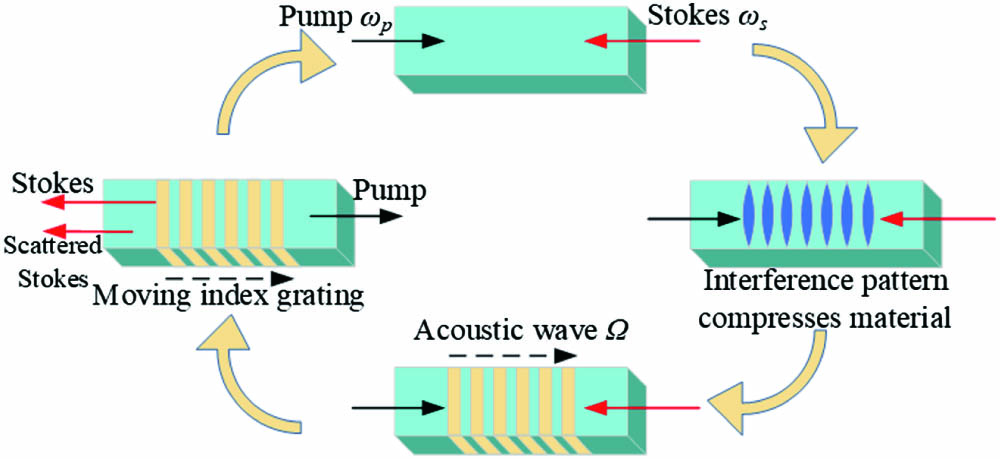
Stimulated Brillouin scattering (SBS) is the process in which an intense beam writes an acoustic wave into a medium by electrostriction, and that wave becomes a moving refractive-index grating which reflects the light back. The returning Stokes wave is slightly lower in frequency and travels the opposite way, with a shift of only about 11 GHz in silica fibre — three orders of magnitude below Raman. Small shift, narrow bandwidth and low threshold together make SBS both the hardest power ceiling for narrow-linewidth fibre lasers and the physical basis of narrow-linewidth lasers, distributed sensing and phase conjugation.
Contents
- 1. What Is Stimulated Brillouin Scattering? The Core Concept
- 2. How It Works: How Light Writes the Acoustic Wave
- 3. Key Parameters: Reading an SBS Specification
- 4. Main Types: How SBS Differs Between Media
- 5. Applications: Where SBS Is Actually Used
- 6. Common Misconceptions: Four Widely Held Myths
1. The Core Concept: What Is Stimulated Brillouin Scattering?
Stimulated Brillouin scattering (SBS) is a third-order nonlinear optical effect: as an intense beam propagates through a medium, electrostriction launches an acoustic wave (acoustic phonons), and that wave in turn scatters the incident light into a backward-propagating Stokes wave. Put plainly, the intense beam bounces part of its energy back, and the light that comes back is slightly lower in frequency.
Brillouin and Raman scattering are both inelastic and both involve the interaction of photons with phonons, but the phonons are of different kinds: Raman involves optical phonons (internal molecular vibration, high frequency), Brillouin involves acoustic phonons (elastic sound waves of the medium as a whole, low frequency). That single difference accounts for the whole distance between them in shift, gain bandwidth and propagation direction.
SBS has three distinctive features: the scattered light travels mainly in the opposite direction to the pump (backscattering); the shift is very small, about 10–11 GHz in silica fibre; and the gain bandwidth is very narrow, only tens of MHz. Together these make it an extremely low-threshold effect in fibre — with narrow-linewidth, long-pulse or continuous light, once the input power passes the threshold a large fraction is scattered backwards, which both drops the forward efficiency and can damage components at the front end of the laser.
2. How It Works: How Light Writes the Acoustic Wave
The key to understanding SBS is seeing that the acoustic wave is not pre-existing: the light creates it. The process can be described classically or quantum mechanically, and the two accounts describe the same thing.
The classical picture: light writes a moving grating
As an intense beam propagates, its electric field drives a periodic modulation of density through electrostriction — where the light is strong the medium is compressed and the density rises, where it is weak the density falls. That periodic density distribution is an acoustic wave, travelling at the speed of sound v_s.
A change in density changes the refractive index (the acousto-optic effect), so a refractive-index grating moving at the speed of sound is formed. The incident light is scattered by this grating, and because the grating is moving, the scattered light acquires a Doppler shift. For backscattering the shift is ν_B = 2n·v_s/λ, where n is the refractive index and λ the vacuum wavelength — with n ≈ 1.45 and v_s ≈ 5960 m/s in silica, at 1550 nm this gives about 11 GHz, matching measurement.
The quantum picture: one photon becomes a Stokes photon plus a phonon
A pump photon is annihilated and a lower-frequency Stokes photon plus an acoustic phonon are created. Energy conservation gives ℏω_p = ℏω_s + ℏΩ_B (Ω_B being the Brillouin shift) and momentum conservation k_p = k_s + K, where K is the phonon wavevector. In backscattering k_p and k_s point in opposite directions with similar magnitude, so K ≈ 2k_p — the phonon carries away roughly twice the photon momentum. This also explains why forward Brillouin scattering is so weak: going forward there is almost no momentum to transfer, so the phonon has no part to play.
Positive feedback: why it becomes “stimulated”
Spontaneous Brillouin scattering is always present, just very weak. Once the pump is strong enough, the backward Stokes wave interferes with the pump, the interference fringes reinforce the density modulation, the acoustic wave grows, the scattering grows with it, and the stronger scattering writes a stronger acoustic wave. This is positive feedback: past threshold the backward Stokes power rises steeply and clamps the pump power near a ceiling, with everything above it converted into backward light.
Three numbers to remember SBS: a shift of about 11 GHz (silica fibre at 1550 nm), a gain bandwidth of about 20–30 MHz and a phonon lifetime of about 10 ns. The small shift means it sits too close to the pump to filter out; the narrow bandwidth means only light with a linewidth well below it can drive the process efficiently; and the 10 ns lifetime means a pulse shorter than that never gives the acoustic wave time to build — which is why ultrashort pulses slip past the SBS limit.
3. Key Parameters: Reading an SBS Specification
The parameters of SBS have one thing in common: almost all of them are set by the phonon. How long it lives and how fast it travels determine the shift, the bandwidth and the threshold. These six are the ones to quantify when designing or evaluating:
| Parameter | Meaning | Why it matters |
|---|---|---|
| Brillouin shift ν_B | The frequency offset of the Stokes wave from the pump, set jointly by the speed of sound and the refractive index, ν_B = 2n·v_s/λ. About 10–11 GHz near 1550 nm in standard single-mode fibre. | It decides where the Stokes wave lands — only about 0.09 nm from the pump, so no ordinary filter can separate it. Different materials and dopants give different shifts, and this is part of what lets distributed sensing separate temperature from strain. |
| Brillouin gain coefficient g_B | The Brillouin gain per unit pump intensity, in m/W. About 5×10⁻¹¹ m/W for silica fibre, more than two orders of magnitude above the Raman gain coefficient. | A high gain coefficient means it starts oscillating first at the same power and length — which is the root reason the SBS threshold sits far below the SRS threshold, and why the power limit of a narrow-linewidth system is usually set by SBS rather than SRS. |
| Brillouin gain bandwidth Δν_B | The full width at half maximum of the gain spectrum, set by the phonon lifetime, approximately Δν_B ≈ 1/(πτ_B). About 20–50 MHz in silica fibre, three orders of magnitude narrower than the Raman gain bandwidth. | An extremely narrow bandwidth means it can only amplify light whose linewidth is far below 20 MHz, so it cannot directly amplify broadband signals or short pulses. Conversely, that narrowness is exactly what makes SBS the ideal vehicle for ultra-narrow filtering and slow-light effects. |
| SBS threshold power | The minimum pump power at which SBS becomes significant, proportional to the effective mode area and inversely proportional to the gain coefficient and the fibre length. For continuous narrow-linewidth light in single-mode fibre, typically milliwatts to a few watts depending on length. | It is one of the hardest power ceilings in fibre transmission. The lower the threshold the more readily it starts: to suppress it you change the fibre, the linewidth or add a stress gradient; to exploit it you build extremely low-threshold lasers and sensors. |
| Phonon lifetime τ_B | The decay time of the acoustic phonon, about 10 ns in silica fibre, which directly sets the gain bandwidth: the longer the lifetime, the narrower the bandwidth. | It is the yardstick for whether a pulse will excite SBS. When the pulse is far shorter than 10 ns the acoustic wave never builds before the pulse has gone, so the threshold rises sharply and may become negligible; when far longer, the continuous-wave threshold applies. |
| SBS gain efficiency | g_B/A_eff, in W⁻¹·m⁻¹, folding material properties and waveguide geometry into one number: the Brillouin gain per unit pump power per unit length. | The composite measure of SBS strength: the higher the efficiency, the greater the gain at a given pump and the lower the threshold. Large-mode-area fibre suppresses this number by enlarging A_eff, and thereby raises the power ceiling. |
4. Main Types: How SBS Differs Between Media
Strictly speaking there are no separate “device types” of SBS — it is one effect wearing different faces in different media. The differences fall in two places: the shift is set by the speed of sound, the gain by material and waveguide together. Those are the two numbers to compare when choosing.
By gain medium
- Silica fibre: the usual case. Shift of 10–11 GHz at 1550 nm, gain coefficient about 5×10⁻¹¹ m/W, phonon lifetime about 10 ns, gain bandwidth 20–50 MHz. Almost every SBS problem met in fibre communications and fibre lasers is this one.
- Large-mode-area fibre: the material is unchanged; A_eff is made large so the gain efficiency drops and the SBS threshold rises. This is the standard approach in high-power narrow-linewidth fibre amplifiers, and a textbook case of trading geometry for power.
- Highly nonlinear and photonic-crystal fibre: A_eff squeezed to 1–2 μm² raises the gain efficiency by an order of magnitude and drops the threshold to the milliwatt level. Suited to low-threshold Brillouin lasers, slow-light experiments and high-sensitivity sensing.
- Chalcogenide and fluoride fibre: low sound speed and high refractive index give a Brillouin shift of only a few GHz, while the gain coefficient is more than an order of magnitude above silica. Used for mid-infrared Brillouin lasers and sensing, and for studying on-chip SBS.
- Silicon waveguides and chip platforms: confining the field in a sub-micron waveguide makes A_eff tiny and delivers useful Brillouin gain over centimetres. This is the basis of integrated Brillouin lasers and microwave photonic filters, and the most active direction in SBS research over the past decade.
By gain-spectrum shape
- Single-peak gain spectrum: ordinary single-mode fibre works on a single acoustic mode, so the gain is one narrow peak of 20–30 MHz. Most efficient for amplifying narrow-linewidth light, and also the easiest to drive into oscillation.
- Multi-peak gain spectrum: multi-acoustic-mode fibre (some large-mode-area and non-circular-core designs) shows several gain peaks spaced a few hundred MHz apart, widening the effective bandwidth. This is one route to suppressing SBS without giving up mode area.
5. Applications: Where SBS Is Actually Used
The six areas fall into two groups: power systems that must suppress SBS, and devices and sensors that put it to work. There is one criterion — do you need the narrowband gain it offers, or do you need to get out of its way?
- The power limit of high-power narrow-linewidth fibre lasers: the aspect most often discussed. In high-power single-frequency fibre lasers and narrow-linewidth amplifiers, SBS is usually the first nonlinear effect to reach threshold and it caps the output directly. Beyond threshold large amounts of power are reflected back, which can destabilise the system or damage it. Suppression measures include enlarging the mode area, applying a temperature or strain gradient to broaden the gain, phase modulation to widen the linewidth, and special fibre designs.
- Distributed fibre sensing: exploiting the sensitivity of the Brillouin shift to temperature and strain allows point-by-point measurement along a fibre. The standard techniques are Brillouin optical time-domain reflectometry (BOTDR) and Brillouin optical time-domain analysis (BOTDA). One system can cover tens or even hundreds of kilometres, serving power cable monitoring, pipeline monitoring and structural health monitoring of dams and bridges — here the “drawback”, a shift that drifts with temperature and strain, is precisely the measurement principle.
- Brillouin lasers: put SBS gain inside a fibre ring cavity and you have a Brillouin laser. The output linewidth is extremely narrow (kHz and below), which makes it one of the important routes to ultra-narrow-linewidth sources, used in coherent communications, microwave photonics and high-precision sensing.
- Brillouin amplifiers: use SBS gain to amplify a weak signal. The bandwidth is only tens of MHz, so generality is limited, but it has distinct value in narrowband signal amplification, optical filtering and microwave photonic links.
- Optical phase conjugation and pulse shaping: the backward Stokes wave from SBS is phase-conjugate — its wavefront is the conjugate of the incident one, in effect a mirror that plays light backwards. That property is used to correct aberrations, compensate phase distortion and compress pulses; in high-power laser systems SBS phase-conjugate mirrors are used to improve beam quality.
- Slow light and optical buffering: near an SBS gain or absorption peak the refractive index varies sharply and the group velocity is markedly slowed, giving “slow light”. This has potential value in optical signal processing and buffering, and it is a fundamental testbed for studying light–sound interaction.
6. Common Misconceptions: Four Widely Held Myths
The SBS threshold is low enough to invite misjudgement, and the misunderstandings cluster around treating its conditions as constants.
Misconception 1: SBS and stimulated Raman scattering are much the same, both scattering effects
Both are inelastic scattering, but the differences are of order-of-magnitude scale. Shift: about 11 GHz for Brillouin, about 13 THz for Raman, three orders of magnitude apart. Bandwidth: 20–50 MHz for Brillouin, tens of THz for Raman, again three orders of magnitude. Direction: Brillouin is almost purely backward, Raman works both ways. Threshold: for narrow linewidths Brillouin sits far below Raman and is the first nonlinear effect to appear in fibre. The engineering responses are therefore completely different — Raman gain can be accumulated over long fibre, whereas Brillouin has to be dodged by widening the linewidth or enlarging the mode area.
Misconception 2: The SBS threshold is a fixed value
The threshold is not a constant but a function of several conditions: a longer fibre lowers it, a larger effective mode area raises it, a wider pump linewidth raises it, and non-uniform temperature or strain along the fibre also raises it. For pulsed light, if the pulse is far shorter than the phonon lifetime (about 10 ns) the acoustic wave never establishes and the threshold rises sharply, sometimes to the point of being negligible. So quoting an SBS threshold without also giving length, mode area, linewidth and pulse duration produces a number with no meaning.
Misconception 3: Brillouin scattering in fibre is always harmful
It depends on the application. In high-power laser delivery and long-haul communications SBS genuinely has to be suppressed; in fibre sensing, Brillouin lasers, slow light and phase conjugation it is the core mechanism. Like most nonlinear effects, SBS is neither good nor bad in itself — what matters is which side of the system you put it on.
Misconception 4: SBS only produces backward light and has no effect on forward transmission
The backward Stokes wave is only the visible symptom. In energy terms its power comes out of the forward pump, so the forward power necessarily falls — this is pump depletion. More importantly, at system level the strong backward wave travels back to the laser and causes mode instability and frequency drift, and in the worst case destroys the seed source or the pre-amplifier. That is one reason high-power fibre systems need an isolator at the output, and one reason SBS cannot be assessed from output power alone.
Leave a Reply