


What Is Laser Communication? How Light Is Used to Carry Information
Laser communication is an important concept in laser technology, widely used in industrial manufacturing, scientific research and healthcare. This article systematically introduces the core concepts, working principles, key parameters, main types and typical applications of laser communication, helping readers build a complete knowledge framework.
Table of Contents
- 1. What Is Laser Communication? Understanding the Core Concepts
- 2. Working Principle: How Is Laser Communication Achieved?
- 3. Key Parameters: Understanding the Performance Indicators of Laser Communication
- 4. Main Types: What Kinds of Laser Communication Exist?
- 5. Applications: Where Is Laser Communication Used?
- 6. Common Misconceptions: Pitfalls to Avoid
1. Core Concepts: What Is Laser Communication?
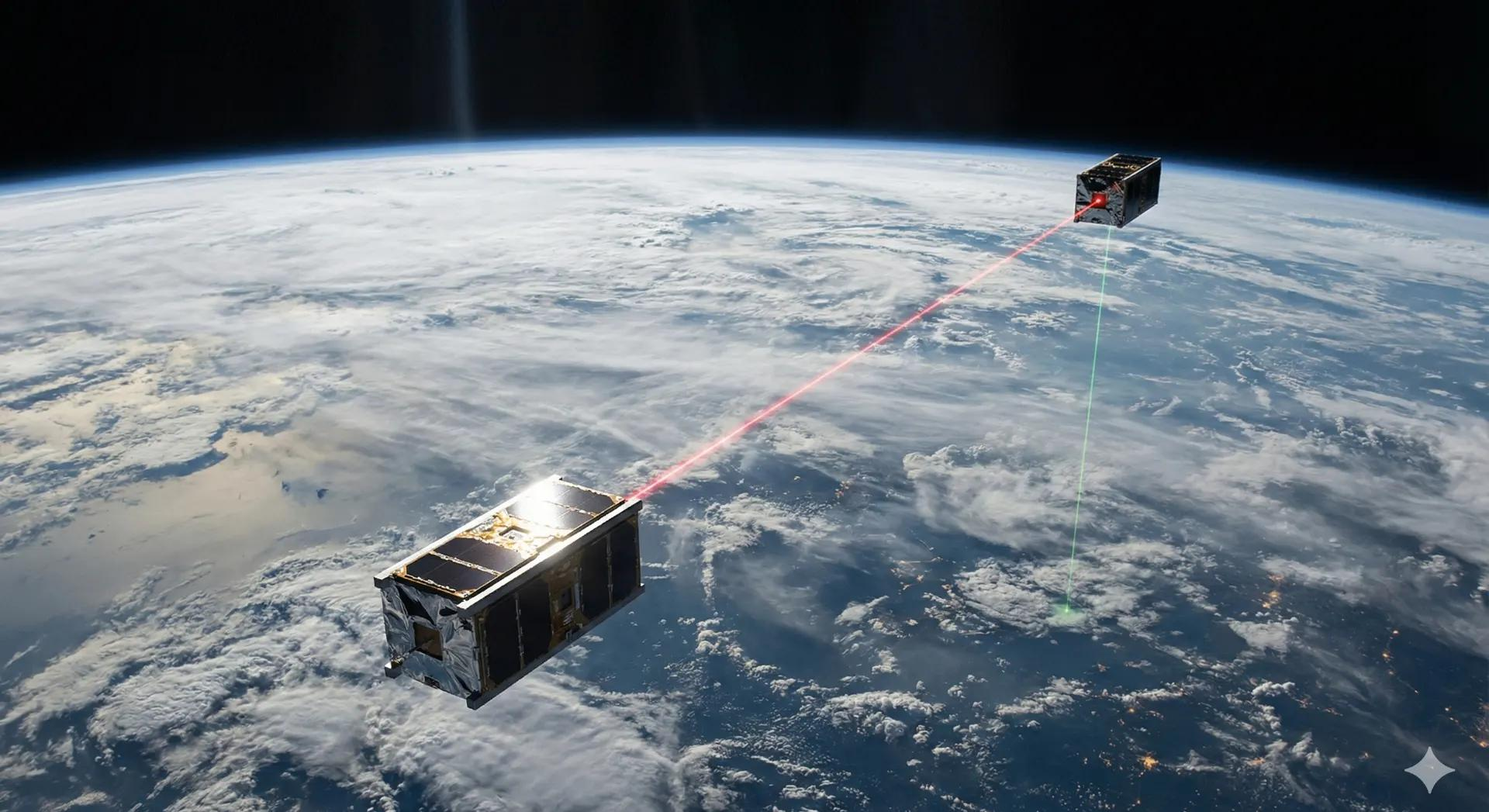
Laser communication, formally called Free-Space Optical Communications (FSO), also called optical wireless communication, refers to a communication method that transmits optical signals directly through air or vacuum without relying on optical fibre or other optical waveguides. It usually uses a laser as the light source, exploiting the highly directional nature of the laser beam to establish a point-to-point high-speed data link between the transmitting and receiving ends. Compared with traditional microwave communication, laser communication has advantages such as enormous bandwidth, extremely strong directionality, good anti-interference capability and no need for spectrum licensing, making it especially suitable for space communication and certain special terrestrial scenarios.
2. Working Principle: How Is Laser Communication Achieved?
The basic principle of free-space optical communication is: the transmitting end modulates an electrical signal onto the laser beam, collimates the beam through an optical telescope and sends it out; the beam travels some distance in free space (air or vacuum), is collected by the telescope at the receiving end, and then a photodetector converts the optical signal back into an electrical signal. Because the wavelength of light is far shorter than that of microwaves, the divergence angle of a laser beam can be made extremely small, meaning the antenna gain is very high—a 25 cm diameter optical telescope can have a gain exceeding 100 dB, far surpassing a microwave antenna of the same size. This means a very small transmit power can achieve long communication distances and high data rates. Of course, extremely high directionality also means the alignment between the two ends must be very precise, usually requiring an automatic tracking and pointing system.
💡 An analogy
Laser communication is like sending Morse code with a flashlight—except this flashlight is a laser, switching billions of times per second, with an extremely narrow beam and very strong directionality, so it is nearly impossible for others to eavesdrop; its secrecy and bandwidth far exceed radio communication.
In summary, laser communication involves the intersection of optics, materials science and precision manufacturing. Mastering its basic principles and key parameters is the foundation for properly selecting and using related products.
3. Key Parameters: Understanding the Performance Indicators of Laser Communication
Understanding laser communication requires mastering the following key parameters, which directly determine product performance and application scenarios:
| Parameter Name | Meaning | Why It Matters |
|---|---|---|
| Communication Distance | From a few hundred metres between buildings to millions of kilometres between planets. | Directly affects laser performance and the choice of application scenarios |
| Data Rate | A single link can reach several Gbps or more, far greater than traditional microwave links. | Directly affects laser performance and the choice of application scenarios |
| Transmit Power | Usually at the watt level for space communication, and much lower for short terrestrial links. | Directly affects laser performance and the choice of application scenarios |
| Beam Divergence Angle | Determines the far-field spot size and power density; the smaller the divergence, the higher the distance efficiency, but the harder the alignment. | Affects the received optical power and alignment difficulty; a smaller divergence concentrates energy but makes alignment harder |
| Receiver Sensitivity | The minimum optical power the detector can correctly demodulate, directly affecting the link budget. | Directly affects laser performance and the choice of application scenarios |
| Telescope Aperture | The size of the optical antenna at both ends; the larger it is, the higher the gain. | Directly affects laser performance and the choice of application scenarios |
The above parameters are interrelated and mutually constrained. In actual selection, a comprehensive trade-off among performance, cost, reliability and other aspects is needed according to specific application requirements.
For more product parameters or selection advice, please contact the Soar Laser technical team.
4. Main Types: What Kinds of Laser Communication Exist?
Laser communication can be classified in many ways, and different dimensions help us understand its characteristics from different angles. The following introduces the common classification methods one by one:
By Application Scenario
Space Optical Communication
Including inter-satellite links, space-to-ground links and deep-space communication; transmission in vacuum is unaffected by weather, making it the field where laser communication has the greatest advantage.
Terrestrial Free-Space Optical Communication
The ‘last mile’ connection between buildings, as a supplement or backup to optical fibre.
Short-Range Optical Wireless Communication
Indoor visible-light communication, short-range high-speed interconnection between devices and so on.
By Modulation Method
Intensity Modulation / Direct Detection (IM/DD)
The most common method, encoding information by changing the laser intensity, with the receiver directly detecting the light intensity.
Coherent Optical Communication
Uses a local oscillator light mixed with the signal light, giving higher sensitivity and enabling multidimensional modulation using phase, polarisation and so on.
By System Architecture
FSO/RF Hybrid System
Combines laser communication with radio-frequency communication: laser for high-speed transmission in good weather, automatically switching to RF backup in bad weather.
Precision Alignment System with Tracking
Used in long-distance, high-precision space communication scenarios.
Different types of laser communication have their own characteristics and suitable scenarios. Actual selection requires comprehensive consideration of specific application needs, performance requirements and budget constraints. If in doubt, you can contact the Soar Laser technical team for professional selection advice.
5. Applications: Where Is Laser Communication Used?
Laser communication has a very wide range of applications, covering industrial manufacturing, scientific research, healthcare, communications and information, and many other fields. The following introduces several main aspects:
- The applications of free-space optical communication are expanding rapidly. In aerospace, it is the preferred technology for high-speed inter-satellite links in satellite internet constellations, and Europe, the United States and China have all successfully demonstrated inter-satellite laser communication
- in deep-space exploration, laser communication can greatly increase the rate at which planetary probes return data to Earth, far surpassing traditional radio-frequency communication. On the ground, FSO is often used for high-speed interconnection between campuses, parks and city buildings, especially where laying fibre is inconvenient. It is also used for temporary communication deployment (such as emergency disaster relief and large events) and security-isolation scenarios (such as physically isolated links between military command centres). In addition, visible-light communication has unique applications in special fields such as indoor positioning and underwater communication.
Typical Application Scenarios in Detail
Scenario 1: Optical Fibre Communication
the core backbone of modern communication networks; the transmission capacity of a single fibre has reached the terabit-per-second level, supporting the massive data traffic of the internet and data centres.
Scenario 2: Space Laser Communication
laser communication between satellites and between satellites and the ground offers higher bandwidth, stronger secrecy and better anti-interference capability than microwave communication.
Scenario 3: Underwater Optical Communication
using blue-green lasers for underwater communication has unique advantages in submarine communication and underwater robotics, complementing traditional underwater acoustic communication.
Scenario 4: Short-Range High-Speed Interconnection
optical interconnection between servers and between chips in data centres replaces electrical signals with lasers, solving bandwidth bottlenecks and power-consumption problems.
6. Common Misconceptions
Many people have somewhat plausible but mistaken notions about laser communication. See whether you fall into any of the following misconceptions:
Misconception 1: Laser communication can completely replace optical fibre communication.
in fact, terrestrial FSO is greatly affected by atmospheric attenuation (fog, rain, snow) and is far less reliable than optical fibre; it is more a supplement than a replacement, suitable for scenarios where fibre cannot be laid or rapid deployment is needed
Misconception 2: Laser communication is always faster than optical fibre.
the single-wavelength rate of optical fibre communication has reached hundreds of gigabits per second and can be expanded to tens of terabits through wavelength-division multiplexing; fibre still has an absolute advantage in total capacity
Misconception 3: Laser communication is ‘absolutely secure’ and cannot be eavesdropped.
although the laser beam is narrow and hard to intercept, it is not completely immune to eavesdropping—partially tapping the beam in the optical path can obtain the signal; it is simply much harder than radio-frequency communication
Misconception 4: Laser communication is the same as optical fibre communication.
optical fibre communication is a type of laser communication, but laser communication also includes free-space laser communication (atmospheric laser communication, inter-satellite laser communication, etc.). Optical fibre communication sends light through fibre, while free-space laser communication transmits the laser beam directly in air or vacuum without a physical medium, suitable for inter-satellite communication, emergency communication and other scenarios.
The above are several common misconceptions about laser communication. In practical applications, comprehensive judgment is needed based on specific product parameters and use conditions. If in doubt, it is recommended to consult a professional technician.
Leave a Reply