


What Is Lidar? How the Eye of Autonomous Driving Works
Lidar is an important concept in laser technology, widely used in industrial manufacturing, scientific research and healthcare. This article systematically introduces the core concepts, working principles, key parameters, main types and typical applications of lidar, helping readers build a complete knowledge framework.
Table of Contents
- 1. What Is Lidar? Understanding the Core Concepts
- 2. Working Principle: How Is Lidar Achieved?
- 3. Key Parameters: Understanding the Performance Indicators of Lidar
- 4. Main Types: What Kinds of Lidar Exist?
- 5. Applications: Where Is Lidar Used?
- 6. Common Misconceptions: Pitfalls to Avoid
1. Core Concepts: What Is Lidar?
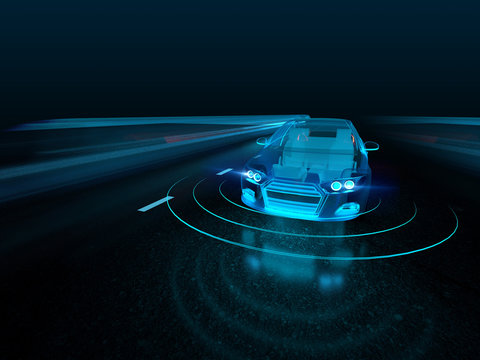
Lidar (Light Detection and Ranging, early on also called laser radar) is a technology that uses laser beams for active remote-sensing detection, obtaining information such as distance, speed and material composition by measuring the returned signal after the laser interacts with a target. Its basic working principle is similar to radar, but it uses light waves rather than radio waves. Because the wavelength of light is far shorter than that of microwaves, lidar can achieve higher angular and distance resolution and generate very fine three-dimensional point-cloud images. In recent years, with the development of autonomous-driving technology, lidar has become a core sensor attracting much attention.
2. Working Principle: How Is Lidar Achieved?
The core mechanism of lidar is the time-of-flight method: emit a short laser pulse at a target, measure the time from emission until it is reflected or scattered back, and calculate the target’s distance from the speed of light. By scanning the laser beam in two dimensions, the three-dimensional depth information of the whole scene (the point cloud) can be obtained. Besides direct time-of-flight, there is also coherent-detection lidar: mixing the weak returned optical signal with a local oscillator’s light (heterodyne detection), which not only measures distance but also precisely measures the target’s radial velocity through the Doppler shift. There is also differential absorption lidar (DIAL), which measures the concentration of specific gases in the atmosphere by tuning the laser wavelength to the ‘on’ and ‘off’ states of a gas absorption line.
💡 An analogy
Lidar is like giving a robot 3D eyes—it continuously emits laser pulses around it, measures the return time of each point, calculates the distance, then scans the whole space, finally generating a precise three-dimensional point-cloud map so the machine can see every detail of the world around it.
In summary, lidar involves the intersection of optics, materials science and precision manufacturing. Mastering its basic principles and key parameters is the foundation for properly selecting and using related products.
3. Key Parameters: Understanding the Performance Indicators of Lidar
Understanding lidar requires mastering the following key parameters, which directly determine product performance and application scenarios:
| Parameter Name | Meaning | Why It Matters |
|---|---|---|
| Laser Wavelength | Common ones include 532 nm, 905 nm, 1064 nm and 1550 nm; the choice balances atmospheric transmittance, detector performance and eye safety. | Directly affects laser performance and the choice of application scenarios |
| Measurement Distance | From a few metres at close range to hundreds of kilometres for atmospheric detection; automotive lidar is usually tens to 200 metres. | Directly affects laser performance and the choice of application scenarios |
| Distance Resolution / Accuracy | Depends on pulse width and timing accuracy, usually at the centimetre level or better. | Directly affects laser performance and the choice of application scenarios |
| Angular Resolution | Determines the density of the point cloud and the ability to resolve detail; related to beam divergence and the scanning mechanism. | Directly affects laser performance and the choice of application scenarios |
| Scan Frequency / Frame Rate | The number of complete scans per unit time; usually 10–20 Hz in autonomous driving. | That is, the frame rate, affecting the ability to track dynamic targets; autonomous driving usually requires above 10–20 Hz |
| Field of View | The angular range of detection in the horizontal and vertical directions. | Directly affects laser performance and the choice of application scenarios |
The above parameters are interrelated and mutually constrained. In actual selection, a comprehensive trade-off among performance, cost, reliability and other aspects is needed according to specific application requirements.
For more product parameters or selection advice, please contact the Soar Laser technical team.
4. Main Types: What Kinds of Lidar Exist?
Lidar can be classified in many ways, and different dimensions help us understand its characteristics from different angles. The following introduces the common classification methods one by one:
By Detection Principle
Direct-Detection (ToF) Lidar
Directly measures the pulse time of flight; simple in structure and currently the most mainstream technical route.
Coherent-Detection Lidar
Uses optical heterodyne detection, with higher sensitivity and the ability to measure speed simultaneously, mostly used in meteorology and surveying.
FMCW (Frequency-Modulated Continuous-Wave) Lidar
Emits a laser with continuously modulated frequency, obtaining distance and velocity from the beat frequency, with strong anti-interference capability.
By Scanning Method
Mechanical Rotating Lidar
A motor rotates the whole transmit-receive system; the most mature technology, but large in size and high in cost.
MEMS-Mirror Lidar
Uses a micro-electromechanical mirror to scan; small in size and low in cost, the current mainstream development direction.
Optical Phased-Array (OPA) Lidar
Pure solid state, deflecting the beam by controlling the phase difference of each emitting element, considered the ultimate technical route.
Flash Lidar
Illuminates the whole field of view in a single flash, received by an area-array detector, with no moving parts.
Different types of lidar have their own characteristics and suitable scenarios. Actual selection requires comprehensive consideration of specific application needs, performance requirements and budget constraints. If in doubt, you can contact the Soar Laser technical team for professional selection advice.
5. Applications: Where Is Lidar Used?
Lidar has a very wide range of applications, covering industrial manufacturing, scientific research, healthcare, communications and information, and many other fields. The following introduces several main aspects:
- Lidar has a very broad range of applications. In autonomous driving, it provides vehicles with high-precision 3D environmental perception and is one of the key sensors for Level 3 and above autonomous driving
- in surveying and geographic information, airborne and terrestrial lidar are used for topographic mapping, urban 3D modeling and forestry resource surveys
- in atmospheric and environmental monitoring, lidar measures aerosol distribution, cloud height, wind-speed profiles and greenhouse-gas concentrations
- in robotics and industrial automation, lidar is used for AGV navigation, safety obstacle avoidance and 3D dimensional inspection
- in archaeology and cultural heritage, airborne lidar can penetrate vegetation to discover hidden ancient sites. In addition, it is used in port logistics, rail transit, security monitoring and many other fields.
Typical Application Scenarios in Detail
Scenario 1: Autonomous Driving
one of the core sensors of autonomous vehicles, precisely perceiving the surrounding 3D environment, identifying pedestrians, vehicles and obstacles to achieve safe autonomous navigation.
Scenario 2: Surveying and Geographic Information
airborne and terrestrial lidar are used for topographic mapping, urban 3D modeling, forestry surveys and so on, rapidly acquiring high-precision point-cloud data.
Scenario 3: Robotics and AGVs
service robots, industrial AGVs and logistics robots use lidar for environmental perception, autonomous navigation and obstacle avoidance.
Scenario 4: Security and Surveillance
for perimeter security, people counting and trajectory tracking, lidar is unaffected by lighting and can work continuously 24 hours a day.
6. Common Misconceptions
Many people have somewhat plausible but mistaken notions about lidar. See whether you fall into any of the following misconceptions:
Misconception 1: Lidar is the ‘only correct answer’ for autonomous driving.
in fact, pure-vision solutions are also developing rapidly; lidar has high accuracy but is costly and greatly affected by rain, snow and fog; each technical route has its pros and cons, and multi-sensor fusion is the general trend
Misconception 2: The farther lidar sees, the better.
for autonomous driving, it is not only about distance but also comprehensive indicators such as point-cloud density, angular resolution, anti-interference capability and reliability; blindly pursuing long range has no practical significance
Misconception 3: Solid-state lidar means ‘no moving parts at all.’
many so-called ‘semi-solid-state’ or ‘hybrid solid-state’ lidars still contain micro-moving parts such as MEMS mirrors inside; truly completely static pure solid state (such as OPA) is still far from mature
Misconception 4: Lidar is just an advanced rangefinder.
lidar does more than measure distance; it obtains 3D point-cloud data of the environment through rapid scanning, equivalent to taking a three-dimensional photo of the surroundings. A rangefinder measures only one point, while lidar can acquire the distance of hundreds of thousands of points at once, building a complete 3D environmental model—the core technological foundation of autonomous driving and robot navigation.
The above are several common misconceptions about lidar. In practical applications, comprehensive judgment is needed based on specific product parameters and use conditions. If in doubt, it is recommended to consult a professional technician.
Leave a Reply