


What Are Laser Warning Signs? Do You Recognize These Labels?
What Are Laser Warning Signs? Do You Recognize These Labels? – this article systematically introduces the core concepts, working principles, key parameters, main types, application scenarios and common misconceptions of laser warning signs, helping you fully understand this important topic in laser safety.
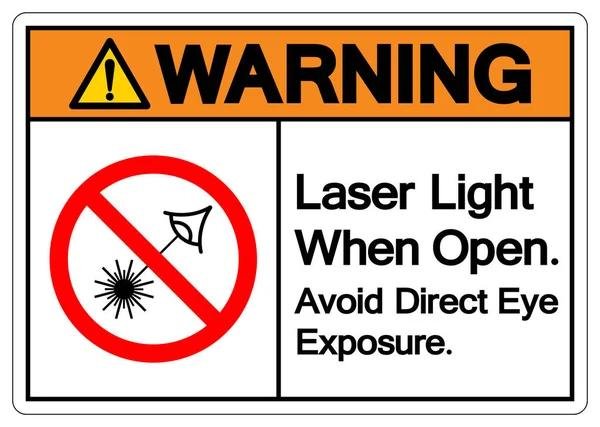
Table of Contents
- I. What Are Laser Warning Signs? Clarifying the Core Concept
- II. Working Principle: How Do Laser Warning Signs Work?
- III. Key Parameters and Metrics
- IV. Main Types: What Kinds of Laser Warning Signs Exist?
- V. Application Scenarios: Where Are Laser Warning Signs Used?
- VI. Common Misconceptions: Pitfalls to Avoid
I. Core Concept: What Are Laser Warning Signs?
Laser warning signs are the “visual language” of laser safety management, using standardised graphics, colours and text to quickly convey laser hazard information, warning levels and protection requirements to personnel. They are the first line of defence in laser safety – before a person even enters a hazardous area, the sign tells them what risks lie inside and what preparations to make. For salespeople, warning signs are a “small but beautiful” category among laser safety accessories: low unit price but high volume and fast repeat purchases, and a compliance must-have. Helping customers complete their signage scheme both increases order value and demonstrates service attentiveness.
II. Core Content and Mechanism
To understand how laser warning signs work, it can be broken down into several key steps or mechanisms. Its core mechanism can be understood at the following levels:
The design of laser warning signs is based on two principles: the safety colour-coding system and the graphic symbol system. For colours, the internationally accepted safety colours are: yellow background + black symbol = Warning, alerting to potential danger; red border + diagonal slash = Prohibition, indicating an action is not allowed; blue background + white symbol = Mandatory, indicating a protective measure must be taken. Graphic symbols convey information with minimal imagery – for example, a radiating sunburst represents laser radiation, and a person wearing goggles represents mandatory eye protection. The benefit of standardisation is that even without understanding the text, the colours and symbols convey the general meaning – especially important for multinational companies and multilingual environments.
III. Key Parameters and Metrics
To understand laser warning signs, knowing concepts and principles is not enough – you must also understand its key parameters. The following are the core parameters and their significance:
| Parameter name | Meaning | Why it matters |
|---|---|---|
| Hazard class marking | The label must state the laser product class (Class 2/3B/4, etc.) – this is the most core information | The class number on the sign is the most intuitive hazard cue, letting personnel quickly judge the risk level |
| Wavelength and power | Usually the maximum output wavelength range and maximum power must be marked so experienced personnel can judge the specific risk type | Marking wavelength and power helps personnel judge the specific risk type and select correct protective equipment |
| Warning wording | Class 3B and above use “DANGER,” Class 2/3R use “CAUTION” – the wording has strict class distinctions | The wavelength and power information on the sign guides selection of correct protective equipment |
| Protection notice | Such as “avoid eye or skin exposure to direct or scattered radiation” | Clear protective-action instructions guide personnel to take correct measures and avoid accidental injury |
| Standard number | Marking the standard complied with (e.g. IEC 60825-1) | Standardised warning wording conveys key safety information, ensuring operators are aware of the main risks |
IV. Main Types: What Kinds of Laser Warning Signs Exist?
Laser warning signs can be classified by function into several major categories. Product labels: permanent labels affixed directly to laser equipment, which the manufacturer must provide, containing key information such as class, wavelength and power. Area warning signs: signs hung at the entrance of laser labs or work areas, larger and eye-catching, alerting entrants to laser radiation, often with mandatory signs such as “eye protection must be worn.” Duct / fibre labels: used to mark the routing and hazard of laser transmission ducts or optical fibres. Instruction labels: more detailed text descriptions placed near the equipment, describing risks and emergency measures. By class wording they can also be divided into the “DANGER” level (for Class 3B and 4) and the “CAUTION/WARNING” level (for Class 2 and 3R). In addition, invisible lasers (IR/UV) require special marking of “invisible laser radiation.”
V. Application Scenarios: Where Are Laser Warning Signs Used?
- Different scenarios need different signage schemes. Research laboratories usually have multiple laser sources of different classes, requiring independent warning signs and status lights at each bench and a comprehensive warning sign at the entrance. Industrial processing workshops mostly use Class 4 laser equipment, needing eye-catching danger signs, area-isolation signs and interlock status indicators, while considering dust, oil and weather resistance. Hospitals / medical aesthetics institutions need to protect both staff and patients; signs must be clear and easy to understand while considering patients’ psychological comfort (not too frightening). Outdoor / public areas with laser equipment (such as landmark lasers and LiDAR) need to inform the public of safe distances and precautions. Sales can offer “signage kit” recommendations based on the customer’s application scenario – how many entrance signs, equipment labels and status lights – providing a one-stop complete package.
👉 Want to learn more about real-world applications of laser warning signs? Visit Soar Laser’s application case page, or contact our technical team directly for professional advice.
VI. Common Misconceptions
Many people have fuzzy ideas about laser warning signs. See if you fall into any of these traps:
Myth 1: “Just stick a yellow triangle and it’s fine”
Far from enough. Laser warning signs have strict content requirements and must include hazard class, wavelength range, maximum power, warning wording and more – missing any item fails the standard.
Myth 2: “All lasers use the same sign”
Wrong. Different classes use different wording (DANGER vs CAUTION), invisible lasers have special markings, and sign styles differ across countries / standards.
Myth 3: “The more signs, the safer”
Not necessarily. Too many cluttered signs cause visual fatigue and reduce sensitivity to real danger. Signs should be eye-catching, accurate and well-placed, not simply more-is-better.
Myth 4: “Signs only go on the equipment”
Not enough. Besides the equipment itself, signs are also needed at laser work-area entrances, near the beam path, at fibre connections and other locations, forming a complete warning system.
Reference source:RP Photonics Encyclopedia
Leave a Reply