


What Is Metal Coating? Features of Gold, Silver and Aluminium Coatings
Metal coating is an important concept in laser technology, widely used in industrial manufacturing, scientific research and healthcare. This article systematically introduces the core concepts, working principles, key parameters, main types and typical applications of metal coating, helping readers build a complete knowledge framework.
Table of Contents
- 1. What Is Metal Coating? Understanding the Core Concepts
- 2. Working Principle: How Is Metal Coating Applied?
- 3. Key Parameters: Understanding the Performance Indicators of Metal Coating
- 4. Main Types: What Kinds of Metal Coating Exist?
- 5. Applications: Where Is Metal Coating Used?
- 6. Common Misconceptions: Pitfalls to Avoid
1. Core Concepts: What Is Metal Coating?
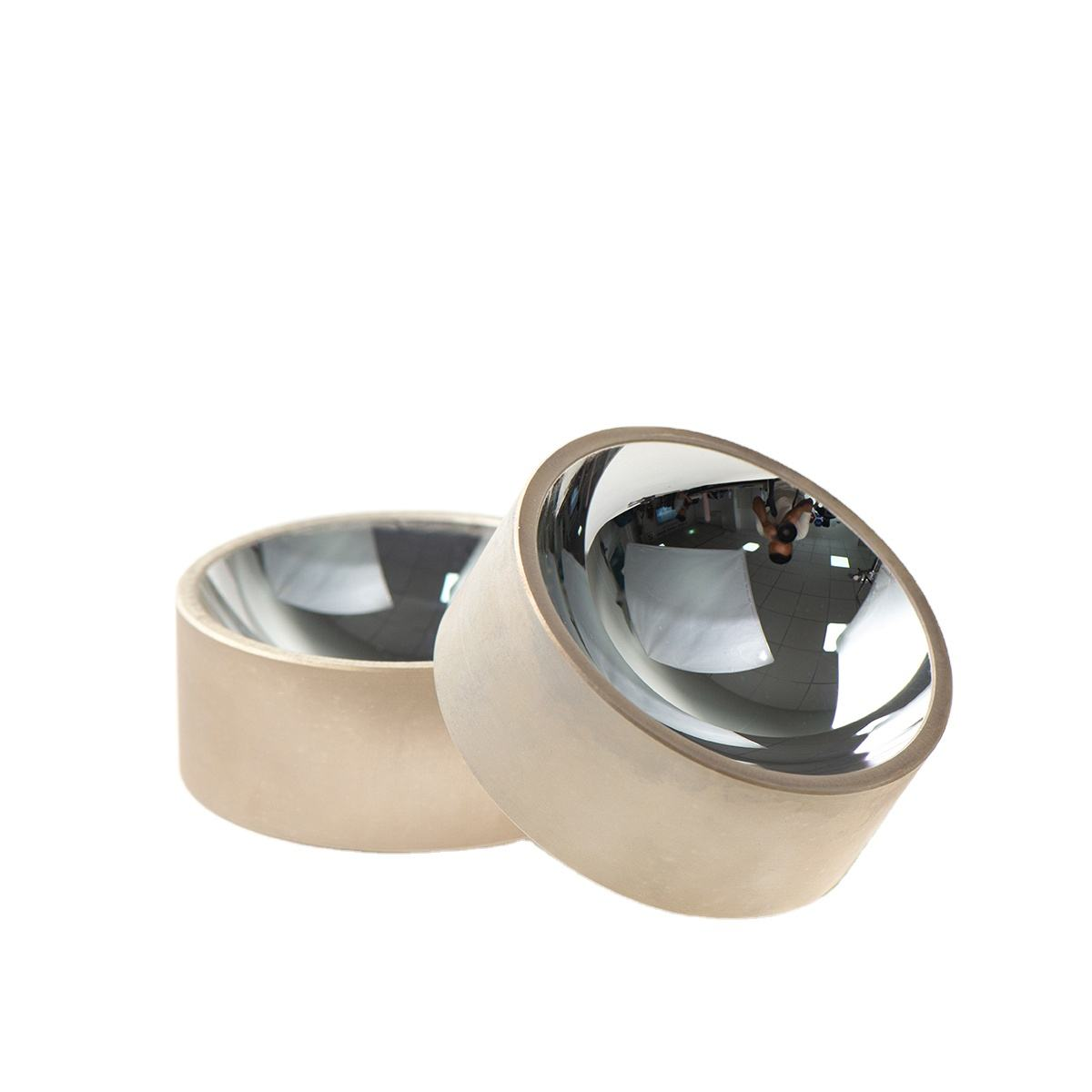
Metal coating is a coating technology that applies a thin metal film to the surface of an optical component to achieve an optical function. The most common application is the metal mirror—using the strong reflection of light by metal to make a mirror. The household mirror we look into every day is a glass mirror silvered on the back, while a metal-coated mirror used in optics deposits a thin film of aluminium, silver or gold on the front surface of a glass or metal substrate. Compared with dielectric coatings, the biggest feature of metal coating is extremely broad reflection bandwidth—it reflects from visible light to infrared and even far infrared, and is insensitive to angle of incidence and polarisation state, with a simple process and low cost. But metal absorbs light, so its reflectivity cannot be as high as a dielectric coating, and its damage threshold is much lower.
2. Working Principle: How Is Metal Coating Applied?
The working principle of metal coating is completely different from that of dielectric coating—it does not rely on interference, but on the free electrons in the metal. There are a large number of freely mobile electrons inside metal; when light (an electromagnetic wave) is incident on the metal surface, the free electrons oscillate under the electric field of the light. These oscillating electrons radiate a new electromagnetic wave (the reflected light), while part of the energy of the electron motion is converted into heat (absorption). Since the response of free electrons covers an extremely wide frequency range, metal reflection has a very broad spectral bandwidth. Different metals have different free-electron densities and binding forces, so their reflection spectra differ: aluminium reflects well in the ultraviolet and visible, silver has the highest reflectance in the visible and near-infrared, and gold performs best in the infrared. Metal films usually also require a dielectric protective film to prevent oxidation and scratching.
💡 An analogy
Metal coating is like applying a layer of metal to the back of glass—just like the mirrors we see every day, with a layer of aluminium or silver on the back of the glass. The free electrons in the metal strongly reflect the incident light back, giving a very broad reflection spectrum, but part of the light is absorbed, so the efficiency is not as high as a dielectric coating.
In summary, metal coating involves the intersection of multiple disciplines including optics, materials science and precision manufacturing. Mastering its basic principles and key parameters is the foundation for properly selecting and using related products.
3. Key Parameters: Understanding the Performance Indicators of Metal Coating
Understanding metal coating requires mastering the following key parameters, which directly determine product performance and application scenarios:
| Parameter Name | Meaning | Why It Matters |
|---|---|---|
| Metal Material | — Aluminium, silver, gold, chromium, etc.; different metals have different applicable bands and reflectance | Directly affects laser performance and the choice of application scenarios |
| Average Reflectance | — The average reflection ratio over a specified band; silver is about 95% in the visible, gold about 97%–99% in the near-infrared | Reflectance varies greatly between metals: silver is highest in the visible and near-infrared, gold is best in the infrared, and aluminium works in both ultraviolet and visible |
| Operating Wavelength Range | — Ultraviolet, visible, near-infrared or far-infrared | Gold coatings are excellent from near- to far-infrared but poor in the visible; aluminium coatings cover ultraviolet to near-infrared but are inferior to gold and silver in the infrared |
| Protective Layer Type | — Whether there is a protective layer (SiO₂, Si₃N₄, etc.), and whether it is enhanced or ordinary protective | Directly affects laser performance and the choice of application scenarios |
| Damage Threshold | — The damage threshold of metal films is far lower than that of dielectric films, a bottleneck for high-power applications | Directly affects laser performance and the choice of application scenarios |
| Surface Quality | — Scratch and dig grade | Directly affects laser performance and the choice of application scenarios |
The above parameters are interrelated and mutually constrained. In actual selection, a comprehensive trade-off among performance, cost, reliability and other aspects is needed according to specific application requirements.
For more product parameters or selection advice, please contact the Soar Laser technical team.
4. Main Types: What Kinds of Metal Coating Exist?
Metal coating has many common types. By metal material: aluminium coating—the most versatile and cheapest, usable from ultraviolet to near-infrared, with about 90% reflectance (visible), prone to oxidation and usually needing a protective layer; silver coating—the highest reflectance in the visible and near-infrared (about 95%–98%), but silver tarnishes and oxidizes easily and must have a protective layer; gold coating—very high reflectance from 600 nm to the far infrared (above 20 μm), and gold does not oxidize easily so it can sometimes be used without a protective layer; chromium coating—not highly reflective, but with excellent adhesion, often used as a transition layer or neutral-density filter. By structure: bare metal film—no protective layer, high reflectance but easily damaged; protected metal film—a dielectric protective layer (such as SiO₂) added on the metal, wipe-resistant but with slightly lower reflectance; enhanced metal film—a hybrid structure of metal plus a multilayer dielectric film, combining the broad spectrum of metal with the high reflection and high damage threshold of dielectric films.
5. Applications: Where Is Metal Coating Used?
Metal coating has a very wide range of applications, covering industrial manufacturing, scientific research, healthcare, communications and information, and many other fields. The following introduces several main aspects:
- Metal coating has an irreplaceable place in optics. In infrared optics, especially the mid-to-far infrared (e.g. CO₂ lasers at 10.6 μm), dielectric coatings are difficult to make well because of high material absorption, so metal coating becomes the mainstay—gold-coated copper mirrors are standard equipment for high-power CO₂ lasers. In general optical instruments, aluminium-coated mirrors are widely used as general-purpose mirrors because they are cheap, broadband and angle-insensitive. In ultrafast lasers, metal mirrors have extremely low dispersion and are sometimes used as broadband mirrors or reference mirrors. In spectrometers and other instruments, gold and silver mirrors are used in broadband reflective optical systems. In astronomical optics, the primary mirrors of large-aperture telescopes are usually coated with aluminium or silver. A practical tip for salespeople: if a customer needs a mirror that is “broadband, cheap and angle-independent,” metal coating is the first choice
- if they need “high reflection, low loss and high power,” a dielectric mirror should be recommended instead.
Typical Application Scenarios in Detail
Scenario 1: Mirrors
thanks to their broadband reflection characteristics, metal-film mirrors are widely used in broadband optical systems, spectroscopic instruments and illumination systems, and are also low in cost.
Scenario 2: Decoration and Protection
applying a metal film to glass, plastic and other surfaces can produce a mirror effect for decoration, packaging and reflective devices, often with a protective layer to improve durability.
Scenario 3: Electromagnetic Shielding
applying a metal film to a plastic housing provides electromagnetic shielding, widely used for EMI/EMC protection in electronic products and communication equipment.
Scenario 4: Conductive Electrodes
applying a transparent conductive metal film (such as ITO) to glass, plastic and other substrates is used in touch screens, displays and solar cells.
6. Common Misconceptions
Many people have somewhat plausible but mistaken notions about metal coating. See whether you fall into any of the following misconceptions:
Misconception 1: Metal mirrors and dielectric mirrors are about the same, so buy whichever is cheaper.
The two are completely different in core indicators such as reflectance, damage threshold, bandwidth and angle sensitivity; choosing the wrong one may render the system inoperable.
Misconception 2: The thicker the metal film, the higher the reflectance.
In fact, once a metal film reaches a certain thickness (about 100 nm), reflectance is essentially saturated; making it thicker will not raise reflectance and only wastes material and increases stress.
Misconception 3: Gold film has the highest reflectance.
Gold is indeed excellent in the infrared, but in the visible its reflectance is lower than silver’s, and in the ultraviolet even lower than aluminium’s. Each band has its own most suitable metal.
Misconception 4: Metal films are all very robust.
Quite the opposite—an unprotected metal film is extremely delicate: it scratches on contact, fingerprints cannot be wiped off, and silver film reacts with sulphur in the air and turns black. Optical metal mirrors are generally handled “face up, untouched by hand.”
The above are several common misconceptions about metal coating. In practical applications, comprehensive judgment is needed based on specific product parameters and use conditions. If in doubt, it is recommended to consult a professional technician.
Leave a Reply