


What Are Dielectric Coatings? Why Do They Outperform Metal Coatings?
Dielectric coatings are an important concept in laser technology, widely used in industrial manufacturing, scientific research and healthcare. This article systematically introduces the core concepts, working principles, key parameters, main types and typical applications of dielectric coatings, helping readers build a complete knowledge framework.
Table of Contents
- 1. What Are Dielectric Coatings? Understanding the Core Concepts
- 2. Working Principle: How Are Dielectric Coatings Made?
- 3. Key Parameters: Understanding the Performance Indicators of Dielectric Coatings
- 4. Main Types: What Kinds of Dielectric Coatings Exist?
- 5. Applications: Where Are Dielectric Coatings Used?
- 6. Common Misconceptions: Pitfalls to Avoid
1. Core Concepts: What Are Dielectric Coatings?
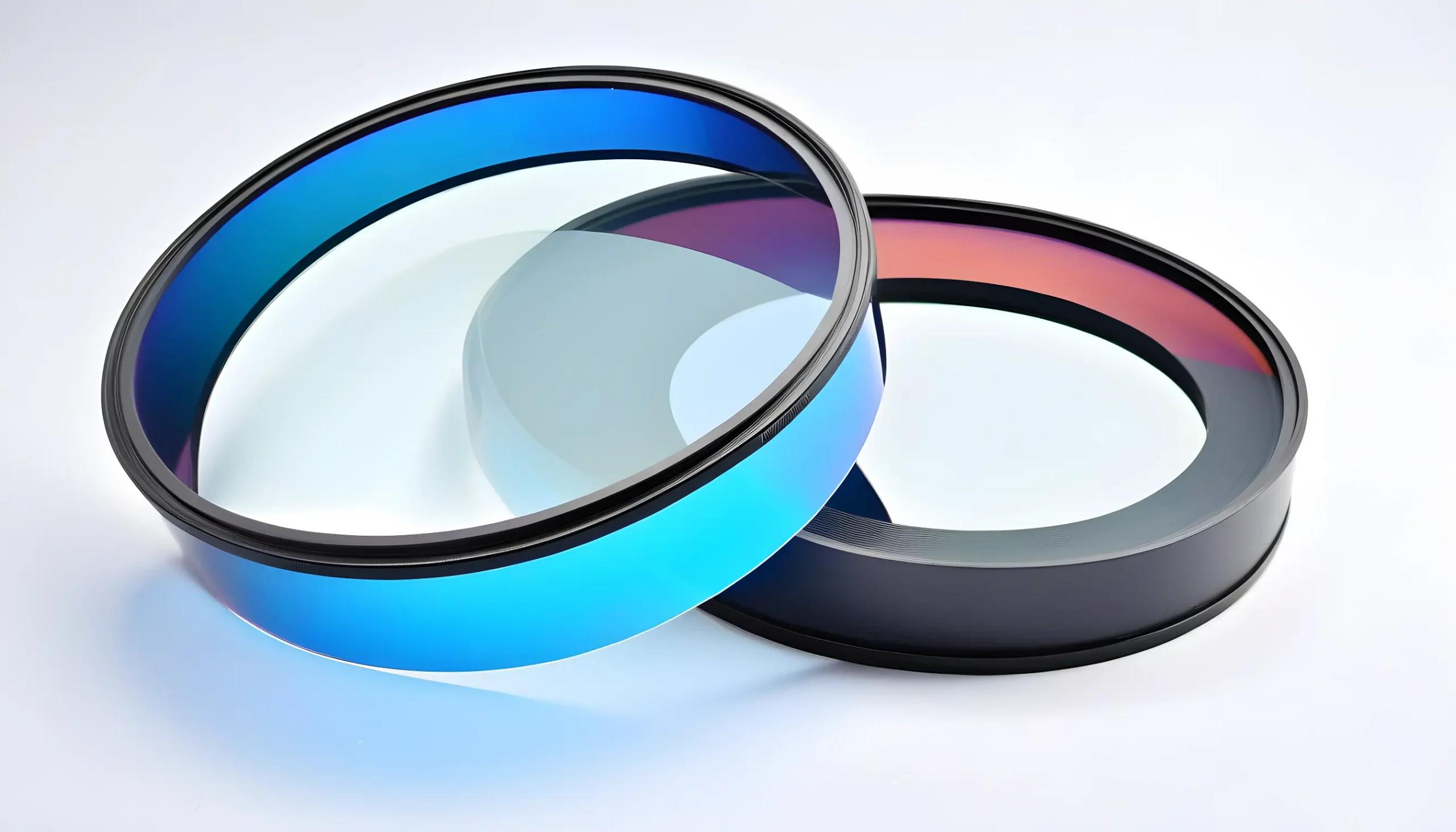
Dielectric coatings, fully called dielectric optical thin films, also known as interference coatings or multilayer coatings, are the most technically sophisticated and most widely used class of optical coatings. They are formed by alternately stacking one or more layers of transparent dielectric materials (that is, non-conductive insulating materials) on an optical substrate. Unlike metal coatings, dielectric coating materials are themselves transparent and absorb no or very little light; their control of light relies entirely on the interference effect between the reflected and transmitted light at each layer interface. Through careful selection of materials and the thickness of each layer, dielectric coatings can achieve almost all optical functions: anti-reflection, high reflection, beam splitting, polarisation and filtering. It can be said that dielectric coatings are the ‘main force’ of modern optical coatings, and the vast majority of high-performance laser optical components use dielectric coatings.
2. Working Principle: How Are Dielectric Coatings Made?
The core principle of dielectric coatings is thin-film interference of light. When light enters a multilayer dielectric thin-film structure, the interface between every two adjacent material layers (with different refractive indices) produces a portion of reflected light and a portion of transmitted light. Because these light waves come from the same incident light, they are coherent—the phase difference depends on the optical thickness of each layer (physical thickness × refractive index) and the angle of incidence. When these reflected/transmitted waves are superposed, they are enhanced where the phases are the same (constructive interference) and canceled where the phases are opposite (destructive interference). By precisely controlling the refractive index and thickness of each layer, light of different wavelengths and polarisations can be ‘directed’ to be reflected or transmitted in the designed proportions. It is like a conductor leading an orchestra—each layer is a musician, and the thickness and refractive index are the score, finally performing the spectral response curve we want.
💡 An analogy
A dielectric coating is like a mirror built from a brick wall of many transparent film layers—the thickness and refractive index of each ‘brick layer’ are precisely designed, using the interference effect of light to make the reflected light add up layer by layer to a very high reflectivity. Compared with the solid wall of a metal coating, a dielectric coating absorbs almost no light and is more efficient.
In summary, dielectric coatings involve the intersection of multiple disciplines including optics, materials science and precision manufacturing. Mastering their basic principles and key parameters is the foundation for properly selecting and using related products.
3. Key Parameters: Understanding the Performance Indicators of Dielectric Coatings
Understanding dielectric coatings requires mastering the following key parameters, which directly determine product performance and application scenarios:
| Parameter Name | Meaning | Why It Matters |
|---|---|---|
| Refractive Index Contrast | — The difference between high- and low-index materials; the larger the difference, the fewer layers are needed to achieve the same performance and the wider the bandwidth | Directly affects laser performance and the choice of application scenarios |
| Number of Layers | — Ranging from a single layer to over a hundred layers; more layers mean more complex functions and higher cost | Directly affects laser performance and the choice of application scenarios |
| Optical Loss | — Including absorption loss and scatter loss; the loss of a high-quality dielectric coating can be as low as the ppm level | Directly affects laser performance and the choice of application scenarios |
| Film Density | — Affects the refractive index, environmental stability and damage threshold | Directly affects laser performance and the choice of application scenarios |
| Laser-Induced Damage Threshold (LIDT) | — A core indicator for high-power laser applications | A core indicator for high-power applications; the LIDT of dielectric coatings is usually far higher than that of metal coatings |
| Spectral Characteristics | — The curve of reflectance/transmittance versus wavelength | Directly affects laser performance and the choice of application scenarios |
The above parameters are interrelated and mutually constrained. In actual selection, a comprehensive trade-off among performance, cost, reliability and other aspects is needed according to specific application requirements.
For more product parameters or selection advice, please contact the Soar Laser technical team.
4. Main Types: What Kinds of Dielectric Coatings Exist?
Dielectric coatings can be classified in several ways. By number of layers, they are divided into single-layer dielectric coatings (the simplest anti-reflection coatings) and multilayer dielectric coatings (the vast majority of functional coatings). By the way the refractive index varies, they are divided into step-index coatings (the refractive index changes abruptly at each layer, the most common) and gradient-index coatings (continuously varying refractive index, such as Rugate coatings). By function, they are divided into anti-reflection coatings, high-reflection coatings, beam splitters, polarisers, filter coatings and so on (the other types covered in this series of notes). By material system, they are divided into: oxide dielectric coatings—SiO₂/TiO₂, SiO₂/Ta₂O₅, etc., used in the visible and near-infrared, the most mainstream system; fluoride dielectric coatings—MgF₂, LaF₃, etc., used in the deep ultraviolet and mid-to-far infrared; semiconductor dielectric coatings—such as GaAs/AlGaAs crystalline mirrors, used in the infrared and precision metrology. By deposition process, they can also be divided into electron-beam evaporated coatings, ion-assisted deposited coatings, ion-beam sputtered coatings and so on, with large quality differences between processes.
5. Applications: Where Are Dielectric Coatings Used?
Dielectric coatings have a very wide range of applications, covering industrial manufacturing, scientific research, healthcare, communications and information, and many other fields. The following introduces several main aspects:
- Dielectric coatings are the cornerstone of lasers and modern optics. In laser systems, from cavity mirrors to output couplers and from beam expanders to isolators, almost every optical component has a dielectric coating on its surface—a laser contains as many sets of dielectric coating designs as it has optical components. In optical communications, core devices such as WDM filters and thin-film polarisers are all based on dielectric coating technology. In imaging optics, every element of a high-end lens is coated with a multilayer broadband anti-reflection coating. In biomedical optics, various fluorescence filters and dichroic mirrors are masterpieces of dielectric coatings. In aerospace and defence optics, dielectric coatings are used in various imaging, detection and laser systems. For salespeople, understanding the ‘capability boundaries’ of dielectric coatings—what can be done, what is difficult and what cannot be done—is the key to recommending products accurately.
Typical Application Scenarios in Detail
Scenario 1: Laser Cavity Mirrors
Laser cavity mirrors almost always use dielectric coatings, which can achieve ultra-high reflectivity above 99.9% with very low absorption and a high damage threshold.
Scenario 2: Beam-Splitting and Polarisation Components
Beam splitters, polarisers, waveplates and so on are all designed based on the interference effect of dielectric coatings and are the core components for controlling light beams in laser systems.
Scenario 3: Optical Filters
Various bandpass filters, cutoff filters and narrowband filters make extensive use of dielectric coatings to select the passage of specific wavelengths of light.
Scenario 4: Anti-Reflection Coatings
Applying anti-reflection coatings to the surfaces of optical components such as lenses, windows and prisms reduces reflection loss and improves system transmission efficiency and image quality.
6. Common Misconceptions
Many people have somewhat plausible but mistaken notions about dielectric coatings. See whether you fall into any of the following misconceptions:
Misconception 1: Dielectric coatings are just ‘non-conductive films’ with little technical content.
In fact, the design of a high-end dielectric coating involves the precise optimisation of dozens or even hundreds of film layers, with each layer’s thickness controlled to the sub-nanometre level; it is the culmination of optics, materials and control technology.
Misconception 2: Dielectric coatings are all transparent.
The coating materials themselves are transparent, but the effect of multilayer interference can make the coating appear completely opaque at certain wavelengths (high reflection), or even show various colours—this is normal.
Misconception 3: Dielectric coatings have zero absorption.
Although dielectric materials have very low absorption, it is not completely zero—impurities, defects and interface scattering all introduce losses, and these losses are critical in ultra-high-precision applications.
Misconception 4: There is only one way to make dielectric coatings.
The ‘same’ coating made by different deposition processes can differ enormously in density, damage threshold and environmental stability, with prices differing by several times to more than ten times.
The above are several common misconceptions about dielectric coatings. In practical applications, comprehensive judgment is needed based on specific product parameters and use conditions. If in doubt, it is recommended to consult a professional technician.
Leave a Reply