


What Is Rare-Earth Doping? The Active Ingredient in Fibres and Crystals
Table of Contents
- 1. What Is Rare-Earth Doping? Understanding the Core Concepts
- 2. Working Principle: How Does Rare-Earth Doping Work?
- 3. Key Parameters: Understanding Rare-Earth Doping Performance Indicators
- 4. Main Types: What Kinds of Rare-Earth Doping Exist?
- 5. Applications: Where Is Rare-Earth Doping Relevant?
- 6. Common Misconceptions
1. Core Concepts: What Is Rare-Earth Doping?
Rare-earth doping is the technique of using trivalent rare-earth element ions (lanthanide ions) as laser-active centres, doped into a transparent host material (such as a crystal, glass or optical fibre) to make a gain medium capable of optical amplification. It is the most core and widely used gain mechanism in solid-state lasers.
The so-called “rare earths” refer to the 15 lanthanide elements (from lanthanum La to lutetium Lu) plus scandium and yttrium, 17 elements in total. But only a few are actually widely used in lasers—neodymium (Nd), ytterbium (Yb), erbium (Er), thulium (Tm) and holmium (Ho) are the five most important. Rare-earth-doped lasers are also often called “doped insulator lasers,” because the host material is usually an insulator (oxide crystal, glass, ceramics, etc.) while the doped ions are the true light-emitting centres.
2. Working Principle: How Does Rare-Earth Doping Work?
1. The special nature of the 4f shell
The laser transitions of rare-earth ions occur inside the 4f electron shell. This shell is shielded by the outer 5s and 5p shells and is relatively little affected by the surrounding lattice environment. Therefore the emission wavelength of a rare-earth ion is determined mainly by the ion species, with the host playing only a “fine-tuning” role. It is precisely because of this shielding that transitions within the 4f shell are forbidden transitions—low transition probability and long upper-level lifetimes (usually microseconds to milliseconds). A long lifetime means energy can be “stored” in the excited state, crucial for Q-switching to produce high-peak-power pulses.
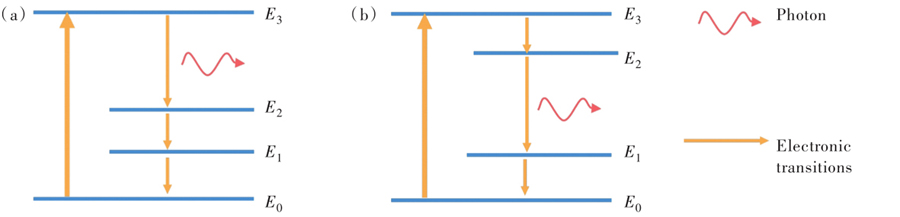
2. Working process
1. Pump light illuminates the gain medium; rare-earth ions absorb pump photons and are excited from the ground state to a higher pump level. 2. The ions fall rapidly by multiphonon relaxation (nonradiative transition) to the metastable upper laser level. 3. Ions in the upper level transition by stimulated emission to the lower laser level, releasing a laser photon. 4. Ions in the lower level return to the ground state by multiphonon relaxation, completing a cycle.
3. Energy transfer and co-doping
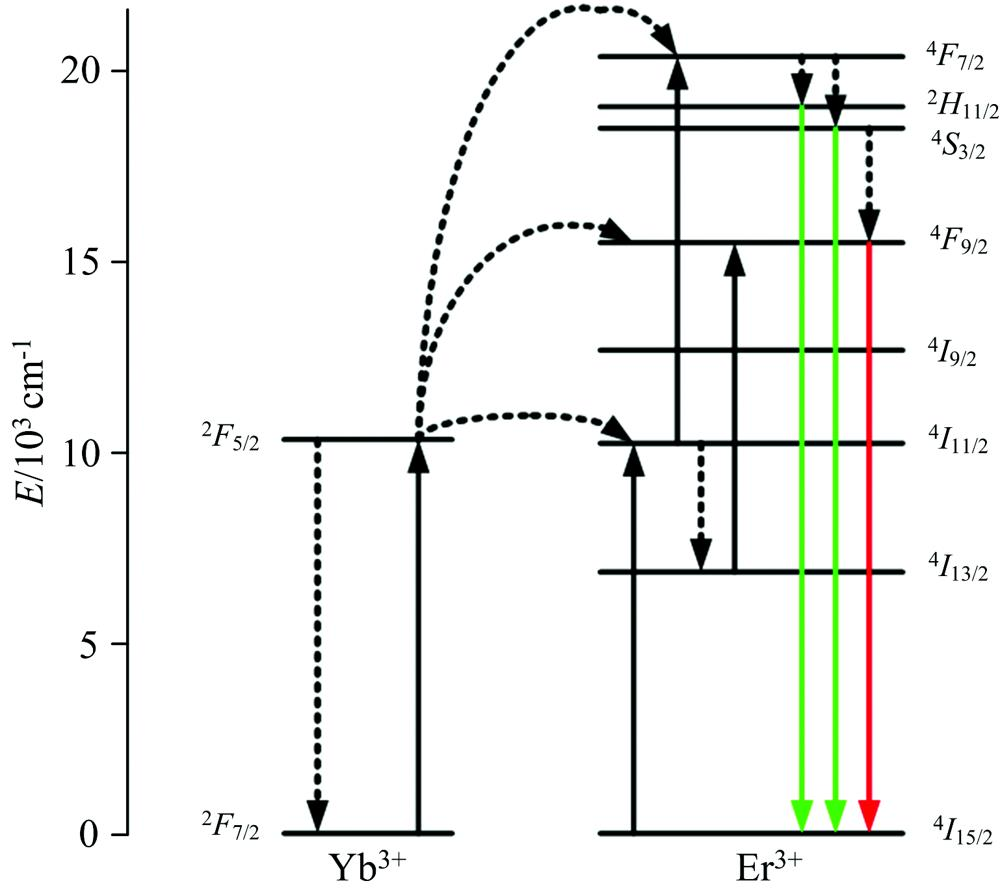
Sometimes two rare-earth ions are doped together. The most typical is erbium-ytterbium co-doping: Yb ions absorb pump light and transfer energy to Er ions via dipole–dipole interaction, making Er lase. This “sensitizer–activator” scheme greatly improves pump efficiency, because Yb’s absorption cross section is far larger than Er’s.
3. Key Parameters: Understanding Rare-Earth Doping Performance Indicators
The core parameters are described below:
| Parameter Name | Meaning |
|---|---|
| Absorption Cross Section | Measures how strongly an ion absorbs pump light, usually in cm². A larger cross section means more pump light absorbed over the same length. |
| Stimulated-Emission Cross Section | Measures the strength of stimulated emission, directly determining gain. Typical rare-earth values are in the 10⁻²¹–10⁻¹⁹ cm² range. |
| Upper-Level Lifetime | How long the excited state survives. A long lifetime favors energy storage (Q-switching); a short one means faster response. |
| Fluorescence Spectrum | The spectral distribution of an ion’s spontaneous emission, reflecting possible laser wavelength ranges and gain bandwidth. |
| Quantum Efficiency | The fraction of upper-level ions returning to the ground state by radiative transition (emitting light). Nonradiative transitions (multiphonon relaxation, energy transfer to defects, etc.) lower quantum efficiency. |
| Concentration-Quenching Threshold | Beyond a certain doping concentration, ions are too close together and lose energy through cross-relaxation or upconversion, reducing efficiency. |
| Pump and Laser Wavelengths | Different ions have characteristic absorption and emission wavelengths, determining a laser’s operating band. |
4. Main Types: What Kinds of Rare-Earth Doping Exist?
Rare-earth doping can be classified in several ways, and different dimensions help us understand it from different angles. The common classification methods are introduced below:
By Main Laser Ion
| Ion | Typical Emission Wavelength | Main Feature | Typical Application |
|---|---|---|---|
| Neodymium (Nd³⁺) | 1064nm, 1342nm, 946nm | Four-level system, high efficiency, most mature technology | Industrial processing, medicine, rangefinding |
| Ytterbium (Yb³⁺) | 1000~1100nm | Simple level structure, small quantum defect, very high efficiency | High-power fibre lasers, thin-disk lasers |
| Erbium (Er³⁺) | 1550nm, 2.9μm | Communication band + mid-infrared band, eye-safe | Optical communication amplifiers, medical lasers |
| Thulium (Tm³⁺) | 1.7–2.1 μm, 480 nm (upconversion) | Eye-safe band, can upconvert to blue | Medical surgery, upconversion lasers |
| Holmium (Ho³⁺) | 2.1μm, 2.8~2.9μm | Eye-safe, mid-infrared | LiDAR, medicine |
| Praseodymium (Pr³⁺) | Visible multiple bands | Can produce red/green/blue multicolor upconversion laser | Visible fibre lasers |
| Cerium (Ce³⁺) | Ultraviolet (280–330 nm) | UV emission, also used as co-dopant to suppress photodarkening | UV lasers, anti-photodarkening co-doping |
By Host Type
Crystal hosts
YAG, YVO₄, YLF, sapphire, etc. Ordered lattice, large emission cross section, good thermal conductivity, relatively narrow bandwidth.
Glass hosts
Silicate, phosphate and fluoride glasses, etc. Disordered structure, broad gain bandwidth, poorer thermal conductivity.
Ceramic hosts
Polycrystalline ceramics, between crystal and glass, can be made large and highly doped.
Fibre hosts
Silica fibre, phosphate fibre, ZBLAN fluoride fibre, etc.; the waveguide structure favors high power.
By Doping Scheme
Single doping
Only one laser-active ion doped
Co-doping
Two or more ions using energy transfer to improve performance (e.g. Er/Yb co-doping)
5. Applications: Where Is Rare-Earth Doping Relevant?
Main application areas:
- Industrial processing: Yb-doped fibre lasers and Nd:YAG lasers for cutting, welding, marking and cleaning.
- Optical fibre communications: the erbium-doped fibre amplifier (EDFA) is the cornerstone of long-haul optical communications, known as “the heart of optical fibre communication.”
- Medicine and aesthetics: Nd:YAG for ophthalmic surgery and vascular lesions; Er:YAG for dentistry and skin resurfacing; Tm-doped fibre for soft-tissue surgery.
- LiDAR and rangefinding: eye-safe Er- and Tm-doped lasers for LiDAR; passively Q-switched Nd lasers for traditional rangefinding.
- Research instruments: various rare-earth-doped lasers used in spectroscopy, cold-atom physics, bioimaging and other research fields.
- Defence and security: high-power Yb-doped fibre lasers for directed-energy weapons; mid-infrared Tm- and Ho-doped lasers for infrared countermeasures.
- Precision measurement: narrow-linewidth Er-doped fibre lasers for fibre sensing, coherent communications and precision metrology.
6. Common Misconceptions
Here are a few common misconceptions:
Misconception 1: ‘Rare-earth elements are scarce “rare earths.”‘
the name “rare earth” is misleading. In fact many rare-earth elements are not scarce in the Earth’s crust—cerium is more abundant than copper. “Rare” refers more to their dispersed occurrence and difficulty of purification than to total scarcity
Misconception 2: ‘The higher the rare-earth doping concentration, the better.’
doping concentration is a double-edged sword. High concentration does absorb pump light over a shorter length, but too high means ions are too close and suffer concentration quenching—energy is dissipated among ions through energy transfer, lowering laser efficiency and aggravating upconversion and photodarkening
Misconception 3: ‘The same rare-earth ion has the same wavelength regardless of host.’
although 4f transitions are less affected by the host, the host’s crystal field still splits the levels (Stark splitting), changing emission wavelength and spectral shape. Yb-doped YAG and Yb-doped silica fibre have clearly different emission spectra—YAG lines are narrower with higher peaks, fibre lines broader
Misconception 4: ‘Rare-earth-doped lasers can only output infrared light.’
although most rare-earth-doped lasers do work in the infrared, through upconversion some ions (such as Tm, Pr, Er) can output visible or even ultraviolet light. In addition, combined with nonlinear frequency conversion (such as second-harmonic and sum-frequency generation), rare-earth lasers can produce wavelengths from ultraviolet to mid-infrared
Leave a Reply