


What Is the Stimulated-Emission Cross Section? An Atom’s Ability to Emit Light
Table of Contents
- 1. What Is the Stimulated-Emission Cross Section? Understanding the Core Concepts
- 2. Working Principle: How Does the Stimulated-Emission Cross Section Work?
- 3. Key Parameters: Understanding Stimulated-Emission Cross Section Indicators
- 4. Comparison of Stimulated-Emission Cross Sections Across Gain Media
- 5. Practical Significance and Applications of the Stimulated-Emission Cross Section
- 6. Common Misconceptions
1. Core Concepts: What Is the Stimulated-Emission Cross Section?
The stimulated-emission cross section, usually denoted σem or σ21, is a physical quantity measuring how strongly a single particle (atom, ion or molecule) undergoes stimulated emission. Its unit is area (commonly cm² or m²); it can be understood as the effective cross-sectional area with which each excited particle “captures” an incident photon and produces stimulated emission.
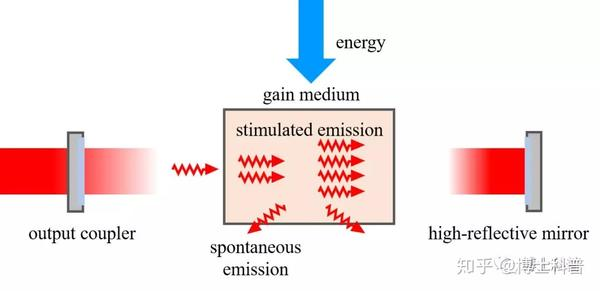
The larger the cross section, the more easily an incident photon triggers stimulated emission in that particle, and the higher the gain per unit length. Therefore the stimulated-emission cross section is one of the most core parameters for evaluating gain-media performance, directly determining laser threshold, gain magnitude and saturation characteristics. Corresponding to the stimulated-emission cross section is the absorption cross section σabs or σ12, measuring the probability that a particle absorbs an incident photon from the ground state and is excited to a higher level. In four-level systems the absorption cross section at the laser wavelength is nearly zero; in three-level or quasi-three-level systems there is significant absorption at the laser wavelength—the reabsorption effect.
2. Working Principle: How Does the Stimulated-Emission Cross Section Work?
1. Physical meaning and quantitative relation
The stimulated-emission cross section answers this question: given an excited particle and an incoming photon, what is the probability of stimulated emission? The quantitative relation can be expressed by a simple formula: > stimulated-emission rate = stimulated-emission cross section × photon flux density Photon flux density is the number of photons passing per unit area per unit time (I/hν, where I is intensity and hν is photon energy). So the larger the cross section, the faster stimulated emission occurs at the same intensity.
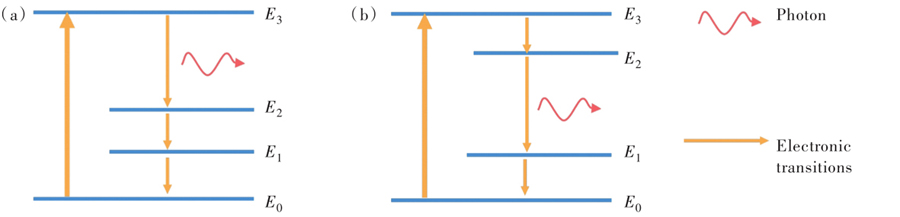
2. Relation to the gain coefficient
The gain coefficient g of a gain medium (amplification per unit length, in 1/m) equals the stimulated-emission cross section times the upper-level population density: > g = σem × N2 where N2 is the population density in the upper level. This means: to obtain high gain, either use a medium with a large cross section or raise the upper-level population density (i.e. increase pump intensity). For quasi-three-level systems, because of ground-state reabsorption, the net gain must subtract the reabsorption term: > g = σem × N2 – σabs × N1
3. Effective stimulated-emission cross section
In solid-state laser gain media, the rare-earth ion’s 4f levels are split by the crystal field into a series of sub-levels (Stark levels), forming so-called Stark level manifolds. Because transitions between different sub-levels have different wavelengths and cross sections, what is actually measured is an “averaged” cross section, called the effective stimulated-emission cross section. The effective cross section is temperature-sensitive because temperature changes the population distribution among sub-levels (Boltzmann distribution).
3. Key Parameters: Understanding Stimulated-Emission Cross Section Indicators
The core parameters are described below:
| Parameter Name | Meaning | Why It Matters |
|---|---|---|
| Peak Cross Section | The cross section at the highest point of the gain spectrum, the most commonly quoted parameter. Typical values: laser crystals about 10⁻¹⁹–10⁻²⁰ cm², laser glasses about 10⁻²¹–10⁻²⁰ cm², semiconductors and dyes on the order of 10⁻¹⁶ cm². | The maximum stimulated-emission cross section, usually at the gain peak. A larger peak cross section means higher gain at that wavelength and easier lasing there. |
| Cross-Section Spectrum | How the cross section varies with wavelength—the shape of the gain spectrum. It determines the laser’s wavelength range, gain bandwidth and tuning characteristics. | The curve of stimulated-emission cross section versus wavelength, determining a gain medium’s bandwidth and gain-spectrum shape. A broader cross-section spectrum allows a wider tuning range and supports shorter pulses. |
| Absorption Cross Section | The cross section corresponding to absorption. The absorption cross section at the pump wavelength determines pump absorption efficiency; at the laser wavelength it affects threshold efficiency (reabsorption). | Affects pump-light absorption efficiency—the larger the absorption, the lower the pump power needed to reach inversion |
| Cross-Section–Lifetime Product (στ Product) | The product of stimulated-emission cross section and upper-level lifetime, an important figure of merit for overall gain-media performance. A larger στ product means lower threshold pump power. | A figure of merit comprehensively reflecting gain-media performance. A larger στ product means better overall laser performance—both high gain and sufficient energy storage. |
| Polarisation Dependence | In anisotropic media (such as birefringent crystals), the cross section varies with the polarisation direction of light, sometimes by several times. | How gain varies with polarisation direction. Less polarisation dependence means more stable output and is favorable for polarisation-insensitive applications such as optical communications. |
| Temperature Coefficient | How the cross section changes with temperature, especially important for quasi-three-level systems. | Describes how sensitively gain-media parameters change with temperature. A smaller temperature coefficient means more stable output power and wavelength, with lower demands on temperature control. |
4. Comparison of Stimulated-Emission Cross Sections Across Gain Media
The stimulated-emission cross section varies enormously by gain-medium type, from 10⁻¹⁶ to 10⁻²¹ cm²—a span of five orders of magnitude. The typical cross sections and physical reasons for each type are given below:
| Gain Medium Type | Typical Stimulated-Emission Cross Section | Order-of-Magnitude Comparison | Physical Reason |
|---|---|---|---|
| Semiconductor gain media | ~10⁻¹⁶ cm² | Largest | Allowed transitions (interband electronic transitions), high oscillator strength |
| Laser dyes | ~10⁻¹⁶ cm² | Very large | Molecular electronic transitions, spin-allowed, high oscillator strength |
| Laser crystals (rare-earth-doped) | ~10⁻¹⁹~10⁻²⁰ cm² | Moderate | 4f forbidden transitions, but uniform crystal environment gives narrower lines and higher peaks |
| Laser glasses (rare-earth-doped) | ~10⁻²⁰~10⁻²¹ cm² | Smaller | Severe inhomogeneous broadening, varied ion environments, lower peaks and broader bandwidth |
| Gases (atoms/ions) | Widely varying | Varies | Depends on the specific transition’s oscillator strength and gas pressure; lines generally very narrow |
Why is the cross section of glass lower than that of crystal?
This is an important rule. Glass is amorphous, so the chemical environment around each rare-earth ion differs slightly, causing each ion’s energy-level positions and cross-section values to differ slightly. This is inhomogeneous broadening—the spectrum is broadened and the peak naturally lowered. In a crystal the lattice is highly ordered and all ions have nearly identical environments, so the line is narrower and the peak higher.
Cross-section differences among ions
Even in the same host crystal, emission cross sections of different active ions vary greatly. Taking YAG as an example: Nd³⁺ has an emission cross section of about 28×10⁻²⁰ cm² at 1064 nm, while Yb³⁺ has about 2.2×10⁻²⁰ cm² at 1030 nm—more than an order of magnitude apart. This directly affects the laser characteristics of the two materials: Nd:YAG has high gain and low threshold; Yb:YAG has lower gain but small quantum defect and high efficiency.
5. Practical Significance and Applications of the Stimulated-Emission Cross Section
Although a fundamental physical parameter, the stimulated-emission cross section profoundly affects laser design and application, being the core basis for gain-media selection and laser design:
- Threshold estimation: the threshold pump power of a laser is inversely proportional to the stimulated-emission cross section. A larger cross section means a lower threshold and easier lasing. It is one of the first parameters considered when selecting a gain medium.
- Gain calculation: designing gain-medium length and choosing doping concentration both require the cross section. For example, to obtain 20 dB of small-signal gain, given the cross section and upper-level population density, the required medium length can be calculated.
- Saturation analysis: saturation intensity and saturation fluence are both inversely proportional to the cross section. A larger cross section means lower saturation intensity—a large-cross-section medium saturates easily, suited to low-power high-gain applications; a small-cross-section medium saturates less easily, suited to high-energy pulse amplification.
- Passive mode-locking stability: a medium with a sufficiently large cross section more easily achieves stable passive mode locking and is less prone to Q-switching instability. This is why some glass gain media tend to exhibit Q-switching instability.
- Laser type selection: need short pulses and large energy? Choose a medium with small cross section and long lifetime (high saturation energy). Need high efficiency and low threshold? Choose a large-cross-section medium.
- Temperature sensitivity assessment: the gain of quasi-three-level systems is temperature-sensitive largely because the effective cross section changes with temperature.
6. Common Misconceptions
Here are a few common misconceptions:
Misconception 1: ‘The larger the stimulated-emission cross section, the better the gain medium.’
a large cross section only means high gain per unit length and low threshold, which is not always good. Large-cross-section media often have narrow gain bandwidth (crystal vs glass) and low saturation intensity, unfavorable for high-energy pulse amplification. Evaluating a gain medium requires considering multiple parameters
Misconception 2: ‘Absorption and emission cross sections have similar values.’
at certain wavelengths absorption and emission cross sections may be close or even simply related (as described by the McCumber relation), but their spectral shapes usually differ. Especially in quasi-three-level systems, at short wavelengths the absorption cross section is large and emission small; at long wavelengths the reverse. This is why gain efficiency can be higher at longer wavelengths
Misconception 3: ‘A material’s stimulated-emission cross section is a fixed value.’
the stimulated-emission cross section depends on wavelength, temperature and polarisation. Especially for amorphous materials such as glass, temperature changes alter the effective cross-section value and spectral shape. When quoting cross-section data, the wavelength and temperature conditions must be stated
Misconception 4: ‘A higher-gain laser necessarily has a larger stimulated-emission cross section.’
gain is the product of cross section and upper-level population. High gain may come from a large cross section, or from high doping concentration or strong pumping. One cannot judge cross-section size simply from gain magnitude
Leave a Reply