


What Is Upconversion? How Low-Energy Photons Combine into High-Energy Ones
Table of Contents
- 1. What Is Upconversion? Understanding the Core Concepts
- 2. Working Principle: How Does Upconversion Work?
- 3. Key Parameters: Understanding Upconversion Performance Indicators
- 4. Main Types of the Upconversion Effect
- 5. Applications of the Upconversion Effect
- 6. Common Misconceptions
1. Core Concepts: What Is Upconversion?
Upconversion is an anti-Stokes luminescence phenomenon in which a material absorbs multiple low-energy (long-wavelength) photons and emits one higher-energy (shorter-wavelength) photon. Simply put, infrared light is used for excitation but visible or even ultraviolet light is emitted—the output photon has more energy than an input photon.
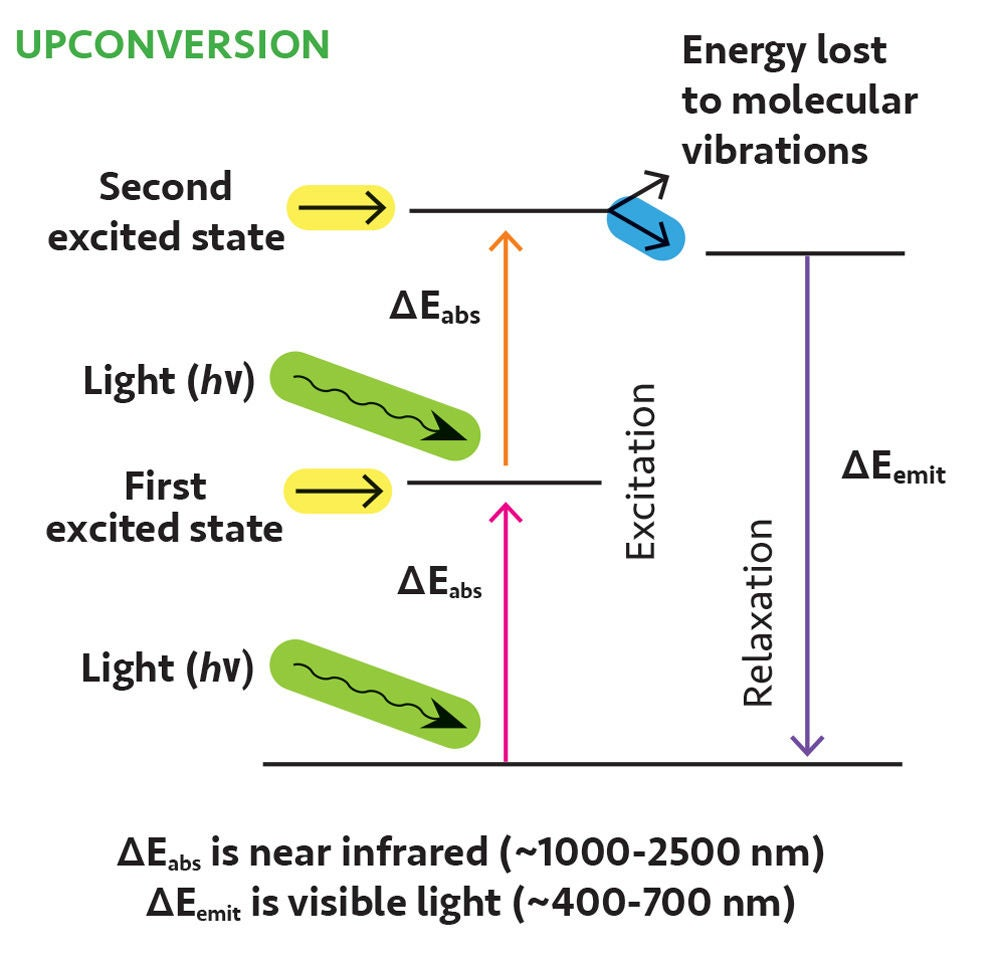
This may seem counterintuitive, since emitted light usually has a longer wavelength than the excitation light (Stokes’ law). The key to upconversion is that the excitation energy does not come from a single high-energy photon, but from stepwise absorption of several low-energy photons or energy transfer between ions, which “pump” the ion step by step to a higher level before it decays radiatively to emit a short-wavelength photon. Upconversion is most common in rare-earth-doped materials, especially those doped with erbium, thulium or praseodymium. It has both a useful side (generating short-wavelength lasers) and a harmful side (causing energy loss in gain media).
2. Working Principle: How Does Upconversion Work?
1. Mechanism 1: Excited-State Absorption (ESA)
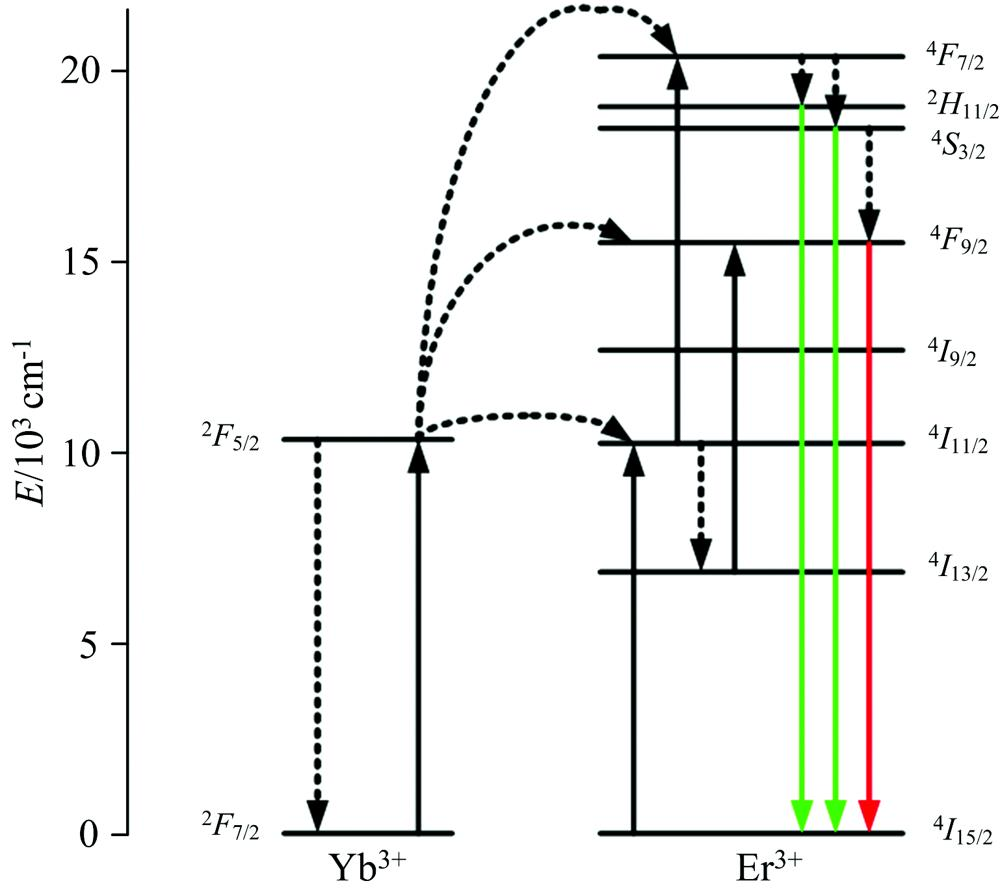
This is a single-ion upconversion process, in which one ion successively absorbs several pump photons and climbs step by step to higher levels: 1. The ion absorbs a first pump photon and jumps from the ground state to an intermediate excited state. 2. If the intermediate state lives long enough (it has not yet decayed to the ground state), it absorbs a second pump photon and jumps to a higher level. 3. Sometimes a third photon is absorbed to reach an even higher level. 4. Finally the ion in the high level returns radiatively to the ground state, emitting a short-wavelength photon with energy far above a single pump photon. A typical example is green upconversion luminescence in Er-doped fibre: the Er ion absorbs a 980 nm pump photon and is excited to the ⁴I₁₁/₂ level, absorbs another photon to reach ⁴F₇/₂, then relaxes rapidly to ⁴S₃/₂ and ²H₁₁/₂, from which it decays to the ground state emitting green light around 550 nm.
2. Mechanism 2: Energy Transfer Upconversion (ETU)
This process involves two or more ions and is also called Auger upconversion: 1. Two neighboring ions are both pumped to excited states. 2. One ion transfers its excitation energy to the other and returns to the ground state. 3. The ion receiving the energy is “lifted” to a higher level (equivalent to the sum of two excited-state energies). 4. This high-level ion decays to the ground state, emitting a short-wavelength photon. This mechanism is especially significant at high doping concentrations, because ions are close together and energy transfer is efficient. It is usually harmful—it consumes the upper-laser-level population and lowers laser efficiency.
3. Conditions for upconversion to occur
For upconversion to be significant, the key is that the intermediate level must have a long enough lifetime to have a chance to absorb the next photon or receive energy transfer before decaying. This is why host materials with low phonon energy (such as the fluoride glass ZBLAN) are especially suitable for upconversion lasers—low phonon energy means slow multiphonon relaxation and long intermediate-level lifetimes.
3. Key Parameters: Understanding Upconversion Performance Indicators
The core parameters are described below:
| Parameter Name | Meaning | Why It Matters |
|---|---|---|
| Upconversion Efficiency | The ratio of output upconversion luminescence power to input pump power. Efficient upconversion lasers require careful design of ion species, host material and doping concentration. | Reflects the ability to convert low-energy photons into high-energy ones, directly determining the output power and efficiency of an upconversion laser. Higher efficiency means stronger short-wavelength output for the same pump. |
| Upconversion Emission Wavelength | Determined by the energy gap between the ion’s high level and ground state. Common ones include green (erbium), blue (thulium, praseodymium) and red (praseodymium). | Determines the output wavelength of an upconversion laser, a core application metric. Different dopant ions and host materials yield various wavelengths from visible to near-infrared. |
| Number of Pump Photons | How many pump photons must be absorbed to produce one upconversion photon. Two-photon upconversion is most common; three-photon also exists. | The number of pump photons absorbed in the process, determining the order and efficiency of upconversion. More photons mean a larger wavelength-conversion ratio but usually lower efficiency and higher pump-power requirements. |
| Ion Concentration Dependence | The rate of energy-transfer upconversion is proportional to the nth power of concentration (n = number of ions involved), so high concentration accelerates upconversion. | How upconversion efficiency varies with doping concentration. Too low a concentration means large ion spacing and difficult energy transfer; too high means severe concentration quenching. An optimal doping concentration exists for maximum efficiency. |
| Phonon Energy | The lower the host’s phonon energy, the longer the intermediate-level lifetime and the higher the upconversion efficiency. | The host material’s phonon energy directly affects upconversion efficiency. Low-phonon-energy hosts (such as fluorides) have little nonradiative transition and high efficiency; high-phonon-energy hosts are less efficient but chemically stable. |
| Pump Threshold | The pump threshold of upconversion lasers is usually higher than that of ordinary lasers, because a higher excitation density is needed to populate the high levels. | The minimum pump power needed for upconversion lasing to start. A lower threshold means easier start-up, lower demands on the pump source and higher overall system efficiency. |
4. Main Types of the Upconversion Effect
The upconversion effect can be classified along different dimensions: by physical mechanism, by output wavelength, by host material, etc.
By Physical Mechanism
| Mechanism Type | English Abbreviation | Ions Involved | Features and Notes |
|---|---|---|---|
| Excited-State Absorption Upconversion | ESA | 1 ion | A single ion successively absorbs several pump photons; occurs even at low concentration, requires a long intermediate-level lifetime |
| Energy Transfer Upconversion | ETU | 2 or more ions | Energy transfer between ions, more significant at higher concentration, usually a harmful loss mechanism |
| Cooperative Luminescence | Cooperative | 2 ions | Two ions return to the ground state simultaneously, emitting one photon whose energy equals their sum—very low efficiency |
| Photon Avalanche Upconversion | PA | multiple ions | Cross-relaxation positive-feedback amplification, with a clear threshold and potentially high efficiency |
By Output Wavelength
| Type | Representative Active Ion | Typical Wavelength | Main Application |
|---|---|---|---|
| Green Upconversion | Er³⁺ (Yb³⁺ sensitized) | ~550 nm | Bioimaging, displays, upconversion lasers, anti-counterfeiting |
| Blue Upconversion | Tm³⁺, Pr³⁺ (Yb³⁺ sensitized) | ~450~480 nm | Blue light sources, data storage, biomedicine |
| Red Upconversion | Pr³⁺, Er³⁺ | ~600~670 nm | Display technology, photodynamic therapy |
| UV Upconversion | Tm³⁺, Pr³⁺ | ~300~400 nm | Photolithography, biomedicine, photocatalysis |
By Host Material
Fluoride Glass (ZBLAN, etc.)
Lowest phonon energy (~500 cm⁻¹), slow multiphonon relaxation, long intermediate-level lifetime and highest upconversion efficiency—the mainstream host for upconversion fibre lasers. But chemical stability is relatively poor and mechanical strength low.
Oxide Crystals
Higher phonon energy (~800 cm⁻¹), lower efficiency for some upconversion transitions, but high mechanical strength and good thermal properties, suited to high-power and harsh environments. Common ones include YAG, YVO₄ and GdVO₄ crystals.
Nanocrystals / Nanoparticles
Rare-earth-doped upconversion nanoparticles (UCNPs), tens to hundreds of nanometres in size, convert near-infrared light to visible or ultraviolet, with unique value in biomedical imaging, anti-counterfeiting and solar cells.
Upconversion Is Not Always a Good Thing
It should be stressed that in most solid-state and fibre lasers, upconversion is a harmful effect—it consumes the upper-level population, lowers laser efficiency and can excite ions to even higher levels, causing excited-state absorption and photodarkening. Only in dedicated upconversion lasers and upconversion-material applications is upconversion a beneficial effect to be exploited.
5. Applications of the Upconversion Effect
- Applications that use upconversion:
- Upconversion fibre lasers: Tm-doped ZBLAN fibre produces blue light, Er-doped fibre produces green, and Pr-doped fibre produces red/green/blue multicolor light. The waveguide structure of fibre maintains high pump intensity, especially suited to upconversion, which needs high excitation density.
- Upconversion nanomaterials: rare-earth-doped upconversion nanoparticles convert near-infrared to visible or ultraviolet light, with important uses in biomedical imaging (deep tissue penetration plus low background fluorescence), anti-counterfeiting and solar cells (harvesting near-infrared).
- Visible solid-state lasers: some upconversion crystal lasers produce visible light directly, without nonlinear frequency conversion.
- Three-dimensional displays: upconversion materials emit colored light under infrared laser excitation, enabling true 3D display technology.
- Scenarios where upconversion must be suppressed as a negative effect:
- High-power fibre lasers: cooperative upconversion at high doping concentrations consumes upper-level ions, lowering efficiency and potentially aggravating photodarkening.
- Fibre amplifiers: upconversion at high-power operation causes gain reduction and extra heat load.
- Pulse amplifiers: quenching processes such as upconversion limit energy-storage efficiency.
6. Common Misconceptions
Here are a few common misconceptions:
Misconception 1: ‘Upconversion is the same as frequency doubling—both use long wavelengths to generate short wavelengths.’
although the results look similar (long in, short out), the physics is completely different. Frequency doubling is a nonlinear optical effect requiring phase matching and occurring in nonlinear crystals; upconversion is an energy-level transition process occurring in doped ions and needs no phase matching. Frequency doubling combines two photons into one higher-energy photon through a parametric process in a nonlinear medium, with no intermediate energy levels involved
Misconception 2: ‘Upconversion violates the law of conservation of energy.’
upconversion does not violate energy conservation. The output photon does have more energy than each input photon, but several input photons are absorbed, so total energy is conserved—one high-energy photon’s energy equals the sum of n low-energy photons (minus losses)
Misconception 3: ‘Upconversion lasers are all highly efficient.’
in reality upconversion lasers are usually far less efficient than ordinary downconversion lasers. The reason is simple: each upconversion photon consumes n pump photons, with various losses along the way. Even relatively efficient upconversion fibre lasers typically have only a few to low tens of percent optical-to-optical efficiency
Misconception 4: ‘All rare-earth-doped materials show significant upconversion.’
upconversion strength depends on the host material and ion species. In high-phonon-energy hosts (such as silica glass), multiphonon relaxation is fast and intermediate levels short-lived, so upconversion is weak; only in low-phonon-energy hosts (fluoride glasses, some crystals) is it significant. Different ions also vary greatly in upconversion behaviour
Leave a Reply