


Pulse compression is an important concept in laser technology—understanding its principles, key parameters and applications is essential for correct component selection and system design. This article explains it clearly, from principles and key parameters to main types and typical applications.
Table of Contents
- 1. What Is Pulse Compression? Understanding the Core Concepts
- 2. Working Principle: How Does Pulse Compression Work?
- 3. Key Parameters: Understanding Pulse Compression Performance Indicators
- 4. Main Types: What Kinds of Pulse Compression Exist?
- 5. Applications: Where Is Pulse Compression Relevant?
- 6. Common Misconceptions: Pitfalls to Avoid
1. Core Concepts: What Is Pulse Compression?
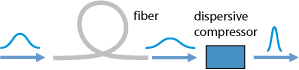
< Pulse compression is a technique that shortens the temporal width of an optical pulse by optical means, a key operation in ultrashort-pulse systems. It falls into two categories: linear compression uses dispersive elements to remove the chirp so all frequency components arrive together, compressing the pulse to the transform limit; nonlinear compression first broadens the spectrum through nonlinear effects and then compresses dispersively to obtain an even shorter output, reaching compression ratios above an order of magnitude.
Pulse compression is the process of recompressing a stretched, chirped pulse back to a short duration—it relies on grating pairs or chirped mirrors to compensate dispersion, working with the stretcher so a CPA system can both amplify energy and preserve an ultrashort pulse width.
2. Working Principle: How Does Pulse Compression Work?
Understanding how pulse compression works can be broken down into several key steps or mechanisms. Let us look at them one by one:
The principle of linear compression is intuitive: if a pulse carries a chirp (the instantaneous frequency differs between the leading and trailing edges), a dispersive element of opposite sign makes the leading frequencies “wait” for the trailing ones, so all frequencies recombine in time and the pulse reaches its narrowest, transform-limited width. Common compressors include grating pairs, prism pairs and chirped mirrors. Nonlinear compression has two steps: first the pulse passes through a nonlinear medium where self-phase modulation greatly broadens the spectrum and creates a chirp, then a dispersive compressor removes the chirp and shortens the pulse.
3. Key Parameters: Understanding Pulse Compression Performance Indicators
| Parameter Name | Meaning | Why It Matters |
|---|---|---|
| Compression Ratio | Ratio of input to output pulse width. Linear compression depends on the input chirp; nonlinear compression reaches 5×–10×. | The ratio of input to output pulse width, directly reflecting compression capability and key to the increase in peak power in a CPA system. |
| Output Pulse Width | The theoretical lower bound is set by spectral bandwidth (transform-limited width). | The compressed pulse width, directly determining the final peak power and time resolution. |
| Throughput | Grating compressors usually have significant loss. | The energy transmission through compression, affecting overall system efficiency; grating compressor efficiency is typically above 90%. |
| Pulse Quality | Presence of pedestals or satellite pulses, and how close the time-bandwidth product is to the transform limit. | The time-bandwidth product and pulse contrast after compression, reflecting how complete the dispersion compensation is. |
| Higher-Order Dispersion | Causes pulse-shape distortion. | Third-order and higher dispersion components cause pre-pulses and trailing edges, seriously degrading pulse contrast and peak power. |
These parameters are not isolated; they are interrelated and mutually constrained. In pulse compression there is a trade-off among compression ratio, spectral width and residual dispersion: to compress to a shorter width requires a broader spectrum and more precise dispersion compensation, otherwise sidelobes remain.
If you are not familiar with these parameters, that is fine—Soar Laser’s product pages have detailed descriptions, and you can also consult our technical engineers directly to help you select.
4. Main Types: What Kinds of Pulse Compression Exist?
Pulse compression can be classified in several ways, and different dimensions help us understand it from different angles. The common classification methods are introduced below:
By Type
Linear (Dispersive) Compression
Only dispersion compensation, without changing spectral bandwidth. Grating pairs offer large dispersion and high-power handling, the CPA standard; prism pairs have low loss and are common for intracavity compensation; chirped mirrors provide precisely controllable dispersion for broadband femtosecond pulses.
Nonlinear Compression
Broaden the spectrum via self-phase modulation first, then compress dispersively—an important route to shorter pulses.
Different types of pulse compression have their own advantages and disadvantages; there is no absolute “best,” only “most suitable.” Selection should consider your specific application, power requirements, budget and other factors. For example, for high-power industrial applications fibre lasers may be more suitable; for research with ultrashort-pulse needs, Ti:sapphire may be preferable.
5. Applications: Where Is Pulse Compression Relevant?
Pulse compression has a very wide range of applications, from industrial manufacturing to healthcare, from communication networks to scientific research—almost anywhere lasers are used. A few fields are briefly described below:
- Pulse compression is a “standard” stage in ultrafast laser systems. In CPA systems, compression is the final and most critical step—it determines the system’s peak power and pulse quality. Intracavity dispersion compensation in femtosecond lasers is essentially pulse compression. Nonlinear compression is an important route to few-cycle pulses, used in frontier research such as attosecond science and strong-field physics.
Typical Application Scenarios in Detail
Scenario 1: pulse compression is a “standard” stage in ultrafast laser systems; in CPA systems it is the final and most critical step
it determines the system’s peak power and pulse quality. Intracavity dispersion compensation in femtosecond lasers is essentially pulse compression. Nonlinear compression is an important route to few-cycle pulses, used in frontier research such as attosecond science and strong-field physics.
👉 Want to learn more about practical applications of pulse compression? Please visit Soar Laser’s application-case page, or contact our technical team directly for professional advice.
6. Common Misconceptions
Many people have somewhat plausible but mistaken notions about pulse compression. See whether you fall into any of the following:
Misconception 1: ‘A pulse can be compressed without limit.’
the pulse-width lower bound is set by spectral bandwidth (the Fourier transform limit); linear compression at best reaches the transform limit, and going shorter requires nonlinear spectral broadening first
Misconception 2: ‘The higher the compression ratio, the better.’ chasing a high compression ratio often sacrifices pulse quality
higher-order dispersion causes pedestals, satellite pulses and other distortions
Misconception 3: ‘Grating compressors are very efficient.’
a typical reflective grating needs four reflections at about 10–15% loss each, so total efficiency may be only around 50%
Misconception 4: ‘A broad spectrum alone lets you compress to any pulse width.’
the compression limit depends on both spectral bandwidth and phase flatness; however broad the spectrum, higher-order dispersion or uncompensated chirp will prevent reaching the transform-limited duration
Of course, there are far more misconceptions about pulse compression than these. Laser technology develops rapidly, with new materials and processes constantly emerging, so some previous “common knowledge” may already be outdated. If you have other questions, please leave a comment and we will answer them one by one.
Leave a Reply