


What Is a Gas Gain Medium? The Principles of CO₂ and He-Ne Lasers
Table of Contents
- 1. What Is a Gas Gain Medium? Understanding the Core Concepts
- 2. Working Principle: How Do Gas Gain Media Work?
- 3. Key Parameters: Understanding Gas Gain Medium Performance Indicators
- 4. Main Types of Gas Gain Media
- 5. Applications of Gas Gain Media
- 6. Common Misconceptions
1. Core Concepts: What Is a Gas Gain Medium?
A gas gain medium is a type of gain medium using a gas (or gas mixture) as the laser-active substance; it is a long-standing and widely varied branch of the laser family. Gas lasers were the first type to achieve continuous-wave operation (the He-Ne laser, 1961) and remain among the highest-output-power lasers today (industrial CO₂ lasers can exceed ten kilowatts).
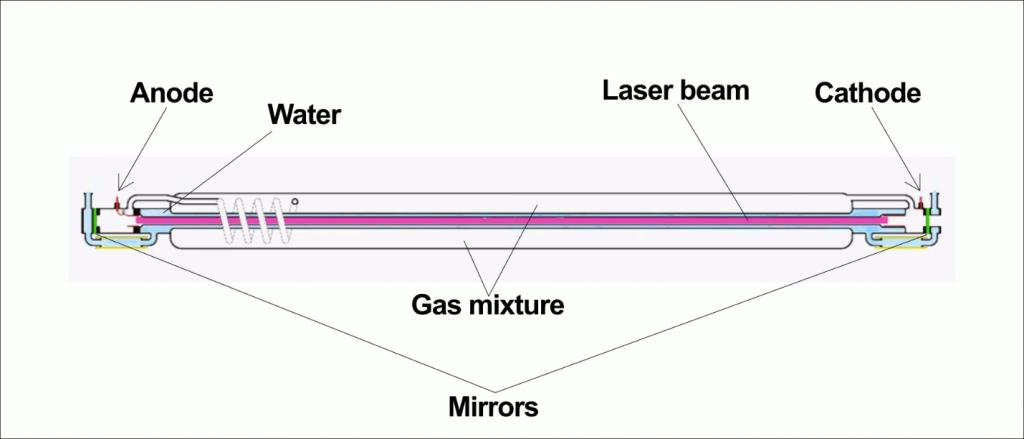
Unlike solid gain media, the laser-active particles of a gas gain medium are free atoms, ions or molecules dispersed in the gas, with almost no interaction among them. This brings two notable features: first, the optical homogeneity of a gas is excellent, giving very high output beam quality; second, although the thermal conductivity of gas is not high, heat can be carried away by flow, so power scalability is also good.
2. Working Principle: How Do Gas Gain Media Work?
1. Atomic gas lasers (taking He-Ne as an example)
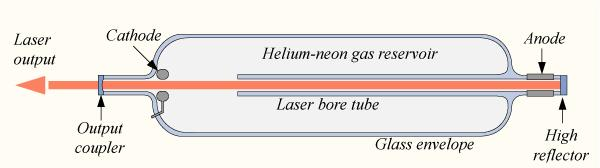
1. A mixture of helium and neon gas is filled into the discharge tube. 2. High voltage produces a gas discharge; electrons accelerate in the electric field and collide with helium atoms, exciting them to a metastable level. 3. Metastable helium atoms collide with neon atoms, transferring energy resonantly to excite neon atoms to the upper laser level (because helium’s metastable level is nearly equal to a certain excited level of neon). 4. Neon atoms accumulate in the upper level, achieving population inversion and producing laser light through stimulated emission.
2. Molecular gas lasers (taking CO₂ as an example)
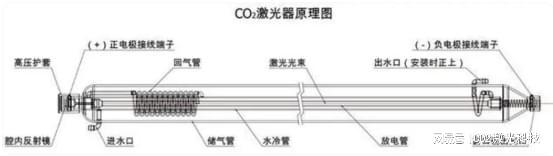
1. The working gas of a CO₂ laser is a mixture of CO₂, N₂ and He. 2. Discharge excites N₂ molecules to vibrationally excited states (N₂ is a homonuclear diatomic molecule that cannot radiate photons directly, so its energy storage time is long). 3. Excited N₂ molecules collide with CO₂ molecules, resonantly transferring energy to excite CO₂ to the upper laser level (a combined symmetric-stretching and bending vibrational level). 4. CO₂ molecules transition from the 00¹ level to the 10⁰ level, producing 10.6 μm far-infrared laser light. 5. He helps CO₂ molecules relax rapidly from the lower level back to the ground state (heat conduction + collisions), preventing lower-level bottlenecking.
3. Excimer lasers
An excimer is a special molecule—it only binds into a stable molecule in an excited state and dissociates immediately in the ground state. This means the lower laser level is always empty, making it a naturally perfect four-level system with very high gain. Excimer lasers emit deep-ultraviolet light and are widely used in photolithography and ophthalmic surgery. A common feature of gas lasers is that the gain medium can flow; gas circulation carries heat out of the resonator, an important reason gas lasers can achieve high average power.
3. Key Parameters: Understanding Gas Gain Medium Performance Indicators
The core parameters are described below:
| Parameter Name | Meaning | Why It Matters |
|---|---|---|
| Gain Coefficient | The gain coefficient of gases is usually not high (far below semiconductors and dyes), because gas density is low and there are few active particles per unit volume. But gas can be made very long to accumulate total gain. | Determines how much light is amplified per unit length, directly affecting a laser’s gain capability and cavity-length design |
| Small-Signal Gain | 33 Amplification per unit length. CO₂ lasers have gain of about 0.01–0.1 cm⁻¹; He-Ne is even lower. | The gain coefficient at low signal intensity, reflecting the intrinsic amplification ability of the gain medium. Higher small-signal gain means stronger amplification but also more prone to gain saturation. |
| Spectral Linewidth | Gas laser lines are usually very narrow (Doppler or collision broadening), with extremely narrow linewidth, suitable as narrow-linewidth frequency-stabilized sources. | The width of the gain medium’s fluorescence or laser spectrum, determining achievable laser linewidth and tuning range. Broader lines mean a larger tuning range and better suitability for ultrashort-pulse generation. |
| Emission Wavelength | Determined by the gas species. He-Ne is 632.8 nm (red), CO₂ is 10.6 μm (mid-to-far infrared), excimers are ultraviolet, argon-ion is 488 nm/514.5 nm (blue-green). | Determines the laser wavelength a gain medium can output, directly dictating the laser’s application scenarios. Different emission wavelengths serve different needs in materials processing, medicine and communications. |
| Upper-Level Lifetime | Varies widely. Atomic gas lasers have longer upper-level lifetimes (millisecond scale), molecular gases shorter. | Affects energy-storage capability—the longer the lifetime, the more energy Q-switching can store and the larger the pulse energy |
| Efficiency | CO₂ lasers can reach 10%–20% electro-optic efficiency, the highest among gas lasers. He-Ne efficiency is very low (about 0.01%). | Measures the overall ability of a gain medium to convert pump energy into laser energy. Higher efficiency means better energy utilisation, less heat and lower long-term operating cost. |
| Gas Pressure | Affects gain, linewidth and discharge stability. Low pressure gives low gain but narrow linewidth; high pressure gives high gain but broader linewidth. | Affects the output power, gain and linewidth of gas lasers. Higher pressure means greater particle density in the gain medium, but also broadens the line and affects mode quality, requiring optimised selection. |
4. Main Types of Gas Gain Media
Gas lasers come in many varieties; by the nature of the laser-active particles they can be divided into the following major categories:
1. Atomic gas lasers
Use energy-level transitions of neutral atoms to produce laser light. The most typical representative is the helium-neon (He-Ne) laser:
- He-Ne laser: 632.8 nm red light, good beam quality, narrow linewidth, widely used for alignment, measurement, holography and teaching
- Copper-vapor laser: 510 nm/578 nm (green/yellow), high-repetition-rate pulses, used for precision machining and research
- Helium-cadmium laser: 442 nm blue/325 nm ultraviolet, used for photolithography and fluorescence excitation
2. Ion gas lasers
Use energy-level transitions of ionized ions to produce laser light, with high output power but low efficiency:
- Argon-ion laser: multiple lines including 488 nm (blue) and 514.5 nm (green), continuous output power up to tens of watts
- Krypton-ion laser: multiple visible lines including 647 nm red, commonly used in medicine and displays
3. Molecular gas lasers
Use vibrational/rotational transitions of molecules, with wavelengths mostly in the infrared:
- CO₂ laser: 10.6 μm mid-to-far infrared, the highest-power industrial gas laser, 10%–20% electro-optic efficiency
- CO laser: 5–6 μm mid-infrared, high efficiency, used for materials processing and medicine
- N₂ molecular laser: 337 nm ultraviolet, ultrashort pulses, commonly used to pump dye lasers
- Chemical oxygen-iodine laser (COIL): 1.315 μm, extremely high power, for military directed-energy weapons
4. Excimer lasers
Use transitions of excited-state dimers (excimers), emitting deep-ultraviolet light:
- F₂: 157 nm (vacuum ultraviolet)
- ArF: 193 nm (deep ultraviolet)—the main light source for semiconductor photolithography
- KrF: 248 nm (ultraviolet)
- XeCl: 308 nm (near ultraviolet)
- XeF: 351 nm (near ultraviolet)
5. Other special types
- Metal-vapor lasers: copper vapor, gold vapor, etc.
- Gas-dynamic lasers: use rapid cooling by aerodynamic expansion to achieve population inversion
- Alkali-vapor lasers: rubidium or cesium vapor, optically pumped, with high efficiency and high-power potential
5. Applications: Where Are Gas Gain Media Relevant?
Main application areas:
- Industrial cutting and welding: CO₂ lasers are the traditional workhorse of industrial processing; though strongly challenged by fibre lasers in recent years, they retain advantages in thick-plate cutting and non-metal processing.
- Photolithography and micromachining: excimer lasers (especially ArF 193 nm) are the core light source for semiconductor photolithography, sustaining Moore’s law; excimer lasers are also used in micromachining, marking and surface modification.
- Medical field: CO₂ lasers for surgery (soft-tissue cutting); excimer lasers for refractive eye surgery (LASIK); argon-ion lasers for ophthalmic treatment and dermatology.
- Research and measurement: He-Ne lasers are the classic alignment and measurement source; narrow-linewidth gas lasers are used for precision spectroscopy and atomic physics research.
- Defence and directed energy: the chemical oxygen-iodine laser (COIL) is one technology route for airborne and space-based laser weapons, reaching megawatt-level power.
- Laser marking: CO₂ lasers are very widely used for marking non-metals (plastics, wood, leather, paper, etc.).
- Environmental monitoring: mid-infrared gas lasers (such as CO and CO isotope lasers) are used for gas spectroscopy detection.
6. Common Misconceptions
Here are a few common misconceptions:
Misconception 1: ‘Gas lasers are completely obsolete.’
although gas lasers are being replaced by fibre lasers in many areas (such as low-to-medium-power industrial processing), they remain irreplaceable in far-infrared high-power (CO₂), deep ultraviolet (excimer) and ultra-high-power (chemical lasers) fields. In particular, no other technology currently challenges the excimer laser’s position in semiconductor photolithography
Misconception 2: ‘All gas lasers have good beam quality.’
indeed, gases have good optical homogeneity and theoretically high beam quality. But high-power gas lasers (such as fast axial-flow CO₂ lasers) suffer some beam-quality degradation from gas-flow turbulence and thermal effects, while waveguide CO₂ lasers are limited by the waveguide structure
Misconception 3: ‘Gas lasers are all electrically pumped.’
most gas lasers are indeed electrically discharge pumped, but there are exceptions. Chemical lasers achieve population inversion through chemical reactions and need no electrical energy; alkali-vapor lasers are optically pumped; gas-dynamic lasers achieve inversion through expansion cooling
Misconception 4: ‘Gas lasers cannot reach very high power.’
quite the opposite: gas lasers are among the highest-power lasers of all types. A single industrial CO₂ laser can reach tens of kilowatts, and chemical lasers (such as COIL) can reach the megawatt level. The key is that gas can flow, carrying heat away promptly
Leave a Reply