


What Is a Semiconductor Gain Medium? How Electrons and Holes Emit Light
Table of Contents
- 1. What Is a Semiconductor Gain Medium? Understanding the Core Concepts
- 2. Working Principle: How Do Semiconductor Gain Media Work?
- 3. Key Parameters: Understanding Semiconductor Gain Medium Performance Indicators
- 4. Main Types: What Kinds of Semiconductor Gain Media Exist?
- 5. Applications: Where Are Semiconductor Gain Media Relevant?
- 6. Common Misconceptions
1. Core Concepts: What Is a Semiconductor Gain Medium?
A semiconductor gain medium is a type of gain medium based on semiconductor materials that achieves optical amplification through interband or intersubband transitions. It is the core of semiconductor lasers (most typically laser diodes) and is currently the highest-volume, most widely used laser gain medium.
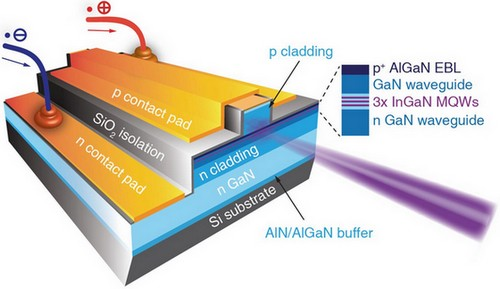
Unlike traditional doped-insulator gain media, the light emission of a semiconductor gain medium does not come from doped impurity ions but from the semiconductor material’s own electronic band structure. An electron transitions from the conduction band to the valence band and recombines with a hole, releasing a photon—this process can be spontaneous (LED) or stimulated (laser). Semiconductor lasers can exceed 50% electrical-to-optical conversion efficiency, far above other laser types, and are compact, long-lived and directly modulatable, making them one of the most important light sources of the information age.
2. Working Principle: How Do Semiconductor Gain Media Work?
1. Basic mechanism of interband transitions
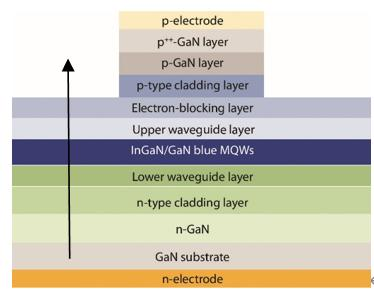
1. PN junction and carrier injection: the core of a semiconductor gain medium is a PN junction (more commonly a P-I-N heterostructure). With a forward applied voltage, electrons from the N region and holes from the P region are injected into the middle active region. 2. Formation of population inversion: in the active region, if the electron density in the conduction band and the hole density in the valence band are both high enough, population inversion is formed—more electrons in the lower conduction-band levels than in the upper valence-band levels. At this point stimulated emission exceeds stimulated absorption and the material can amplify light. 3. Stimulated-emission amplification: when a photon with energy near the band gap is incident, it stimulates conduction-band electrons to transition to the valence band and recombine with holes, releasing an identical photon. This continuously duplicates photons, achieving amplification. 4. Direct and indirect band gap: only direct-band-gap semiconductors (such as GaAs, InGaAs, GaN) emit light efficiently. In indirect-band-gap semiconductors (such as silicon) the conduction-band minimum and valence-band maximum are not at the same momentum, so electron–hole recombination needs a phonon for momentum conservation, giving extremely low emission efficiency—they can hardly be used as laser gain media.
2. Quantum wells and quantum dots
Modern semiconductor lasers almost all use quantum-well structures—the active region is made extremely thin (a few nanometres), electrons are confined in the well in the vertical direction and the band structure becomes quantized. This significantly increases gain and lowers threshold current. Quantum-dot structures were developed further, with even better performance.
3. Key Parameters: Understanding Semiconductor Gain Medium Performance Indicators
The core parameters are described below:
| Parameter Name | Meaning |
|---|---|
| Gain Coefficient | Optical amplification per unit length. Semiconductor gain coefficients are very high, reaching the 10³ cm⁻¹ order, so the gain region need only be a few hundred micrometres or shorter. |
| Threshold Current Density | The minimum current density needed to reach laser oscillation, one of the core metrics of semiconductor laser performance. |
| Internal Quantum Efficiency | The fraction of injected electron–hole pairs that recombine radiatively to emit light. |
| Modal Gain and Confinement Factor | The overlap between the optical-field mode and the active region determines the actual modal gain. The waveguide structure is crucial for confining the optical field. |
| Differential Gain | How gain changes with carrier concentration, determining the laser’s modulation bandwidth. |
| Emission Wavelength | Determined by the material’s band gap. GaAs-based about 800–1000 nm, InP-based about 1300–1600 nm, GaN-based about 400–550 nm. |
| Gain Bandwidth | Semiconductor gain bandwidth is fairly broad, usually tens of nanometres, enabling wavelength tuning and high-speed modulation. |
| Carrier Lifetime | Semiconductor carrier lifetimes are very short (nanosecond scale), so gain responds very fast, but it is unsuitable for energy storage and Q-switching. |
4. Main Types: What Kinds of Semiconductor Gain Media Exist?
Semiconductor gain media can be classified in several ways, and different dimensions help us understand them from different angles. The common classification methods are introduced below:
By Material System
GaAs-based
GaAs, AlGaAs, InGaAs, etc., emitting about 650–1100 nm, used for pump sources, data communications, CD/DVD
InP-based
InGaAsP/InP, emitting about 1300–1600 nm, the mainstay of optical fibre communications
GaN-based
GaN, InGaN, emitting about 400–550 nm, blue/violet lasers for blue-ray storage, displays and pumping
Mid-infrared semiconductors
Such as antimonides and lead salts, for mid-infrared gas detection
Quantum-cascade materials
Intersubband transitions, covering a wide mid-infrared and terahertz range
By Structure Type
Edge-Emitting Lasers (EEL)
Emit from the chip edge—the most common laser-diode form
Vertical-Cavity Surface-Emitting Lasers (VCSEL)
Emit from the chip surface, with a circular beam and easy array integration
Vertical-External-Cavity Surface-Emitting Lasers (VECSEL)
Also called semiconductor disk lasers, optically pumped with an external cavity, high power and good beam quality
Quantum-Cascade Lasers (QCL)
Unipolar (electrons only), intersubband transitions, the mainstay for mid-infrared and terahertz
Semiconductor Optical Amplifiers (SOA)
Both facets anti-reflection coated, used for optical signal amplification and all-optical signal processing
By Gain Dimension
Bulk material
Early structure, now rarely used
Quantum well (QW)
Mainstream structure with excellent performance
Quantum dot (QD)
Emerging structure with lower threshold, better temperature characteristics and broader bandwidth
Different types of semiconductor gain media have their own advantages and disadvantages; there is no absolute “best,” only “most suitable.” Selection should consider your specific application, power requirements, budget and other factors. For example, for high-power industrial applications fibre lasers may be more suitable; for research with ultrashort-pulse needs, Ti:sapphire may be preferable.
5. Applications: Where Are Semiconductor Gain Media Relevant?
Main application areas:
- Optical fibre communications: InP-based DFB lasers are the core source of optical communication systems, and together with EDFA form the foundation of modern optical communications; directly modulated high-speed lasers serve data centres and 5G fronthaul.
- Pump sources: high-power GaAs-based laser diodes are the pump source for nearly all fibre lasers and most solid-state lasers—without semiconductor pump sources there would be no modern high-power fibre-laser industry.
- Data storage: red and blue laser diodes are the read/write sources for CD, DVD and Blu-ray discs.
- Industrial processing: direct diode lasers combining multiple laser diodes are entering industrial cutting and welding markets, with clear efficiency advantages.
- Consumer electronics: laser pointers, laser keyboards, 3D sensing (VCSELs in iPhone Face ID), laser TVs, etc.
- Medicine and aesthetics: semiconductor lasers for hair removal, skin treatment and dentistry.
- Gas sensing: quantum-cascade lasers are the core source for mid-infrared gas detection, used in environmental monitoring, industrial process control and medical breath diagnostics.
- Research and defence: semiconductor lasers of various wavelengths are used in scientific research and defence equipment.
6. Common Misconceptions
Here are a few common misconceptions:
Misconception 1: ‘Semiconductor lasers are exactly the same as laser diodes.’
laser diodes are indeed the mainstay of semiconductor lasers, but not the whole story. Semiconductor lasers also include optically pumped VECSELs (semiconductor disk lasers) and quantum-cascade lasers—all with semiconductor gain media but different structures and pumping methods
Misconception 2: ‘Semiconductor lasers all have poor beam quality.’
low-power single-mode semiconductor lasers actually have good beam quality (near diffraction-limited), such as communication lasers and VCSELs. High-power multimode laser diodes do have poorer beam quality, but remain usable after fibre coupling and beam shaping. VECSEL beam quality is near diffraction-limited
Misconception 3: ‘Semiconductor lasers cannot reach high power.’
this is outdated. A single laser diode can now output tens of watts, and with diode bars and stacks, kilowatt-level or higher power is achievable. Direct diode lasers have entered the industrial processing market
Misconception 4: ‘Semiconductor gain media only suit electrical pumping.’
although electrical pumping is the most common and efficient method, semiconductors can also be optically pumped. The VECSEL is a typical optically pumped semiconductor laser, combining the advantages of semiconductor gain media and an external cavity for both high power and excellent beam quality
Misconception 5: ‘All semiconductor materials can serve as laser gain media.’
only direct-band-gap semiconductors emit light and lase efficiently. Indirect-band-gap materials such as silicon and germanium are very inefficient—though research is underway on silicon-based lasers (via strain engineering or germanium-tin alloys), it is far from mature
Leave a Reply