


What Is an Optical Amplifier? Amplifying a Weak Optical Signal Directly
You may often hear the term optical amplifier, but what exactly is it? What role does it play in a laser system, and how does it differ from other similar technologies? This article works from the underlying physics through to the engineering application and sets out the mechanism, the key parameters, the main types and the practical applications of optical amplifiers.
Table of contents
- 1. What is an optical amplifier? Getting the core concept straight
- 2. Working principle: how an optical amplifier is achieved
- 3. Key parameters: reading the specifications of an optical amplifier
- 4. Main types: what kinds of optical amplifier are there
- 5. Applications: where is an optical amplifier used?
- 6. Common misconceptions: pitfalls to avoid
1. Core concept: what is an optical amplifier?
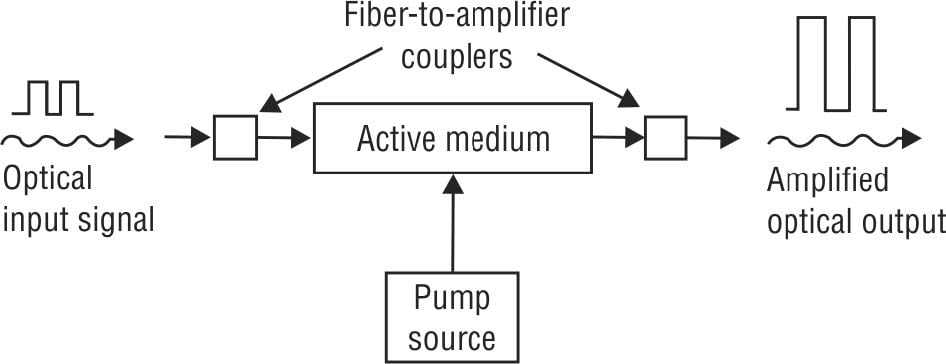
An optical amplifier is one of the most fundamental concepts in the laser field. It is a device that takes an input optical signal and outputs a higher optical power; in short, it is a “power amplifier for light”. Its core function is to raise the power of an optical signal without converting that signal into an electrical one. Optical amplifiers usually handle laser beams, which may travel in free space or along a fibre. The amplification takes place in what is called the “gain medium”, and the gain medium has to take energy from an external source (a process called “pumping”). Most optical amplifiers are pumped optically or electrically.
Optical amplifiers are indispensable in modern optical communication and laser technology. They solve the problem of power loss in long-haul transmission and in complex systems, and they form the basis of all-optical networks and high-power laser systems.
The performance of an optical amplifier sets the amplification quality, the transmission distance and the signal-to-noise ratio. In long-haul communication, laser systems and optical sensing, the amplifier is often what limits the performance of the whole system. Only by understanding the underlying physics can the key figures be picked out during selection.
Compared with an ordinary optical component or an ordinary light source, the distinguishing feature of an optical amplifier is how deliberately it acts — it does not merely let light pass through, it takes an active part in the generation, amplification or modulation of that light. This active role is precisely why a laser can do things ordinary light cannot.
2. Working principle: how is an optical amplifier achieved?
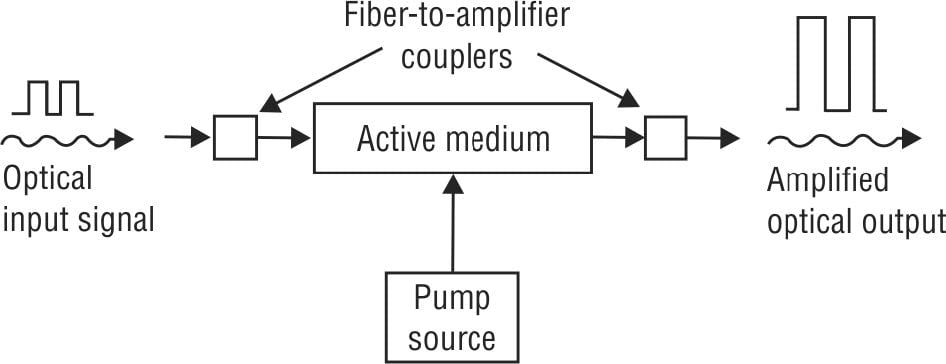
The working principle of an optical amplifier breaks down into two mechanisms, described below.
The first type is the laser amplifier (stimulated-emission type)
The laser amplifier achieves gain through stimulated emission and is the most common type. Its core physical mechanism is stimulated emission: the atoms, ions or molecules in the gain medium are pumped into an excited state, and when the signal light passes through, it “triggers” those excited particles to fall back to a lower energy level while releasing photons with the same frequency, the same direction and the same phase as the signal light, and the signal is thereby amplified. The gain medium of this kind of amplifier is usually an insulator doped with rare-earth ions (such as erbium or ytterbium) — a crystal, a glass or a fibre — or a semiconductor. Typical examples are fibre amplifiers and the semiconductor optical amplifier (SOA).
The second type is the nonlinear optical amplifier
A nonlinear amplifier does not rely on population inversion and stimulated emission; it uses optical nonlinear effects instead. The main types are:
- Optical parametric amplifier (OPA): based on the second-order nonlinear effect (χ⁽²⁾), amplifying through energy conversion between the pump light, the signal light and the idler light
- Raman amplifier: uses stimulated Raman scattering in the fibre to transfer energy from the pump light to the signal light
- Brillouin amplifier: uses stimulated Brillouin scattering, with phonons mediating the energy transfer between the signal light and the pump light
One important difference between the two is that a laser amplifier can store a certain amount of energy in the gain medium (for instance in the form of excited-state particles), whereas a nonlinear amplifier only provides gain while the pump light is present and has no energy storage capability.
◆ An analogy
If an optical transmission system is a marathon relay race, an optical amplifier is the “refuelling station” along the route — it does not change the direction of the run (the propagation direction of the light), but it tops up the energy of the tired runners (the attenuated optical signal) so that they can finish the course. The quality of the refuelling station (the noise figure and the gain of the amplifier) determines the final result.
In both cases the underlying logic is the same: a specific energy transfer process converts the energy supplied by the pump source into new photons that match the frequency and phase of the signal light, and the power of the signal is thereby raised.
The parameters of an optical amplifier are also interdependent. A higher gain usually brings more noise, a wider bandwidth lowers the gain efficiency, and a higher output power makes the nonlinear effects more visible. A genuinely good amplifier design balances gain, noise, bandwidth and output power against one another, which is why amplifier design is at once precise science and systems engineering.
3. Key parameters: reading the specifications of an optical amplifier
◆ Gain formula

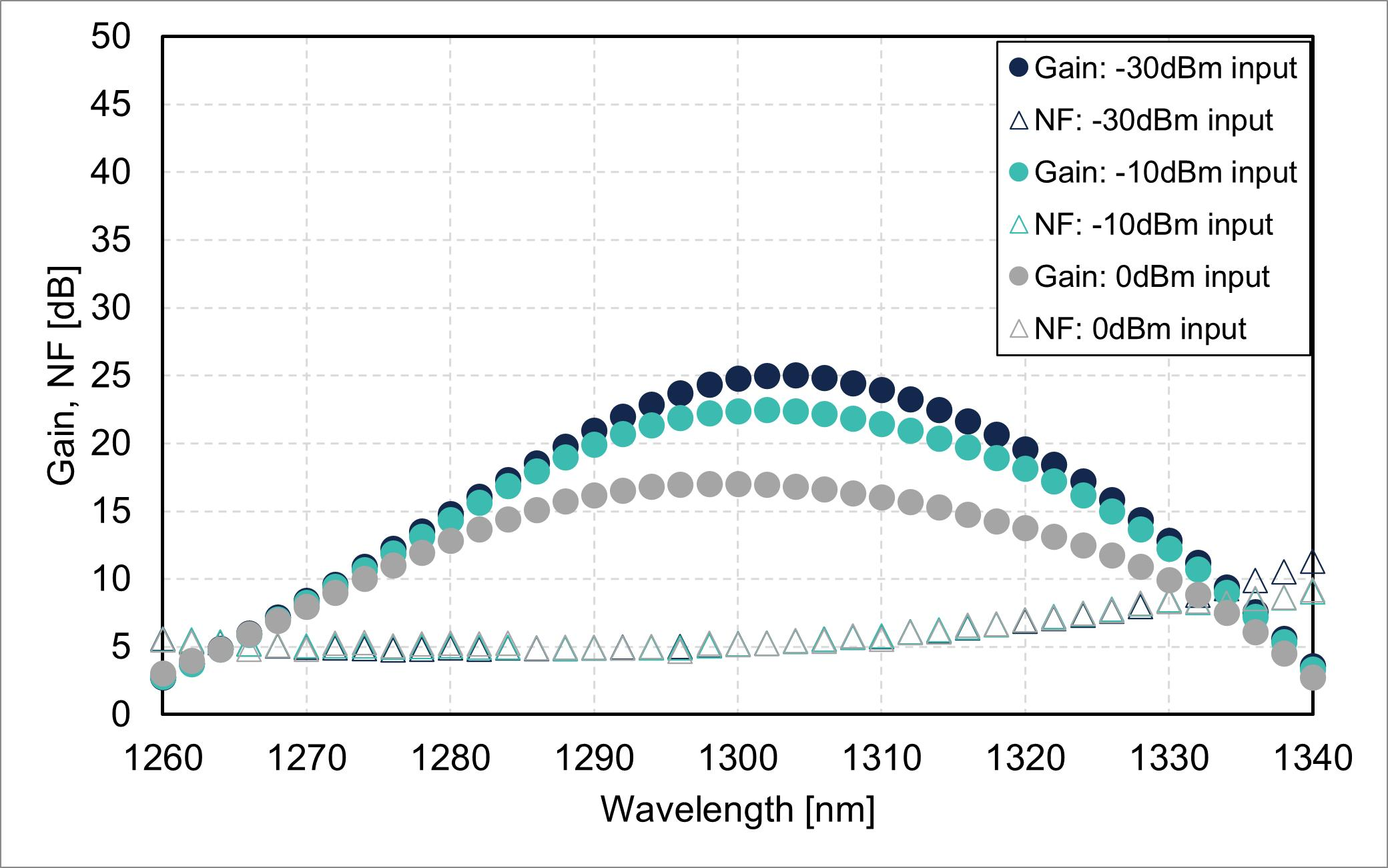
The gain G is defined as the ratio of the output power Pout to the input power Pin; expressed in decibels (dB) it is ten times the logarithm.
Gain is the most basic performance parameter of an optical amplifier and sets the factor by which the signal is amplified.
In practice a few key parameters decide whether a device is suitable. The table below sets out the core specifications of an optical amplifier and what each one means:
| Parameter | Meaning | Practical significance |
|---|---|---|
| Maximum gain | The largest amplification factor the amplifier can deliver, usually expressed in decibels (dB) | Sets how far the signal is boosted after passing through the amplifier; insufficient gain leaves the signal too weak to be received properly |
| Noise figure (NF) | The ratio of the noise added by the amplifier to the input noise, in dB | Directly affects the output signal-to-noise ratio; the lower the NF the better the amplifier, and a low-noise preamplifier typically has an NF below 5 dB |
| Saturated output power | The output power at which the gain has fallen by 3 dB, that is the maximum power the amplifier can deliver | Determines whether the amplifier can drive the following link or device; beyond the saturation region the gain is compressed |
| Gain bandwidth | The wavelength range over which the gain exceeds a specified value, for example the C band of an EDFA (erbium-doped fibre amplifier) covers about 35 nm | Sets how many wavelength channels the amplifier can handle at once, which is a key figure for WDM systems |
| Polarisation-dependent gain (PDG) | The extent to which the gain varies with the polarisation state of the input light, in dB | An excessive PDG causes jitter in the system; high-speed optical communication systems normally require it to be below 0.5 dB |
| Pump efficiency | The signal gain produced per unit of pump power, reflecting the energy conversion efficiency | Affects the power consumption and the cost of the amplifier; the higher the efficiency, the less pump power is needed |
These parameters are not independent of one another. Gain and bandwidth typically trade off against each other: raising the gain often narrows the available bandwidth, and the reverse holds as well. Pump efficiency, saturated output power and noise figure are coupled in a similar way, so no single figure can be used to judge an amplifier.
If some of these parameters are unfamiliar, the Soar Laser product pages carry detailed specifications, and our technical engineers can advise on selection directly.
4. Main types: what kinds of optical amplifier are there?
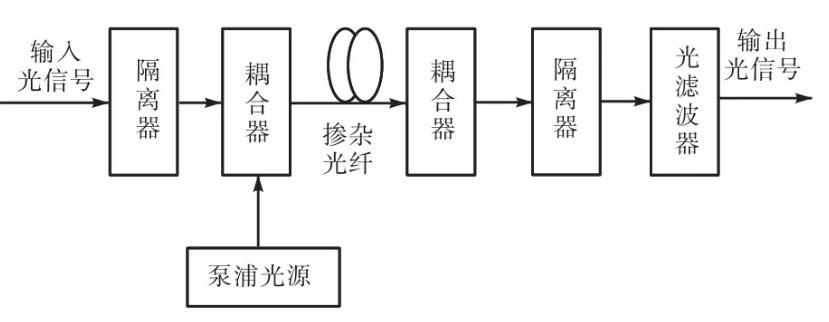
An optical amplifier can be classified along several dimensions, each of which brings out a different engineering trade-off. Here are the four most common ways of classifying them:
By working principle
Laser amplifier (stimulated-emission type)
Fibre amplifiers, semiconductor optical amplifiers, bulk solid-state amplifiers
Nonlinear amplifier
Optical parametric amplifiers, Raman amplifiers, Brillouin amplifiers
By the form of the gain medium
Fibre amplifier
The gain medium is a doped fibre; good beam quality and easy heat dissipation
Semiconductor optical amplifier
The gain medium is a semiconductor waveguide; compact and electrically pumped
Bulk amplifier
The gain medium is a laser crystal or glass; large power potential
By structural configuration
Single-pass amplifier
The light passes through the gain medium only once
Multi-pass amplifier
The light passes through the same gain medium several times to obtain higher gain
Regenerative amplifier
The light is held in a resonator and amplified over multiple round trips; suitable for ultrashort pulses
Amplifier chain (MOPA configuration)
Several amplifier stages are cascaded, with a preamplifier providing high gain and a power amplifier delivering the high output power
By function (in the communication field)
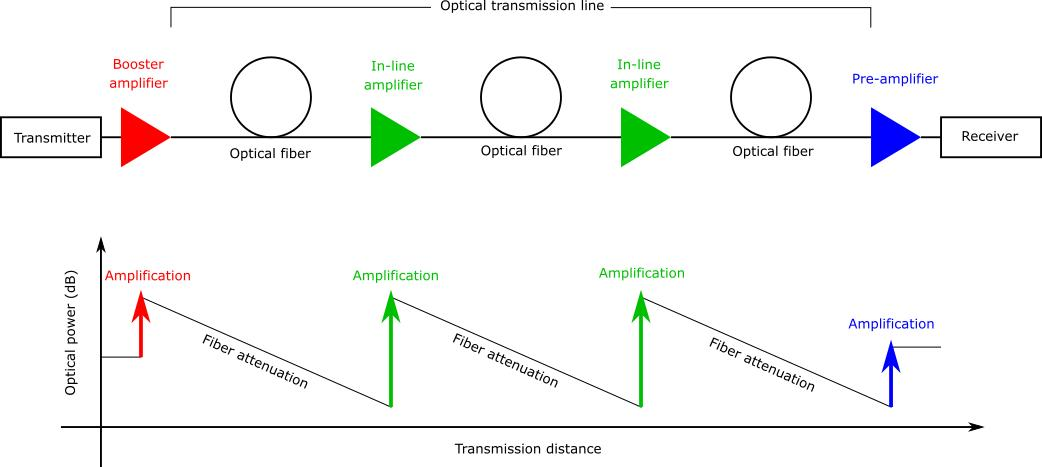
Booster amplifier
Placed at the transmitter end to raise the launch power
In-line amplifier
Placed mid-span to compensate for the fibre loss
Preamplifier
Placed ahead of the receiver to improve the receive sensitivity
Each type has its own advantages and drawbacks, and there is no absolute “best”, only what “fits”. Long-haul optical communication goes for an EDFA, high-speed signal handling goes for an SOA, ultrafast research with wide tunability goes for an OPA, and ultra-long submarine cables commonly use a hybrid of EDFA with distributed Raman. Selection has to weigh gain, noise, bandwidth, power, cost and size at the same time.
5. Applications: where is an optical amplifier used?
Optical amplifiers are used across a very wide range of fields, from industrial manufacturing to healthcare, from communication networks to scientific research; anywhere light has to be carried further or made stronger, an amplifier is involved. By main field they fall into the following categories:
- 1. Optical fibre communication: the largest application area for optical amplifiers. In long-haul fibre systems the amplifier (mainly an EDFA) compensates the transmission loss of the fibre, allowing signals to travel thousands of kilometres without optical-electrical regeneration. It is deployed in three forms: booster, in-line and preamplifier.
- 2. Laser processing and manufacturing: high-power fibre amplifiers and solid-state amplifiers serve industrial processes such as laser cutting, welding, marking and 3D printing, delivering output powers of kilowatts and beyond.
- 3. Ultrashort pulses and ultrafast lasers: ultrafast amplifiers amplify femtosecond or picosecond pulses to extremely high peak powers for research, medicine and precision manufacturing.
- 4. Optical sensing and measurement: optical preamplifiers boost weak sensing signals and improve detection sensitivity, as in distributed fibre temperature sensing and fibre-optic gyroscopes.
- 5. Defence and aerospace: high-power optical amplifiers are used in laser radar, directed-energy weapons and space optical communication.
Typical application scenarios
Scenario 1: optical fibre communication
This is where optical amplifiers are used in the greatest numbers. In a long-haul fibre system the EDFA compensates the loss of the fibre and allows the signal to cross thousands of kilometres without regeneration. Where it is deployed decides its type: a booster at the transmitter raises the launch power, an in-line amplifier every few tens of kilometres compensates the accumulated loss, and a preamplifier at the receiver pulls a signal that has already decayed to near the noise floor back into a usable range. All-optical regeneration is what this makes possible.
Scenario 2: laser processing and manufacturing
High-power fibre amplifiers and solid-state amplifiers serve laser cutting, welding, marking and 3D printing, with output powers in the kilowatt range. What matters here is how much usable processing power can be extracted per unit of pump power, that is the optical-to-optical conversion efficiency and the ability to shed the heat. A low-efficiency amplifier means a larger power supply and a more elaborate cooling system for the same processing power, and the size and cost of the machine rise with them.
Scenario 3: ultrashort pulses and ultrafast lasers
Ultrafast amplifiers take a seed of milliwatt power and push it to very high peak powers, for nonlinear spectroscopy, micro-machining and ultrafast dynamics. Here the demands on bandwidth and dispersion are far stricter than the demands on total power, so the amplifier usually also has to compensate for pulse broadening and a chirped Bragg grating or a bulk dispersion compensator becomes part of the system.
Scenario 4: optical sensing and measurement
An optical preamplifier sits ahead of the detector and amplifies the weak sensing signal before it reaches the detector, raising the detection sensitivity, as in distributed fibre temperature sensing and fibre-optic gyroscopes. These applications are far more sensitive to the noise figure than to the gain, because the signal has already reached close to the noise floor on arrival; every decibel of added noise costs a decibel of measurement resolution.
Scenario 5: defence and aerospace
High-power optical amplifiers are used in laser radar, directed-energy weapons and space optical communication. The constraints here are rarely laboratory figures but weight, volume, heat dissipation and reliability. Amplifier efficiency determines the power supply weight and radiator size for a given output power, and the unit has to survive vibration, temperature cycling and long continuous operation, which often calls for a specially ruggedised design.
◆ Want to see more real application cases for optical amplifiers? Visit the application case page of Soar Laser, or contact our technical team directly for professional advice.
6. Common misconceptions
Several fairly widespread but inaccurate beliefs circulate about optical amplifiers, and they need to be cleared up one by one:
Misconception 1: an optical amplifier is the same thing as a laser amplifier
A laser amplifier is only one large group of optical amplifiers. There are also nonlinear amplifiers such as the optical parametric amplifier and the Raman amplifier, whose working principle is entirely different and which rely on neither stimulated emission nor population inversion.
Misconception 2: the higher the gain, the greater the output power
Gain is only the amplification factor; the output power is also limited by the saturation power. The maximum output power of an amplifier with very high gain but low saturation power can be far below that of an amplifier with lower gain but higher saturation power. High-gain amplifiers suit weak signals, high-power amplifiers suit raising the power level.
Misconception 3: an optical amplifier amplifies the signal without adding noise
Every optical amplifier adds noise as it amplifies, and the noise comes mainly from amplified spontaneous emission (ASE). Quantum mechanics even sets a theoretical lower bound on the noise figure of a phase-insensitive amplifier — 3 dB — so noise-free amplification is not possible.
Misconception 4: every optical amplifier can store energy
Only laser-type amplifiers (such as fibre amplifiers and solid-state amplifiers) can store energy in excited-state particles, and for that reason they can produce peak powers far above the pump power when operating in pulsed mode. Nonlinear amplifiers such as the parametric amplifier and the Raman amplifier have no energy storage capability and only provide gain while the pump light is present.
There are more misconceptions than these. Laser technology develops quickly and new materials and new processes keep appearing, so some earlier “common sense” may already be out of date. If you have other questions, leave a comment and we will answer them one by one.
◆ Recommended reading
- What is an EDFA? The signal refuelling station of fibre communication
- What is a fibre amplifier? EDFA is only one of them
- What is gain? How the amplification capability of an optical amplifier is measured
- What is a noise figure? Why an amplifier adds noise
- What is an SOA? The principle and characteristics of a semiconductor optical amplifier
Leave a Reply