


What Are Sum- and Difference-Frequency Generation (SFG/DFG)? Adding and Subtracting Two Beams to Change Colour
Sum-frequency generation (SFG) adds two beams into a third of higher frequency; difference-frequency generation (DFG) subtracts them into one of lower frequency. Both are second-order nonlinear processes sharing the same phase-matching logic. This article covers the energy and momentum relations, why DFG is the same thing as optical parametric amplification, seven key parameters, and the practical reach from mid-infrared to terahertz.
Contents
- 1. What Are SFG and DFG? The Core Concept
- 2. How It Works: What Makes SFG and DFG Possible
- 3. Key Parameters: Reading an SFG/DFG Device Specification
- 4. Main Types: Which Kinds of SFG/DFG Set-up Exist
- 5. Applications: Where SFG and DFG Are Actually Used
- 6. Common Misconceptions: Four Widely Held Myths
1. The Core Concept: What Are SFG and DFG?
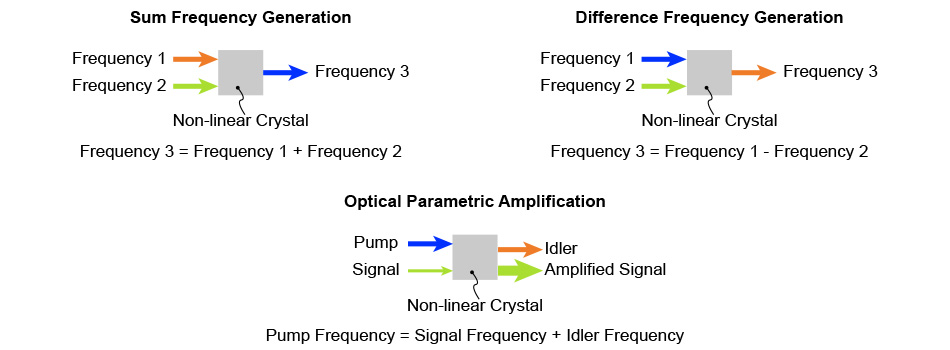
Sum-frequency generation (SFG) and difference-frequency generation (DFG) are two important second-order nonlinear effects. What they share is that two input beams of different frequency interact in a nonlinear crystal and a third beam at a new frequency comes out. The only difference is whether that third frequency is the sum or the difference of the other two.
Sum-frequency generation: two input beams at ω₁ and ω₂ pass through the crystal and produce the sum at ω₃ = ω₁ + ω₂. In photon terms, an ω₁ photon and an ω₂ photon merge into a single higher-energy ω₃ photon.
Difference-frequency generation: two input beams at ω₁ and ω₂ (with ω₁ > ω₂) produce the difference at ω₃ = ω₁ − ω₂. In photon terms, a high-frequency ω₁ photon is annihilated and an ω₂ photon plus a ω₃ photon appear. There is a second consequence worth noting: the low-frequency ω₂ beam is amplified in the process — which is why DFG is fundamentally a form of optical parametric amplification.
SFG, DFG, second-harmonic generation and optical parametric oscillation all belong to the same family of second-order frequency conversion, sharing the same physics and the same phase-matching requirement. What sets SFG and DFG apart is flexibility: doubling can only halve a wavelength, whereas SFG and DFG can be combined to reach almost any wavelength you need, which is why they are the main tool for filling wavelength gaps.
2. How It Works: What Makes SFG and DFG Possible
Step 1: Sum-frequency generation (SFG) — two photons become one
The energy relation for SFG is ℏω₁ + ℏω₂ = ℏω₃: two lower-energy photons merge into one higher-energy photon. Both inputs are consumed and a higher-frequency beam emerges. This is an up-conversion process, and its effect is to push light towards shorter wavelengths.
The phase-matching condition is k₁ + k₂ = k₃, where k is the wave vector of each wave in the crystal. Since the three frequencies differ, crystal dispersion has to be compensated by some mechanism if the three waves are to stay in step over the whole crystal length.
Step 2: Difference-frequency generation (DFG) — one photon splits
The energy relation for DFG is ℏω₁ = ℏω₂ + ℏω₃: a high-energy photon splits into one of intermediate energy and one of lower energy. The high-frequency pump ω₁ is consumed, the low-frequency signal ω₂ is amplified, and the difference beam ω₃ — also called the idler — is generated. This is a down-conversion process.
The phase-matching condition is k₁ = k₂ + k₃, equivalently k₁ − k₂ = k₃. Compared with SFG there is now a minus sign, meaning the wave vectors of the two inputs subtract, and the demand placed on crystal dispersion points the opposite way — the same crystal usually needs a different cut angle or poling period for SFG than for DFG.
Two relationships worth remembering
Doubling is a special case of SFG: when the two inputs have the same frequency (ω₁ = ω₂ = ω), SFG degenerates into second-harmonic generation with ω₃ = 2ω. Doubling therefore needs no separate theory; it is SFG solved under the degenerate condition.
DFG is the same thing as optical parametric amplification: physically it is one process described from two angles — DFG from the point of view of frequency conversion, OPA from the point of view of the signal gaining power. That is also why DFG devices are often used directly as OPAs.
◆ An analogy
SFG and DFG are the optical version of harmony and beating in sound: play two notes together and the ear hears both a higher combined tone (SFG) and a slow waxing and waning formed by their difference (DFG, that is, the beat). The difference is that light is an electromagnetic wave many orders of magnitude higher in frequency — that “difference tone” lands in the mid-infrared or even terahertz, where no ear can follow it but a detector can.
3. Key Parameters: Reading an SFG/DFG Device Specification
An SFG or DFG device has to keep three beams in hand at once, which makes the parameters more sensitive than for a doubler. These seven have to be confirmed before anything else:
| Parameter | What it means | Why it matters |
|---|---|---|
| Conversion efficiency | The ratio of SFG/DFG output power to input pump power. It depends on the intensity of both inputs, the nonlinear coefficient and length of the crystal, and the quality of phase matching. | Sets output power and overall system efficiency. Because two beams have to take part, SFG efficiency is usually below that of single-beam doubling; real designs optimise the power ratio and polarisation of the two inputs to get the most out of it. |
| Effective nonlinear coefficient d_eff | The nonlinear strength actually at work under a given phase-matching condition, in pm/V — the basic parameter for choosing a crystal and calculating efficiency. | Sets the real strength and efficiency of the conversion. d_eff already folds the intrinsic coefficient together with the geometric factor of the matching configuration, so at equal conditions a larger value gives higher efficiency. |
| Phase-matching bandwidth | The wavelength or temperature range over which useful conversion is maintained. Broadband work — ultrashort pulses, wide tuning — depends on it most. | Sets how forgiving the device is about wavelength, temperature and angle. A wide band is more stable and easier to align, and is a prerequisite for ultrashort pulses and tuneable lasers. |
| Walk-off angle | Under critical phase matching, the angle between the Poynting vector of the extraordinary wave and its wave vector. Severe walk-off limits the effective interaction length and the beam quality. | Bears directly on effective length and output beam quality. With severe walk-off the three beams separate in space, efficiency drops and the spot distorts, so high-power designs should prefer a low walk-off scheme. |
| Group-velocity mismatch | Waves of different frequency travel at different group velocities in the crystal, so pulses drift apart in time. This is the main limit on ultrashort-pulse SFG and DFG. | Decides whether a femtosecond or picosecond system can use a long crystal. The larger the group-velocity difference, the sooner the pulses separate and the lower the efficiency. |
| Acceptance angle and temperature bandwidth | The tolerance of phase matching to incidence angle or crystal temperature. The wider the tolerance, the easier the alignment and the more stable the operation. | Measures how forgiving the device is about angle and temperature. Wide tolerance means looser operating conditions, less long-term drift, and easier alignment and volume production. |
| Pump depletion | At high conversion the pump power drops noticeably — that is pump depletion. It can be ignored in the low-efficiency approximation but must be included at high efficiency. | Reflects how far the pump has been converted into signal and idler. More depletion means more complete energy transfer, but pushing too far invites back-conversion and the output falls again. |
4. Main Types: Which Kinds of SFG/DFG Set-up Exist
There are three axes: the type of effect, which decides whether frequency goes up or down; the matching method, which decides tuning and walk-off; and the application, which decides the target band. Real devices stack all three.
By type of effect
- Sum-frequency generation (SFG): up-conversion, with an output shorter in wavelength than either input, used to reach specific visible or ultraviolet wavelengths. A typical case is 1064 nm plus 1342 nm giving 593.5 nm yellow-orange.
- Difference-frequency generation (DFG): down-conversion, with an output longer than both inputs, commonly used for mid-infrared and terahertz. A typical case is two near-infrared beams mixing down to 3–5 μm.
By phase-matching method
- Birefringent phase matching: uses the birefringence of the crystal and reaches matching through angle or temperature. It comes in type I and type II, critical and non-critical variants; tuning is flexible, but critical matching carries walk-off.
- Quasi-phase matching (QPM): periodically inverted domain structures (PPLN, PPKTP and the like) compensate the mismatch. It can exploit the crystal’s largest nonlinear coefficient and allows flexible wavelength design, and it is increasingly common in SFG and DFG, at the cost of demanding poling and tight period tolerances.
By application
- Visible generation: SFG turns infrared into visible light, reaching colours such as yellow and orange that ordinary lasers cannot deliver directly.
- Mid-infrared generation: DFG provides continuously tuneable output in the mid-infrared (2–5 μm and beyond) for spectroscopy and environmental monitoring.
- Terahertz generation: two lasers of very closely spaced frequency are mixed, and the small difference falls in the terahertz band.
- Up-conversion detection: a weak infrared signal is summed with a strong pump to move it into the visible or near-infrared, where an efficient silicon detector or photomultiplier can measure it.
5. Applications: Where SFG and DFG Are Actually Used
The six directions fall into three groups: filling in wavelengths that do not exist, moving an unmeasurable band somewhere measurable, and linking frequencies in precision metrology. The test is always whether a source or a detector exists in the target band.
- Visible lasers at unusual wavelengths: SFG is the main way to reach certain visible wavelengths. Summing 1064 nm with 1342 nm from two neodymium lasers gives 593.5 nm yellow-orange, used in laser displays and dermatology; a sodium guide star needs 589 nm, normally obtained by summing 1064 nm with 1319 nm. The two wavelengths differ by a few nanometres yet use two different input combinations — a neat illustration of SFG as build-to-order wavelength assembly.
- Mid-infrared sources: DFG is an important route to broadband tuneable mid-infrared. Choose the two near-infrared pump wavelengths and the output tunes continuously across 2–5 μm and beyond. The mid-infrared is known as the molecular fingerprint region, where the characteristic absorption bands of most molecules sit, which is why gas detection, trace spectroscopy and environmental monitoring all depend on it.
- Terahertz radiation: mixing two lasers whose frequencies are very close produces a difference in the 0.1–10 THz range. This is one of the main routes to coherent terahertz radiation, with prospects in security imaging, non-destructive materials testing and high-speed communication.
- Infrared up-conversion detection: a weak infrared signal is summed with a strong pump into the visible or near-infrared and then measured with a silicon detector or photomultiplier. Silicon detectors have far lower noise-equivalent power in the visible than mid-infrared detectors do, so moving the band before detecting can improve sensitivity by orders of magnitude.
- Frequency chains and optical frequency combs: in precision metrology such as optical frequency combs and optical clocks, SFG and DFG are what weld different frequency intervals together; without them the microwave reference cannot be connected to optical frequencies at all.
- Quantum optics: spontaneous parametric down-conversion — the quantum version of DFG — produces entangled photon pairs and is one of the most used light sources in quantum communication and quantum computing experiments.
6. Common Misconceptions
SFG and DFG are often treated as two unrelated effects, and the misunderstandings grow from there. These four are the ones we are asked about most:
Misconception 1: SFG and DFG are two completely independent effects
They are two directions of one physical process, both bound by energy conservation and phase matching and linked to each other through the Manley-Rowe relations — which state, in essence, that producing one photon necessarily consumes one photon, locking the flow of energy and photon number together. In a sense DFG is the reverse of SFG, and only by seeing that link does the whole picture of nonlinear frequency conversion come together.
Misconception 2: in SFG the two input beams are depleted equally in power
They are not. In photon number, every sum photon produced consumes one ω₁ photon and one ω₂ photon, so the two beams lose the same number of photons. But the frequencies differ, so the energy carried away differs, and the power depletion ratio equals the frequency ratio: P₁ depleted / P₂ depleted = ω₁ / ω₂. That bears directly on the power budget of the two sources — the higher-frequency one is drained faster.
Misconception 3: DFG produces only one output beam
A DFG stage has two output effects: it generates the difference beam ω₃ and it amplifies the signal ω₂. A weak ω₂ actually gains power as it passes through, and ω₃ appears alongside it. This is exactly why DFG is also called optical parametric amplification — it amplifies as well as converts, rather than merely shifting a wavelength.
Misconception 4: an SFG/DFG crystal only needs to phase match at the target wavelength
Choosing a crystal means looking at all three wavelengths — two in, one out — together. The crystal must transmit well at all three, the refractive indices at all three must combine to satisfy the matching condition, and the polarisations, walk-off and group velocities all have to be compatible. Picking a crystal on the output wavelength alone usually ends in poor efficiency or poor beam quality.
Leave a Reply