


What Is Optical Parametric Oscillation (OPO)? The OPO Laser with a Tuneable Wavelength
An optical parametric oscillator (OPO) looks like a laser: it has a resonator, it has a threshold, and it emits coherent light. Yet its gain does not come from stimulated emission — it comes from parametric amplification inside a nonlinear crystal. It uses a second-order nonlinear effect to turn one high-frequency pump beam into two lower-frequency beams, the signal and the idler. This article explains how OPG differs from OPO, how the three resonance schemes trade threshold against tuning, six key parameters and six application areas.
Contents
- 1. What Is Optical Parametric Oscillation? The Core Concept
- 2. How It Works: How Optical Parametric Oscillation Is Realised
- 3. Key Parameters: Reading an OPO Specification
- 4. Main Types: Which Kinds of OPO Exist
- 5. Applications: Where OPOs Are Actually Used
- 6. Common Misconceptions: Four Widely Held Myths
1. The Core Concept: What Is Optical Parametric Oscillation?
An optical parametric oscillator (OPO) is a coherent light source that behaves much like a laser, except that its gain comes from parametric amplification in a nonlinear crystal rather than from stimulated emission. Using a second-order nonlinear effect, it converts one high-frequency pump beam into two beams of lower frequency — the signal and the idler — which satisfy ωp = ωs + ωi, that is, the pump frequency equals the signal frequency plus the idler frequency.
The outstanding advantage of an OPO is its very wide tuning range. Change the phase-matching condition — crystal temperature, crystal angle, or the poling period of a quasi-phase-matched crystal — and the signal and idler wavelengths move continuously, covering everything from the visible through the mid-infrared and on to the terahertz. An ordinary laser cannot do this, because its wavelength is pinned by the emission bandwidth of the gain medium, typically to a few nanometres.
The price is that an OPO must have a resonator to provide feedback, so that the signal or the idler circulates inside the cavity and picks up parametric gain again and again. Like a laser, an OPO has an oscillation threshold: below it, the parametric gain inside the cavity cannot overcome the cavity losses and oscillation never starts; only above it does a sustained coherent output appear. That threshold line is the starting point for understanding every design trade-off in an OPO.
2. How It Works: How Optical Parametric Oscillation Is Realised
From OPG to OPO: only with a cavity does it become an oscillator
The physics at the heart of an OPO is parametric down-conversion: inside a nonlinear crystal, one high-frequency pump photon splits into a signal photon and an idler photon, conserving both energy (ℏωp = ℏωs + ℏωi) and momentum (kp = ks + ki, that is, phase matching).
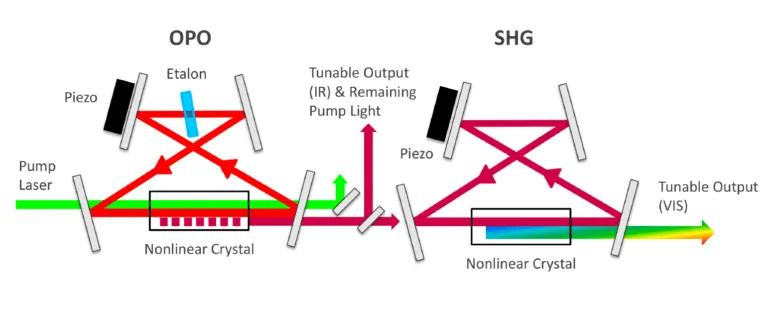
If the pump simply passes through the crystal once, the signal and idler produced are very weak. That is optical parametric generation (OPG), which behaves more like superfluorescence and is poor in both directionality and monochromaticity. Put mirrors at both ends of the crystal to form a resonator and let the signal (or signal plus idler) reflect back and forth, gaining a little parametric gain on every pass, and once the gain exceeds the cavity losses sustained oscillation builds up: that is an OPO. The cavity is not there to select frequency; it is there to accumulate a gain that is minute on a single pass.
Three resonance schemes: a trade-off in threshold
How many of the beams resonate inside the cavity directly sets the threshold and the difficulty of tuning, and it is the single most important choice in OPO design:
- Single resonance (SRO): only one of the two, signal or idler, resonates in the cavity while the other leaves after a single pass. The threshold is higher, but tuning is straightforward and operation is stable, which makes it the most widely used type.
- Double resonance (DRO): both signal and idler resonate. The threshold is more than an order of magnitude below that of an SRO, but tuning becomes difficult — the device is extremely sensitive to cavity length and pump wavelength and readily hops between modes.
- Triple resonance (TRO): the pump resonates as well. The threshold is the lowest of all, but three resonance conditions must be met at once, leaving an extremely narrow stable window; in practice it is hardly ever used.
Wavelength tuning: moving the phase-matching point
Tuning is, in essence, a matter of moving the phase-matching condition. For a given pump wavelength, the pairs of signal and idler wavelengths that satisfy kp = ks + ki are not unique: change the crystal temperature, the angle or the poling period and you select a different split, so the wavelengths move. Take 532 nm green pumping as an example: the signal tunes across 700–1000 nm while the idler tunes across 1100–2500 nm, the two strictly complementary (as the signal moves to longer wavelengths the idler must move to shorter ones).
The pumping scheme sets the output format
Continuous-wave pumping gives a continuous output whose linewidth can be made narrow, but the threshold becomes extremely sensitive to cavity losses. Nanosecond pulsed pumping (a Q-switched laser) offers high peak power and starts oscillating most easily, and the output is nanosecond pulses as well. Synchronous pumping uses a mode-locked femtosecond or picosecond laser, and the cavity length must match the pump repetition rate exactly so that each round trip coincides with the next pump pulse — the output is therefore ultrashort pulses too.
◆ An analogy
The relationship between an OPO and a laser is a little like that between a pipe organ and a reed: a laser makes its own sound because the reed vibrates (stimulated emission, with energy stored in the upper laser level), whereas an OPO cannot sound on its own — it is a cavity that the pump blows through, and the moment the air stops the sound stops too, because nothing is stored inside. That explains two characteristics of the OPO: its response is fast enough to follow femtosecond pulses, and any fluctuation in the pump appears immediately in the output.
3. Key Parameters: Reading an OPO Specification
Two of the parameters below are unique to the OPO — threshold and tuning range — while the rest are shared with lasers. These six are the ones to confirm when specifying a device:
| Parameter | Meaning | Why it matters |
|---|---|---|
| Optical-to-optical conversion efficiency | The ratio of the output signal power (or signal plus idler power) to the input pump power. Continuous-wave OPOs typically reach 30%–60%, pulsed OPOs 50%–80%. | It sets the overall energy efficiency and the output power level. The higher the efficiency, the less pump power is needed for a given output, and the lower the heat load and the cost. In high-power applications conversion efficiency is the first consideration. |
| Oscillation threshold | The minimum pump power needed to sustain oscillation, governed by the nonlinear coefficient of the crystal, the cavity losses and the output coupling. An SRO threshold is typically more than an order of magnitude above a DRO threshold. | The threshold decides whether the OPO oscillates at all and how much pump power is required. A high threshold forces a larger pump laser, and the system cost jumps with it. Low-threshold design is the key to making OPOs practical. |
| Wavelength tuning range | The range over which the output wavelength can be tuned continuously, set jointly by the pump wavelength, the crystal material and the tuning method. | This is the OPO’s central value proposition. An ordinary laser is confined by its gain medium to a narrow tuning range, whereas an OPO can run all the way from the visible to the mid-infrared, which is what makes it key to spectroscopy, remote sensing and similar fields. |
| Linewidth | The spectral width of the output. A free-running OPO is typically tens of GHz; add frequency-selective elements such as etalons or gratings and it can be narrowed to the MHz or even the kHz level. | It determines monochromaticity and coherence. High-resolution spectroscopy and precision measurement need a narrow linewidth, whereas a device used purely as a pump source is relaxed about it. When specifying, ask first whether you are buying the wavelength or the coherence. |
| Beam quality M² | How closely the output approaches an ideal Gaussian beam; the closer M² is to 1, the better. | It bears directly on far-field focusing and propagation. Because of walk-off, thermal effects and similar mechanisms, an OPO usually delivers worse beam quality than its pump. Applications such as cutting and marking are especially sensitive to M². |
| Phase-matching scheme | The technique used to phase-match the parametric process: angle tuning, temperature tuning or quasi-phase matching (QPM). | It governs the tuning method, the tuning speed, the usable crystal length and the conversion efficiency. Angle tuning is flexible and fast but suffers walk-off; temperature tuning avoids walk-off but is slow; QPM can exploit the largest d coefficient, at the cost of a lower damage threshold. |
4. Main Types: Which Kinds of OPO Exist?
There are three threads to classify by: the resonance scheme, which sets threshold and stability; the pumping scheme, which decides whether the output is continuous or ultrashort; and the crystal type, which sets the tuning method and the efficiency ceiling.
By resonance scheme
- Singly resonant OPO (SRO): one beam only (usually the signal) oscillates in the cavity while the idler leaves after a single pass. The threshold is higher, but tuning is convenient and operation stable, which makes it the most common type in industry and research.
- Doubly resonant OPO (DRO): signal and idler both oscillate. The threshold is low, but tuning is difficult and mode hopping is easy; it is mainly used where pump power is limited or an extremely low threshold is required.
By pumping scheme
- Nanosecond pulsed OPO: pumped by a Q-switched nanosecond laser, with high pulse energy and wide wavelength coverage, widely used in spectroscopy and remote sensing.
- Continuous-wave OPO (CW OPO): pumped by a continuous-wave laser, giving a continuous output with a narrow linewidth, well suited to high-resolution spectroscopy. Quasi-phase-matched crystals such as PPLN are usually chosen to obtain enough gain to bring the threshold down.
- Synchronously pumped OPO: pumped by a mode-locked femtosecond or picosecond laser with the cavity length matched to the pump repetition rate, delivering ultrashort pulses for ultrafast spectroscopy and nonlinear optics research.
By crystal type
- Conventional birefringently phase-matched OPO: uses crystals such as BBO, LBO or KTP and tunes by angle or temperature. The tuning range is wide, but critical phase matching brings walk-off.
- Quasi-phase-matched OPO (QPM-OPO): uses periodically poled crystals such as PPLN or PPKTP. Efficiency is high, and several poling periods can be fabricated on one crystal (a multigrating design), so changing period changes wavelength — a very convenient way to tune.
5. Applications: Where OPOs Are Actually Used?
The six areas below fall into three groups: spectroscopy and remote sensing, which need an arbitrary wavelength; countermeasures and materials processing, which need high-power mid-infrared; and quantum technology, which needs squeezed states and entanglement. The test is always the same — can an ordinary laser deliver that wavelength, or that quantum state?
- Laser spectroscopy: one of the most important application areas for the OPO. Its wide tuning makes it an ideal source for molecular and atomic spectroscopy, especially in the mid-infrared (2–5 μm and beyond) — the region known as the molecular fingerprint region, where the characteristic absorption bands of a great many molecules lie and which no ordinary laser covers so broadly. Combined with absorption spectroscopy, photoacoustic spectroscopy and related techniques, it serves environmental monitoring, gas analysis and combustion diagnostics.
- Military and defence: the 3–5 μm mid-infrared light generated by an OPO can be used for infrared countermeasures (IRCM), jamming the seeker of an infrared-guided missile. High-power mid-infrared OPOs are an important building block of such laser systems.
- Quantum optics research: the OPO is the key device for generating squeezed light and entangled photon pairs. Operated below threshold it is the standard squeezed-light source (and a spontaneous parametric down-conversion source); operated above threshold it emits bright squeezed light. It is indispensable in quantum information, quantum computing and quantum-enhanced metrology.
- Biomedicine and imaging: the near- and mid-infrared output of an OPO serves multiphoton imaging and optical coherence tomography (OCT). Tunability allows the wavelength to be matched to the absorption and scattering of different biomolecules, which is particularly useful when mapping the distribution of lipids, collagen and water.
- Lidar and remote sensing: a tuneable OPO is the core source for differential absorption lidar (DIAL) — tune the wavelength onto an absorption line of a gas such as CH₄ or CO₂ and take one measurement, then tune to a nearby non-absorbing wavelength and take another; the ratio of the two returns gives the column concentration of that gas.
- Materials processing: some materials absorb strongly at particular mid-infrared wavelengths, and processing with a bespoke OPO wavelength can give better results — transparent polymers, for instance, absorb markedly more strongly near 2 μm than at 1 μm.
6. Common Misconceptions
An OPO looks and handles like a laser, so the misunderstandings cluster around treating it as just another laser. These four come up most often:
Misconception 1: An OPO is the same thing as a laser, just a different name
Both have a resonator and a threshold, and both emit coherent light, but the gain mechanisms are entirely different. A laser amplifies by stimulated emission after population inversion, which involves level transitions and energy storage; an OPO amplifies by a parametric process in a nonlinear crystal, with no population inversion — energy passes straight from the pump to the signal and idler, and nothing is stored. Two observable consequences follow. An OPO responds instantaneously (it can follow femtosecond pulses, and the output stops the instant the pump does), and it has no storage-type noise such as ASE: its noise is inherited from the pump.
Misconception 2: An OPO can only output two fixed wavelengths (signal and idler)
Quite the opposite: the whole point of an OPO is that both of those wavelengths can be tuned continuously over a wide range. Changing the crystal temperature, angle or poling period redistributes signal and idler across a broad span. For a given pump wavelength there are, in principle, infinitely many signal/idler pairs that satisfy phase matching, provided the two frequencies sum to the pump frequency. “Two wavelengths” means one signal and one idler at any instant, not one single pair for ever.
Misconception 3: The higher the conversion efficiency, the higher the output power
Conversion efficiency is only a ratio of output to input; the absolute output power still has to be multiplied by the pump power. Chasing efficiency single-mindedly also carries other costs: worse beam quality, broader spectrum, poorer stability. One further point is easily confused — the OPO output is split between signal and idler, and most applications take only one of them, so “total efficiency” and “single-beam efficiency” are two different figures. Always ask which one is being quoted.
Misconception 4: An OPO can only produce infrared light
The output band depends on the pump wavelength and the crystal material, and the spread is very wide. Pump with ultraviolet or blue light and you reach the visible and near-infrared; pump in the near-infrared and you reach the mid-infrared; pump with two beams of very similar frequency and the difference falls in the terahertz. Add second-harmonic and sum-frequency stages downstream and an OPO system can cover an enormous spectrum from ultraviolet to far-infrared. Calling it a “universal source” is not much of an exaggeration — but each band needs its own crystal, its own cavity mirrors and its own pump, and no single box covers them all.
Leave a Reply