


An autocorrelator is the most common tool for measuring ultrashort pulse width—femtosecond and picosecond pulses are too fast for electronics, so width must be read indirectly by optical autocorrelation. This article covers the principles, key parameters, main types and typical applications.
Table of Contents
- 1. What Is an Autocorrelator? Understanding the Core Concepts
- 2. Working Principle: How Is an Autocorrelator Implemented?
- 3. Key Parameters: Understanding the Performance Indicators of an Autocorrelator
- 4. Main Types: What Kinds of Autocorrelator Exist?
- 5. Applications: Where Are Autocorrelators Used?
- 6. Common Misconceptions: Pitfalls to Avoid
1. Core Concepts: What Is an Autocorrelator?
< An autocorrelator is the core instrument for measuring the pulse width of ultrashort laser pulses (picosecond and femtosecond scale). Since the response speed of electronic detectors is far too slow for femtosecond pulses, the temporal shape of a pulse cannot be measured directly; an autocorrelator uses nonlinear optical effects to make a pulse ‘correlate’ with itself, indirectly measuring the pulse width. It is one of the most basic and most commonly used pulse-diagnostic tools in ultrafast laser laboratories.
An autocorrelator does not measure optical power directly; it overlaps a pulse with a delayed copy of itself in a nonlinear crystal and infers the pulse width from the second-harmonic signal—the standard way to measure pulses too short for electronic detectors.
2. Working Principle: How Is an Autocorrelator Implemented?
Understanding the working principle of an autocorrelator can actually be broken down into several key steps or mechanisms. Let us look at them one by one:
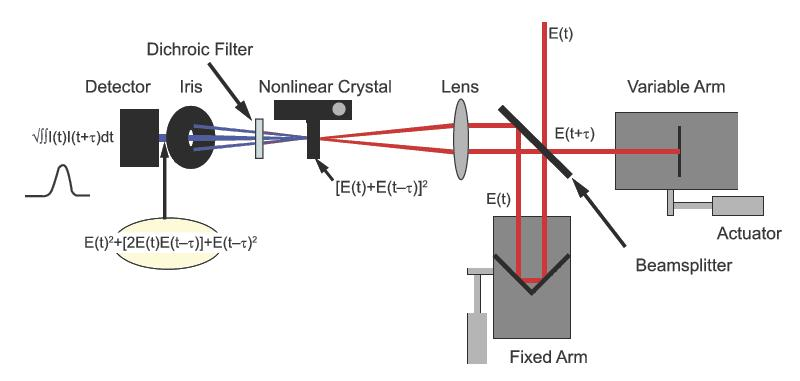
The basic idea of an autocorrelator is: first split the incoming pulse into two identical beams with a beam splitter, pass one beam through an adjustable optical-path delay line (changing the relative time difference between the two beams), then focus both beams simultaneously into a nonlinear crystal. When the two pulses overlap in time, they generate a new optical signal through sum-frequency or second-harmonic generation; as the time difference grows and the overlap decreases, the signal intensity falls. The detector records the nonlinear signal intensity at different delays, giving an ‘autocorrelation trace,’ from whose width the actual pulse width is inferred. Different pulse shapes have different conversion factors (about 1.414 for a Gaussian pulse, about 1.54 for a sech² pulse).
3. Key Parameters: Understanding the Performance Indicators of an Autocorrelator
| Parameter Name | Meaning | Why It Matters |
|---|---|---|
| Measurable Pulse-Width Range | From a few femtoseconds to tens of picoseconds, depending on the delay-line travel and crystal thickness | The most core parameter of an autocorrelator, determining the pulse-width range that can be measured; it must match the pulse under test. |
| Wavelength Range | Must match the phase-matching conditions of the nonlinear crystal | The applicable wavelength interval of the instrument, determined by the nonlinear crystal’s phase-matching conditions and covering the wavelength of the pulse under test. |
| Sensitivity | The lowest pulse energy that can be measured, related to the crystal’s nonlinear coefficient and detector performance | The minimum pulse energy or average power that can be measured, determining whether weak-light pulses and small signals can be measured. |
| Dynamic Range | The ratio of signal peak to background, affecting whether the pulse pedestal can be detected | The ratio of the maximum to the minimum measurable signal, reflecting the instrument’s adaptability to pulses of different intensities. |
| Delay-Line Precision | Determines the time resolution, usually set by mechanical displacement accuracy | The displacement precision of the optical delay line, directly affecting time resolution and the accuracy of pulse-width measurement. |
These parameters are not isolated; they are interrelated and mutually constrained. For example, there is often a trade-off between an autocorrelator’s measurable pulse-width range and sensitivity—a wider range usually means lower sensitivity to short pulses, and vice versa. So to evaluate quality, you must consider the parameters together rather than one alone.
If you are not familiar with these parameters, that is fine—Soar Laser’s product pages have detailed parameter descriptions, and you can also consult our technical engineers directly to help you select.
4. Main Types: What Kinds of Autocorrelator Exist?
Autocorrelators can be classified in many ways, and different dimensions help us understand their characteristics from different angles. The following introduces the common classification methods one by one:
By Type
Intensity Autocorrelators (IAC)
Two beams enter the nonlinear crystal at different angles and the sum-frequency signal intensity is measured; no background interference, the most commonly used type
Interferometric Autocorrelators (more accurately IMIAC, formerly IFROG)
Two beams interfere collinearly and are then frequency-doubled; the signal has rapid oscillations, is more sensitive to chirp and can measure shorter pulses
Scanning Autocorrelators
Scan point by point by moving the delay line; requires a stable pulse train
Single-Shot Autocorrelators
Uses a cylindrical lens to map time delay to spatial position, obtaining the complete autocorrelation trace in one image; suitable for low-repetition-rate amplifiers
Two-Photon-Absorption Autocorrelators
Uses the two-photon-absorption effect in a photodiode, needing no nonlinear crystal and simpler in structure
Different types of autocorrelators have their own advantages and disadvantages; there is no absolute ‘best,’ only ‘most suitable.’ Selection should consider your specific application scenario, power requirements, budget and other factors. For example, for industrial applications with high power requirements, fibre lasers may be more suitable; for research applications with ultrashort-pulse needs, Ti:sapphire may be more suitable.
5. Applications: Where Are Autocorrelators Used?
Autocorrelators have a very wide range of applications, from industrial manufacturing to healthcare, from communication networks to scientific research—almost everywhere lasers are used, autocorrelators are indispensable. Let us look at a few fields briefly:
- Ultrafast laser factory testing: measuring the output pulse width of mode-locked lasers
- Pulse-compression system tuning: verifying compression results and optimising the dispersion compensation of grating pairs or chirped mirrors
- Ultrafast amplifier performance monitoring: monitoring pulse-width changes during amplification
- Routine diagnostics in research labs: daily alignment and performance checks of femtosecond laser systems
- Industrial ultrafast-laser quality control: rapidly checking ultrashort pulse quality on production lines
Typical Application Scenarios in Detail
Scenario 1: Ultrafast Laser Factory Testing
measuring the output pulse width of mode-locked lasers Factory testing uses an autocorrelator to quickly verify the output pulse width of mode-locked lasers against nameplate specs and keep records for traceability.
Scenario 2: Pulse-Compression System Tuning
verifying compression results and optimising the dispersion compensation of grating pairs or chirped mirrors When tuning a pulse-compression system, an autocorrelator verifies the compression result and guides optimisation of grating-pair or chirped-mirror dispersion compensation.
Scenario 3: Ultrafast Amplifier Performance Monitoring
monitoring pulse-width changes during amplification Pulse width drifts during ultrafast amplification with pump and alignment; an autocorrelator monitors these changes and gives early warning.
Scenario 4: Routine Diagnostics in Research Labs
daily alignment and performance checks of femtosecond laser systems In research labs, daily alignment and performance checks of femtosecond systems rely on an autocorrelator as a routine, fast way to judge system state.
Scenario 5: Industrial Ultrafast-Laser Quality Control
rapidly checking ultrashort pulse quality on production lines On industrial lines, an autocorrelator rapidly samples ultrashort pulse quality, catching anomalies upstream and keeping batches consistent.
👉 Want to learn more about practical application cases of autocorrelators? Please visit Soar Laser’s application-case page, or contact our technical team directly for professional advice.
6. Common Misconceptions
Many people have somewhat plausible but mistaken notions about autocorrelators. See whether you fall into any of the following misconceptions:
Misconception 1: ‘An autocorrelator can reveal the true pulse shape.’
the autocorrelation trace is symmetric and cannot tell whether a pulse is chirped or asymmetric; it can only assume a pulse shape and then convert to a pulse width
Misconception 2: ‘The width of the autocorrelation trace is directly the pulse width.’
you must multiply by a conversion factor based on the assumed pulse shape; different shapes have different factors, so the FWHM cannot be taken directly as the pulse width
Misconception 3: ‘Any nonlinear crystal can be used for autocorrelation.’
the crystal thickness must match the pulse-width range; femtosecond pulses need extremely thin crystals to avoid group-velocity mismatch
Misconception 4: ‘Scanning and single-shot types give the same result.’
single-shot measures one pulse, while scanning averages over many pulses; if the pulses jitter, the results differ
Misconception 5: ‘An autocorrelator directly gives the true pulse width.’
the autocorrelation trace must assume a pulse shape to convert to width; different shape assumptions give different results
Of course, there are far more misconceptions about autocorrelators than these. Laser technology is developing rapidly, with new materials and new processes constantly emerging, so some previous ‘common knowledge’ may already be outdated. If you have other questions, please leave a comment and we will answer them one by one.
Leave a Reply