


Have you ever wondered why laser beams have a Gaussian distribution – bright in the middle, dim at the edges, like a little hill?
For many applications this “more energy in the middle, less on the sides” distribution is actually troublesome. In laser welding, too much centre energy easily burns through while the edges are under-welded; in laser annealing, the whole area must be heated uniformly; in aesthetic medicine, uneven energy causes uneven skin burns.
That is when beam shapers and beam homogenizers come in – they can turn a “bright-centre, dim-edge” Gaussian beam into a “uniformly bright across the whole field” flat-top beam.
Today let’s explain this thoroughly: what is the principle of beam shaping? What technical routes exist? Which suits each scenario? And what parameters matter when selecting?
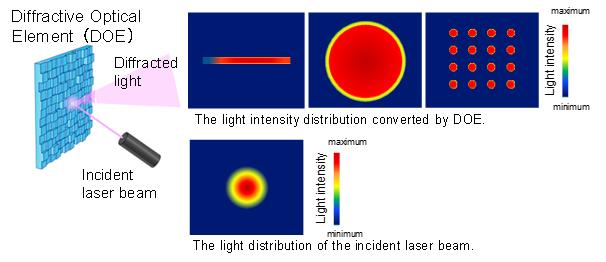
Table of Contents
- I. What Is a Beam Shaper? Why Convert Gaussian to Flat-Top?
- II. Two Schools: Beam Shaper vs Beam Homogenizer – Fundamentally Different
- III. 5 Mainstream Technical Routes: Refractive, Diffractive, Microlens, Light Pipe, Diffuser
- IV. 7 Core Parameters to Check When Buying a Beam Shaper
- V. 6 Major Applications of Beam Shapers
- VI. 6 Common Misconceptions About Using Beam Shapers
I. What Is a Beam Shaper? Why Convert Gaussian to Flat-Top?
Starting from the basics: almost every laser outputs a beam with a Gaussian distribution. What does that mean? The centre of the spot is brightest and it gets dimmer toward the edge, with an intensity curve identical to a Gaussian function.
This distribution is good for “focusing light to the smallest point” (the diffraction limit is defined for Gaussian beams), but for many scenarios needing uniform energy distribution it is a real headache:
- Laser welding: excessive centre energy easily burns through or causes spatter, while the edges do not weld through
- Laser annealing: the whole surface must be heated evenly; a Gaussian distribution overheats the centre
- Laser marking / etching: inconsistent line depth affects processing quality
- Aesthetic medicine: uneven energy = uneven heating = uncontrollable efficacy and risk
- Lithography illumination: chip manufacturing demands near-strict illumination uniformity
A beam shaper is the optical element that solves this problem. Its core mission is: convert the input Gaussian beam into an output flat-top (flat-top / top-hat) beam – nearly identical intensity across the entire spot.
Besides the most common flat-top spot, beam shapers can also generate:
- 🔹 Donut-shaped spot – for laser cutting and drilling
- 🔹 Square / rectangular spot – for laser processing and lithography illumination
- 🔹 Line-shaped spot – for laser welding and thin-film annealing
- 🔹 Dot-matrix / array spots – for parallel processing and 3D sensing
II. Two Schools: Beam Shaper vs Beam Homogenizer – Fundamentally Different
Many people lump “beam shaper” and “beam homogenizer” together, but their working principles and performance characteristics are essentially different. The RP Photonics Encyclopedia clearly points out the difference between the two:
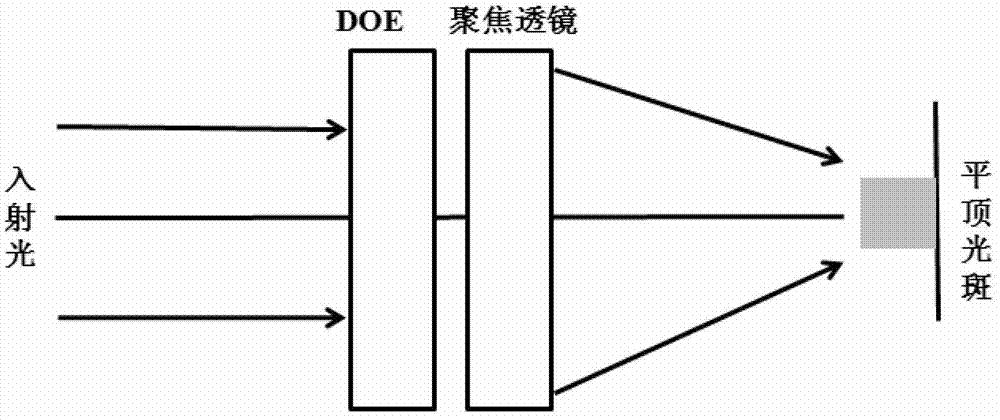
Beam Shaper – Deterministic Field Mapping
Principle: through a precisely designed optical surface (aspheric) or micro/nano-structure (DOE), the incident energy is deterministically redistributed into the target distribution. There is a strict correspondence between input and output.
Features:
- ✅ High energy efficiency (near 100%)
- ✅ Very steep edges (almost knife-cut)
- ✅ No speckle, preserving spatial coherence
- ✅ Good uniformity within the flat-top region
- ❌ Extremely sensitive to input beam parameters (diameter, divergence, mode deviation all seriously affect results)
- ❌ Generally only for single-mode (M²≈1) lasers
Beam Homogenizer – Beam Integration / Superposition
Principle: the incident beam is split into many sub-beams, then superimposed at the target plane, achieving uniformity through an “averaging effect.” Essentially it obtains uniform intensity by scrambling the wavefront and reducing coherence.
Features:
- ✅ Insensitive to input beam variations (still homogenizes with input deviations)
- ✅ Suitable for multimode lasers
- ✅ Relatively simple structure
- ❌ Has speckle (interference grains with coherent sources)
- ❌ Wider edge transition
- ❌ Slightly lower energy efficiency
- ❌ Uniform only at a specific working plane
A simple analogy: a shaper is like an “actuary”, sending each portion of energy precisely where it belongs; a homogenizer is like a “blender”, scrambling the light and relying on large numbers to achieve uniformity.
III. 5 Mainstream Technical Routes: Refractive, Diffractive, Microlens, Light Pipe, Diffuser
Beam shaping / homogenization products on the market are numerous, but by technical principle they fall mainly into these 5 categories:
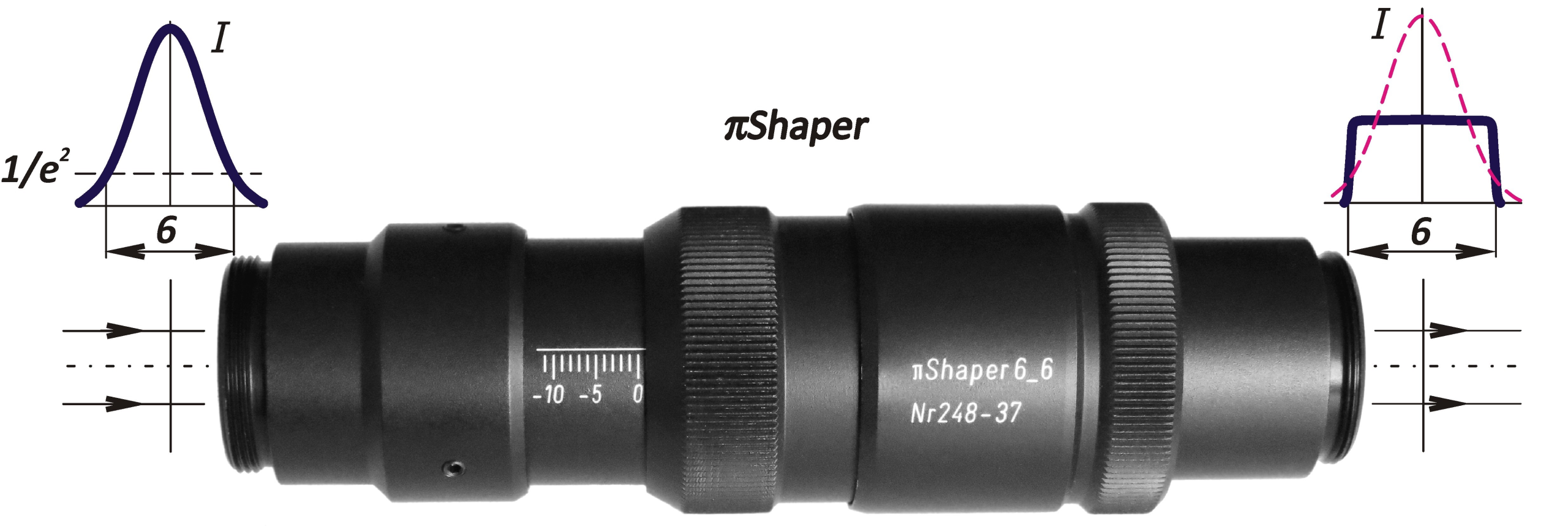
1. Refractive Beam Shaper
Representative products: πShaper, AdlOptica, Edmund flat-top beam shapers
Principle: uses two (or more) precisely designed aspheric lenses. The first lens “bends” the Gaussian beam’s wavefront, the second “flattens” it again while redistributing the energy. The whole process is fully deterministic.
Advantages:
- Very high energy efficiency (>95%), almost no loss
- No dispersion, no high-order diffractive stray light
- High damage threshold (suitable for high-power lasers)
- Good uniformity, no speckle
Disadvantages:
- Can only be designed for a specific input beam (diameter and mode must match)
- Aspheric fabrication is difficult and costly
- Relatively single function (usually only Gaussian → flat-top)
Applications: high-precision shaping of high-power single-mode lasers, research applications
2. Diffractive Optical Element (DOE)
Representative products: Holo/Or, PowerPhotonic, Jenoptik diffractive shapers
Principle: micro/nano-scale diffractive structures are fabricated on the element surface, using diffraction to precisely control the output light field. By designing different diffractive patterns, almost any spot shape can be generated.
Advantages:
- Extremely high design freedom, generating circular/square/donut/array/line and any other shape
- Thin and light, easy to integrate
- One element can perform multiple functions (shaping + splitting + focusing)
Disadvantages:
- Highly wavelength-sensitive (deviation from design wavelength seriously degrades performance)
- Sensitive to input beam diameter and divergence
- Has high-order diffraction losses, efficiency typically 80-95%
- Lower damage threshold than refractive types
Applications: applications needing special spot shapes, consumer electronics (3D sensing), research
3. Microlens Array Homogenizer (Fly’s Eye Homogenizer)
Representative products: Thorlabs Fly’s Eye Homogenizers
Principle: consists of two microlens arrays (MLA) and one condenser lens. The first MLA cuts the incident beam into many sub-beams; the second MLA + condenser superimposes all sub-beams at the target plane, achieving uniformity through superposition averaging.
Advantages:
- Good homogenization, insensitive to incident beam shape
- Output is typically square/rectangular, with adjustable size
- Compact structure, easy to integrate
- Wide applicable wavelength range
Disadvantages:
- Speckle with coherent sources
- Wider edge transition region
- Spot uniform only at a specific working distance
Applications: lithography illumination, microscope illumination, LED homogenization, display illumination
4. Light Pipe / Mixing Rod
Representative products: Thorlabs Hexagonal Light Mixing Rods
Principle: a solid glass rod (usually square or hexagonal cross-section); light enters one end and undergoes multiple total internal reflections on the side walls, effectively “stirring” the beam many times. Exiting the other end, the intensity distribution across the face is very uniform.
Advantages:
- Good homogenization
- Simplest structure, low cost
- Suitable for incoherent sources (LEDs, etc.)
- High damage threshold (fused silica rods handle high power)
Disadvantages:
- Fixed working distance (uniform near the exit face)
- Coupling efficiency limited by numerical aperture (NA)
- Rod length affects homogenization (longer is more uniform but lossier)
Applications: LED illumination homogenization, high-power laser pump homogenization, projection display
5. Engineered Diffuser
Representative products: Thorlabs Engineered Diffusers, RPC Photonics
Principle: a precisely designed microstructured diffuser – not ordinary ground glass with random scattering, but an engineered microstructure that scatters incident light into a specific shape (circle, square, line) with uniform intensity.
Advantages:
- Smallest size, lowest cost
- Insensitive to input beam parameters
- Multiple spot shapes available
Disadvantages:
- Average uniformity
- Low light utilisation at large scattering angles
- Contrast / edge sharpness inferior to other approaches
Applications: illumination homogenization, consumer products, applications with modest uniformity requirements
🔍 A Special Member: the Powell Lens
The Powell lens is a special one-dimensional beam shaper – it turns a thin laser beam into a laser line with uniform intensity along its length. A normal cylindrical lens produces a line that is bright in the middle and dim at the ends, whereas the Powell lens, through its special aspheric roof-shaped profile, redistributes energy to the ends of the line, achieving uniform line intensity.
Powell lenses are widely used in machine vision, 3D structured-light measurement, laser scribing and other fields.
IV. 7 Core Parameters to Check When Buying a Beam Shaper
1. Uniformity
Measures the intensity fluctuation within the flat-top region. Common expressions:
- PV value (peak-to-valley): maximum intensity – minimum intensity, e.g. ±5%
- RMS contrast: root-mean-square deviation, better reflecting overall uniformity
- ISO standard uniformity: evaluates the flat-top region per ISO 13694
2. Edge Steepness
The width of the transition region from full intensity down to zero (or 10%). Field-mapping shapers have very steep edges (possibly only a few micrometres), while homogenizers are wider. For applications needing precise boundaries (such as lithography), this is a key parameter.
3. Efficiency
The fraction of energy within the target spot relative to total incident energy. Highest for refractive (>95%), then diffractive (80-95%), lowest for diffusers (depends on scattering angle).
4. Input Beam Specifications
Including diameter (1/e²), divergence, M² factor, wavelength, etc. Field-mapping shapers are extremely sensitive to these parameters and must strictly match design values; homogenizers are far more tolerant.
5. Output Spot Shape and Size
Circular? Square? Rectangular? Line? Donut? Array? What size? These determine the choice of technical route.
6. Working Distance
The distance from the shaper exit to the uniform-spot plane. Homogenizers usually have a fixed working distance, while refractive field-mapping shapers can maintain a flat top over a longer depth of focus.
7. Laser-Induced Damage Threshold (LIDT)
A key metric for high-power laser applications. Both pulsed and CW damage thresholds must be considered and converted according to your laser parameters (wavelength, pulse width, repetition rate).
📊 Core Parameter Quick-Reference Table
| Parameter | Meaning | Typical value / unit | Selection point |
|---|---|---|---|
| Uniformity | Intensity fluctuation within the flat-top region | ±2% ~ ±10% | ±5% is usually adequate for industrial use; research / lithography demands more |
| Edge steepness | Transition width from full intensity to 10% | Micron scale or percentage | Key metric for lithography and other precision-boundary applications |
| Efficiency | Energy in target spot / total incident energy | 70% ~ 99% | Refractive highest >95%, diffuser lowest |
| Input beam diameter | Designed 1/e² incident beam diameter | mm | Field-mapping must match strictly; a 10% deviation sharply reduces uniformity |
| Working wavelength | Wavelength range optimised in design | nm | DOE highly wavelength-sensitive, refractive somewhat more tolerant |
| Working distance (WD) | Distance from shaper exit to uniform-spot plane | mm | Homogenizers usually have fixed WD, refractive has longer depth of focus |
| Damage threshold (LIDT) | Maximum laser power / energy density it can withstand | J/cm² or W/cm² | High-power applications prefer refractive type or fused silica material |
| M² factor requirement | Requirement on incident beam quality | — | Field-mapping usually requires M²<1.2, homogenizers work with multimode |
Comparison Table of Five Technical Routes
| Technical route | Principle | Efficiency | Uniformity | Input sensitivity | Power handling | Cost |
|---|---|---|---|---|---|---|
| Refractive | Aspheric lens energy remapping | Very high (>95%) | High | High | High | High |
| Diffractive (DOE) | Micro/nano-structure diffraction | High (80-95%) | Very high | Extremely high | Medium | Medium-high |
| Microlens array | Sub-beam superposition integration | Medium-high | Medium | Low | High | Medium |
| Light pipe / mixing rod | Multiple total-internal-reflection folds | High | Good | Low | Extremely high | Low |
| Engineered diffuser | Microstructure scattering | Medium-low | Average | Very low | High | Very low |
V. 6 Major Applications of Beam Shapers
1. Laser Material Processing
This is the largest application area for beam shapers. In laser welding, annealing, ablation, thin-film deposition and other processes, uniform energy distribution means uniform processing quality. Especially in busbar tab welding and prismatic cell housing welding of power batteries, flat-top spots effectively reduce spatter and cold welds.
2. Semiconductor Manufacturing / Lithography
In chip manufacturing, illumination uniformity of the lithography system directly determines yield. The illumination system in a lithography tool uses very complex beam-homogenization schemes (usually microlens arrays + various integrator mirrors), controlling intensity nonuniformity at the exposure plane to within a fraction of a percent.
3. Medicine and Aesthetics
In dermatological laser treatments, ophthalmic surgery and aesthetic procedures, uniform energy distribution means uniform efficacy and safety. With a Gaussian spot, excessive centre energy easily burns while insufficient edge energy is ineffective. A flat-top spot delivers a consistent dose across the entire treatment area.
4. Machine Vision and 3D Measurement
The uniform laser line produced by a Powell lens is a core component of structured-light 3D cameras. Uniform line intensity means consistent measurement accuracy, with no clear middle and blurry ends.
5. Research and Laboratory
Nonlinear optics experiments, atom cooling, optical tweezers, spectroscopy – many research scenarios require spots of specific shape and uniform distribution.
6. Laser Display and Illumination
In laser projection displays, the laser must be projected uniformly onto the display panel or DMD. With a Gaussian distribution, the centre of the image is brighter than the surroundings, seriously degrading the viewing experience.
👉 Related products:Laser optics | Laser welding machines
VI. 6 Common Misconceptions About Using Beam Shapers
Myth 1: Beam shapers and homogenizers are the same thing
Correction: completely different. A shaper is deterministic energy redistribution; a homogenizer relies on beam superposition and averaging. The former has high efficiency and steep edges but is input-sensitive; the latter is highly tolerant but has speckle.
Myth 2: A flat-top beam stays flat-top over long distances
Correction: a flat-top beam is not an eigenmode of free space (the Gaussian beam is). Due to diffraction, the flat-top edges gradually “spread out” during propagation and the beam shape changes. It is usually uniform only within a specific working plane.
Myth 3: Any laser can use the same shaper
Correction: for field-mapping shapers (refractive/diffractive), the input beam diameter, divergence and mode must match strictly. A 10% difference in input can greatly degrade output uniformity. Always confirm your laser parameters before buying.
Myth 4: The higher the uniformity, the better
Correction: extremely high uniformity usually means extremely high cost and very narrow operating conditions. Many industrial applications are fine with ±5% uniformity; blindly pursuing higher uniformity only adds cost.
Myth 5: A DOE can make any shape, so just buy one universal unit
Correction: a DOE can indeed generate various shapes, but each DOE is designed for specific input parameters (wavelength, diameter, divergence) and is not a universal part. Switch lasers and the result may be completely wrong.
Myth 6: Speckle is only a cosmetic issue and doesn’t affect use
Correction: speckle is a serious problem for many applications. In lithography it causes uneven exposure; in imaging it lowers resolution; in some processing applications it causes inconsistent surface roughness. If your laser has high coherence and you demand high uniformity, pay special attention to homogenizer speckle.
References
- RP Photonics Encyclopedia – Beam Shapers
- RP Photonics Encyclopedia – Beam Homogenizers
- RP Photonics Encyclopedia – Flat-top Beams
- Thorlabs Fly’s Eye Homogenizers product documentation
- Thorlabs Hexagonal Light Mixing Rods product documentation
- Edmund Optics – Laser Beam Shaping Overview application note
This article is for educational purposes and reference only. For specific product selection advice, please contact our technical team.
Leave a Reply