


Have you ever noticed that when marking near the edge of a workpiece with a laser marker, the lines look a bit “crooked”? Or when laser drilling, the centre holes are straight but the edge holes are slanted?
That is not the galvo’s fault, nor a programming problem – it is an inherent characteristic of a standard F-Theta scan lens: when scanning near the edge, the beam strikes the workpiece at an angle.
If your application demands high hole-wall perpendicularity, cut-edge quality, or positional accuracy, what you need may not be a standard F-Theta lens but a – telecentric scan lens.
Today let’s clarify: what exactly is a telecentric scan lens? How does it differ from a standard F-Theta lens? Why can it keep the laser “always perpendicular”? And which applications require telecentricity?
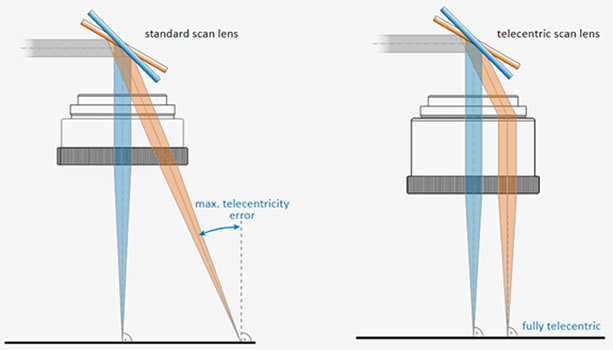
Table of Contents
- I. What Is a Telecentric Scan Lens? The Core Feature in One Sentence
- II. Why Telecentricity? What’s Wrong with Oblique Incidence?
- III. The Optical Principle of Telecentric Design: The Magic of Aperture Stop + Focal Plane
- IV. Telecentric F-Theta vs Standard F-Theta: What’s the Real Difference?
- V. 8 Key Parameters to Check When Buying a Telecentric Scan Lens
- VI. 6 Applications That Require a Telecentric Scan Lens
- VII. 6 Common Misconceptions About Telecentric Scan Lenses
I. What Is a Telecentric Scan Lens? The Core Feature in One Sentence
A telecentric scan lens, also called a telecentric F-Theta lens or telecentric scan lens, is the “high-end player” in the scan lens family.
Building on the standard F-Theta lens, it adds one key design feature: making the chief ray of the focused beam perpendicular to the workpiece surface across the entire scan field.
What does “chief ray perpendicular” mean? It means that whether the laser scans the centre or the edge, the beam always comes straight down, not at an angle.
One formula sums it up:
Telecentric scan lens = F-Theta linear scanning + perpendicular incidence + flat-field focusing
It combines three key characteristics:
- ✅ F-Theta characteristic: image height is proportional to scan angle (y = f·θ), giving uniform scanning speed
- ✅ Telecentric characteristic: chief rays strike the workpiece surface perpendicularly across the entire field
- ✅ Flat-field characteristic: all foci lie on the same plane, so the whole field is in focus
II. Why Telecentricity? What’s Wrong with Oblique Incidence?
You might say: “What’s a little tilt? As long as it focuses, it’s fine, right?”
For low-precision applications like laser marking, oblique incidence is indeed not a big problem. But for many precision-machining scenarios, the problems it brings are fatal:
1. Slanted Hole Walls (the Most Critical Problem)
In laser drilling, if the beam strikes at an angle, the hole produced is slanted – the hole wall has a taper and is not perpendicular. For micro-hole machining of precision electronic components (such as PCB through-holes and wafer vias), hole-wall perpendicularity is a core metric. Slanted holes lead to poor subsequent plating and unreliable connections.
2. Positional Error Varies with Workpiece Height
If the workpiece surface is not perfectly flat (has slight undulations), the position where the obliquely incident beam lands shifts with height – similar to the perspective effect of “near large, far small.” With a telecentric design, because the beam is perpendicular, height variations do not change the spot position, eliminating perspective error.
3. Spot Ellipticity
Under oblique incidence, the projection of a circular beam onto a plane becomes an ellipse; the spot size along the major axis increases and energy density drops, causing nonuniform processing. A telecentric design keeps spots circular across the entire field.
4. Asymmetric Energy Distribution
Oblique incidence also makes the energy distribution of the focused spot asymmetric and shifts its centre, affecting the consistency of processing quality.
III. The Optical Principle of Telecentric Design: The Magic of Aperture Stop + Focal Plane
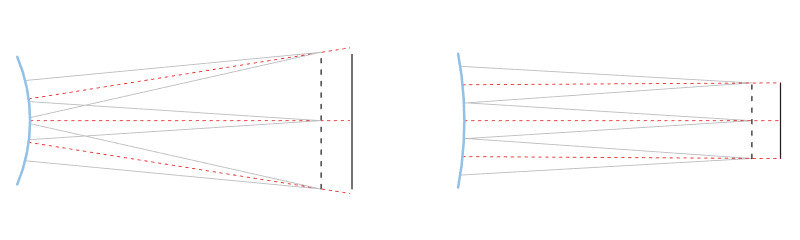
Telecentric design sounds mysterious, but its principle can be stated in one sentence: place the aperture stop at the focal plane, and the chief rays become parallel to the optical axis.
Standard Lens vs Telecentric Lens
In a standard lens, the aperture stop sits somewhere in the middle of the lens; the chief rays from different object heights that pass through the stop are tilted – the closer to the edge, the larger the tilt angle. That is why edge rays strike at an angle.
In a telecentric lens, the aperture stop is placed at the object-side focal plane. At this point, only rays parallel to the optical axis on the object side (chief rays) can pass through the stop and participate in imaging. Regardless of the object’s position, chief rays remain parallel to the optical axis, so they always strike the image plane perpendicularly.
The Special Case of Scan Lenses
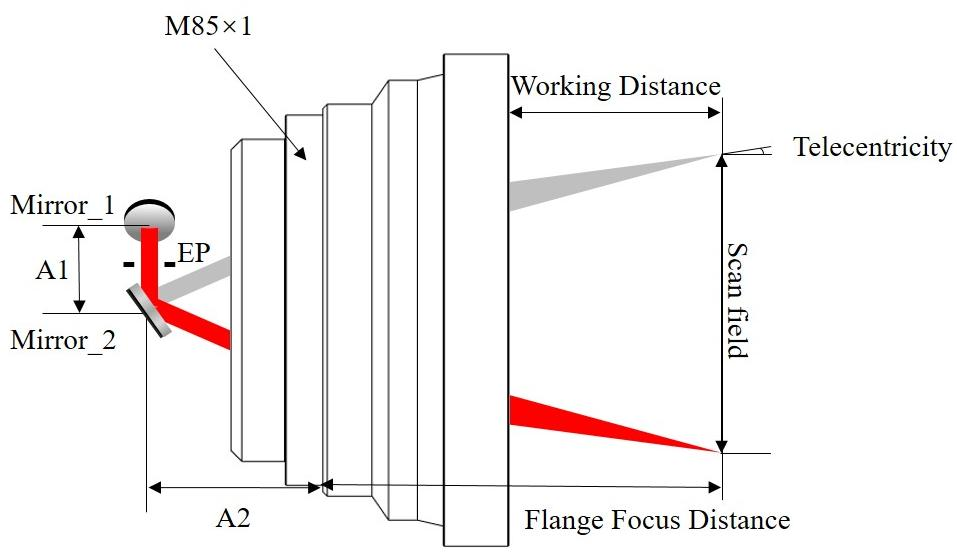
For a scan lens, the galvo itself acts as the aperture stop – the beam reflected off the galvo appears to emanate from a finite-sized stop. To achieve telecentricity, a special lens-group design is needed so that rays deflected by the galvo at different angles all become chief rays perpendicular to the focal plane after passing through the lens.
This means telecentric scan lenses generally require more lens elements, more complex structures, and larger lens apertures.
IV. Telecentric F-Theta vs Standard F-Theta: What’s the Real Difference?
Many people confuse these two types of scan lens. The table below makes it completely clear:
| Feature | Standard F-Theta lens | Telecentric F-Theta lens |
|---|---|---|
| Chief ray incidence angle | Perpendicular at centre, tilted at edge | Perpendicular incidence across the entire field |
| Hole-wall perpendicularity | Edge holes have taper | Hole walls perpendicular across the entire field |
| Spot shape | Elliptical at the edge | Nearly circular across the entire field |
| Positional error (uneven workpiece) | Varies significantly with height | Virtually unchanged |
| Scan range | Can be very large (e.g. Φ300 mm) | Limited by aperture, generally smaller |
| Lens aperture / size | Smaller | Much larger (aperture ≈ 2× image height + entrance pupil) |
| Number of elements | 2-4 elements | 4-8 elements or more |
| Cost | Lower | High (typically 2-5×) |
| Typical applications | Laser marking, general engraving | Precision drilling, precision cutting |
An important physical limitation: the scan range of a telecentric scan lens is severely limited by lens aperture. Because all outgoing rays must be perpendicular to the focal plane, the beam at every scan position must exit “straight out” from the corresponding position on the lens, so the lens’s clear aperture must at least equal the scan range plus the incident beam diameter.
In other words, to make a telecentric lens with a 100 mm scan range, the lens aperture must be at least over 100 mm – which is why large-field telecentric lenses are so expensive.
V. 8 Key Parameters to Check When Buying a Telecentric Scan Lens
1. Focal Length
Focal length determines the scan range (scan radius ≈ f × θ) and focused spot size. A longer focal length gives a larger scan range but also a larger spot; choose according to actual needs.
2. Scan Field
Also called the field of view, usually expressed as a square or circle, e.g. 60×60 mm, 100×100 mm, Φ80 mm. The scan field of a telecentric lens is generally smaller than that of a standard F-Theta; confirm it meets your processing area requirement when selecting.
3. Telecentricity
Measures the maximum deviation angle of the chief ray from the perpendicular, in degrees (°). Smaller is better. Quality products have telecentricity < 1°, general products are between 1-3°. This is the most core performance metric of a telecentric lens.
4. Working Distance (WD)
The distance from the last surface of the lens to the focal plane. A longer working distance helps protect the lens from spatter and fumes, but telecentric lenses with long working distances are harder to design and more expensive.
5. Entrance Pupil
The maximum incident beam diameter the lens accepts. The incident beam must fill the entrance pupil to achieve the best focusing and the smallest spot. Typically used together with a beam expander.
6. F-Theta Distortion
The deviation of actual image height from theoretical y = f·θ, expressed as a percentage. Quality products can reach < 0.1%, general products within 0.5%.
7. Design Wavelength and Coating
Telecentric lenses are designed for a specific wavelength and must match your laser wavelength (e.g. 355 nm, 532 nm, 1064 nm, 10.6 μm CO₂, etc.). Coating also affects transmission efficiency and damage threshold.
8. Focused Spot Size
Usually estimated by the diffraction-limited spot size. For Gaussian beam incidence (M²≈1), the 1/e² spot diameter at focus is approximately d ≈ 1.27 × λ × f / D; for circular-aperture diffraction with uniform illumination, the Airy disk diameter is d = 2.44 × λ × f / D. The actual spot also depends on beam quality M² and aberrations. Telecentric lenses generally provide a more uniform spot size across the entire field.
VI. 6 Applications That Require a Telecentric Scan Lens
1. Precision Laser Drilling
This is the largest application area for telecentric scan lenses. Micro-hole machining of PCB/FPC, wafer vias, nozzle holes, fuel-injector holes – any drilling application requiring perpendicular, round holes must use a telecentric lens. Standard F-Theta lenses produce slanted-edged holes that simply cannot meet the requirement.
2. Precision Laser Cutting / Scribing
Wafer dicing, ceramic cutting, glass cutting and other applications demanding high kerf perpendicularity and edge quality. Telecentric design ensures uniform illumination on both sides of the kerf and a smooth cut face.
3. Semiconductor / Electronics Manufacturing
Laser processing in chip fabrication and packaging, such as wafer marking, silicon wafer dicing, BGA ball attachment, demands extremely high precision, making telecentric lenses standard equipment.
4. Medical Devices
In ophthalmic surgery (such as LASIK) and dermatological treatments, perpendicular beam incidence and uniform energy distribution directly affect treatment efficacy and safety.
5. 3D Printing / Additive Manufacturing
In technologies such as selective laser melting (SLM) and selective laser sintering (SLS), uniformity of energy distribution and spot consistency directly affect part density and mechanical properties.
6. Research and Lithography
Precision optical experiments in the lab, laser lithography, micro/nano-fabrication and other applications with extremely high demands on positional accuracy and spot quality.
👉 Related products:F-Theta scan lenses | Laser marking machines | Laser welding machines
VII. 6 Common Misconceptions About Telecentric Scan Lenses
Myth 1: Telecentric scan lenses and F-Theta lenses are two different things
Correction: a telecentric scan lens is a subclass of F-Theta lens. It is first an F-Theta lens (satisfying the linear scanning relation y = f·θ), and telecentric design is added on that basis. Not all F-Theta lenses are telecentric, but all telecentric scan lenses are F-Theta.
Myth 2: The greater the telecentricity, the better
Correction: the telecentricity value represents the angle of deviation from perpendicular, so smaller is better. Telecentricity < 1° is better than < 3°. Don’t get it backwards.
Myth 3: Telecentric scan lenses can achieve very large scan ranges
Correction: the scan range of a telecentric lens is severely limited by lens aperture (aperture at least ≈ scan range + incident beam diameter). A large-field telecentric lens is very expensive and bulky. Most telecentric lenses have a scan range between 50-200 mm.
Myth 4: All laser marking requires a telecentric lens
Correction: ordinary laser marking (text, patterns, QR codes) has almost no perpendicularity requirement, so a standard F-Theta lens is entirely sufficient – no need to spend several times more on telecentric. Telecentricity is mainly for applications with perpendicularity requirements such as drilling and precision cutting.
Myth 5: Telecentric lenses produce smaller spots than standard F-Theta
Correction: spot size is mainly determined by focal length and incident beam diameter (diffraction limit formula). A telecentric lens and a standard F-Theta of the same focal length have similar theoretical minimum spots. The advantage of telecentricity lies in consistent spot size and round shape across the field, not in a smaller spot.
Myth 6: Telecentric lenses and telecentric scan lenses are the same thing
Correction: the telecentric lens in industrial vision (object-side telecentric) and the telecentric scan lens in laser processing (image-side telecentric) work on similar principles but in opposite directions. A vision telecentric lens means “seeing without perspective distortion,” while a telecentric scan lens means “beaming without angular tilt.” Don’t confuse them.
References
- RP Photonics Encyclopedia – Scanning Lenses
- RP Photonics Encyclopedia – F-Theta Lenses
- Cascade Laser Corporation – Scanning Lenses (F-theta) technical documentation
- Sigma Koki fθ lens selection guide
- CASTECH – F-theta scan lens technical principles
- Sill Optics – Telecentric Scan Lenses product materials
This article is for educational purposes and reference only. For specific product selection advice, please contact our technical team.
Leave a Reply