


If a laser system is a “light knife,” then the focusing lens is the cutting edge of that knife.
A single small lens determines whether laser energy can be concentrated, whether the spot is fine enough, whether cuts are sharp enough, and whether welds are strong enough. Don’t be fooled by its simple structure – it may just be a round piece of glass – there is a lot of knowledge behind it.
Today let’s talk about the most fundamental and most often overlooked component in laser processing: the focusing lens. What are the differences between plano-convex, bi-convex, and aspheric lenses? How do you choose the focal length? And how does it relate to F-Theta scan lenses? This article explains it all.
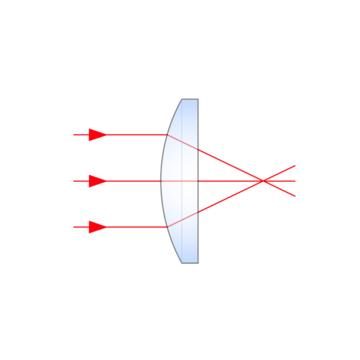
▲ Plano-convex lens focusing principle: parallel incident light is refracted by the convex surface and converges at the focal point on the right
Table of Contents
- I. What Is a Focusing Lens? The “Energy Magnifier” in Laser Processing
- II. How a Focusing Lens Works: How Is Spot Size Calculated?
- III. Five Focusing Lens Types Compared: Plano-Convex, Bi-Convex, Meniscus, Aspheric, Reflective
- IV. 8 Key Parameters to Check When Buying a Focusing Lens
- V. Focusing Lens vs F-Theta Scan Lens – Don’t Confuse Them Again!
- VI. Six Major Applications of Focusing Lenses
- VII. 7 Common Misconceptions About Using Focusing Lenses
I. What Is a Focusing Lens? The “Energy Magnifier” in Laser Processing
A focusing lens, as its name suggests, is an optical lens that “converges a laser beam to a single point.” Using the refraction principle of a convex lens, it focuses parallel or divergent laser beams onto an extremely small focal point, concentrating energy to a level sufficient to melt metal, vaporize material, and pierce glass.
You might think: isn’t it just a convex lens? What’s there to talk about?
Not really. A focusing lens looks simple, but different combinations of material, surface profile, coating, focal length, and aperture produce vastly different focusing results. Choose correctly and the laser is fast and precise; choose wrongly and not only is efficiency low, but the lens can easily burn out.
In laser processing systems, focusing lenses rarely work alone:
- 🔹 In a laser cutting head: a collimator + focusing lens work together to collimate and focus the fibre output light
- 🔹 In a laser marking machine: a beam expander + galvo + F-Theta scan lens (a scan lens is essentially a complex focusing lens group)
- 🔹 In a handheld welding gun: a single focusing lens directly converges the light exiting the fibre
II. How a Focusing Lens Works: How Is Spot Size Calculated?
The principle of a focusing lens boils down to the “convex lens converges light” taught in high-school physics. But in the laser field, we have more precise calculation formulas.
Diffraction-Limited Spot Size
The size of the focused spot is determined by the diffraction limit, but the calculation method depends on the mode of the incident beam:
(1) Gaussian Beam Incidence (the Most Common Laser Case)
For a fundamental-mode Gaussian beam (TEM₀₀, M²≈1) focused by an ideal lens, the spot diameter at the focus (at 1/e² intensity) is:
d₀ = 4λf / (πD) ≈ 1.27 × λ × f / D
where D is the diameter of the incident Gaussian beam (at 1/e²). This is the most commonly used formula in the laser field.
(2) Uniform Plane Wave Incidence (Circular Aperture Diffraction)
If the incident intensity is uniformly distributed (a plane wave filling a circular aperture), an Airy disk forms at the focus, whose first dark-ring diameter is:
d_Airy = 2.44 × λ × f / D
Here D is the diameter of the circular aperture (clear aperture). This formula is commonly used in incoherent optical systems and imaging systems.
Parameter definitions:
- d: focused spot diameter (note the intensity position used in each definition: 1/e² for Gaussian, first dark ring for the Airy disk)
- λ: laser wavelength (e.g. 1064 nm = 1.064×10⁻⁶ m)
- f: focal length of the lens
- D: incident beam diameter (at 1/e², Gaussian beam) or clear aperture (plane wave)
Several important conclusions follow from this formula:
- Shorter wavelength means smaller spot – which is why UV lasers (355 nm) enable finer processing
- Shorter focal length means smaller spot – but a short focal length means a close working distance, with the lens near the workpiece and easily contaminated
- Thicker incident beam means smaller spot – which is why a beam expander is often added upstream
Depth of Focus
Light does not converge to a single “geometric point”; around the focus there is a region where energy remains sufficiently concentrated, called the depth of focus (also twice the Rayleigh range).
Depth of focus DOF ≈ 2 × λ × (f/D)²
The smaller the spot, the shorter the depth of focus. This is why fine processing demands high Z-axis positioning accuracy – a slight deviation puts the beam out of focus.
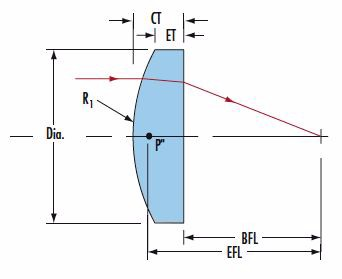
▲ Key parameters of a plano-convex lens: EFL (effective focal length), BFL (back focal length), CT (centre thickness), ET (edge thickness), Dia. (clear aperture)
III. Five Focusing Lens Types Compared: Plano-Convex, Bi-Convex, Meniscus, Aspheric, Reflective
1. Plano-Convex Lens (PCX)
Structure: one flat surface and one convex spherical surface
Features:
- ✅ Simple structure, lowest cost
- ✅ Small spherical aberration with collimated incidence (convex side facing the incident light)
- ✅ The most commonly used focusing lens type in laser processing
- ❌ Still has residual spherical aberration and cannot reach the diffraction limit
Usage note: plano-convex lenses are directional! Collimated light must enter through the convex side and exit through the flat side to minimise spherical aberration. Reversing the lens significantly increases spherical aberration and spreads the spot.
Applications: the vast majority of industrial laser processing (cutting, welding, marking, etc.)
2. Bi-Convex Lens (DCX)
Structure: both surfaces are convex spherical, usually with symmetric curvature
Features:
- ✅ Suitable for object-to-image conjugate ratios between 1:5 and 5:1 (i.e. object and image distances are similar)
- ✅ Compact structure, achieving convergence within a short distance
- ❌ Larger spherical aberration than plano-convex, not suitable for collimated focusing aiming at the smallest spot
Applications: beam reduction, finite-conjugate imaging, optical instruments, etc.
3. Meniscus Lens
Structure: one convex and one concave surface, with overall positive optical power
Features:
- ✅ Usually part of a compound lens group, used to correct aberrations
- ✅ Can reduce spherical aberration to some extent
- ❌ Rarely used alone as a focusing lens
Applications: compound focusing lens groups, camera objectives, etc.
4. Aspheric Lens
Structure: the surface is not spherical but a specially designed aspheric profile
Features:
- ✅ Can fully correct spherical aberration; a single element can reach diffraction-limited focusing
- ✅ Smaller, rounder spot, closer to an ideal Gaussian distribution
- ✅ One aspheric lens can replace a group of spherical lenses, making the system more compact
- ❌ Difficult to manufacture and costly (usually several to tens of times that of a spherical lens)
- ❌ Demands high mounting and alignment precision
Applications: precision optics, research experiments, high-end laser processing, fibre coupling, etc.
5. Reflective Focusing Optics
Typical representative: off-axis parabolic mirror (OAP)
Features:
- ✅ Zero chromatic aberration – all wavelengths focus identically
- ✅ Minimal thermal effects, suitable for extremely high-power (several kW and above) lasers
- ✅ Usable over an ultra-broad band (from UV to far IR)
- ❌ Difficult alignment and troublesome adjustment
- ❌ Bulky and expensive
Applications: high/extremely high-power lasers, multi-wavelength/ultrafast lasers, research experiments
How to Choose by Material?
| Material | Applicable wavelength | Features |
|---|---|---|
| BK7 / K9 glass | Visible to near-IR | Low cost, general-purpose, low to medium power |
| Fused silica | UV to near-IR | High damage threshold, first choice for high power, good thermal stability |
| Zinc selenide (ZnSe) | CO₂ laser (10.6 μm) | Designed specifically for CO₂ lasers |
| Silicon (Si) / Germanium (Ge) | Mid to far IR | IR thermal imaging, IR lasers |
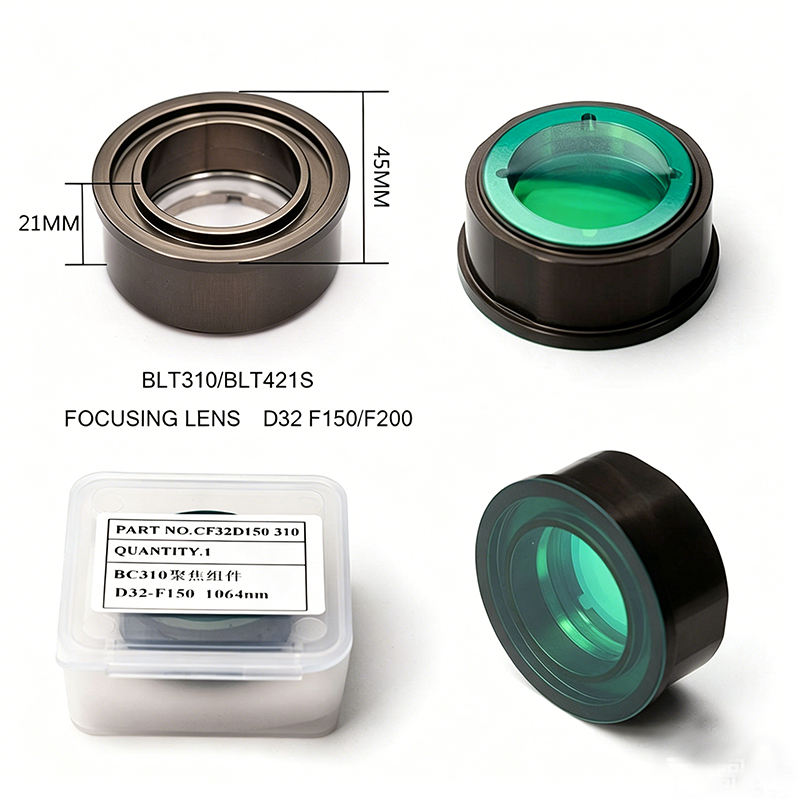
▲ A typical laser focusing lens assembly (with metal barrel and mounting thread), containing the focusing lens and a protective window
IV. 8 Key Parameters to Check When Buying a Focusing Lens
1. Focal Length (EFL / f)
This is the most critical parameter of a focusing lens. Choosing focal length is essentially a trade-off between “spot size” and “working distance / depth of focus”:
- Short focal length (e.g. below 50 mm): small spot, high energy density, but short working distance and shallow depth of focus; suitable for fine processing
- Medium focal length (50-150 mm): the most common range, balancing spot size and working distance; the most versatile
- Long focal length (above 200 mm): larger spot, longer depth of focus, longer working distance; suitable for cutting and welding thick materials
2. Clear Aperture
The effective working diameter of the lens. It must exceed the incident beam diameter (a 1.5-2× margin is recommended), otherwise beam clipping causes power loss and diffraction rings.
3. Back Focal Length (BFL)
The distance from the last surface of the lens to the focus. It determines the mounting distance from the lens to the workpiece and is important for the structural design of cutting heads, welding heads, and similar equipment. Note that BFL is not equal to EFL (for thick lenses the two differ markedly).
4. Surface Accuracy
Usually expressed as λ/4, λ/10, etc. (reference wavelength typically 632.8 nm). Higher surface accuracy means smaller aberrations and better focusing quality. Laser-grade lenses typically require λ/4 or better.
5. Surface Quality
Expressed as scratch-dig, e.g. 60-40, 40-20, 10-5. Smaller numbers mean a smoother surface. High-power lasers demand better surface quality because defects can easily initiate damage.
6. Laser-Induced Damage Threshold (LIDT)
The lifeline of high-power applications. You must consider both continuous-wave (CW, in W/cm or W/cm²) and pulsed (in J/cm²) damage thresholds, and convert according to your laser parameters (wavelength, pulse width, repetition rate).
7. Coating
Laser lenses are usually coated with an anti-reflection (AR) coating to reduce surface reflection losses. Common types include:
- Single-wavelength V-coat: lowest reflectance at a specific wavelength
- Broadband AR coating: covers a wavelength range, good versatility
Coating directly affects transmittance and damage threshold and must match the laser wavelength.
8. Centration
The deviation between the lens’s optical axis and its mechanical axis, usually expressed as an angle (in arcminutes). Large centration error causes astigmatism and an asymmetric spot.
V. Focusing Lens vs F-Theta Scan Lens – Don’t Confuse Them Again!
Many newcomers to lasers confuse focusing lenses with F-Theta scan lenses. In fact, their relationship is this: an F-Theta scan lens is a special focusing lens group used for scanning.
The table below makes the differences clear:
| Feature | Focusing lens | F-Theta scan lens |
|---|---|---|
| Core function | Single-point focusing (stationary focus) | Two-dimensional scanning focus (focus moves across a plane) |
| Optical structure | Usually 1 element, at most 2 | Complex group of 3-6 lens elements |
| Aberration correction | Corrects on-axis aberrations only (spherical aberration) | Corrects aberrations across the full field (field curvature, distortion, astigmatism, coma, etc.) |
| Special design | None | F-Theta distortion (y=f·θ) to ensure scanning linearity |
| Spot consistency | Only one on-axis focus | Spot size and shape essentially uniform across the field |
| Typical applications | Cutting heads, welding guns, fixed optical paths | Laser marking machines, galvo welders, 3D-printing galvos |
| Cost | Low (tens to hundreds of RMB) | High (thousands to tens of thousands of RMB) |
Simply put: for a galvo scanning system, use a scan lens; for a fixed or one-dimensionally moving optical path, use a focusing lens.
VI. Six Major Applications of Focusing Lenses
1. Laser Cutting
This is one of the largest application areas for focusing lenses. In the cutting head of a fibre laser cutter, the usual combination is “collimator + focusing lens”; the focusing lens converges the collimated laser into a fine, sharp spot for cutting metal sheet. Use a long focal length for thick materials and a short focal length for thin materials.
2. Laser Welding
Including handheld welding, automated welding, galvo welding, etc. Welding usually requires a spot of a certain size and a longer depth of focus, so the focal length chosen is somewhat longer than for cutting.
3. Laser Marking / Engraving
In marking machines, focusing is performed by the F-Theta scan lens (a scan lens is also a type of focusing lens). Together with the galvo, it enables scanning marking across a two-dimensional plane.
4. Laser Drilling
Micro-hole machining requires a very small spot and high energy density, usually using a short-focal-length focusing lens with a high-quality beam. PCB drilling and wafer vias are typical applications.
5. Laser Cladding / Hardening
These applications require spots of specific size and shape; sometimes compound lenses or integrator lenses are used to obtain rectangular or line-shaped spot distributions.
6. Research and Precision Optics
Various laboratory laser experiments, spectroscopy, nonlinear optics, etc. all require different types of focusing lenses. Research applications demand high focusing quality and often use aspheric lenses or reflective focusing optics.
👉 Related products:Laser optics | F-Theta scan lenses | Laser cutting machines
VII. 7 Common Misconceptions About Using Focusing Lenses
Myth 1: Focusing lenses and scan lenses are the same thing
Correction: a focusing lens is a single-point focusing element (usually 1-2 elements), while a scan lens is a complex lens group (3-6 elements) used in scanning systems. They differ greatly in function, structure, and cost.
Myth 2: The shorter the focal length, the better
Correction: a short focal length does give a smaller spot, but the depth of focus is shorter and the working distance closer. Too short a depth of focus means extremely high demands on workpiece flatness and Z-axis positioning – the slightest error puts the beam out of focus. Moreover, with the lens close to the workpiece, it is easily contaminated by spatter and fumes. Focal length should be chosen by balancing actual needs.
Myth 3: Plano-convex lenses can be used either way
Correction: plano-convex lenses are clearly directional! With collimated incidence, the convex side must face the incident light and the flat side the outgoing light (focus side). Reversing the lens greatly increases spherical aberration, enlarges the spot, and lowers energy density. Many people install them backwards and then wonder why the results are poor.
Myth 4: Aspheric lenses are always better than spherical lenses
Correction: aspheric lenses can indeed eliminate spherical aberration and deliver better focusing quality, but they cost several to tens of times as much as spherical lenses. They also demand higher alignment precision; poor mounting can actually give worse results. For most industrial applications, a high-quality spherical lens is entirely adequate.
Myth 5: Coating doesn’t matter as long as light passes through
Correction: coating matters enormously! An uncoated glass lens reflects about 4% at each interface – roughly 8% loss for two surfaces. A high-quality AR coating can reduce reflection at each surface to below 0.1%. Coating also directly affects the damage threshold – poorly coated lenses are easily damaged at high power.
Myth 6: The larger the lens, the better
Correction: the clear aperture only needs to pass the beam completely (with a 1.5-2× margin). An oversized lens wastes money, is harder to make with uniform surface quality, is heavier, and is more troublesome to mount.
Myth 7: A burned lens means a quality problem
Correction: a burned lens can have many causes: excessive power, mismatched coating, a dirty lens (dust absorbing energy and causing local overheating), insufficient cooling, etc. It is not necessarily a lens quality problem. Keeping the lens clean and choosing parameters correctly are the keys to longer life.
References
- RP Photonics Encyclopedia – Optical Lenses
- RP Photonics Encyclopedia – Focusing of Laser Beams
- Thorlabs – Focusing & Collimating Lenses product documentation
- Newport – Focusing and Collimating technical guide
- Edmund Optics – Lens Selection Guide
- ULS – Laser Focusing Lenses Application Note
This article is for educational purposes and reference only. For specific product selection advice, please contact our technical team.
Further Reading
- What Is an F-Theta Scan Lens? How Does the “Flat-Field Magic” Work in Laser Marking Machines?
- What Is a Telecentric Scanning Lens? Why Is It Essential for Laser Drilling? Differences from Standard F-Theta
- What Is a Flat-Field Lens? Understand Its Principles, Differences from F-Theta Scan Lenses, and Selection Tips
Leave a Reply