


In high-end fields such as high-power lasers, UV lithography and space optics, one glass material is a true “all-rounder” — transparent from deep UV all the way to near-IR, with a thermal expansion coefficient so low it is almost negligible, yet able to withstand intense laser bombardment. It is fused silica glass, also called fused quartz or fused silicon dioxide.
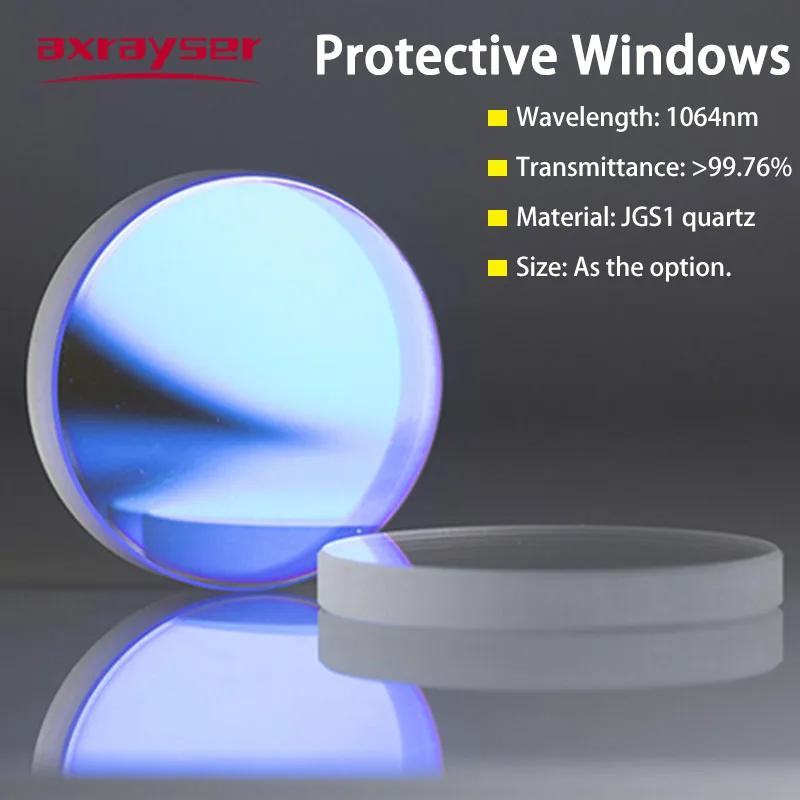
Why do the protective windows of high-power fibre lasers, the projection objectives of lithography machines and the optical telescopes on satellites all choose fused silica? What is the essential difference between it and ordinary BK7 optical glass? And what grades do the Chinese designations JGS1, JGS2 and JGS3 correspond to? In this article we explain fused silica thoroughly.
References
Table of Contents
- I. Core Concepts: What Is Fused Silica Glass?
- II. Working Principle: Why Is Fused Silica So Special?
- III. Key Parameters: Core Performance Metrics of Fused Silica
- IV. Classification: UV Grade vs IR Grade, Chinese Grade Designations
- V. Applications: Where Is Fused Silica Used?
- VI. Common Misconceptions: 6 Misunderstandings About Fused Silica
I. Core Concepts: What Is Fused Silica Glass?
Fused silica glass, also called fused quartz or fused silicon dioxide, is a special glass with high-purity silicon dioxide (SiO₂) as its sole component. It is not ordinary glass — ordinary glass contains sodium, potassium, calcium, boron and many other components, while fused silica is essentially “pure” amorphous SiO₂.
How is fused silica made? Simply put, ultra-high-purity quartz crystal (rock crystal or synthetic silica feedstock) is heated to about 2000 °C to melt, then cooled rapidly — because cooling is so fast, atoms do not have time to arrange into an ordered crystal structure and instead “freeze” into a glassy state.
To use an analogy: ordinary optical glass is like a pot of “mixed-element congee” with all kinds of ingredients; fused silica is like “plain white rice” — an extremely single component, just SiO₂.
Fused silica’s core advantages can be summed up as “three highs”:
- High purity: extremely low impurity content (metal impurities at the ppb level in some synthetic fused silica)
- High transmission: excellent transmission from deep UV to near-IR
- High stability: very low thermal expansion coefficient, very strong chemical stability, high laser damage threshold
It is precisely because of these characteristics that fused silica has become an indispensable core material in high-power lasers, UV optics, semiconductor lithography, space optics and other high-end fields.
II. Working Principle: Why Is Fused Silica So Special?
1. Starting from the Molecular Structure
The basic structural unit of fused silica is the SiO₄ tetrahedron — a silicon atom at the centre with four oxygen atoms at the vertices. These tetrahedra connect by sharing vertex oxygen atoms, forming a three-dimensional random network.
Compared with quartz crystal (rock crystal), fused silica’s atomic arrangement is short-range ordered, long-range disordered:
- Short-range order: each silicon atom is always surrounded by four oxygen atoms forming a tetrahedron (same as in the crystal)
- Long-range disorder: the connection angles and orientations between tetrahedra are random with no periodicity (this is the difference between the glassy and crystalline states)
It is precisely this pure-SiO₂ random-network structure that gives fused silica its unique properties: a single component with few impurities means very low optical absorption and scattering; strong Si–O bonds give high hardness and good chemical stability; the “flexibility” of the network means volume changes very little with temperature.
2. Difference from Ordinary Optical Glass (BK7/K9)
| Property | Fused silica | BK7/K9 borosilicate glass |
|---|---|---|
| Main components | pure SiO₂ (>99.9%) | SiO₂ + B₂O₃ + alkali oxides, etc. |
| Refractive index nd | ~1.4585 | ~1.5168 |
| Abbe number Vd | ~67.7 | ~64.2 |
| UV transmission lower limit | ~180 nm (synthetic grade) | ~350nm |
| Thermal expansion coefficient | 0.55×10⁻⁶/℃ | 7.1×10⁻⁶/℃ |
| Laser damage threshold | high (~10 J/cm² @1064 nm, 10 ns) | medium (~3–5 J/cm²) |
| Softening point | ~1600℃ | ~550℃ |
| Price | fairly high | fairly low |
There are two most significant differences: one is UV transmission range (fused silica works into the deep UV, while BK7 cuts off at 350 nm); the other is thermal expansion coefficient (fused silica is more than an order of magnitude smaller than BK7, with minimal deformation on temperature change).
3. UV Fused Silica vs IR Fused Silica
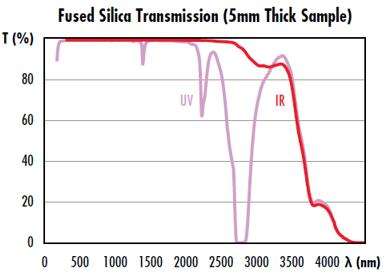
UV-grade fused silica: produced by vapor-phase synthesis from silicon tetrachloride, with extremely low metal-impurity content (ppb level) and excellent deep-UV transmission; but hydroxyl (OH) content is usually high (hundreds to ~1000 ppm), an inherent feature of the synthesis process. High transmission from deep UV (~180 nm) to near-IR (~2.2 μm). Typical grades: Corning 7980, Heraeus Suprasil, Chinese JGS1. Used in UV optics, high-power lasers, lithography, etc.
IR-grade fused silica: produced by melting rock crystal or by electric fusion, with very low hydroxyl content (<5–10 ppm, some grades <1 ppm), effectively eliminating OH absorption peaks at 1.38 μm, 2.2 μm, 2.7 μm and elsewhere, giving significantly better transmission in the IR than synthetic UV grade. Typical grades: Corning 7940, Heraeus Infrasil, Chinese JGS3. Used in IR optics, CO₂ laser windows, etc.
III. Key Parameters: Core Performance Metrics of Fused Silica
| Parameter | Typical value (synthetic UV grade) | Notes |
|---|---|---|
| Refractive index nd (587.6 nm) | 1.45846 | slightly lower than BK7 |
| Abbe number Vd | 67.7 | low dispersion |
| Transmission range | 180nm ~ 2.2μm | depends on the specific grade |
| Thermal expansion coefficient (20–100 °C) | 0.55×10⁻⁶/℃ | about 1/13 that of BK7 |
| Refractive-index temperature coefficient dn/dT | 1.28×10⁻⁵/℃ | |
| Density | 2.20 g/cm³ | |
| Softening point | ~1600℃ | far higher than ordinary glass |
| Laser damage threshold | ~10 J/cm² (@1064nm, 10ns) | significantly higher than BK7 |
What does a thermal expansion coefficient of 0.55×10⁻⁶/°C mean? With a 100 °C temperature change, a 1-metre fused-silica rod elongates only 0.055 mm. Under the same conditions BK7 glass elongates 0.71 mm and ordinary steel 1.2 mm. This low-expansion characteristic lets fused silica maintain extremely high dimensional accuracy and optical stability even in violently changing temperatures.
Why is the laser damage threshold high? Because fused silica is highly pure with few defects, and its Si–O bond energy is large, so photons cannot easily break the bonds. In high-power nanosecond laser systems, fused silica’s LIDT is typically 2–3 times BK7’s, which is why windows and lenses in high-power lasers are almost all made of fused silica.
IV. Classification: UV Grade vs IR Grade, Chinese Grade Designations
1. By Manufacturing Method
Electric-fused silica (Electric Fused): quartz powder or silica sand melted in an electric furnace. Lower cost but relatively higher impurities. UV transmission starts around 250–280 nm. Used in ordinary UV optics and low-to-mid-range laser components.
Synthetic fused silica: made from high-purity silicon compounds (such as SiCl₄) by chemical methods such as flame hydrolysis. Extremely pure (metal impurities at ppb level), excellent UV transmission down below 180 nm. Used in deep-UV lithography, excimer lasers and high-end research instruments.
2. Chinese Grade Designations (JGS Series)
| Grade | Type | Equivalent to | Features and applications |
|---|---|---|---|
| JGS1 | far-UV optical quartz glass | synthetic fused silica | transmits 185–2500 nm, deep-UV applications, lithography machines, excimer lasers |
| JGS2 | UV optical quartz glass | electric-fused quartz | transmits 220–2500 nm, ordinary UV optics, UV lamps |
| JGS3 | IR optical quartz glass | IR fused silica | transmits 260–3500 nm, low hydroxyl, IR optics, CO₂ lasers |
V. Applications: Where Is Fused Silica Used?
1. High-Power Lasers
This is one of fused silica’s most core application areas. The output windows, lenses and mirror substrates of high-power solid-state and fibre lasers are almost all fused silica. The reason is simple — its high laser damage threshold and low thermal expansion let it withstand the “baking” of high-power lasers without deforming or being damaged.
2. UV Optics and Lithography
In the deep-UV (DUV) and vacuum-UV (VUV) bands, ordinary glass is completely opaque while synthetic fused silica stays highly transparent. Therefore the optical systems of semiconductor lithography machines and the optical components of excimer lasers (193 nm ArF, 248 nm KrF) must use synthetic fused silica.
3. Space Optics and Astronomy
Optical components on space telescopes and satellites place extremely high demands on material stability — temperatures in space swing violently (from minus a hundred degrees to plus a hundred degrees Celsius), so the material’s thermal expansion must be minimal. Fused silica, with its extremely low thermal expansion and excellent space-environment stability, is one of the materials of choice for space optics.
4. Semiconductor Manufacturing
In semiconductor chip manufacturing, quartz glass is widely used as diffusion furnace tubes, wafer carriers, cleaning tanks and photomask substrates, because it withstands high temperatures, is chemically stable (barely reacting with acids), is highly pure and will not contaminate wafers.
5. Optical Fibre Communication
The core and cladding of optical fibre are essentially doped fused silica. High-purity synthetic quartz glass is the base material for making low-loss optical fibre — fibre loss can be as low as below 0.2 dB/km, inseparable from the ultra-high purity of the quartz material.
VI. Common Misconceptions: 6 Misunderstandings About Fused Silica
Misconception 1: Fused silica is rock crystal, a crystalline material
No. Rock crystal (quartz crystal) is crystalline SiO₂ with a periodic atomic arrangement and birefringence; fused silica is glassy (amorphous) SiO₂ with a long-range-disordered atomic arrangement, isotropic and with no birefringence. The two have the same chemical composition but completely different microstructures and significantly different properties.
Misconception 2: Fused silica is transparent in all wavelength bands
Fused silica’s transmission range is indeed wide, but it has limits. At the deep-UV end (<160 nm), even the highest-quality synthetic fused silica begins to absorb strongly; at the IR end, transmission gradually declines beyond about 2.5 μm and it is essentially opaque above 4 μm.
Misconception 3: Fused silica is not afraid of heat and can be heated or cooled rapidly at will
Fused silica’s softening point is indeed very high (above 1000 °C) and its thermal expansion coefficient low, giving much better thermal-shock resistance than ordinary glass. But that does not mean it is completely immune to thermal shock — if the temperature gradient is too large (e.g. local rapid heating to a high temperature), it can still crack from thermal stress. It is simply many times more thermal-shock resistant than ordinary glass.
Misconception 4: Fused silica is hard, so it will not scratch
Fused silica’s Mohs hardness is about 5.5–6.5 — indeed a little harder than ordinary glass — but it can still be scratched by harder substances. Diamond, silicon carbide, aluminium oxide and even sand can scratch it. So high-precision fused-silica optical components still need careful protection and cleaning.
Misconception 5: JGS1 and JGS2 are similar and interchangeable
Very different. JGS1 is a far-UV-grade quartz made by synthesis, with metal impurities at the ppb level and relatively high transmission at 185 nm; JGS2 is a UV-grade quartz made by electric fusion, with relatively higher impurities and a UV cutoff around 220 nm. In deep-UV applications JGS2 is almost unusable, while JGS1 is the standard.
Misconception 6: Fused silica does not react with any chemical substance
Fused silica’s chemical stability is indeed excellent — at room temperature it barely reacts with acids (except hydrofluoric acid and hot phosphoric acid), alkalis or organic solvents. But it has two “nemeses”: one is hydrofluoric acid (HF), which strongly attacks SiO₂; the other is hot concentrated alkali solution, which also corrodes it slowly at high temperature. When using and cleaning fused-silica components, avoid contact with these two types of substances.
References:
- RP Photonics Encyclopedia: Fused Silica — optical properties and classification of fused silica
- Corning 7980 / 7979 synthetic fused silica product manuals
- Heraeus Suprasil / Infrasil fused silica technical data
- Optical Quartz Glass — a domestic specialised work on quartz glass
Related Products: Optical Resonators and Components
Leave a Reply