


There is a remarkable crystal, second in hardness only to diamond, yet transparent from deep UV all the way to mid-IR; it can serve as a smartphone watch crystal resisting daily wear, and as a missile window withstanding high-speed aerodynamic heating. It is sapphire crystal — the single-crystal form of aluminium oxide (Al₂O₃).
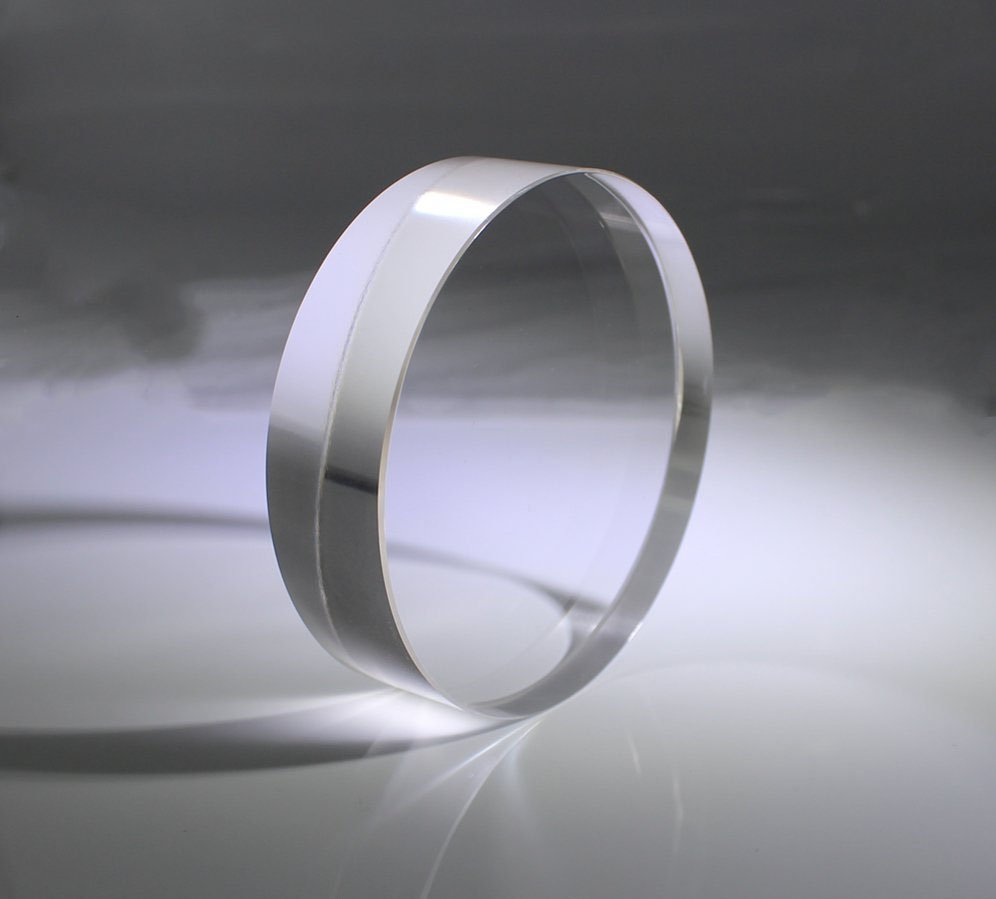
When most people hear “sapphire” they think of a blue gemstone. But in optics and industry the sapphire we use is colorless and transparent — pure Al₂O₃ single crystal is naturally colorless; the blue colour comes from impurities. In this article we discuss sapphire crystal systematically: its structure, properties, growth methods, what c-plane/a-plane/m-plane mean, and its applications in lasers and optics.
References
Recommended Reading
Table of Contents
- I. Core Concepts: What Is Sapphire Crystal?
- II. Working Principle: Crystal Structure and Optical Properties
- III. Key Parameters: Sapphire’s Core Performance Metrics
- IV. Classification: Growth Methods, Crystal Orientations and Application Categories
- V. Applications: Where Is Sapphire Used?
- VI. Common Misconceptions: 6 Misunderstandings About Sapphire
I. Core Concepts: What Is Sapphire Crystal?
Sapphire is a single-crystal form of aluminium oxide (Al₂O₃), a mineral second in hardness only to diamond in nature. Its chemical composition is aluminium oxide, it belongs to the trigonal crystal system and has an atomic structure with hexagonal symmetry.
Many people think of blue gemstones on hearing “sapphire,” but sapphire is not necessarily blue. Pure Al₂O₃ single crystal is colorless and transparent; the blue sapphires we normally see contain small amounts of titanium (Ti⁴⁺) and iron (Fe²⁺) impurities. In optical and industrial applications we usually use colorless, transparent, high-purity sapphire single crystal.
Put simply: gem-grade sapphire is beautiful because of impurities; industrial-grade sapphire is useful because it has none.
Sapphire occupies a very special place in optics because it combines many “contradictory” advantages:
- both hard (Mohs 9, second only to diamond) and transparent (from deep UV to mid-IR)
- both with a very high melting point (2050 °C) and good thermal conductivity
- both a quality optical-window material and a key semiconductor-substrate material
II. Working Principle: Crystal Structure and Optical Properties
1. Crystal Structure: Trigonal Al₂O₃
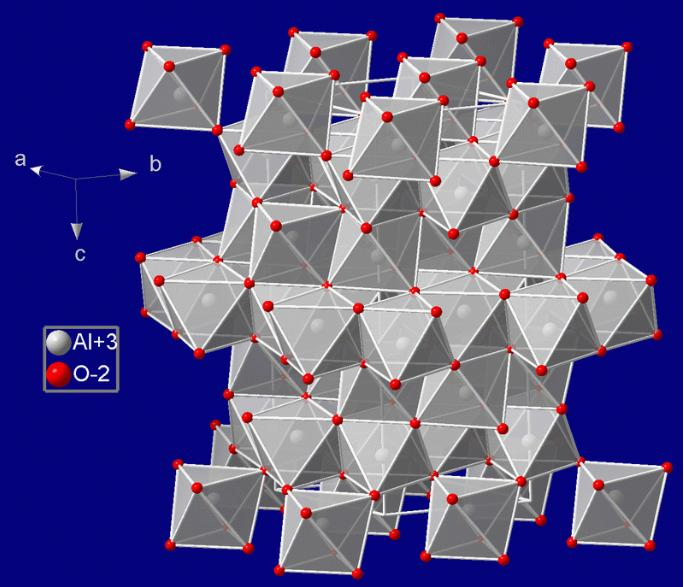
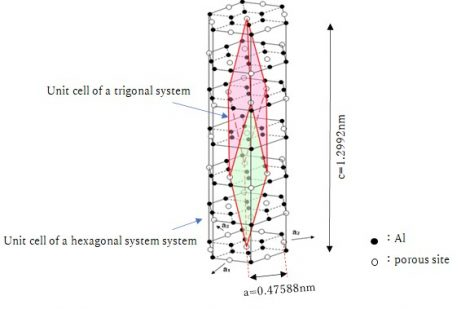
Sapphire’s chemical composition is Al₂O₃ (corundum structure), belonging to the trigonal crystal system. In each unit cell, oxygen atoms are arranged in hexagonal close packing, with aluminium atoms filling the octahedral interstices.
Because sapphire is an anisotropic crystal (not isotropic like glass), its physical properties vary with crystal direction. This gives rise to a very important concept in sapphire optics — crystal-plane orientation.
There are three common sapphire orientations:
| Orientation | Plane index | Features | Main applications |
|---|---|---|---|
| c-plane | (0001) | perpendicular to the optical axis, no birefringence for incidence along the c-axis | LED substrates, optical windows (most common) |
| a-plane | (112̄0) | parallel to the c-axis, has birefringence | special optics, GaN optoelectronic devices |
| m-plane | (101̄0) | parallel to the c-axis, non-polar plane | non-polar GaN growth, polarisation optics |
Why so many planes? Because sapphire is anisotropic — refractive index, thermal expansion coefficient and growth rate all depend on direction. Different applications require different orientations for optimal performance.
2. Optical Properties: Wide Transmission Range and High Hardness
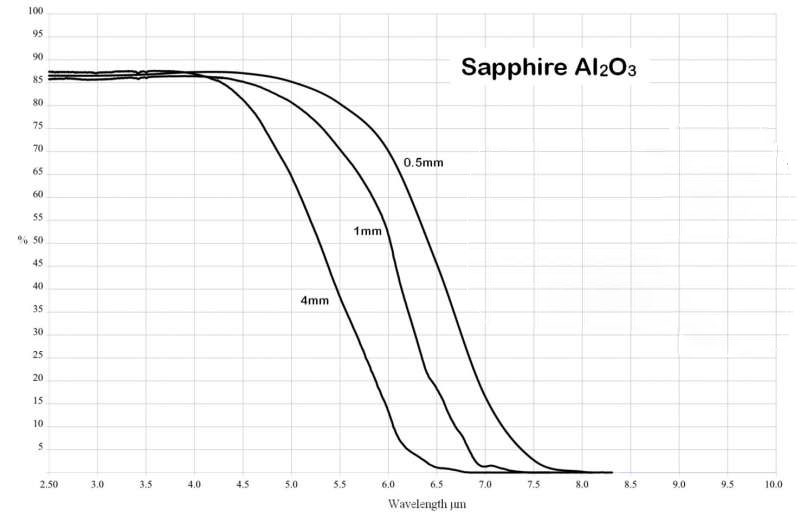
Sapphire’s optical transmission range is very wide: from about 150 nm deep UV all the way to about 5.5 μm mid-IR, with high transmission over most of that range (about 85% or more, accounting for Fresnel reflection at both surfaces).
Sapphire’s refractive index (ordinary ray n_o) is about 1.768 and extraordinary ray n_e about 1.760. The birefringence is about 0.008, making it a positive uniaxial crystal. For a c-plane sapphire window, when light is normally incident (along the c-axis), no birefringence occurs, so c-plane windows are the most commonly used.
3. Mechanical and Thermal Properties
- Mohs hardness: 9 (second only to diamond’s 10, about twice quartz glass)
- Melting point: 2050 °C (can work in high-temperature environments)
- Thermal conductivity: about 40 W/(m·K) (along c-axis, at room temperature), much better than most glass materials
- Thermal expansion coefficient: about 7.7×10⁻⁶/°C along c-axis, about 7.3×10⁻⁶/°C along a-axis
High hardness means sapphire is highly wear- and scratch-resistant, which is why many optical windows operating in harsh environments (such as military pod windows and missile windows) are made of sapphire.
III. Key Parameters: Sapphire’s Core Performance Metrics
| Parameter | Value / range | Notes |
|---|---|---|
| Chemical composition | Al₂O₃ | aluminium oxide single crystal |
| Crystal system | trigonal | positive uniaxial crystal |
| Melting point | 2050℃ | |
| Mohs hardness | 9 | second only to diamond |
| Density | 3.98 g/cm³ | |
| Refractive index n_o (589 nm) | 1.768 | ordinary-ray refractive index |
| Refractive index n_e (589 nm) | 1.760 | extraordinary-ray refractive index |
| Transmission range | 150nm ~ 5.5μm | from deep UV to mid-IR |
| Thermal conductivity (25 °C, c-axis) | about 40 W/(m·K) | significantly higher than glass |
| Thermal expansion coefficient (c-axis) | 7.7×10⁻⁶/℃ |
Wide transmission range: sapphire is one of the few optical materials covering deep UV to mid-IR simultaneously. For optical systems operating across wavelength bands, sapphire is a very valuable window material.
High hardness and high damage threshold: sapphire’s Mohs hardness reaches 9, extremely scratch- and wear-resistant. Its laser damage threshold is also high, making it suitable for high-power laser systems, especially ultrafast lasers — sapphire’s small nonlinear effects and high thermal conductivity allow better heat dissipation.
IV. Classification: Growth Methods, Crystal Orientations and Application Categories
1. By Growth Method
Kyropoulos Method (KY): the seed crystal is dipped into the melt surface, slowly pulled upward and rotated while the temperature is gradually lowered for crystal growth. Can grow large, high-quality sapphire crystals with few defects and good uniformity. It is currently the mainstream growth method for LED-substrate sapphire, widely used by many companies.
Heat Exchanger Method (HEM): a heat exchanger controls the temperature gradient, with crystallization starting from the bottom of the crucible. Can grow very large crystals (>200 kg), suited to mass production. Mostly used for large sapphire windows and defence applications.
Czochralski Method (CZ): the seed crystal is slowly pulled up from the melt while rotating. Fast growth, but crystal size and quality are relatively limited. Mostly used for small-size optical-grade sapphire.
2. By Application Field
- Sapphire for LED substrates: 2-inch, 4-inch, 6-inch and 8-inch wafers, precision polished, for growing GaN epitaxial layers
- Optical-grade sapphire: windows, lenses and prisms of various sizes for laser, IR and UV optics
- Semiconductor-grade sapphire: SOI substrates, GaN power-device substrates
- Sapphire for consumer electronics: smartphone camera cover glass, smartwatch crystals
- Sapphire for defence and military: IR windows, missile domes, armored viewports
V. Applications: Where Is Sapphire Used?
1. LED Substrates (the Largest Market)
Sapphire is currently the mainstream substrate material for gallium nitride (GaN) based LEDs; over 90% of LED chips worldwide are grown on sapphire substrates. Although the lattice mismatch between GaN and sapphire is considerable (about 16%), buffer-layer technology solves it well. Sapphire substrates offer mature technology, moderate cost and good light transmission.
2. Laser Windows and Ultrafast-Laser Optics
Thanks to its high hardness, high laser damage threshold and wide transmission range, sapphire is a window-material choice for many lasers. Especially in ultrafast (femtosecond) lasers, sapphire’s high thermal conductivity and relatively controllable nonlinear effects make it suitable as the output window of high-power ultrafast lasers and the protective window of gain media.
3. Infrared Optics and Mid-IR Windows
Sapphire still has good transmission in the mid-IR band (3–5 μm), with high hardness and good mechanical strength, making it suitable for IR detection-system windows. Military IR pods and missile-guidance windows often use sapphire — it must both transmit IR well and withstand aerodynamic heating and abrasion at high flight speeds.
4. Deep-UV Optics
Sapphire stays transparent in the deep-UV band (down to about 150 nm), better than most optical glasses and quartz materials. Therefore sapphire is an important window material in deep-UV optical instruments and excimer-laser systems.
5. Consumer Electronics
From smartphone camera cover glass to smartwatch crystals, sapphire’s use in consumer electronics is growing. Although all-sapphire phone screens still face cost and process challenges, in small-area, high-value applications sapphire’s hardness and scratch resistance are unmatched advantages.
VI. Common Misconceptions: 6 Misunderstandings About Sapphire
Misconception 1: All sapphires are blue
This is the most common misunderstanding. The name “sapphire” comes from gemology, but in industry and optics the sapphire crystal we speak of is usually colorless, transparent, high-purity Al₂O₃ single crystal. Sapphire appears blue only when titanium and iron impurities are added. In fact, red corundum is called ruby (chromium-doped), blue is called sapphire (Ti/Fe-doped), and other colours are called fancy sapphires.
Misconception 2: Sapphire is a glass, similar to quartz glass
Not at all. Sapphire is a crystal (atoms arranged in a periodic, ordered structure), while quartz glass is amorphous (atoms disordered over long range). Crystals have birefringence, a definite melting point and anisotropy; glass is isotropic with no definite melting point. In hardness, thermal conductivity and transmission range, sapphire significantly outperforms quartz glass, but it is also much harder to process and far more expensive.
Misconception 3: Any orientation of a sapphire window is the same
No. Sapphire is an anisotropic uniaxial crystal whose physical properties depend on crystal direction. The most common is the c-plane sapphire window — when light is normally incident (along the c-axis) no birefringence occurs. If an a-plane or m-plane is used as a window, normal incidence still produces birefringence, splitting one beam into two, which is avoided in most applications.
Misconception 4: Sapphire is so hard it cannot break
Sapphire is indeed very hard (Mohs 9) with excellent scratch resistance. But hardness does not mean indestructible — sapphire is relatively brittle and can shatter under impact (think of sapphire watch glass: scratch-proof but drop-sensitive). Also, if temperature changes too quickly (thermal shock), because its thermal expansion coefficient is not especially low, thermal stress may cause cracking.
Misconception 5: Sapphire is transparent in all infrared bands
Sapphire’s IR cutoff is around 5.5 μm; in the 3–5 μm mid-IR band it indeed transmits well. But in the 8–14 μm far-IR band sapphire is opaque — the far-IR requires materials such as ZnSe, Ge and Si. So not all IR applications can use sapphire; it depends on the specific operating band.
Misconception 6: LED-substrate sapphire and optical-window sapphire are the same
Although both are sapphire crystal, they differ in orientation, purity, defect requirements and surface processing. LED substrates require extremely low dislocation density and very high surface flatness (because semiconductor epitaxial layers are grown on them), while optical windows focus more on optical uniformity, transmission and surface figure accuracy.
References
- RP Photonics Encyclopedia – Sapphire
- Crytur Sapphire Datasheet technical manual
- Sapphire Crystal Growth and Applications
- Crystal Optics textbook
- Infrared Optical Materials Handbook
👉 To learn more about lasers, browse other sections of the Laser Encyclopedia.
📖 Further Reading:
- Fused Silica Glass — another high-power laser material, compared for selection
- Optical Windows — sapphire as a window material
- Optical Glass and Window Materials — overview of window materials
🔗 Related Products: Optical Resonators and Components
Leave a Reply