


Have you ever wondered: why can lasers emit green, ultraviolet, even deep-ultraviolet light? After all, common laser crystals such as Nd:YAG emit 1064 nm infrared light. The answer lies in nonlinear optical crystals — remarkable crystals that can “transform” laser light of one wavelength into another, like “magic converters” in the optical world.
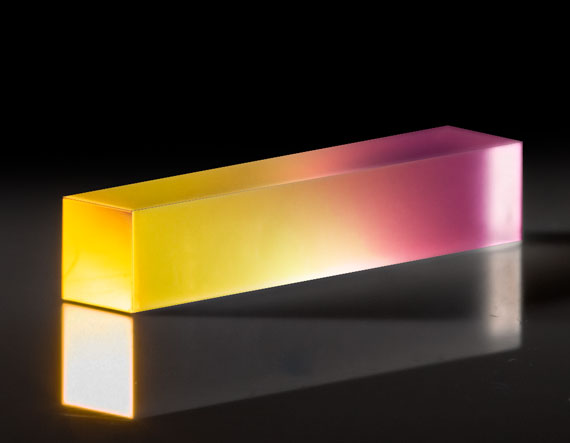
From green laser pointers to UV lithography machines, from optical parametric oscillators to terahertz sources, nonlinear optical crystals are almost everywhere. But what exactly is a nonlinear optical effect? What is phase matching? The names BBO, LBO, KTP and KDP are dizzying — what are the differences between them? In this article we systematically sort out the whole picture of nonlinear optical crystals.
📋 Table of Contents
- I. Core Concepts: What Is a Nonlinear Optical Crystal?
- II. Working Principle: Nonlinear Effects and Phase Matching
- III. Key Parameters: How to Judge a Good Nonlinear Crystal?
- IV. Classification: The Borate, Phosphate and Niobate Families
- V. Applications: Where Are Nonlinear Crystals Used?
- VI. Common Misconceptions: 6 Misunderstandings About Nonlinear Crystals
I. Core Concepts: What Is a Nonlinear Optical Crystal?
Nonlinear optical crystals are a class of special crystalline materials that produce nonlinear optical effects. Quite simply, when light passes through such a crystal, properties of the output light such as frequency, phase and polarisation undergo “nonlinear” changes — the input and output are no longer related by a simple linear relationship.
Let us put it more intuitively:
- Ordinary optical glass: whatever wavelength goes in comes out the same, only slightly weaker and direction-shifted
- Nonlinear optical crystal: light goes in and what comes out may be doubled-frequency light (1064 nm in, 532 nm out), or new wavelengths may be generated, or even weak light amplified
To use an analogy: ordinary optical materials are like an “honest mirror” — they reflect you exactly as you are; nonlinear optical crystals are like a “magic mirror” — you go in one colour and they turn out another.
The essence of nonlinear optical effects: under intense laser light, atoms (or ions, electrons) in the crystal undergo sufficiently large displacements, so that the polarisation P of the medium is no longer simply linearly related to the electric field E, requiring higher-order nonlinear terms:
P = ε₀(χ⁽¹⁾E + χ⁽²⁾E² + χ⁽³⁾E³ + …)
where χ⁽¹⁾ is the linear susceptibility (corresponding to ordinary refraction, absorption, etc.), χ⁽²⁾ the second-order nonlinear susceptibility (frequency doubling, sum/difference frequency, OPO, etc.), and χ⁽³⁾ the third-order nonlinear susceptibility (third harmonic, four-wave mixing, Kerr effect, etc.).
Nonlinear optical crystals mainly exploit second-order nonlinear effects (χ⁽²⁾), because these have the highest efficiency and broadest applications. Second-order effects can exist only in crystals without inversion symmetry (non-centrosymmetric crystals) — which is why not every transparent crystal can be a nonlinear optical crystal.
II. Working Principle: Nonlinear Effects and Phase Matching
1. What Second-Order Nonlinear Optical Effects Exist?
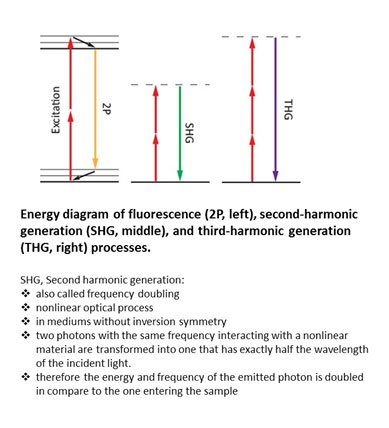
The main effects based on the second-order nonlinear susceptibility χ⁽²⁾ are:
- Second-harmonic generation (SHG / frequency doubling): two photons of the same frequency ω “merge” into one photon of frequency 2ω. Example: 1064 nm → 532 nm green. This is the most commonly used and most mature nonlinear effect.
- Sum-frequency generation (SFG): two photons of different frequencies ω₁ and ω₂ combine to produce a photon of frequency ω₁+ω₂. Example: 1064 nm + 532 nm → 355 nm UV.
- Difference-frequency generation (DFG): a high-frequency photon ω₁ and a low-frequency photon ω₂ interact to produce a difference-frequency photon ω₁-ω₂. Commonly used to generate mid- and far-infrared laser light.
- Optical parametric oscillation (OPO): a high-frequency pump photon ω_p splits into a signal photon ω_s and an idler photon ω_i, satisfying ω_p = ω_s + ω_i. Its biggest advantage is an extremely wide wavelength-tuning range.
- Optical parametric amplification (OPA): similar principle to OPO but without a resonator; pump light amplifies a weak signal. Commonly used in ultrafast lasers.
2. Phase Matching: The “Switch” of Nonlinear Effects
For nonlinear optical effects to occur efficiently, there is a very critical prerequisite — phase matching (Phase Matching).

Why is phase matching needed? As the fundamental light propagates in the crystal, it continuously “excites” doubled-frequency light. But because of dispersion, the fundamental and doubled light have different refractive indices and thus different propagation speeds — a phase difference accumulates between doubled light generated earlier and later; if it grows large enough, “destructive” rather than “constructive” interference occurs and conversion efficiency cannot rise.
The core idea of phase matching is: by some means, make the phase velocities (i.e. refractive indices) of the fundamental light and the newly generated frequency equal in the crystal, so the doubled light adds in phase and efficiency is maximised.
3. Three Phase-Matching Methods
| Phase-matching method | Principle | Representative crystals / applications | Pros and cons |
|---|---|---|---|
| Angle phase matching | uses birefringence, adjusts propagation angle to equalize n | BBO, LBO, KDP (most common) | flexible tuning, but has walk-off effect |
| Temperature phase matching | changes refractive index by changing temperature | LBO non-critical phase matching (NCPM) | no walk-off, large acceptance angle, but inconvenient tuning |
| Quasi-phase matching (QPM) | periodically reverses the sign of the nonlinear coefficient | PPLN (periodically poled lithium niobate) | can use the largest d coefficient, flexible tuning, but hard to fabricate and low damage threshold |
In angle phase matching there are two important engineering concepts:
- Walk-off Angle: the energy-flow direction of the e-ray differs from the wave-vector direction, causing the doubled light to deviate from the fundamental light direction. The larger the walk-off angle, the more it limits effective interaction length.
- Acceptance Angle: the angular deviation at which conversion efficiency falls to half its maximum. The larger the acceptance angle, the more tolerant the crystal is of angle and the easier it is to use.
III. Key Parameters: How to Judge a Good Nonlinear Crystal?
| Parameter name | Symbol | Meaning | Notes |
|---|---|---|---|
| Nonlinear coefficient | d_ij | magnitude of second-order nonlinear susceptibility | the larger, the higher the conversion efficiency |
| Transmission range | – | wavelength interval transparent to the crystal | must cover all wavelengths involved in the interaction |
| Phase-matching range | – | wavelength range over which phase matching is achievable | determines which wavelength bands the crystal can be used in |
| Laser damage threshold | LIDT | maximum laser power/energy density the crystal withstands | key parameter for high-power applications |
| Walk-off angle | ρ | energy-flow walk-off in angle phase matching | the smaller the better |
| Acceptance angle | Δθ | angular tolerance of phase matching | the larger, the easier to use |
| Temperature bandwidth | ΔT | temperature tolerance of phase matching | the larger, the more stable |
Nonlinear coefficient d_ij: the most direct parameter measuring a crystal’s “nonlinear capability.” But d is not the larger the better — crystals with large d often have low damage thresholds and narrow transmission ranges, requiring a comprehensive trade-off. Typical d values: KDP about 0.4 pm/V, BBO about 2 pm/V, LiNbO₃ about 25 pm/V.
Laser damage threshold: nonlinear processes generally need high light intensity to occur efficiently, but too high an intensity damages the crystal. The damage threshold is an important factor limiting the maximum output power of nonlinear crystals.
IV. Classification: The Borate, Phosphate and Niobate Families
1. Borate Series (most widely used)
Representative crystals: BBO (β-BaB₂O₄), LBO (LiB₃O₅), CBO (CsB₃O₅), BIBO (BiB₃O₆), CLBO (CsLiB₆O₁₀)
Features: good UV transmission, relatively high damage threshold; currently the most widely used nonlinear crystal family. Mainly used for doubling and sum-frequency from UV to visible, and high-power laser frequency conversion.
2. Phosphate / Arsenate Series
Representative crystals: KDP (KH₂PO₄), KD*P (KD₂PO₄), KTP (KTiOPO₄), RTP (RbTiOPO₄)
Features: the KDP family can be grown as large (even metre-scale) single crystals; KTP has a large nonlinear coefficient. KDP is used in high-power lasers (such as inertial-confinement fusion); KTP is used for green doubling (the mainstay of commercial green lasers).
3. Niobate Series
Representative crystals: LiNbO₃ (lithium niobate), MgO:LiNbO₃ (magnesium-doped lithium niobate), KNbO₃
Features: very large nonlinear coefficients (more than an order of magnitude larger than BBO), but low damage thresholds and susceptibility to photorefraction. Periodically poled lithium niobate (PPLN) and lithium-niobate-on-insulator (LNOI) are hot topics in integrated photonics today.
4. Infrared Nonlinear Crystals
Representative crystals: AgGaS₂ (silver gallium sulfide), ZnGeP₂ (zinc germanium phosphide), GaSe (gallium selenide), OP-GaAs
Features: can achieve phase matching in the mid- to far-infrared, used for mid/far-IR OPO and terahertz generation. But damage thresholds are low, and some crystals are toxic or hard to grow.
V. Applications: Where Are Nonlinear Crystals Used?
1. Laser Frequency Conversion (the Main Application)
This is the biggest use of nonlinear optical crystals. Solid-state lasers have limited output wavelengths (such as 1064 nm, 1080 nm), but applications need various wavelengths — green, UV, deep UV, mid-IR and so on. Many of these cannot be produced directly by the laser medium but are “transformed” by nonlinear crystals.
- Green lasers: 1064 nm doubled via KTP or LBO to 532 nm green
- UV lasers: 1064 nm first doubled to 532 nm, then sum-frequency to 355 nm UV
- Deep-UV lasers: further sum-frequency or doubling to 266 nm or even 177.3 nm
2. Optical Parametric Oscillators (OPO)
OPO is currently one of the most effective means of obtaining broadly tunable laser light. A nonlinear crystal plus two cavity mirrors convert a fixed-wavelength pump laser into continuously tunable signal and idler light. BBO-OPO tunes from visible to near-IR, PPLN-OPO covers the mid-IR, and ZGP-OPO extends into the far-IR.
3. Frequency Conversion and Amplification of Ultrafast Lasers
In femtosecond ultrafast lasers, nonlinear crystals are also indispensable. Crystals such as BBO and LBO are used for doubling and sum-frequency of ultrafast light; optical parametric amplification (OPA, NOPA) is an important technique for generating ultrashort pulses with ultra-broad tuning ranges.
4. Electro-Optic Modulation and Q-Switching
Crystals such as KDP, KD*P and LiNbO₃ also have significant electro-optic (Pockels) effects. These are used to make electro-optic modulators, electro-optic switches and laser Q-switches. The KD*P Pockels cell is one of the most commonly used Q-switch elements in high-power lasers.
5. Integrated Optics and Photonics
Thanks to its excellent electro-optic and nonlinear properties, lithium niobate is called “optical silicon.” Periodically poled lithium niobate (PPLN) and the latest lithium-niobate-on-insulator (LNOI) technology have important applications in integrated photonics, optical communication and quantum optics.
VI. Common Misconceptions: 6 Misunderstandings About Nonlinear Crystals
Misconception 1: Any crystal can produce nonlinear optical effects
No. Second-order nonlinear effects (doubling, sum-frequency, etc.) can occur only in crystals without inversion symmetry. If a crystal is centrosymmetric, χ⁽²⁾ = 0 and there is no second-order nonlinear effect. This is why quartz crystal, though transparent, cannot be a doubling crystal (it is centrosymmetric). Glass is isotropic and has even less second-order nonlinearity.
Misconception 2: The larger the nonlinear coefficient, the better the crystal
A large nonlinear coefficient is certainly beneficial, but it is not the only metric — you must also consider damage threshold (crystals with large d often have low damage thresholds), transmission range, phase-matching range, walk-off angle, chemical stability, price and so on. For example, lithium niobate’s nonlinear coefficient is an order of magnitude larger than BBO’s, but its damage threshold is low and it is prone to photorefraction, so BBO or LBO are more commonly used in high-power applications.
Misconception 3: If phase matching is achieved, conversion efficiency will be 100%
Phase matching only satisfies the condition for “constructive addition”; actual conversion efficiency is limited by many factors: crystal length, fundamental-light power density, crystal losses, beam quality, walk-off effect and so on. For doubling, nanosecond-pulse doubling efficiency is typically 30–60%, and CW doubling efficiency is lower still.
Misconception 4: One crystal can perform only one nonlinear conversion
No. One nonlinear crystal can perform multiple nonlinear processes, as long as phase-matching conditions are met. For example, BBO can double 1064 nm to 532 nm, double 532 nm to 266 nm, and also do OPO to produce tunable laser light — different applications just need different crystal cut angles.
Misconception 5: Temperature has little effect on nonlinear crystals
Quite the opposite — temperature has a large effect. On one hand, refractive index changes with temperature, so when temperature changes the phase-matching condition changes — which is why many nonlinear crystals need precise temperature control. On the other hand, high-power laser light passing through the crystal creates thermal effects that not only change phase-matching conditions but may also cause thermal lensing, thermal stress or even crystal fracture.
Misconception 6: Nonlinear crystals are only used for laser frequency conversion
Frequency conversion is indeed the main application of nonlinear optical crystals, but it goes far beyond that. Electro-optic modulation (Q-switches, electro-optic modulators), optical parametric amplification, terahertz generation, quantum optics (entangled photon-pair generation) and integrated photonics all rely on nonlinear optical crystals.
📚 References
- RP Photonics Encyclopedia – Nonlinear Crystals
- Nonlinear Optics (Robert W. Boyd)
- Principles of Nonlinear Optics (Shen Yuen-Ron)
- Nonlinear Optical Crystal Materials Science
- Laser Frequency Conversion Technology
👉 To learn more about lasers, browse other sections of the Laser Encyclopedia.
Leave a Reply