


Laser Cleaning: Should You Convert Gaussian to Flat-Top? Do You Need DOE Beam Shaping?
One-sentence conclusion: most laser cleaning jobs do not need dedicated beam shaping — high-speed galvo scanning plus pass overlap already integrates the energy into a uniform distribution in space. Shaping is really worthwhile only for single-pass processing without overlap, heat-sensitive thin parts, and high-uniformity requirements; for wide-area cleaning, the more useful move is stretching the spot into a line, not necessarily a flat-top. Even if you do want a flat-top, a DOE (diffractive optical element) is only one of several technical routes, not a must-have.
1. The Answers to the Three Questions, Up Front
- Should the Gaussian beam be converted to a flat-top? It depends. Mainstream cleaning equipment (handheld units, robots, gantry systems) that uses galvo scanning with multi-pass overlap basically does not need it; only single-pass processing that cannot overlap, heat-sensitive thin parts, and applications with high uniformity requirements justify a dedicated flat-top conversion.
- Do you need a DOE? A DOE is one route to flat-top conversion, with the highest design freedom, thin elements and easy integration; it suits low-to-mid power levels and applications needing line, square, ring or multi-spot patterns. If you pursue high efficiency, high power and stability, refractive beam shapers or homogenizing optics should come first.
- The key to wide-area cleaning is not “flat-top” but a “line spot”. Stretching the spot into a uniform line and cleaning one strip per pass significantly improves efficiency — this is the more common shaping need for large-area cleaning.
2. Why Does Cleaning Care About Spot Shape?
Laser cleaning always operates within the process window between the cleaning threshold and the damage threshold: if the energy density is too low, the contaminant shows no reaction and cannot be removed; if too high, the substrate discolors, over-burns, or even suffers structural damage. A direct corollary follows — the energy density at every point of the spot should fall within this window.
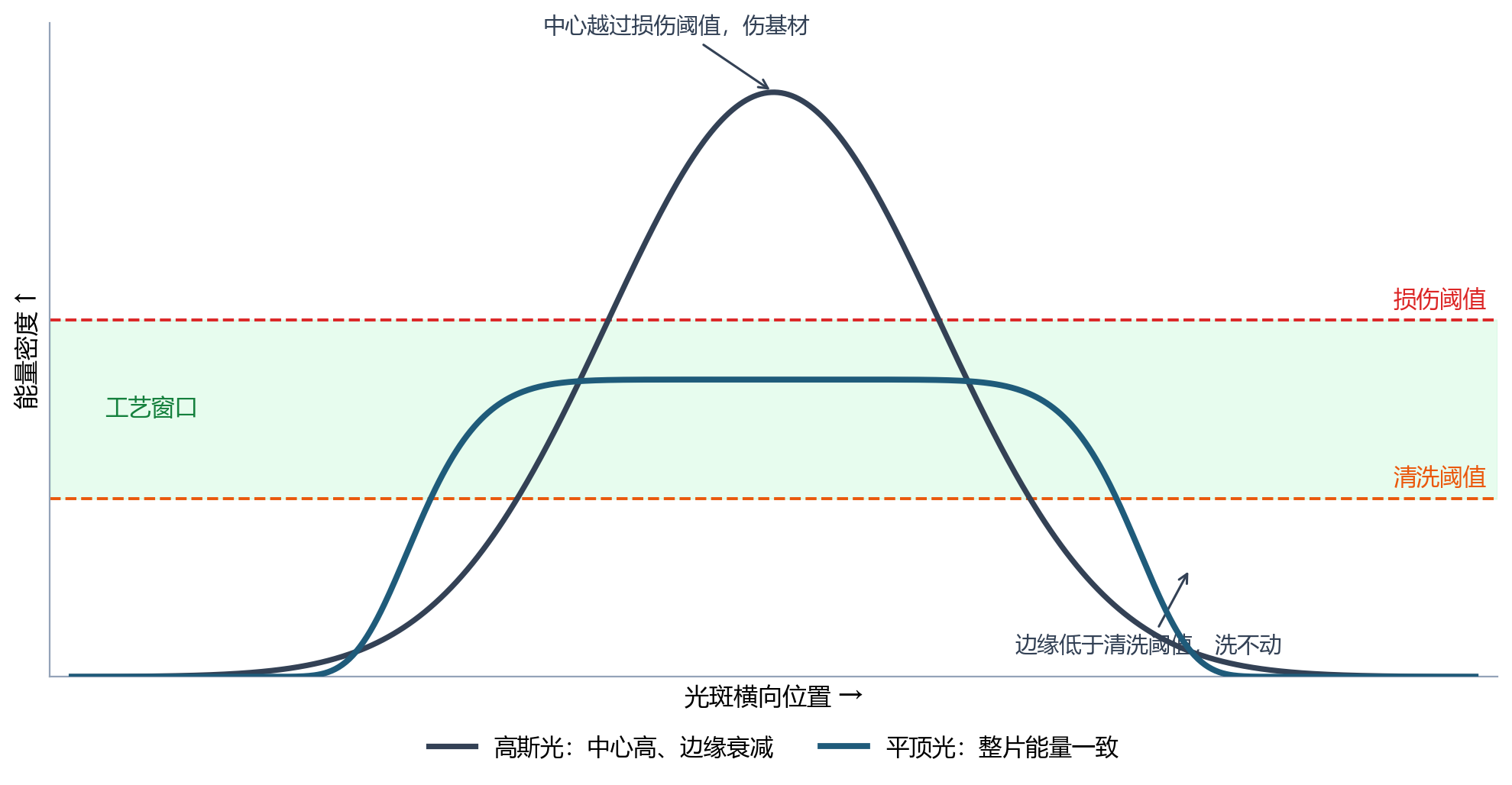
But don’t rush to add a shaper — galvo scanning itself acts as a “shaper”: a small spot moving at high speed, with adjacent scan passes overlapping, smears out the instantaneous Gaussian distribution through temporal and spatial superposition, so the workpiece surface actually receives a uniform dose. That is why the vast majority of cleaning equipment needs no additional shaping optics.
3. Decision Table: Does Your Application Need Shaping?
| Application scenario | Conclusion | Recommended route |
|---|---|---|
| Galvo scanning, multi-pass overlap (handheld / robot / gantry, mainstream models) | Basically not needed | Tune overlap rate, defocus and scan speed (zero extra cost) |
| Wide-area fast cleaning (large-area rust or paint removal) | Needs a “line spot”, not a flat-top | Powell lens / cylindrical lens group / DOE line |
| Single-pass processing, no overlap possible (spot cleaning, low-speed point treatment) | Flat-top recommended | Refractive shaper (higher power); DOE (low-to-mid power, compact integration) |
| Heat-sensitive, thin or precision parts (afraid of the central hot spot) | Flat-top clearly valuable | Refractive first, DOE second (verify power density and LIDT) |
| High uniformity requirements (selective coating removal, mirror-finish parts, cultural relics) | Flat-top required, verified by measurement | Refractive / DOE, accepted with a beam profiler |
| Square / irregular / multi-spot array needed | Only a DOE can flexibly deliver | DOE (customized to actual beam parameters) |
| High-power single-spot flat-top, budget-sensitive | Approach DOE with caution | Prefer refractive / light-pipe homogenization; check DOE damage threshold and zero-order management |
4. Six Routes to Flat-Top (by Suitability Priority)
- Scan integration (zero cost): fast galvo scanning plus pass overlap; try this route to its full extent first — for most scenarios it is the end of the story.
- Line-spot shaping: Powell lens (uniform line), cylindrical lens group, DOE line — the efficiency route for wide-area cleaning.
- Refractive beam shaper: field-mapping type, no zero-order bright spot, typically higher efficiency; customized per single wavelength and relatively expensive, suitable for higher-power, demanding flat-tops.
- DOE (diffractive): highest design freedom (flat-top / line / square / ring / multi-spot), thin element, easy integration; must match wavelength and input beam, manage the zero order, and accept design-related efficiency loss.
- Microlens array (fly-eye) / mixing rod: commonly used for large-area homogenization; the output may carry fine fringes and needs some installation space, suitable for large-spot homogenization.
- Engineered diffuser: low cost, moderate homogenization; edge sharpness and uniformity are average — not the choice for demanding applications.
5. DOE Deep Dive: When to Choose It
| Advantages of a DOE | Points to watch |
|---|---|
| A single element delivers flat-top / line / square / ring / multi-spot, with the greatest design freedom | Wavelength sensitive: an element designed for 1064 nm cannot be used directly at 532 nm |
| Thin element (millimeter scale), easy to integrate inside the cleaning head | Input beam must match: deviations of spot diameter, divergence angle or M² from design values degrade uniformity |
| Semiconductor process gives good batch-to-batch consistency, suitable for productization | The zero-order bright spot must be managed (slight tilt mounting or zero-order-resistant designs) |
| Relatively friendly cost for small-to-mid apertures | Energy has design losses; verify the damage threshold (LIDT) under high power density |
When a DOE fits: hundred-watt class, small-to-mid spot flat-tops; special patterns such as line / square / multi-spot arrays; fixed wavelength and productized batches; compact integration required.
When to be cautious with a DOE: input beam parameters change frequently (one shaper shared across machines); kilowatt-class high-power, large-area cleaning (efficiency, zero-order and cost pressures pile up); scenarios that treat “absolutely uniform, zero loss” as a hard requirement — those should prefer refractive shapers or homogenizing optics.
6. Implementation Checklist: From Tuning to Acceptance
- First squeeze the “scan overlap” route dry: adjust the overlap rate, defocus and scan speed; for most scenarios this is enough.
- Rank your goals clearly: uniformity, width, speed, or special shapes — different goals call for different routes.
- For wide areas, build a line spot; for flat-tops, obtain quotations from both refractive and DOE suppliers and test samples.
- Have the optics supplier do a simulated design based on real beam parameters (wavelength, input spot, M², power density), then test shipped samples.
- Three-piece acceptance kit: beam profiler (shape / uniformity / size), power meter (shaping efficiency), test coupons (uniform cleaning with no substrate damage).
- Don’t forget to verify the LIDT and the mounting position — the power density at the shaper’s location must be calculated first.
7. Frequently Asked Questions
Q1: Is cleaning always better with a flat-top beam?
Not necessarily. In galvo-scanning, multi-pass processes the energy is already homogenized by the scanning itself, so adding a flat-top element brings limited benefit while adding cost, loss and alignment work. The value of a flat-top mainly shows up in single-pass processing that cannot overlap, heat-sensitive thin parts, and high-uniformity applications.
Q2: I want to improve large-area cleaning efficiency — flat-top or line spot?
Line spot first. Use a Powell lens, cylindrical lens group or DOE to shape the beam into a uniform line and cover one strip per pass, improving both coverage width and efficiency; a flat-top mainly solves “uniform energy at a single spot” and does not directly solve “how wide you can clean”.
Q3: Will a DOE be damaged by high power?
There is a risk. A DOE is a wavelength-sensitive element; under high power density you must check its laser damage threshold (LIDT) against the actual power density at the element’s location and manage the zero-order spot; for kilowatt-class, large-area scenarios, refractive shapers or mixing rods are usually recommended.
Q4: Besides a DOE, what other ways are there to make the beam uniform?
In order of priority: scan integration (zero cost), line-spot shaping, refractive beam shaper, DOE, microlens array / mixing rod, engineered diffuser. Choose based on power, beam quality, uniformity requirements and budget — not by defaulting to a DOE.
Further Reading
- What Is a Beam Shaper? Gaussian-to-Flat-Top, 5 Technical Routes, Selection and Misconceptions
- Laser Beam Shaping Encyclopedia
- Laser Cleaning Encyclopedia: Principles, Three Process Methods, Equipment and 8 Common Misconceptions
- DOE Diffractive Optical Element Spot Size Calculator (online tool)
References: public technical materials from shaping-optics vendors such as HOLO/OR, Edmund Optics and LaserComponents; RP Photonics Encyclopedia (Laser Cleaning, Flat-top Beams); on-site encyclopedia articles “Beam Shaper” and “Laser Cleaning”. This article is a technical compilation and does not constitute a purchasing decision; final solutions are subject to sample testing.
Leave a Reply