


What Is Optical Coating? What Do Thin Films on Lenses Do?
Optical coating is an important concept in laser technology, widely used in industrial manufacturing, scientific research and healthcare. This article systematically introduces the core concepts, working principles, key parameters, main types and typical applications of optical coatings, helping readers build a complete knowledge framework.
Table of Contents
- 1. What Is Optical Coating? Understanding the Core Concepts
- 2. Working Principle: How Is Optical Coating Applied?
- 3. Key Parameters: Understanding the Performance Indicators of Optical Coatings
- 4. Main Types: What Kinds of Optical Coating Exist?
- 5. Applications: Where Are Optical Coatings Used?
- 6. Common Misconceptions: Pitfalls to Avoid
1. Core Concepts: What Is Optical Coating?
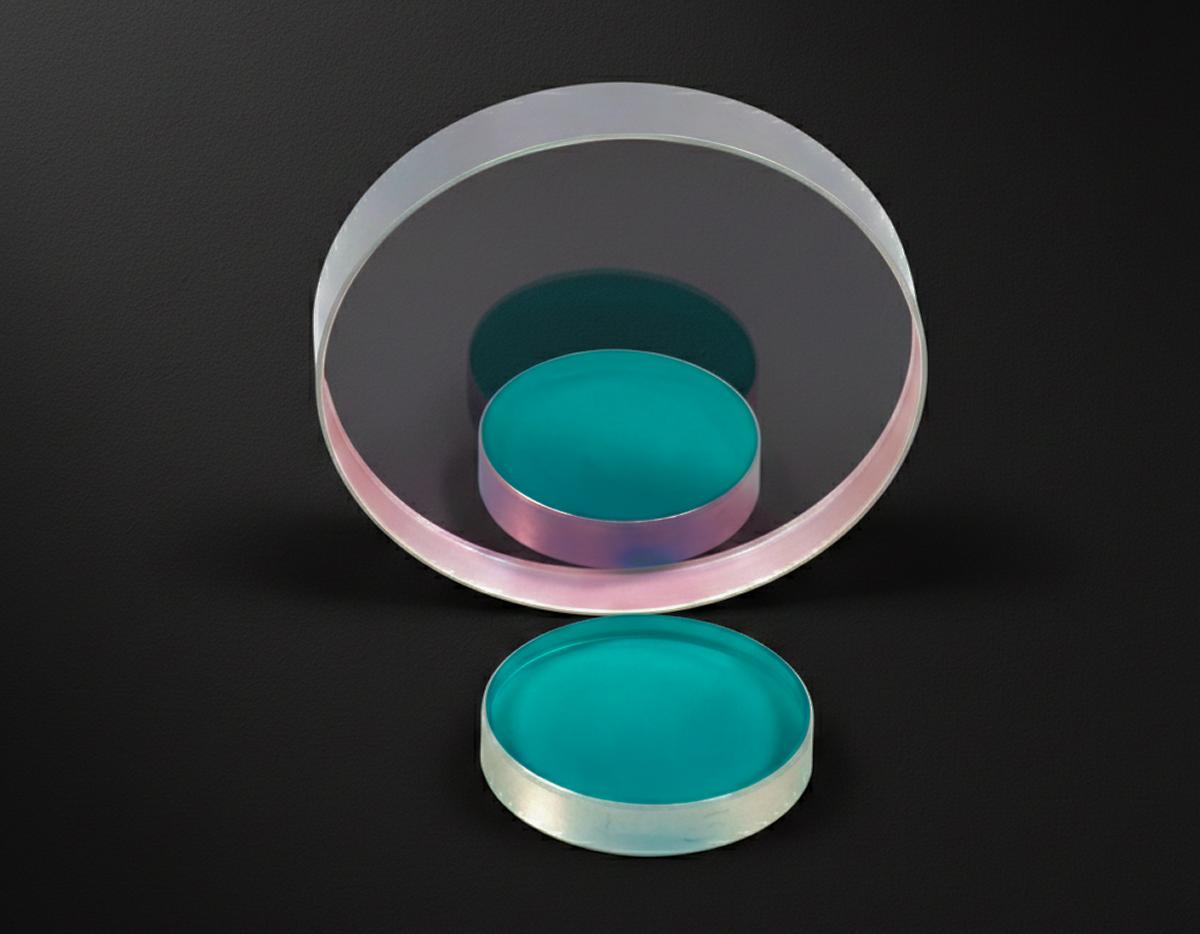
Optical coating refers to depositing one or more extremely thin layers of material on the surface of an optical component (such as a lens, window or mirror) to change how that optical surface reflects, transmits, polarises and otherwise handles light. In simple terms, coating is like giving an optical component ‘a functional optical jacket’ that treats light according to design requirements. The coating thickness is usually on the sub-micron scale—less than one-thousandth the width of a human hair. Optical coatings are the foundation of modern optics and laser technology; almost all laser optical components rely on coatings. Without coatings, an ordinary piece of glass would reflect about 4% of incident light at each surface, and the losses become astonishing when many elements are stacked.
2. Working Principle: How Is Optical Coating Applied?
The core principle of optical coating is the interference effect of light. When light is incident on a multilayer film structure, each interface produces a weak reflected and transmitted wave. There is a phase difference between these waves, resulting in constructive interference (superposition that increases intensity) or destructive interference (mutual cancellation). By precisely controlling the thickness and refractive index of each layer, the reflected light of certain wavelengths can be made to cancel (anti-reflection coatings) or to add up and intensify (high-reflection coatings). Besides interference coatings, there are also metal coatings, which use the strong reflection of incident light by free electrons in the metal, similar to the metallic surface reflections we see every day. These two mechanisms—interference and metal reflection—constitute the two main technical routes of optical coating.
💡 An analogy
An optical coating is like giving an optical component a functional jacket—so thin it is only one-thousandth the width of a hair, yet it can precisely control properties such as reflection, transmission and polarisation. Different coatings are like jackets with different functions: some let more light through (anti-reflection coatings), some reflect almost all light back (high-reflection coatings), and some split light into two beams (beam-splitter coatings).
In summary, optical coating involves the intersection of multiple disciplines including optics, materials science and precision manufacturing. Mastering its basic principles and key parameters is the foundation for properly selecting and using related products.
3. Key Parameters: Understanding the Performance Indicators of Optical Coatings
Understanding optical coatings requires mastering the following key parameters, which directly determine product performance and application scenarios:
| Parameter Name | Meaning | Why It Matters |
|---|---|---|
| Operating Wavelength Range | (whether single wavelength or broadband), angle-of-incidence range (0° normal incidence or 45° oblique incidence), residual reflectance/transmittance (how much loss the customer can tolerate), laser-induced damage threshold LIDT (more critical at higher power), substrate material (glass, crystal or plastic), polarisation requirement (s-polarised, p-polarised or unpolarized), environmental stability (temperature, humidity, wipe resistance), and coating process (affects quality and cost) | Determines at which wavelengths a coating is effective; different applications need different spectral ranges |
| When specifying a coating, focus on the following parameters | Operating wavelength range (single wavelength or broadband), angle-of-incidence range (0° normal incidence or 45° oblique incidence), residual reflectance/transmittance (how much loss the customer can tolerate), laser-induced damage threshold LIDT (more critical at higher power), substrate material (glass, crystal or plastic), polarisation requirement (s-polarised, p-polarised or unpolarized), environmental stability (temperature, humidity, wipe resistance), and coating process (affects quality and cost) | Directly affects laser performance and the choice of application scenarios |
The above parameters are interrelated and mutually constrained. In actual selection, a comprehensive trade-off among performance, cost, reliability and other aspects is needed according to specific application requirements.
For more product parameters or selection advice, please contact the Soar Laser technical team.
4. Main Types: What Kinds of Optical Coating Exist?
By function, optical coatings mainly include the following major categories: anti-reflection coatings (AR) to reduce reflection and increase transmission; high-reflection coatings (HR) to reflect light to the maximum extent; beam-splitter coatings (BS) to split one beam into reflected and transmitted beams in a given ratio; polarising coatings (PO) to split light by polarisation state; filter coatings (FI) to selectively transmit or block specific wavelengths; metal coatings to provide broadband reflection. By material system, they are divided into dielectric coatings (made of transparent dielectric materials, with extremely low absorption) and metal coatings (made of metals such as aluminium, silver and gold, reflecting broadly but with absorption). By structure, they can also be divided into single-layer, multilayer and gradient-index coatings.
5. Applications: Where Are Optical Coatings Used?
Optical coatings have a very wide range of applications, covering industrial manufacturing, scientific research, healthcare, communications and information, and many other fields. The following introduces several main aspects:
- Optical coatings are found in almost every field of optics and photonics. In laser systems, resonator mirrors need high-reflection coatings, output couplers need partial-reflection coatings, and laser crystal end faces need anti-reflection coatings. In imaging and illumination, camera lenses, telescopes and eyeglass lenses all need anti-reflection coatings to reduce glare and improve contrast. In optical communications, filters and beam splitters are core components of wavelength-division multiplexing systems. In biomedical optics, filter sets are used to separate excitation and emission light. In displays and photovoltaics, AR coatings improve display clarity and the light-absorption efficiency of solar cells. It can be said that wherever light travels, optical coatings are present.
Typical Application Scenarios in Detail
Scenario 1: Laser Technology
core components in a laser such as resonator mirrors, output couplers, beam splitters and isolators all rely on optical coatings; coating quality directly determines laser performance and reliability.
Scenario 2: Imaging Optics
in optical systems such as cameras, telescopes, microscopes and eyeglasses, anti-reflection and filter coatings are key technologies for improving image quality.
Scenario 3: Optical Communications
WDM filters, optical isolators and optical couplers are all based on optical coatings at their core, supporting the entire optical communication network.
Scenario 4: Displays and Lighting
AR/VR optics, projection displays and LED lighting make extensive use of various functional coatings to improve optical efficiency and visual quality.
6. Common Misconceptions
Many people have somewhat plausible but mistaken notions about optical coatings. See whether you fall into any of the following misconceptions:
Misconception 1: Coating is just ‘icing on the cake,’ optional.
in fact, for laser systems coating quality directly determines system efficiency and stability; a poor coating can even prevent the whole laser from emitting light or cause damage.
Misconception 2: The higher the coating performance, the better.
in fact, high-performance coatings usually mean stricter angle and wavelength limits, more complex processes and higher cost; choose the appropriate grade according to actual needs.
Misconception 3: All coatings are the same.
coatings produced by different processes (electron-beam evaporation, ion-beam sputtering, etc.) differ greatly in density, damage threshold and environmental stability, with prices differing by several times.
Misconception 4: Coatings never fail.
coatings have a service life; high-power lasers, improper cleaning and harsh environments all accelerate coating aging or damage.
The above are several common misconceptions about optical coatings. In practical applications, comprehensive judgment is needed based on specific product parameters and use conditions. If in doubt, it is recommended to consult a professional technician.
Leave a Reply