


What Is Q-Switching? How to Make Laser Pulses Instantly More Powerful
Imagine “charging up” a laser — first preventing it from emitting light so energy builds up ever higher in the gain medium, then suddenly “opening the floodgate” so all the energy pours out in an instant as a laser pulse. That is Q-switching — it can turn a laser with only tens of watts of average power into a “pulse monster” with peak power reaching megawatts or even gigawatts. From laser marking to laser rangefinding, from medical aesthetics to scientific research, Q-switching is everywhere. Based on authoritative content from the RP Photonics Encyclopedia, this article systematically explains the principles, types and applications of Q-switching.
Table of Contents
- I. What Is Q-Switching? — The “Store-and-Release” Game of Laser Pulses
- II. Core Principles: Q Factor and the Q-Switching Process
- III. The Four Main Types of Q-Switches
- IV. Key Q-Switch Parameters
- V. Typical Applications
- VI. Common Misconceptions: 5 Ideas You May Have Got Wrong
- VII. Recommended Reading
I. What Is Q-Switching? — The “Store-and-Release” Game of Laser Pulses
A Q-switch is a fast optical switch placed inside the laser resonator to control the resonator’s loss — that is, to control its quality factor Q. When Q is very low (loss is very high), the laser cannot oscillate, so pump energy is “stored” in the gain medium as upper-level population; when Q is suddenly raised (loss drops abruptly), the stored energy is released instantly, forming an extremely short, extremely intense laser pulse. This process is called Q-switching [(RP Photonics)](https://www.rp-photonics.com/q_switches.html).
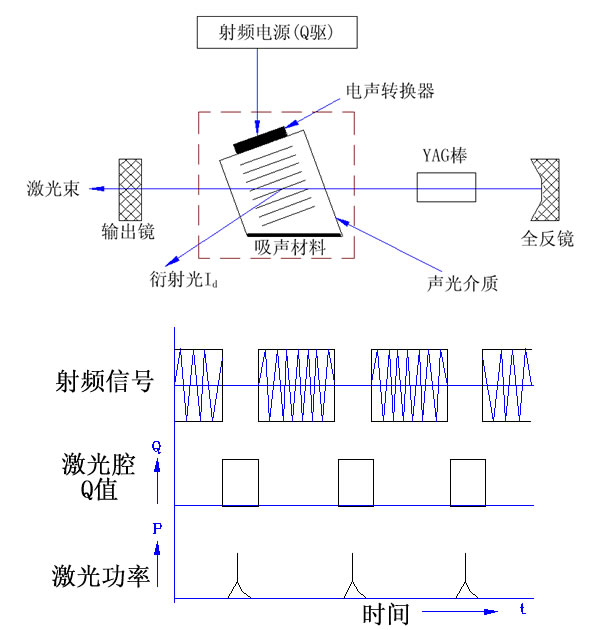
Figure 1: Schematic of an acousto-optic Q-switched laser. The upper diagram shows the resonator structure; the lower shows the timing: RF on → low Q → energy storage; RF off → high Q → pulse output
In the English term Q-switch, the Q stands for quality factor, a concept from resonant circuits in electronics — the lower the resonator loss, the higher the Q. In a laser, Q describes the fraction of energy retained after one round trip in the cavity. The higher the Q, the lower the cavity loss and the easier lasing becomes; the lower the Q, the higher the loss and the harder it is for lasing to start [(RP Photonics)](https://www.rp-photonics.com/q_switches.html).
The core idea of Q-switching is: first lower Q to store energy, then abruptly raise Q to release it. Because the upper-level lifetime of the gain medium (especially solid-state laser crystals) is long (microseconds to milliseconds), a large population inversion can accumulate during this time — far more than during continuous oscillation. When Q suddenly rises, these accumulated inverted particles are converted into a laser pulse through stimulated emission in an extremely short time, with peak power several orders of magnitude higher than continuous output [(RP Photonics)](https://www.rp-photonics.com/q_switches.html).
II. Core Principles: Q Factor and the Q-Switching Process
The Four Stages of Q-Switching
A complete Q-switched pulse formation process can be divided into four stages:
- Energy-storage stage: the Q-switch is in a high-loss state (low Q), pump light continuously illuminates the gain medium, the upper-level population keeps accumulating, and more ions are excited to the metastable level. Because Q is low, the laser threshold is not reached, so no light is emitted.
- Q-switch opens: the Q-switch suddenly switches to a low-loss state (high Q), and the resonator loss drops instantly.
- Rapid pulse build-up: gain far exceeds loss, and laser power grows avalanche-like from spontaneous-emission noise. Each pass through the gain medium is strongly amplified, and the pulse intensity rises exponentially.
- Pulse formation and decay: when the pulse peak arrives, gain has been depleted by stimulated emission to the point of equaling the loss. After that gain continues to fall (the pulse tail) until oscillation stops. The whole pulse width is typically only a few to tens of nanoseconds.
Key Formula: Q-Switched Pulse Energy
Ideally, the energy of a Q-switched pulse approximately equals the energy stored in the gain medium:
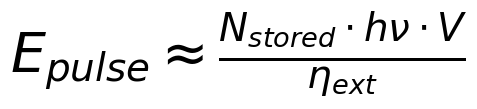
where 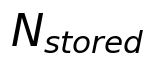 is the accumulated inversion density per unit volume,
 is the photon energy,
 is the mode volume, and
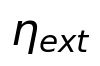 is the output-coupling efficiency. A typical lamp-pumped Nd:YAG laser can produce pulse energies from mJ to J, with peak power reaching MW or even GW levels.
III. The Four Main Types of Q-Switches
| Type | Principle | Characteristics | Typical Applications |
|---|---|---|---|
| Acousto-optic Q-switch (AOM) | An RF signal drives an acousto-optic crystal to generate ultrasound, introducing loss via Bragg diffraction | Most widely used, low cost, long lifetime, moderate switching speed | Industrial marking, laser rangefinding, medicine |
| Electro-optic Q-switch (EOM) | A high-voltage field changes crystal birefringence via the Pockels effect, changing loss with a polariser | Extremely fast switching (sub-nanosecond), narrower pulses, requires high voltage | High-energy pulses, ultrashort nanosecond pulses, research |
| Passive Q-switch | A saturable absorber becomes transparent under intense light, completing Q-switching automatically | No drive power needed, simple structure, large timing jitter | Small lasers, laser rangefinders, portable devices |
| Mechanical Q-switch | A rotating mirror gives high Q only when aligned with the optical axis | Simple structure, high-power tolerant, but large pulse width and vibration | Early lasers, special high-power situations (rarely used now) |
1. Acousto-Optic Q-Switches (Most Common)
The acousto-optic Q-switch (Acousto-optic Q-switch, AO Q-switch) is currently the most widely used type of Q-switch. At its core is an acousto-optic crystal (commonly fused silica, TeO₂, etc.) with an electro-acoustic transducer bonded to its side. When an RF signal (usually tens to hundreds of MHz, a few watts of power) is applied to the transducer, ultrasound is generated inside the crystal, forming a periodic refractive-index modulation — equivalent to a “volume grating.” The incoming laser light encountering this grating undergoes Bragg diffraction, deflecting part of the light out of the resonator and thus introducing loss (typical Bragg diffraction efficiency is about 50% per pass, about 75% double pass; actual values depend on RF power, crystal size and transducer design) [(RP Photonics)](https://www.rp-photonics.com/q_switches.html).
When the RF signal is turned off, the ultrasound disappears, the loss vanishes and Q rises. The switching speed of an acousto-optic Q-switch is limited by the transit time of the acoustic wave across the beam diameter — the thicker the beam, the slower the switching. Therefore for lasers with high power and large spots, the acousto-optic Q-switch slows down [(RP Photonics)](https://www.rp-photonics.com/q_switches.html).
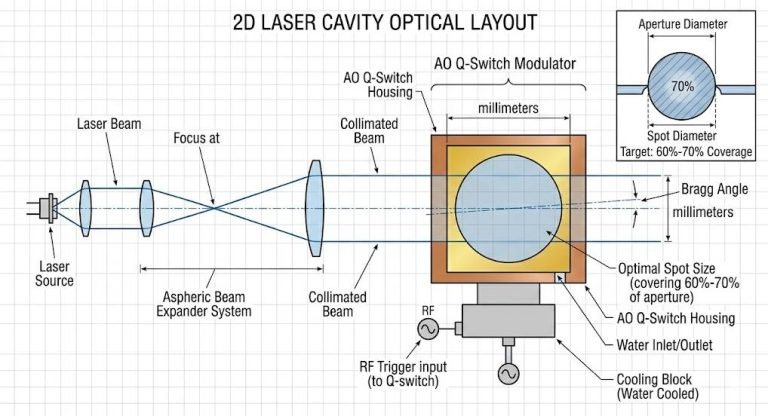
Figure 2: 2D optical layout of an acousto-optic Q-switch, showing the beam path through the acousto-optic modulator and the Bragg diffraction effect
2. Electro-Optic Q-Switches (Fastest)
When faster switching and shorter pulses are needed, the electro-optic Q-switch (Electro-optic Q-switch, EO Q-switch) is used — also called a Pockels cell. It uses the Pockels effect: certain crystals (such as KDP, DKDP, BBO, LiNbO₃ and RTP) develop birefringence under an electric field, proportional to the field strength. Used together with a polariser, the polarisation state — and hence the loss — can be controlled by voltage [(RP Photonics)](https://www.rp-photonics.com/q_switches.html).
The advantage of electro-optic Q-switches is extremely fast switching (rise time can be under 1 ns), producing very narrow Q-switched pulses. Their extinction ratio is also very high, suiting high-gain lasers (if the loss is not high enough, gain “leaks out,” harming energy storage). The disadvantage is the need for high-voltage (several kV to over ten kV) drive circuitry, costing more than acousto-optic Q-switches [(RP Photonics)](https://www.rp-photonics.com/q_switches.html).
3. Passive Q-Switches (Simplest)
A passive Q-switch is essentially a saturable absorber — placed in the resonator, initially in a high-loss state (high absorption); as the intracavity intensity rises, the absorption gradually saturates (becomes transparent), loss drops and Q rises. This process is self-triggering — no external electrical signal is needed; the light completes the Q-switching by itself [(RP Photonics)](https://www.rp-photonics.com/q_switches.html).
The most classic passive Q-switch material is Cr⁴⁺:YAG crystal, widely used in Nd:YAG lasers at 1 μm. The advantages of passive Q-switching are simple structure, no drive circuitry and compact size — many small laser rangefinders use passive Q-switches. The disadvantage is large timing jitter (the exact time the pulse appears is uncontrollable, depending on pump intensity and spontaneous-emission noise), unsuitable for applications needing precise timing [(RP Photonics)](https://www.rp-photonics.com/q_switches.html).
4. Mechanical Q-Switches (Oldest)
The mechanical Q-switch was the earliest Q-switching method — one resonator mirror is mounted on a rotating motor, and only for the instant the mirror aligns with the optical axis is the resonator closed and a pulse produced. The advantages are simple structure, high-power tolerance and a high damage threshold, but the disadvantages are a large pulse width (limited by rotation speed) and mechanical vibration and wear. It is rarely used now [(RP Photonics)](https://www.rp-photonics.com/q_switches.html).
IV. Key Q-Switch Parameters
| Parameter | Meaning | Description |
|---|---|---|
| Operating wavelength | The range of laser wavelengths applicable | Determines the crystal material and anti-reflection coating choice |
| Clear aperture | The beam diameter allowed through | Large-aperture devices are used for high-power lasers |
| Insertion loss (low-loss state) | Single-pass loss when the Q-switch is open | The lower the better; affects laser efficiency |
| Extinction ratio (loss modulation depth) | The ratio between high- and low-loss states | High-gain lasers need a high extinction ratio |
| Switching speed (rise time) | The transition time from low Q to high Q | Determines how short the pulse can be |
| Damage threshold | The maximum optical intensity without optical damage | Critical for high-power / high-energy lasers |
| Repetition rate | The number of pulses produced per second | Acousto-optic Q-switches reach several hundred kHz, electro-optic higher |
V. Typical Applications
1. Industrial Laser Marking
Q-switched fibre lasers and DPSS lasers are the workhorses of laser marking. The high peak power of nanosecond pulses produces clear marks on materials such as metal, plastic and ceramic. Different pulse widths and energies suit the marking needs of different materials.
2. Laser Rangefinding and Radar
The high peak power of Q-switched pulses suits laser rangefinding — emit a short pulse and measure the round-trip time to calculate distance. Small passive-Q-switched Nd:YAG lasers are widely used in handheld rangefinders. Actively Q-switched high-repetition-rate lasers are used in LiDAR [(RP Photonics)](https://www.rp-photonics.com/q_switches.html).
3. Medicine and Aesthetics
Q-switched Nd:YAG lasers (1064 nm and frequency-doubled 532 nm) are a staple of dermatology — used to remove tattoos, age spots, birthmarks and other pigmented skin conditions. The high peak power of Q-switched pulses shatters pigment particles into tiny fragments that are then metabolized and eliminated by the body.
4. Scientific Research
High-energy Q-switched lasers are used in laser-induced breakdown spectroscopy (LIBS), laser ablation, particle acceleration, shock dynamics and other research. The short pulses of electro-optic Q-switching are used in time-resolved spectroscopy and other experiments needing precise timing.
5. Nonlinear Frequency Conversion
The high peak power of Q-switched pulses is ideal for nonlinear optical processes — second-harmonic generation, sum- and difference-frequency generation, optical parametric oscillation and so on. Many green, ultraviolet and mid-infrared lasers are made by adding a nonlinear crystal to a Q-switched infrared laser.
Q-Switching vs. Mode Locking
Q-switching and mode locking are both techniques for producing pulsed laser light, but they differ greatly in principle and characteristics and are often confused. Here is a comparison across key dimensions:
| Comparison Dimension | Q-Switching | Mode Locking |
|---|---|---|
| Core principle | Modulate cavity loss (Q), store then release energy | Lock the phases of multiple longitudinal modes for coherent superposition |
| Pulse width | Nanosecond (ns) scale, shortest about a few hundred ps | Picosecond (ps) to femtosecond (fs) scale |
| Repetition rate | kHz range (adjustable, typically 1–100 kHz) | MHz to GHz range (fixed by cavity length) |
| Pulse energy per pulse | High (mJ to J), energy-storage type | Low (nJ to μJ), oscillator level |
| Peak power | kW to MW | MW to GW (extremely short pulses) |
| Determining factors | Upper-level lifetime, stored energy, switching speed | Gain bandwidth (Fourier-transform limit) |
| Typical applications | Laser marking, cutting, rangefinding, medicine | Precision machining, scientific research, ophthalmic medicine, microscopic imaging |
Key conclusion: A Q-switch cannot produce femtosecond pulses; femtoseconds require mode locking. The reason is simple: Q-switched pulse width is limited by the release speed of stored upper-level energy, reaching at best a few hundred picoseconds; whereas mode locking relies on phase locking in the frequency domain — the broader the spectrum, the shorter the pulse, so as long as the gain bandwidth is broad enough, femtosecond or even shorter pulses can be obtained.
VI. Common Misconceptions: 5 Ideas You May Have Got Wrong
Misconception 1: A Q-switch works best right next to the output mirror
Correction: The position of a Q-switch is actually quite flexible; it need not be at any particular place. It can be near the high-reflectivity mirror, near the output mirror, or elsewhere in the cavity — near the HR mirror, near the output mirror, or between the gain medium and a cavity mirror. The specific position depends on the gain distribution, intracavity intensity distribution, polarisation requirements and other factors. Different applications may have different optimal positions [(RP Photonics)](https://www.rp-photonics.com/q_switches.html).
Misconception 2: An acousto-optic Q-switch’s loss completely absorbs the light
Correction: An acousto-optic Q-switch’s loss is not absorption but Bragg diffraction — light is deflected to another angle, leaving the resonator optical path. That light is not absorbed as heat but exists as another diffracted beam. Therefore acousto-optic Q-switches have relatively low heat load, and damage comes mainly from the high-power-density light itself [(RP Photonics)](https://www.rp-photonics.com/q_switches.html).
Misconception 3: Passive and active Q-switches have similar timing precision
Correction: Far from it! An active Q-switch is triggered by an external electrical signal, with pulse-timing jitter as low as nanoseconds or even sub-nanoseconds; a passive Q-switch is self-triggered, with the pulse time depending on pump power, saturable-absorber recovery time and spontaneous-emission noise, giving jitter of microseconds or more. In applications needing synchronization with other equipment (such as LIDAR and time-resolved spectroscopy), active Q-switching must be used [(RP Photonics)](https://www.rp-photonics.com/q_switches.html).
Misconception 4: The higher the repetition rate, the greater the pulse energy
Correction: Quite the opposite — for a fixed average power, the higher the repetition rate, the less energy each pulse receives (pulse energy = average power / repetition rate). Moreover, at high repetition rates the gain medium has no time to fully store energy between pulses (upper-level population is “used up” by the next pulse before reaching its maximum), so pulse energy drops further. For large-energy pulses you need a low repetition rate; for high average power you can raise the repetition rate [(RP Photonics)](https://www.rp-photonics.com/q_switches.html).
Misconception 5: The higher the repetition rate, the greater the energy per pulse
Correction: Quite the opposite — with pump power held constant, the higher the repetition rate, the lower the energy per pulse. Because average power = pulse energy × repetition rate, the total energy the pump can supply is limited; a high repetition rate means dividing it into more parts per unit time, so each part is naturally smaller. If you need both high repetition rate and large energy, you must raise pump power, use a higher-gain medium, or adopt a MOPA (master oscillator power amplifier) architecture.
VII. Recommended Reading
- What Is Mode Locking? How to Obtain Femtosecond Ultrashort Pulses — another pulse-generation technique, the core of femtosecond ultrafast lasers
- What Is an Optical Resonator? How Do Two Mirrors Trap Light? — to understand Q factor, first understand the resonator
- RP Photonics Encyclopedia: Q-switches — the main reference for this article, the world’s most authoritative laser encyclopedia
Leave a Reply