


1. Core concept: what is a wavemeter?
A wavemeter measures the centre wavelength and the linewidth of monochromatic light. It is used both for laser selection and spectral line calibration and for closed-loop monitoring in frequency stabilisation systems.
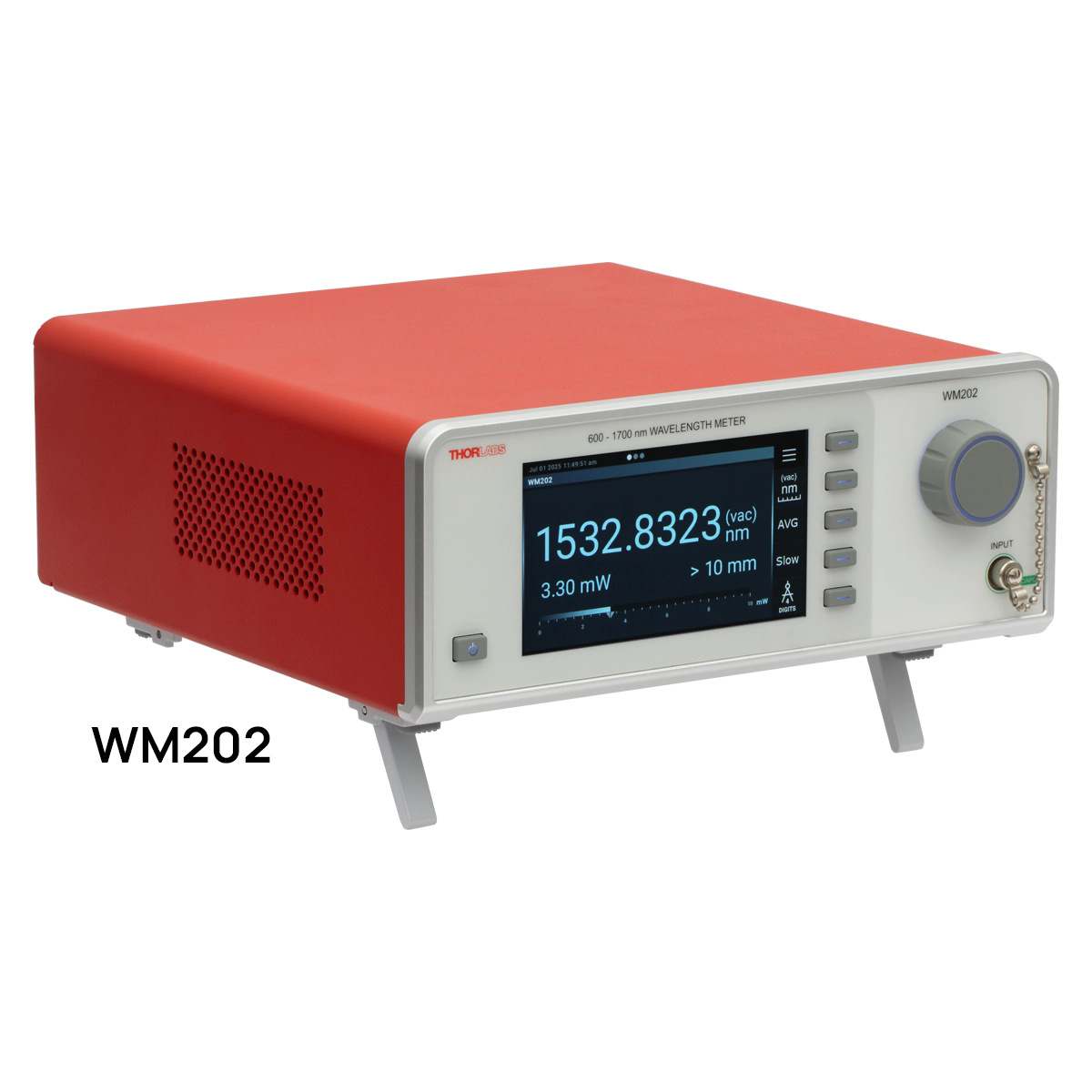
A wavemeter is a precision optical instrument for measuring the wavelength (or frequency) of a laser. It is like the “high-precision ruler” of the laser world — except that what it measures is not length but the wavelength of the light wave, with an accuracy that can reach the parts per million or even the parts per billion.
In laser technology, wavelength is one of the most fundamental parameters. Whether the wavelength of a laser stays at its nominal value, how far apart the wavelengths of two lasers are, and how much the wavelength drifts with temperature or current — all of these are questions a wavemeter answers. In fields such as optical communications, spectroscopy and quantum optics, where wavelength precision requirements are extremely high, the wavemeter is an indispensable calibration tool.
Accurate wavelength measurement is needed because in precision optical applications a tiny wavelength deviation can change the outcome completely — the exact position of a transition line in an atomic spectrum, or the exact alignment of a channel in a DWDM system, both require wavelength measurement errors at the picometer or even femtometer level. Understanding the principle, the parameters and the selection method of wavemeters is the first step toward using precision laser technology well.
2. Working principle: how does a wavemeter work?
The core principle of a wavemeter is interferometry — using the interference of light to measure the wavelength precisely. There are two mainstream technical routes, each with its own advantages:
Scanning Michelson interferometer wavemeters
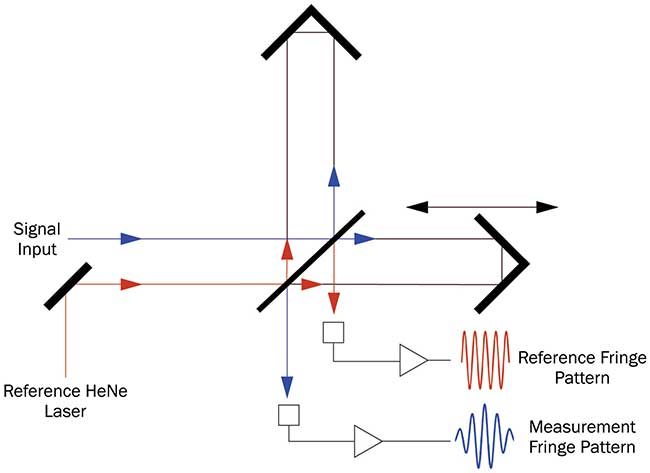
This is the classic wavemeter type, based on the Michelson interferometer:
1. Interferogram acquisition: the laser under test is sent into the Michelson interferometer, where one mirror is moved over a certain range (scanned). As the arm-length difference changes, the interference intensity received by the detector varies periodically, producing interference fringes (an interferogram).
2. Fringe counting and wavelength calculation: the spatial period of the fringes is directly related to the wavelength. For monochromatic light, over a given optical path difference scan range, the number of fringes = 2 × scan distance / wavelength. Measuring the fringe count and the scan distance precisely gives the wavelength of the laser under test.
3. Reference laser calibration: a practical wavemeter contains an internal reference laser of precisely known wavelength (usually a He-Ne laser or another frequency-stabilised source). The reference laser produces fringes in the same interferometer, and its known wavelength calibrates the scan distance and velocity, removing the errors caused by the limited precision of mechanical scanning.
4. Multi-wavelength measurement: if the input light contains several wavelength components (several laser lines, for instance), the interferogram is a superposition of several sinusoidal signals. Taking the Fourier transform of the interferogram gives the complete spectral distribution — which is in fact the working principle of a Fourier transform spectrometer. A high-precision wavemeter can therefore also be used as a low-resolution spectrometer; in other words, it is itself a “multi-wavelength meter”.
The advantage of the scanning Michelson type is a very high relative accuracy (10⁻⁸ and beyond); the drawbacks are its mechanical moving parts and its limited measurement speed.
Fabry-Pérot interferometer wavemeters
This is a fast-growing route, represented by brands such as HighFinesse. It uses equal-thickness interference (Fabry-Pérot interference) formed between two slightly tilted planes:
1. Static interferometer structure: the Fabry-Pérot interferometer consists of two reflecting surfaces with a small wedge angle, forming an air wedge. Light of different wavelengths forms equal-thickness fringes of different spacing on the wedge.
2. CCD imaging and analysis: a CCD camera records the fringe pattern, and the wavelength is derived from the spatial frequency of the fringes.
3. No moving parts: the instrument has no moving parts at all, which makes it compact, highly reliable and extremely fast.
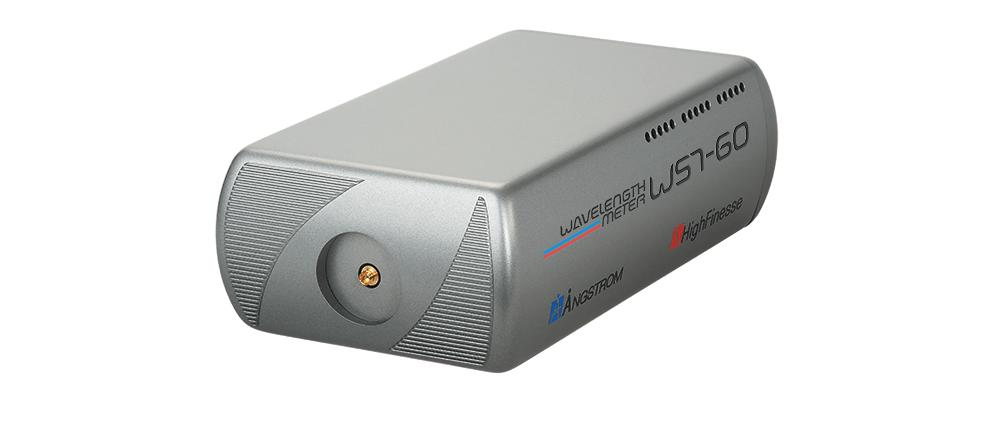
It used to be said that “the Fabry-Pérot type is slightly less accurate than the scanning Michelson type”, but in practice each has its own strengths — the scanning type reaches a higher relative accuracy, while the Fabry-Pérot type is fast and free of moving parts, and high-end models reach the 10⁻⁸–10⁻⁹ range as well. The WS8-2 series of Fabry-Pérot wavemeters from HighFinesse, for example, reach an absolute accuracy of 2 MHz (about 10⁻⁹ relative accuracy) at measurement speeds up to 2.5 kHz, and support both pulsed and continuous-wave lasers (Toptica – HighFinesse WS Series).
There are also diffraction grating wavemeters, which work much like a small spectrometer: grating dispersion and a linear array detector determine the diffraction angle, from which the wavelength is calculated. The accuracy is moderate, but the spectral shape can be observed at the same time.
3. Key parameters: reading the specifications of a wavemeter
Knowing the concept and the principle is not enough to evaluate a wavemeter; you also need to understand its key parameters. The table below sorts out the core parameters.
| Parameter | Meaning | Why it matters |
|---|---|---|
| Wavelength measurement range | The range of wavelengths the instrument can measure. Typical coverage runs from the ultraviolet to the near infrared (for example 190–1700 nm, with some models reaching 2600 nm or even the mid-infrared), and different models cover different bands. | It decides which wavelengths can be measured and is set by the dispersive elements and the detectors. It must cover the laser under test, otherwise no measurement is possible. Wide-band models usually need several detector or optical elements. |
| Absolute wavelength accuracy | How close the measured value is to the true wavelength, usually expressed as an absolute accuracy (such as ±0.001 nm or ±10 MHz) or a relative accuracy (such as ±1 ppm). High-end wavemeters reach MHz and even sub-MHz absolute accuracy. | This is the central specification of a wavemeter and expresses the deviation between the measured and the true value. High-precision wavemeters reach picometer and even femtometer levels for precision metrology and spectral calibration. Note that it is only meaningful if the calibration is traceable to a standard reference source. |
| Wavelength resolution | The smallest wavelength change that can be resolved. Resolution determines whether the instrument can detect a small wavelength drift, and it is usually better (finer) than the accuracy. | It reflects the ability to detect small wavelength changes. Resolution is usually better than accuracy, because accuracy also contains calibration error and systematic bias. High resolution does not imply high accuracy, and vice versa. |
| Measurement repeatability | The consistency between repeated measurements of the same wavelength, i.e. the scatter among the individual results. | It reflects the stability of the instrument. A wavemeter with good repeatability suits long-term monitoring of wavelength drift and relative measurements. Repeatability is usually better than absolute accuracy. |
| Measurement speed / update rate | How many wavelength measurements can be completed per second. For applications that must track a changing wavelength quickly (a laser tuning process, for instance) the measurement speed matters. Fast Fabry-Pérot types reach tens of kHz. | The time needed to complete one wavelength measurement. A fast wavemeter tracks wavelength changes in real time, which suits the monitoring of rapidly tuned lasers. The scanning type is limited by its mechanical motion, while the Fabry-Pérot type is much faster. |
| Power sensitivity / minimum input power | The minimum optical power needed for an accurate measurement. A wavemeter needs enough signal to produce clear interference fringes. | The smallest optical power that can be measured accurately. When the power is too low the signal-to-noise ratio is insufficient, the measurement error grows and it may fail altogether. Fabry-Pérot types are usually more sensitive than scanning types and can measure picosecond pulses down to the picojoule level. |
| Traceability of the wavelength accuracy | High-end wavemeters normally come with a calibration certificate traceable to national measurement standards, which ensures the authority of the measurement. | Whether the wavelength calibration can be traced back to national or international measurement standards. Traceable wavemeters are used for legal metrology and for factory calibration of products. |
Absolute accuracy vs repeatability vs resolution: how they differ
- Absolute accuracy (accuracy): the deviation between the measured value and the true wavelength — the question of whether it is “right”. It is affected by calibration quality and the accuracy of the reference source.
- Repeatability (precision): the consistency between repeated measurements — the question of whether it is “stable”. It is affected by instrument noise and changes in the environment.
- Resolution: the smallest wavelength change that can be measured — the question of whether it is “fine”. It is limited by the optical path difference of the interferometer and the detector pixels.
The usual relationship is: resolution ≥ repeatability ≥ absolute accuracy. An instrument can have a very high resolution (seeing very small changes) while its absolute accuracy is poor if the calibration is off.
4. Main types: what kinds of wavemeter are there?
Wavemeters can be classified in many ways, and each dimension reveals different aspects of their behaviour. The common ones are introduced below:
By measurement accuracy
#### High-precision types
Relative accuracy from 10⁻⁷ to 10⁻⁹ and beyond, used for precision spectroscopy, quantum optics and metrological calibration. Example: the HighFinesse WS8 series.
#### Medium-precision types
Accuracy around 0.01–0.1 nm, relative accuracy 10⁻⁵ to 10⁻⁶, used for general laser calibration and production-line testing.
#### Economic / simple types
Accuracy around 0.1–1 nm, used for rough wavelength monitoring and quick on-site checks.
By technical principle
#### Scanning Michelson interferometer types
The traditional high-precision solution; the scanning structure allows extremely high relative accuracy.
#### Fabry-Pérot interferometer types
No moving parts, compact, fast, with equally extreme accuracy in the high-end models.
#### Grating spectrometer types
Based on dispersion, they show the spectral shape at the same time, with moderate accuracy.
#### Fabry-Pérot interferometer (spectral) types
Very high resolution, but a narrow measurement range (the free spectral range is limited).
By input configuration
#### Free-space input types
The beam enters directly and the optical path has to be aligned.
#### Fibre input types
Input through a fibre, convenient and stable in operation, and the most common type.
#### Multi-channel types
Several input channels can be measured at the same time.
By form factor
#### Benchtop / rack types
For laboratories and production lines, with the highest performance.
#### Portable / USB types
Compact and connected to a computer over USB, convenient for field use.
Each type of wavemeter has its own advantages and drawbacks; there is no absolute “best,” only the “most suitable.” The choice should follow the specific application — the required accuracy, the required speed, the type of laser under test (continuous or pulsed), the budget and other practical factors.
5. Applications: where are wavemeters used?
Wavemeters are widely used in the laser and optoelectronics fields:
- Laser wavelength calibration: almost every precision laser (semiconductor lasers, fibre lasers, dye lasers) has its operating wavelength calibrated with a wavemeter before it ships.
- Laser frequency stabilisation and wavelength locking: the wavemeter serves as the monitoring and feedback element that holds the laser wavelength at an exact value. This is important in atomic physics, spectroscopy and quantum optics experiments.
- Optical communication testing: in DWDM (dense wavelength division multiplexing) systems, each channel wavelength has to be measured and calibrated precisely so that it lands on the standard wavelength grid (such as the ITU-T grid).
- Tunable laser tuning tests: to measure the wavelength accuracy, tuning linearity and tuning speed of a tunable laser across its whole tuning range.
- Spectroscopic research: in high-resolution spectroscopy, precisely measuring the laser wavelength is a precondition for accurate spectral data.
- Gas detection and sensing: in gas detection techniques such as tunable diode laser absorption spectroscopy (TDLAS), the correspondence between the laser wavelength and the absorption line of the gas has to be known precisely.
- Metrology and calibration laboratories: national metrology institutes and corporate calibration laboratories use high-precision wavemeters to establish a local wavelength standard for calibrating other instruments.
- Optical component testing: to measure the centre wavelength and the reflection or transmission spectrum of devices such as fibre Bragg gratings (FBGs) and optical filters.
6. Common misconceptions
Many beliefs about wavemeters are plausible but wrong. Check whether any of the following misconceptions apply to you:
Misconception 1: a wavemeter and a spectrum analyser are the same thing under different names
The two do overlap in function (both can measure wavelength), but their design goals and performance priorities differ. The core goal of a wavemeter is high-precision wavelength measurement: it measures the wavelength of one or a few laser lines very accurately, but it usually cannot reveal fine spectral structure such as side modes or longitudinal modes (the resolution is high, but the dynamic range and the ability to resolve spectral detail are limited). The core goal of a spectrum analyser (OSA) is to present the full spectral shape, measuring the power as a function of wavelength. Its wavelength accuracy may be inferior to that of a dedicated wavemeter, but it shows far more spectral detail (side modes, noise spectra). Simply put: a wavemeter pursues “accuracy”, a spectrum analyser pursues “completeness”.
Misconception 2: the higher the resolution of a wavemeter, the better its accuracy
Resolution and accuracy are different concepts. Resolution is how close two wavelengths can be told apart (“how finely it can see”), while accuracy is the deviation between the measured value and the truth (“whether it measures correctly”). A wavemeter can have very high resolution — enough to separate two nearby wavelengths — and still show a systematic offset in the overall wavelength measurement if the calibration is off. When selecting, do not look at the resolution figure alone; look at the wavelength accuracy (including the traceability of the calibration) and the long-term stability.
Misconception 3: one wavemeter can measure lasers at any wavelength
A wavemeter has a definite measurement range; light outside it cannot be measured accurately and may not be detected at all. This is determined mainly by the spectral response of the internal photodetector and optical elements. A wavemeter intended for the visible band, for example, may use a silicon detector and then cannot see 1550 nm infrared light. Always confirm that the wavelength of the laser under test lies within the specified range. Some wavemeters also have to switch between different detectors or filters to cover a wide band, so the correct band must be selected during operation.
Misconception 4: the input power does not affect the wavelength measurement
Although the principle of wavelength measurement is independent of optical power, in a real instrument too little power gives an insufficient signal-to-noise ratio, unclear fringes, larger measurement error or no measurement at all; too much power may saturate or damage the detector and also degrade the quality of the interferogram. Every wavemeter has a recommended input power range, so the optical power should be kept within the optimum region — neither too low nor too high. For very weak signals, amplification before measurement may be needed.
Wavemeter vs spectrum analyser: comparison table
| Characteristic | Wavemeter | Spectrum analyser (OSA) |
|---|---|---|
| Core goal | Precise measurement of the wavelength value | Analysis of the spectral shape and distribution |
| Wavelength accuracy | Extremely high (pm–fm level, 10⁻⁸–10⁻⁹) | Moderate (depends on the type, usually 0.01 nm or worse) |
| Spectral resolution | High (mainly as the ability to resolve wavelength changes) | Varies widely: 0.1 nm for grating types, MHz level for F-P types |
| Side mode / longitudinal mode observation | Not good at it (fine structure usually not visible) | Good at it (the full spectral shape can be presented) |
| Dynamic range | Limited | High (grating types reach 70 dB and above) |
| Measurement speed | Extremely fast for Fabry-Pérot types (kHz level), slower for scanning types | Slower for grating-scanning types, fast for array types |
| Typical applications | Wavelength calibration, laser stabilisation, metrological calibration | Spectral characterisation, side mode analysis, OSNR measurement |
7. Recommended reading
- What is an optical spectrum analyser? How the colour content of a laser is analysed
- What is an optical power meter? How to measure laser power accurately
- What is a photodiode? The most basic light-detecting device
References:
- RP Photonics Encyclopedia – Wavemeters
- HighFinesse/Ångstrom – WS Series Wavelength Meters (Toptica Product Page)
- Thorlabs – Wavemeter / Wavelength Meter Technical Documentation
Leave a Reply