


A beam profile is the intensity distribution across a laser’s cross-section—it reveals whether the spot is Gaussian, flat-top or irregular and directly determines processing results. This article covers the principles, key parameters, main types and typical applications.
Table of Contents
- 1. What Is a Beam Profile? Understanding the Core Concepts
- 2. Working Principle: How Is a Beam Profile Measured?
- 3. Key Parameters: Understanding Beam Profile Performance Indicators
- 4. Main Types: What Kinds of Beam Profilers Exist?
- 5. Applications: Where Are Beam Profiles Relevant?
- 6. Common Misconceptions: Pitfalls to Avoid
1. Core Concepts: What Is a Beam Profile?
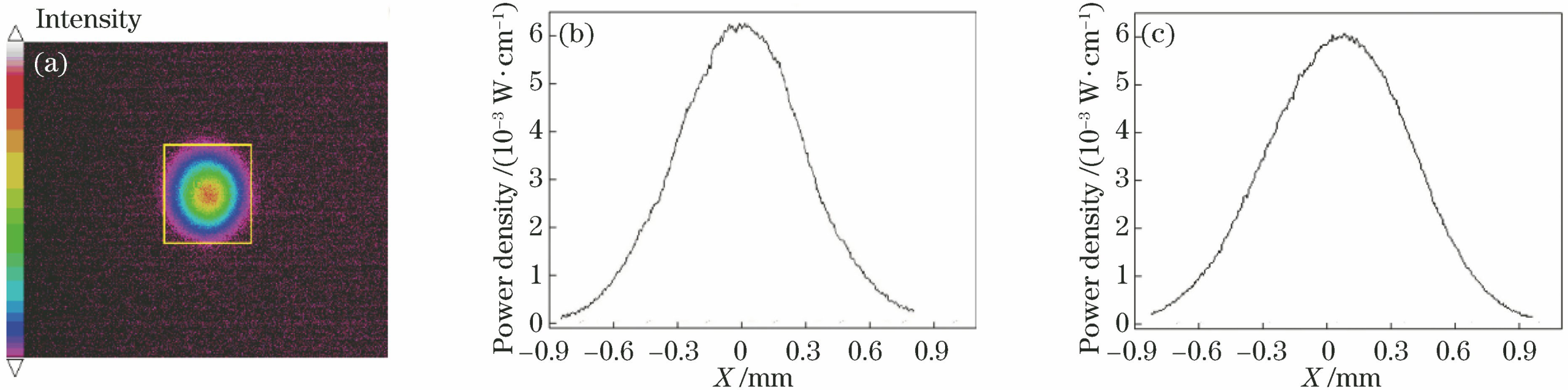
< A beam profile describes the spatial distribution of intensity across a laser beam’s cross-section—in other words, ‘what the spot looks like.’ It includes not only simple parameters such as beam diameter but also the detailed shape of the distribution: a perfect Gaussian, a flat top, or an irregular multi-peak form. Beam profiling is the most basic and most intuitive measurement in laser diagnostics, an important basis for evaluating laser performance, aligning optical systems and monitoring processing quality.
A beam profile is a description of the intensity distribution across the spot, not a component that changes light—it reveals whether a beam is Gaussian, flat-top or irregular and is a key basis for judging processing and coupling performance.
2. Working Principle: How Is a Beam Profile Measured?
Understanding beam profiling can be broken down into several key steps or mechanisms. Let us look at them one by one:
The core idea of beam profiling is to record the intensity at different positions across the beam cross-section. The two most common approaches each have their strengths: camera-based systems image the spot directly with a 2D image sensor (CCD/CMOS), obtaining the full 2D intensity distribution in one shot; scanning systems move a slit, pinhole or knife-edge mechanically through the beam, use a photodetector to record the transmitted intensity, and reconstruct the profile. Cameras are fast and information-rich; scanning profilers offer large dynamic range and high damage threshold.
3. Key Parameters: Understanding Beam Profile Performance Indicators
| Parameter Name | Meaning | Why It Matters |
|---|---|---|
| Beam Diameter / Radius | Several definitions are common: 1/e² (width at 1/e² of peak intensity), D4σ (second-moment method, ISO standard), FWHM (full width at half maximum) | The most basic beam-size parameter, directly determining processed spot size, coupling efficiency and size matching with optical components. |
| Beam Centre Position | The centroid of the spot in a coordinate system | The centroid position, used for beam alignment and pointing-stability monitoring—an important basis for optical system alignment. |
| Ellipticity / Astigmatism | Describes how asymmetric the beam is in horizontal versus vertical directions | Reflects how far the cross-section departs from an ideal circle and symmetry, affecting focus quality and processing uniformity. |
| Fill Factor / Flat-Top Uniformity | For flat-top beams, how uniform the intensity is in the central region | A uniformity metric for flat-top beams, directly affecting consistency in laser heat treatment, lithography and similar applications. |
| Spatial Resolution | Determined by sensor pixel size (camera) or scan step (scanning) | The resolving ability of the measurement system, deciding whether small beams and fine intensity features can be measured accurately. |
These parameters are not isolated; they are interrelated and mutually constrained. For example, there is often a trade-off between the spatial resolution of profile measurement and the spot size it can cover—higher resolution usually means a smaller measurable span, and vice versa. So to evaluate quality, you must consider the parameters together rather than one alone.
If you are not familiar with these parameters, that is fine—Soar Laser’s product pages have detailed descriptions, and you can also consult our technical engineers directly to help you select.
4. Main Types: What Kinds of Beam Profilers Exist?
Beam profilers can be classified in several ways, and different dimensions help us understand them from different angles. The common classification methods are introduced below:
By Type
Camera-Based Profiler
Based on CCD/CMOS/InGaAs cameras, imaging directly, fast, suited to complex beam-shape analysis
Scanning-Slit Profiler
A rotating slit scans the beam, with large dynamic range, suited to high power and fine beam-width measurement
Scanning Knife-Edge Profiler
A knife-edge cuts the beam and the intensity profile is obtained by differentiation, with high resolution
Scanning Pinhole Profiler
A pinhole scans point by point, giving the highest resolution but the slowest speed
Focal-Plane Array Profiler
For mid-to-far infrared (e.g. CO₂ lasers), using pyroelectric or microbolometer arrays
Different beam profilers have their own advantages and disadvantages; there is no absolute ‘best,’ only ‘most suitable.’ Selection should consider your specific application, power requirements, budget and other factors. For example, for high-power industrial applications fibre lasers may be more suitable; for research with ultrashort-pulse needs, Ti:sapphire may be preferable.
5. Applications: Where Are Beam Profiles Relevant?
Beam profiling has a very wide range of applications, from industrial manufacturing to healthcare, from communication networks to scientific research—almost everywhere lasers are used. A few fields are briefly described below:
- Laser Alignment: observe the spot shape directly to guide cavity and fibre-coupling alignment
- M² Measurement: measure beam radius at various propagation positions to compute beam quality
- Processing Quality Control: monitor spot-shape changes to ensure consistent processing
- Optical Component Testing: evaluate lens and mirror quality from beam distortion
- Fibre End-Face Testing: analyse the mode of a fibre output spot to judge whether the fibre works in single-mode
Typical Application Scenarios in Detail
Scenario 1: Laser Alignment
During laser alignment, observing the spot shape guides cavity and fibre-coupling adjustments and quickly shows whether the beam is near an ideal Gaussian profile.
Scenario 2: M² Measurement
In laser-processing quality control, monitoring the profile detects mode degradation, thermal lensing or optics contamination before batch defects occur.
Scenario 3: Processing Quality Control
In optical communication and fibre amplifiers, the beam profile affects coupling efficiency and gain uniformity, informing system optimisation.
Scenario 4: Optical Component Testing
In optical-component testing, profile changes after reflection or transmission reveal mirror aberrations and surface quality.
Scenario 5: Fibre End-Face Testing
In medical and aesthetic lasers, the profile decides energy distribution and treatment uniformity; flat-top beams often give more consistent results.
👉 Want to learn more about practical applications of beam profiling? Please visit Soar Laser’s application-case page, or contact our technical team directly for professional advice.
6. Common Misconceptions
Many people have somewhat plausible but mistaken notions about beam profiles. See whether you fall into any of the following:
Misconception 1: ‘The camera image is the true beam profile.’
sensor saturation, background noise and etalon effects from attenuators all affect the measurement
Misconception 2: ‘Beam diameter is a definite value.’
different beam-width definitions (D4σ, 1/e², FWHM) give different diameters; the definition used must be stated
Misconception 3: ‘Attenuating the beam does not change the profile.’
thermal lensing and surface-reflection interference in poor attenuators distort the measured profile
Misconception 4: ‘Scanning and camera results should be identical.’
the two methods work differently; for non-Gaussian beams results may differ—cameras suit complex shapes, scanning suits power quantification
Misconception 5: ‘Looking at the spot diameter alone is enough.’
spots of the same diameter but Gaussian versus flat-top profiles distribute energy very differently and give markedly different results—the full profile must be examined
Of course, there are far more misconceptions about beam profiles than these. Laser technology develops rapidly, with new materials and processes constantly emerging, so some previous ‘common knowledge’ may already be outdated. If you have other questions, please leave a comment and we will answer them one by one.
Leave a Reply