


What Is Mode Locking? How to Obtain Femtosecond Ultrashort Pulses
If Q-switching is like capturing a snapshot with a 1/1000-second shutter (a nanosecond pulse), then mode locking is like a high-speed camera shooting a trillion frames per second — it can compress laser pulses to femtoseconds (10⁻¹⁵ s) or even shorter. How short is a femtosecond? In one femtosecond, light travels only 0.3 micrometres — less than one-thousandth the diameter of a hair. Mode locking underlies ultrafast science, precision measurement, laser medicine and more. Based on authoritative content from the RP Photonics Encyclopedia, this article systematically explains the principles, types and applications of mode locking.
Table of Contents
- I. What Is Mode Locking? — How Ultrashort Pulses Are Generated
- II. Core Physics: Coherent Superposition of Multiple Longitudinal Modes
- III. Active Mode Locking vs. Passive Mode Locking
- IV. Key Techniques of Passive Mode Locking: Saturable Absorbers
- V. Key Parameters of Mode-Locked Lasers
- VI. Typical Applications
- VII. Common Misconceptions: 4 Ideas You May Have Got Wrong
- VIII. Recommended Reading
I. What Is Mode Locking? — How Ultrashort Pulses Are Generated
Mode locking is a technique for generating ultrashort optical pulses. Its core idea is: make the multiple longitudinal modes (axial modes) in the laser resonator maintain a fixed phase relationship so that they superpose coherently, forming an extremely narrow pulse in time. This pulse travels back and forth in the resonator, and each time it passes the output coupler a portion of energy exits, so the output is a train of repeated ultrashort pulses [(RP Photonics)](https://www.rp-photonics.com/mode_locking.html).
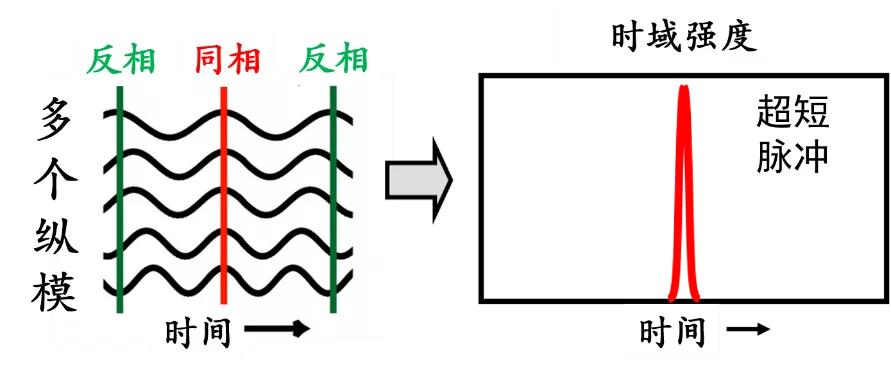
Figure 1: Schematic of the mode-locking principle. The left shows the phase relationship of multiple longitudinal modes; the right shows coherent superposition when in phase, producing an ultrashort pulse (red spike)
Why is it called “mode locking”? Because in a free-running laser, the phases of the longitudinal modes are random and uncorrelated, and the output is their incoherent superposition — the average intensity is essentially constant, with only random fluctuations (at the shot-noise level). But when we “lock” the phases of all longitudinal modes together (fixing the phase differences), they periodically superpose in phase, producing an intense pulse. It is like a large crowd walking every which way suddenly becoming a marching formation — their strength is concentrated together [(RP Photonics)](https://www.rp-photonics.com/mode_locking.html).
The repetition rate of mode-locked pulses equals the round-trip frequency of light in the resonator, i.e. the free spectral range (FSR):
Key Formula: Mode-Locked Pulse Repetition Rate
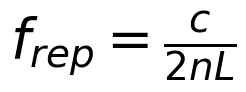
where  is the speed of light in vacuum,
 is the refractive index of the gain medium, and
 is the resonator length. For a resonator 1.5 m long, the repetition rate is about 100 MHz.
II. Core Physics: Coherent Superposition of Multiple Longitudinal Modes
The Relationship Between Pulse Width and Gain Bandwidth
The two key parameters of a mode-locked laser are determined by different factors: the repetition rate is set by the cavity length (f = c / (2nL), with c the speed of light, n the refractive index and L the cavity length) — the shorter the cavity, the higher the repetition rate; the pulse width is set by the gain bandwidth (the Fourier-transform limit) — the broader the gain spectrum, the shorter the pulse can be. These two parameters are designed independently [(RP Photonics · Mode Locking)](https://www.rp-photonics.com/mode_locking.html).
How short can a mode-locked pulse be? The answer depends on the gain medium’s gain bandwidth — the broader the gain spectrum, the more longitudinal modes can participate in mode locking, and the shorter the resulting pulse. This is essentially a Fourier-transform relationship: the broader the frequency spectrum, the narrower the pulse in the time domain [(RP Photonics)](https://www.rp-photonics.com/mode_locking.html).
Key Formula: Pulse Width vs. Bandwidth (Transform Limit)
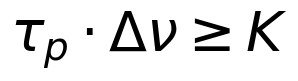
where  is the pulse width (FWHM),
 is the spectral bandwidth, and
 is a constant depending on pulse shape (K≈0.441 for Gaussian pulses, K≈0.315 for sech² pulses). When equality holds, the pulse reaches the “transform limit” — the shortest pulse obtainable for a given bandwidth.
This is why titanium-sapphire (Ti:sapphire) lasers produce the shortest pulses — their tuning range is extremely broad (~650–1100 nm), among the broadest of all laser media, supporting transform-limited pulses as short as about 5 fs. By contrast, Nd:YAG lasers have a narrow gain bandwidth (~0.5 nm), and their mode-locked pulses are usually only a few picoseconds [(RP Photonics)](https://www.rp-photonics.com/mode_locking.html).
III. Active Mode Locking vs. Passive Mode Locking
| Comparison Dimension | Active Mode Locking | Passive Mode Locking |
|---|---|---|
| Working mechanism | An external electrical signal drives an intracavity modulator (acousto- or electro-optic), periodically modulating loss | Uses nonlinear light–matter interaction; the light “starts” mode locking by itself |
| Pulse width | Picosecond scale (limited by modulator speed) | Femtosecond scale (can reach the transform limit) |
| Starting method | Mode locks as soon as the modulator is on; very stable | Usually needs a perturbation to start (e.g. tapping, cavity adjustment) |
| Pulse quality | Wider pulses, low timing jitter | Extremely short pulses, extremely high peak power |
| Typical applications | Communication, optical sampling, precision measurement | Ultrafast spectroscopy, micromachining, scientific research |
Active Mode Locking
Active mode locking uses an optical modulator (usually an acousto-optic modulator AOM or electro-optic modulator EOM) driven by an external electrical signal whose frequency precisely equals the resonator’s longitudinal mode spacing (i.e. the round-trip frequency). The modulator periodically changes the intracavity loss — lowest when the pulse arrives, higher at other times. Thus only pulses synchronised with the modulation survive, achieving mode locking. The advantage of active mode locking is stability and reliability and easy starting, but the pulse width is limited by the modulator’s response speed, usually only to the picosecond scale [(RP Photonics)](https://www.rp-photonics.com/mode_locking.html).
Passive Mode Locking
Passive mode locking needs no external drive signal; instead it uses optical nonlinear effects. The core element is a saturable absorber — its absorption coefficient decreases as light intensity increases (i.e. intense light is less readily absorbed). When a pulse passes, loss is lowest at the pulse peak and higher on the wings, so each pass “shaves” the pulse a little narrower. After many round trips the pulse becomes ever shorter, eventually reaching a steady state. Passive mode locking can produce femtosecond ultrashort pulses and is the mainstream route for ultrafast lasers today [(RP Photonics)](https://www.rp-photonics.com/mode_locking.html).
IV. Key Techniques of Passive Mode Locking
1. Semiconductor Saturable Absorber Mirrors (SESAMs)
SESAM (Semiconductor Saturable Absorber Mirror) is currently the most mature and reliable passive mode-locking element. It is essentially a mirror with a semiconductor absorber layer — high absorption at low intensity (low reflectivity), saturated absorption at high intensity (high reflectivity). SESAMs offer flexible design (wavelength, modulation depth and recovery time can all be tailored), reliable mode-locking start and good stability. The vast majority of commercial solid-state and fibre femtosecond lasers use SESAMs [(RP Photonics)](https://www.rp-photonics.com/semiconductor_saturable_absorber_mirrors.html).
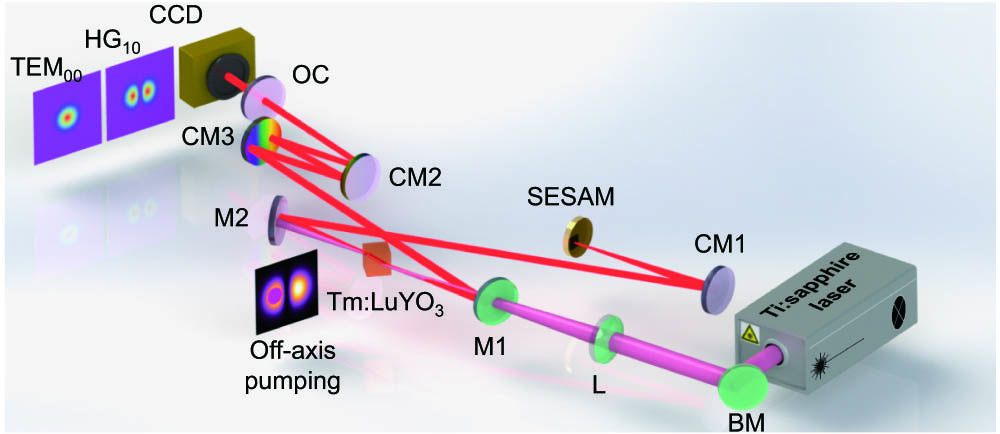
Figure 2: Schematic of an ultrafast laser mode-locked with a SESAM, which serves as one cavity mirror providing saturable absorption for passive mode locking
2. Kerr Lens Mode Locking (KLM)
Kerr lens mode locking (Kerr Lens Mode Locking, KLM) exploits the optical Kerr effect: intense light induces a refractive-index change in a medium, forming a lens-like self-focusing effect. By cleverly designing the resonator, only high-power pulses (after self-focusing) can pass through an aperture or the optimal pump region of the gain medium, while low-power continuous light is lost. KLM can produce extremely short pulses (down to ~5 fs), but the drawback is that it needs “starting” (usually by tapping the resonator) and is sensitive to environmental disturbances [(RP Photonics)](https://www.rp-photonics.com/mode_locking.html).
3. Nonlinear Polarisation Rotation (NPR)
In fibre lasers, nonlinear polarisation rotation (Nonlinear Polarisation Rotation, NPR; also called Nonlinear Polarisation Evolution, NPE) is commonly used as an artificial saturable absorber. The principle is that intensity-induced nonlinear birefringence changes the polarisation state, which, combined with a polariser, produces the effect of “more transmission for intense light, less for weak light.” NPR needs no extra semiconductor material and can produce very short pulses, but it is very sensitive to the environment (temperature, stress) and is hard to make into an all-fibre structure (if polarisation-maintaining fibre must be used, NPR cannot be used) [(RP Photonics)](https://www.rp-photonics.com/mode_locking.html).
4. Other Passive Mode-Locking Methods
- Nonlinear optical loop mirror (NALM): uses nonlinear effects in a fibre loop to realise saturable absorption, commonly used in “figure-eight” fibre lasers.
- Dye saturable absorbers: early mode-locked dye lasers used organic dyes, but these had short lifetimes and needed circulation pumps and are now essentially obsolete.
- Carbon nanotubes / graphene: new saturable-absorption materials with fast response and broad spectral applicability, but still under development.
V. Key Parameters of Mode-Locked Lasers
| Parameter | Meaning | Typical Range |
|---|---|---|
| Pulse width | The temporal full width at half maximum (FWHM) of the pulse | 5 fs to tens of ps |
| Repetition rate | Pulses output per second, equal to the cavity round-trip frequency | A few MHz to a few GHz |
| Average power | Time-averaged output power | mW to hundreds of W |
| Pulse energy | Energy of a single pulse = average power / repetition rate | nJ to mJ (after amplification) |
| Peak power | Instantaneous power at the pulse peak ≈ pulse energy / pulse width | kW to GW (after amplification) |
| Spectral bandwidth | The spectral width of the pulse | Depends on the gain medium |
| Time-bandwidth product | Pulse width × bandwidth, indicating how close the pulse is to the transform limit | 0.315 (transform limit, sech shape) |
VI. Typical Applications
Beyond that: Mode locking is only the “seed source” for femtosecond pulses; the direct output energy of an oscillator is usually only nJ to a few nJ. If high-energy (μJ to mJ or higher) femtosecond pulses are needed, chirped pulse amplification (CPA, Chirped Pulse Amplification) is required — stretch the pulse, amplify it, then compress it back to femtoseconds, to avoid nonlinear effects and optical damage during amplification. See the dedicated article on ultrafast lasers.
1. Ultrafast Spectroscopy and Fundamental Science
Femtosecond lasers can “freeze” the motion of molecules and atoms, capturing the “slow motion” of chemical reactions — this is femtosecond chemistry (1999 Nobel Prize in Chemistry). Attosecond pulses (obtained from high harmonics driven by femtosecond lasers) can even track the motion of electrons. Ultrafast lasers are core tools in physics, chemistry, biology and other fundamental research.
2. Precision Machining and Microfabrication
The extremely short pulse width of femtosecond lasers removes material before heat can diffuse, making it “cold machining” — no heat-affected zone, and extremely smooth, precise edges. It is widely used in medical stent machining, microelectronic wafer dicing, glass drilling and micro/nanostructure fabrication [(RP Photonics)](https://www.rp-photonics.com/mode_locking.html).
3. Biomedical Imaging
Two-photon/multiphoton microscopy relies on femtosecond lasers: two-photon absorption is excited only at the focus where intensity is high enough, giving inherent optical sectioning. Femtosecond lasers are also used in optical coherence tomography (OCT), corneal refractive surgery and other medical applications.
4. Optical Communication and Optical Sampling
Mode-locked lasers are the basis of optical frequency combs — a single fibre laser can generate thousands of equally spaced frequency comb lines, each like a precise “ruler” for measuring optical frequencies and time. In addition, mode-locked laser pulses are used for sampling and measuring high-speed optical signals.
5. LiDAR and Rangefinding
Ultrafast pulses combined with the time-of-flight (ToF) method enable extremely high-precision distance measurement. Fibre femtosecond lasers, being compact and reliable, are especially suited to vehicle- and airborne LiDAR.
VII. Common Misconceptions: 4 Ideas You May Have Got Wrong
Misconception 1: Mode locking is just a faster version of Q-switching, with a similar principle
Correction: The two work on completely different principles. Q-switching is “store then release” — relying on upper-level energy storage to release one big pulse; mode locking is “coherent superposition of multiple longitudinal modes” — using interference of phase-locked longitudinal modes to produce pulses. Q-switched pulse width is determined by the release speed of stored energy (nanoseconds); mode-locked pulse width by the gain bandwidth (femtoseconds/picoseconds). One is an “energy game,” the other a “phase game” [(RP Photonics)](https://www.rp-photonics.com/mode_locking.html).
Misconception 2: The shorter the pulse, the higher the peak power and the greater the energy
Correction: Pulse energy = average power / repetition rate, with no direct relation to pulse width. Peak power ≈ pulse energy / pulse width — a shorter pulse does give higher peak power, but only assuming constant energy. Many femtosecond oscillators have pulse energies of only nanojoules or even picojoules; they seem high-power only because the pulse is short. To obtain high-energy femtosecond pulses, a subsequent amplifier (such as chirped pulse amplification) is needed [(RP Photonics)](https://www.rp-photonics.com/mode_locking.html).
Misconception 3: A passively mode-locked laser mode-locks as soon as it is switched on
Correction: Most passively mode-locked lasers need a “starting” process. Passive mode locking is a nonlinear self-organising process that must “grow” a pulse out of noise. KLM lasers usually need a tap on a mirror to introduce a perturbation; SESAM mode locking starts relatively easily but is not guaranteed 100%. Only active mode locking locks as soon as power is applied [(RP Photonics)](https://www.rp-photonics.com/mode_locking.html).
Misconception 4: All mode-locked laser pulses are transform-limited
Correction: The transform limit is an ideal case. In real lasers, group-velocity dispersion (GVD), self-phase modulation (SPM), higher-order dispersion, gain-bandwidth limits and other factors make pulses deviate from the transform limit. The measure of pulse “quality” is the time-bandwidth product (TBP) — the closer the TBP to the theoretical limit, the “cleaner” the pulse. The TBP of real femtosecond lasers is typically 1.5–3 times the transform limit [(RP Photonics)](https://www.rp-photonics.com/mode_locking.html).
VIII. Recommended Reading
- What Is Q-Switching? How to Make Laser Pulses Instantly More Powerful — another pulse-generation technique, the king of nanosecond high-energy pulses
- What Is a Laser Mode? What Do Transverse and Longitudinal Modes Mean? — understanding longitudinal and transverse modes is the basis for mastering mode locking
- RP Photonics Encyclopedia: Mode Locking — the main reference for this article, the world’s most authoritative laser encyclopedia
Leave a Reply