


Have you ever wondered how a laser marker “draws” a beautiful logo on a metal surface in just a few milliseconds? The answer lies in the two little mirrors inside the machine that constantly “wag back and forth” – these are galvanometer scanners (Galvanometer Scanner). Small as they are, they let the laser beam move precisely across a plane at speeds of several metres per second – the “steering wheel” of the laser-processing world. Today let’s unpack the real science behind this little mirror.
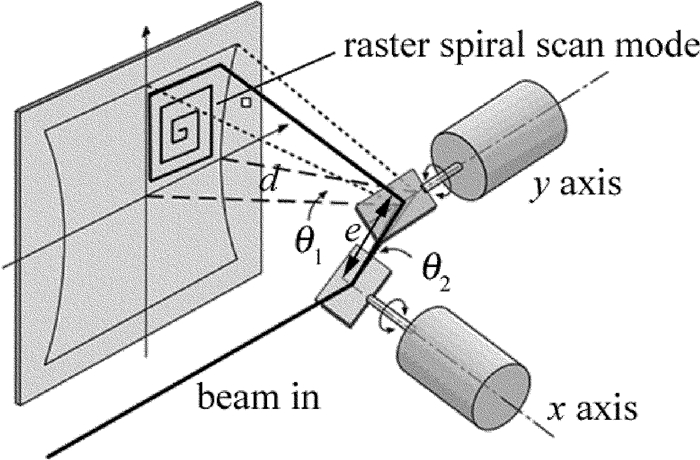
Table of Contents
- I. Core Concept: What Exactly Is a Galvo?
- II. How It Works: How Does a Little Mirror “Hit Exactly Where You Point”?
- III. Key Parameters: What Specs Matter When Choosing a Galvo?
- IV. Types: Who’s in the Galvo Family?
- V. Applications: Where Are Galvos Used?
- VI. Common Misconceptions: Pitfalls to Avoid
- Source Statement
I. Core Concept: What Exactly Is a Galvo?
A galvo scanner, whose English name is Galvanometer Scanner (galvo scanner for short), is an optical scanning device that uses electromagnetic force to drive a mirror to oscillate at high speed, thereby precisely controlling the direction of a laser beam.
Simply put, it is a little mirror that “wags its head” – give it an electrical signal and it deflects by an angle; when laser light strikes the mirror, it is reflected in a different direction. By precisely controlling the mirror’s swing angle, the laser beam can be positioned point by point across a plane, drawing any desired pattern.
In a laser processing system, the galvo plays the role of the “beam steering wheel”. Traditional machining moves the workpiece – slow and limited in precision – whereas the galvo only needs to rotate a mirror weighing a few grams to scan the beam at extremely high speed, orders of magnitude faster than a mechanical stage. That is the secret of how a laser marker completes complex patterns in the blink of an eye.
💡 An analogy: if the laser beam is a paintbrush, the galvo is the hand holding it – it does not move the canvas, only turns the wrist, quickly drawing all kinds of shapes on the canvas.
II. How It Works: How Does a Little Mirror “Hit Exactly Where You Point”?
2.1 Basic Principle of Electromagnetic Drive
A galvo motor is essentially a limited-angle torque motor. Its core principle is similar to the electric motors learned in school: a current-carrying coil in a magnetic field experiences electromagnetic force, generating torque that deflects the mirror mounted on the shaft. The greater the current, the larger the deflection angle.
But unlike an ordinary motor, a galvo does not need to rotate a full turn – it only swings back and forth within a very small angular range (typically ±10° to ±20°), and the swing precision required is extremely high – often at the microradian level.
2.2 Closed-Loop Servo Control: The Key to Precision
Nearly all modern industrial galvos use closed-loop servo control, which is the core of precision assurance. In brief: a position sensor (optical or capacitive) is built into the galvo to detect the mirror’s actual angle in real time; this signal is fed back to the control circuit, compared with the commanded angle, and the drive current is dynamically corrected via a PID algorithm.
This process repeats several thousand times per second, forming a high-speed control loop. It is like driving a car – your eyes watch the road (sensor), your brain judges the direction (PID algorithm), and your hands adjust the steering wheel (drive current) – except the galvo’s “reaction speed” is thousands of times faster than a human’s.
2.3 X-Y Two-Dimensional Scanning
To achieve planar scanning, one mirror is not enough – you need two, handling horizontal (X-axis) and vertical (Y-axis) deflection respectively; this is the so-called X-Y galvo. The two mirrors are arranged orthogonally and placed as close together as possible to reduce the distance between pivot points, making the beam’s deflection centres nearly coincide.
The laser first strikes the X mirror, then reflects onto the Y mirror; through the coordinated swing of the two mirrors, the beam can move freely across the entire plane.
2.4 The F-Theta Scan Lens: The Secret That Makes Scanning “Flat”
You might think: if the mirror turns by angle θ, the beam deflects by 2θ (angle of incidence equals angle of reflection), so the scanned trajectory should be an arc – why is it a plane?
The answer is the F-Theta scan lens. A special scan lens is usually paired behind the galvo; its job is to convert constant-angular-velocity deflection into constant-speed linear motion on the focal plane. A normal lens follows y = f·tanθ, while the F-Theta lens is designed for the linear relation y = f·θ, so when the mirror swings at constant speed, the spot moves in a straight line at constant speed on the work surface, and the focal plane is flat – no clear centre and blurry edge.
III. Key Parameters: What Specs Matter When Choosing a Galvo?
Choosing a galvo is not a matter of “the more expensive the better” – the key parameters must match your application. The following specs are must-sees:
3.1 Scan Angle
The scan angle is the maximum mechanical angle the mirror can deflect, commonly ±10° to ±20°. Note that this is the mechanical angle; the actual beam deflection angle is twice that (due to reflection). A larger scan angle, combined with a scan lens, enables a larger processing field.
3.2 Scan Speed and Resonant Frequency
Scan speed directly determines processing efficiency. A normal non-resonant galvo marks at roughly 1-10 m/s. A resonant galvo is different – it operates at its natural resonant frequency (e.g. 8 kHz, 12 kHz) and is more than 10 times faster! But resonant galvos have a drawback: they can only perform fixed-frequency sinusoidal back-and-forth scanning and cannot position arbitrarily.
3.3 Small-Step Settling Time
This parameter describes how long a galvo takes, after completing a small angular step, to settle within a specified tolerance. Typical values are 100-700 microseconds. The shorter this time, the “quicker the response” and the better the performance when marking tiny characters or negotiating sharp corners.
3.4 Repeatability
Repeatability measures how much the galvo’s actual position varies when the same position command is sent multiple times. High-end products can achieve repeatability below 2 μrad (RMS) – about 0.00011 degrees in angular terms, an astonishing level of precision.
3.5 Linearity
Linearity refers to the maximum deviation between actual and commanded deflection angle over the full travel. High-end galvos can reach over 99.9% linearity, meaning positioning is nearly error-free even at the edge of the scan range.
3.6 Entrance Pupil (Clear Aperture)
The entrance pupil is the effective clear diameter on the mirror. This must be larger than the incident laser beam diameter with some margin, otherwise the beam edge is blocked by the mirror mount (known in the industry as “beam clipping”), affecting spot quality and processing results.
📊 Core Parameter Quick-Reference Table
| Parameter | Meaning | Unit / typical value | Selection point |
|---|---|---|---|
| Scan angle | Maximum mechanical angle the mirror can deflect | ±10° ~ ±20° (mechanical) | Beam deflection = 2× mechanical angle; larger gives bigger field with a scan lens |
| Small-step settling time | Time to settle within tolerance after a small angular step | 100~700 μs | Shorter is better; directly affects quality of small characters and corners |
| Repeatability | Position deviation over repeated same commands | 2~20 μrad (RMS) | High-end products below 2 μrad, the basis of processing accuracy |
| Linearity | Deviation of actual from commanded angle over full travel | Above 99.9% | Affects positioning accuracy at the scan-range edge |
| Clear aperture | Effective clear diameter of the mirror | mm | Must exceed incident beam diameter with margin to avoid clipping |
| Resonant frequency | Mechanical resonance frequency (resonant galvos) | kHz | Resonant type is extremely fast but only sinusoidal, suited to high-speed imaging |
| Applicable wavelength / damage threshold | Mirror coating and power handling | nm / W/cm² | High-power applications must confirm mirror damage threshold |
IV. Types: Who’s in the Galvo Family?
Galvos can be classified in many ways; different dimensions yield different types:
4.1 By Drive Method
- Moving-coil galvo: the coil rotates, driving the mirror to swing. Advantage: fast response; disadvantage: limited coil heat dissipation, unsuitable for long high-power operation.
- Moving-magnet galvo: the permanent-magnet rotor rotates while the coil stays fixed. Good heat dissipation and the mainstream scheme for industrial use today. High-end industrial galvos from well-known brands such as Scanlab and Thorlabs mostly use moving-magnet designs.
4.2 By Motion Characteristic
- Non-resonant galvo: through servo control, achieves precise positioning along arbitrary trajectories. The most common type, used in most laser marking, cutting and welding.
- Resonant galvo: operates at its natural resonant frequency, extremely fast, but only performs back-and-forth scanning at a fixed frequency. Mainly used in high-speed imaging, confocal microscopy and other scenarios with extreme speed demands.
4.3 By Number of Axes
- Single-axis galvo: a single mirror, scanning in one direction only. Commonly used in line-scan applications.
- Dual-axis galvo (X-Y galvo): the most common configuration, two mirrors arranged orthogonally for two-dimensional planar scanning. This is what is installed in laser markers.
- Three-axis galvo: adds a Z-axis dynamic focusing to the X-Y basis, enabling processing in three-dimensional space, commonly used in 3D printing and curved-surface marking.
V. Applications: Where Are Galvos Used?
Small as they are, galvos serve a very wide range of fields – nearly anywhere a laser beam must be manipulated quickly and precisely:
5.1 Laser Processing (the Largest Application Area)
- Laser marking / engraving: marking logos, QR codes and text on metal, plastic, glass and other materials – the most classic galvo application.
- Laser cutting / welding: thin-sheet cutting and precision welding, where the galvo works with a high-power laser for fast processing.
- Laser cleaning: scanning the laser beam to remove dirt, rust and coatings from material surfaces.
5.2 3D Printing
In SLA (stereolithography) and SLS (selective laser sintering) 3D printing, the galvo scans the laser beam to cure photosensitive resin layer by layer or sinter metal powder layer by layer, finally forming a three-dimensional solid part.
5.3 Biomedical Imaging
- Confocal microscopy: uses high-precision galvos for point-by-point laser scanning to acquire three-dimensional tomographic images of samples.
- OCT (Optical Coherence Tomography): a technology commonly used in ophthalmic examinations, achieving high-resolution retinal imaging through galvo scanning.
5.4 Laser Displays
In laser projection and laser TVs, the galvo rapidly scans RGB primary-colour laser beams to form dynamic images on screen. The laser shows you have seen that project text in mid-air also rely on galvos.
5.5 LiDAR and 3D Scanning
Many automotive lidars and industrial 3D scanners use galvos to control the direction of the measurement beam, rapidly acquiring three-dimensional shape data of target objects.
VI. Common Misconceptions: Pitfalls to Avoid
Myth 1: “The faster the galvo, the better”
Many people look at the speed spec first when choosing a galvo, thinking faster is more worthwhile. But the advertised maximum speed usually corresponds to jump speed over large travel; when actually marking small characters or turning sharp corners, the speed is nowhere near that high. Blindly pursuing speed actually increases tracking error, causing “over-burning” at corners – the laser lingers too long at a corner and scorches the material.
Recommendation: choose speed by actual processing content; for fine marking prioritise settling time and repeatability over maximum speed.
Myth 2: “Any galvo and scan lens can be paired at random”
Pairing a galvo with a scan lens is not arbitrary – you cannot just buy any lens and bolt it on. First, the scan lens’s entrance pupil position must coincide with the galvo’s pivot point, otherwise severe edge-spot distortion occurs; second, parameters such as wavelength, clear aperture and maximum scan angle must all match. Poor pairing results at best in deformed edge spots and a smaller field, at worst in beam clipping and coating damage.
Recommendation: select the galvo and scan lens as a matched set, or ask professional technicians to do the matching calculation.
Myth 3: “Accuracy depends only on angular resolution”
Many believe angular resolution (minimum step size) represents galvo accuracy – smaller step means higher accuracy. Not really: angular resolution is only the smallest command unit the galvo can recognise; actual accuracy is also affected by repeatability error, linearity, thermal drift and other factors. Especially thermal drift – during long industrial runs, temperature-induced angular drift is often the largest error source.
Recommendation: look at comprehensive accuracy specs, focus on repeatability and thermal drift, and choose temperature-compensated models for long-running situations.
Myth 4: “The larger the scan angle, the better the value”
A larger scan angle does mean a bigger processing field, but the cost is obvious: at large angles, edge spot quality (distortion, astigmatism, spot enlargement) degrades markedly, and the price of the matching large-field scan lens soars. Paying a premium for a large-angle galvo and using only the middle small area is simply wasteful.
Recommendation: choose the scan angle by the actual required processing field – adequate is enough, no need to blindly pursue large angles.
Reference Sources
This article is compiled from authoritative technical materials including RP Photonics Encyclopedia, Scanlab, Thorlabs and Scanner Optics, for technical study reference only. For more detailed technical parameters and selection advice, please contact our technical team.
Related Product Recommendations
If you are looking for a suitable galvo product, check out Soar Laser’s galvo product category page, covering single-axis, dual-axis and three-axis galvos and scanning systems from brands such as Scanlab, Thorlabs and RAYLASE, with professional selection consulting available.
- 👉 All Galvo Products
- 👉 Galvo Scanning Systems
- 👉 Scanlab Scanning Systems
- 👉 Thorlabs Galvo Scanning Systems
Further Reading
- What Is an F-Theta Scan Lens? How Does the “Flat-Field Magic” Work in Laser Marking Machines?
- Laser Scanning Galvo Principles and Applications
- Telecentric Scan Lenses Explained: Why Laser Drilling Needs One, and How They Differ from Standard F-Theta Lenses
Reference Sources
- RP Photonics Encyclopedia: Laser Scanning (Galvo Scanners)
- ISO 10110 Optics and Photonics – Preparation of drawings for optical elements and systems
- “Principles and Applications of Lasers”, Higher Education Press
Leave a Reply