


In one sentence: A Gaussian beam (the TEM00 fundamental mode) is the beam form actually output by the vast majority of lasers; on any transverse cross-section its intensity follows the Gaussian function e−2ρ²/w², the beam is narrowest at the waist and spreads outward at a fixed divergence angle. Describing it requires only two independent parameters — the beam waist radius w₀ and the wavelength λ — from which all other parameters (Rayleigh length, divergence angle, depth of focus, wavefront radius of curvature, etc.) can be determined. This article presents all of the core formulas, together with 3 worked examples with complete numerical solutions.
Complex Amplitude and Fundamental Parameters of a Gaussian Beam
A Gaussian beam is a solution of the paraxial Helmholtz equation. Its power is concentrated mainly within a cylinder centered on the optical axis, and the intensity distribution on any transverse plane satisfies a circularly symmetric Gaussian function whose width is smallest at the beam waist. Skipping the derivation, the complex amplitude of a Gaussian beam is given directly below:
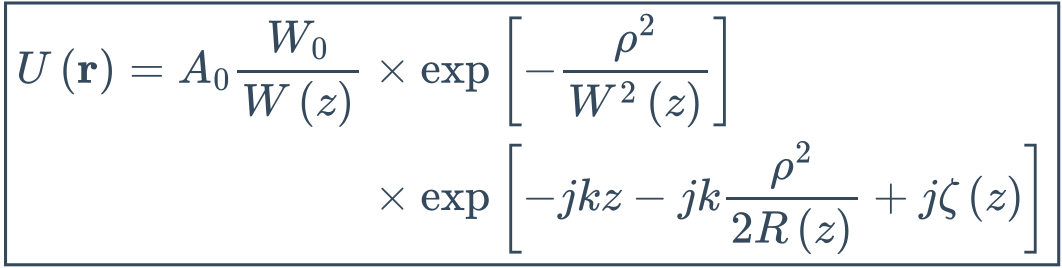
as well as the four important parameters of a Gaussian beam:
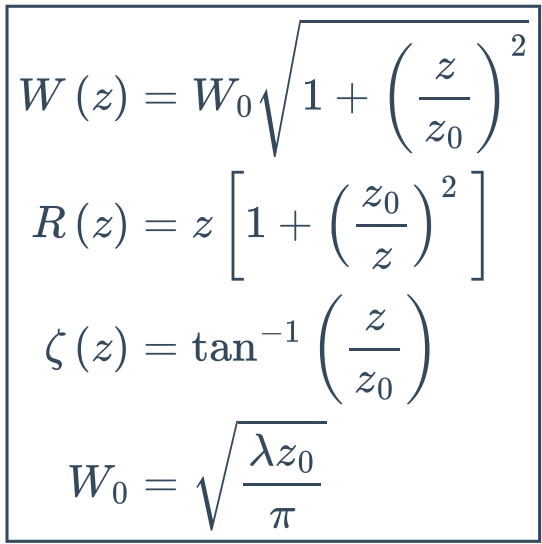
The complex amplitude expression contains two mutually independent parameters, A₀ and z₀, where A₀ is a constant and z₀ is the Rayleigh length, and both can be determined from the boundary conditions. The four parameters represent the beam radius, the radius of curvature, the phase and the waist radius; all of them can be determined from the Rayleigh length z₀ and the wavelength λ.
Core Formulas and Symbol Quick Reference
| Symbol | Meaning | Common unit | Relation / Notes |
|---|---|---|---|
| w₀ (W₀) | Beam waist radius | mm / μm | Radius at the narrowest point of the beam; one of the two independent parameters |
| λ | Wavelength | nm | In a medium, use the in-medium wavelength; the other independent parameter |
| z₀ (zR) | Rayleigh length (Rayleigh range) | mm | z₀ = πw₀²/λ |
| w(z) | Beam radius at z (1/e² definition) | mm | w(z)=w₀√[1+(z/z₀)²] |
| θ₀ | Far-field half-divergence angle | mrad | θ₀ = λ/(πw₀) |
| DOF / b | Depth of focus (confocal length) | mm | DOF = 2z₀ |
| R(z) | Wavefront radius of curvature | mm | R(z)=z[1+(z₀/z)²] |
| ζ(z) | Gouy phase | rad | ζ=arctan(z/z₀), accumulating a total of π over the whole path |
| I₀ | Peak on-axis intensity at the waist center | W/cm² | I₀ = 2P/(πw₀²) |
Beam Intensity (I)
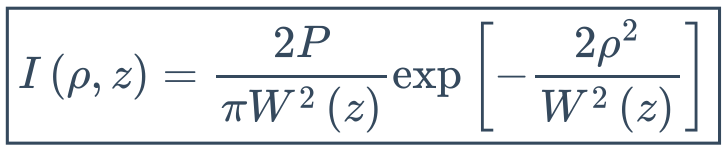
The light intensity is a function of the axial position z and the radial position ρ:

where I₀ is the square of A₀. For any value of z the intensity is always a Gaussian function of ρ — hence the name Gaussian beam. Its intensity is maximal on the axis (ρ = 0) and decreases as ρ increases. The figure below shows the normalized intensity versus radial distance at three axial positions. Clearly, the beam size grows with axial distance.
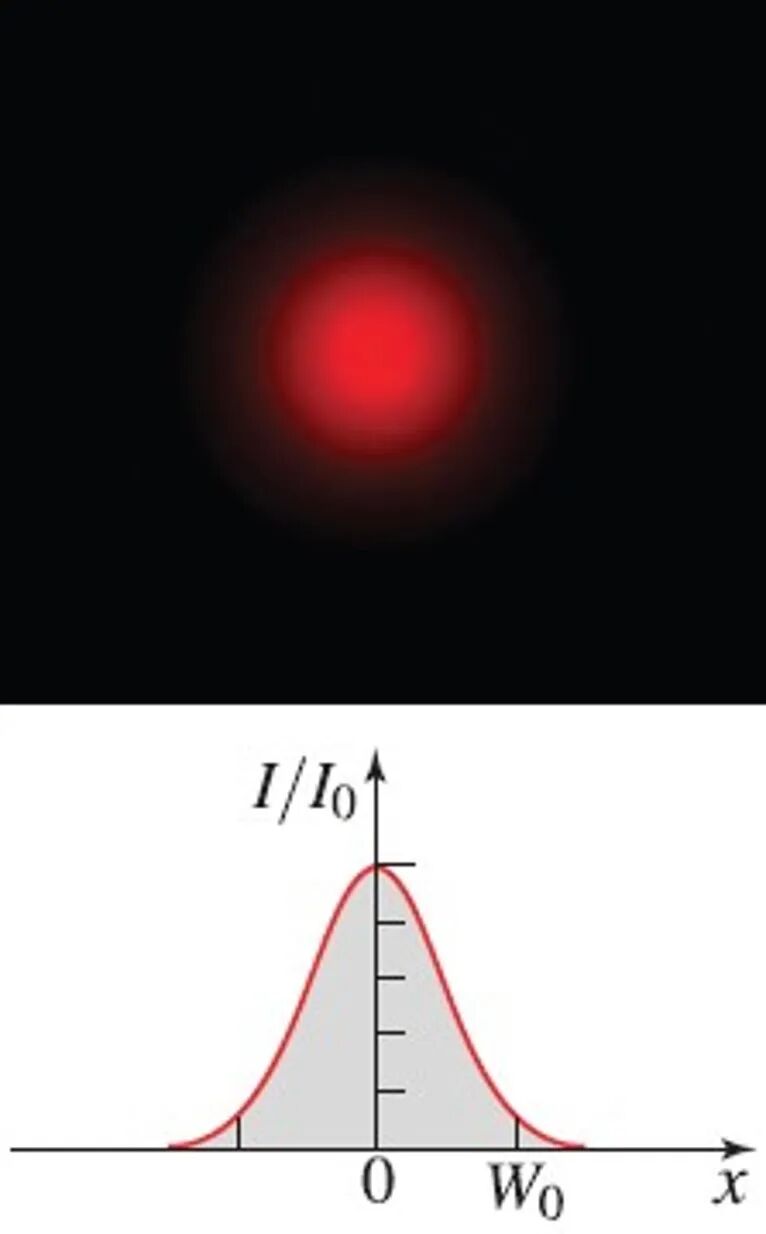
z = 0
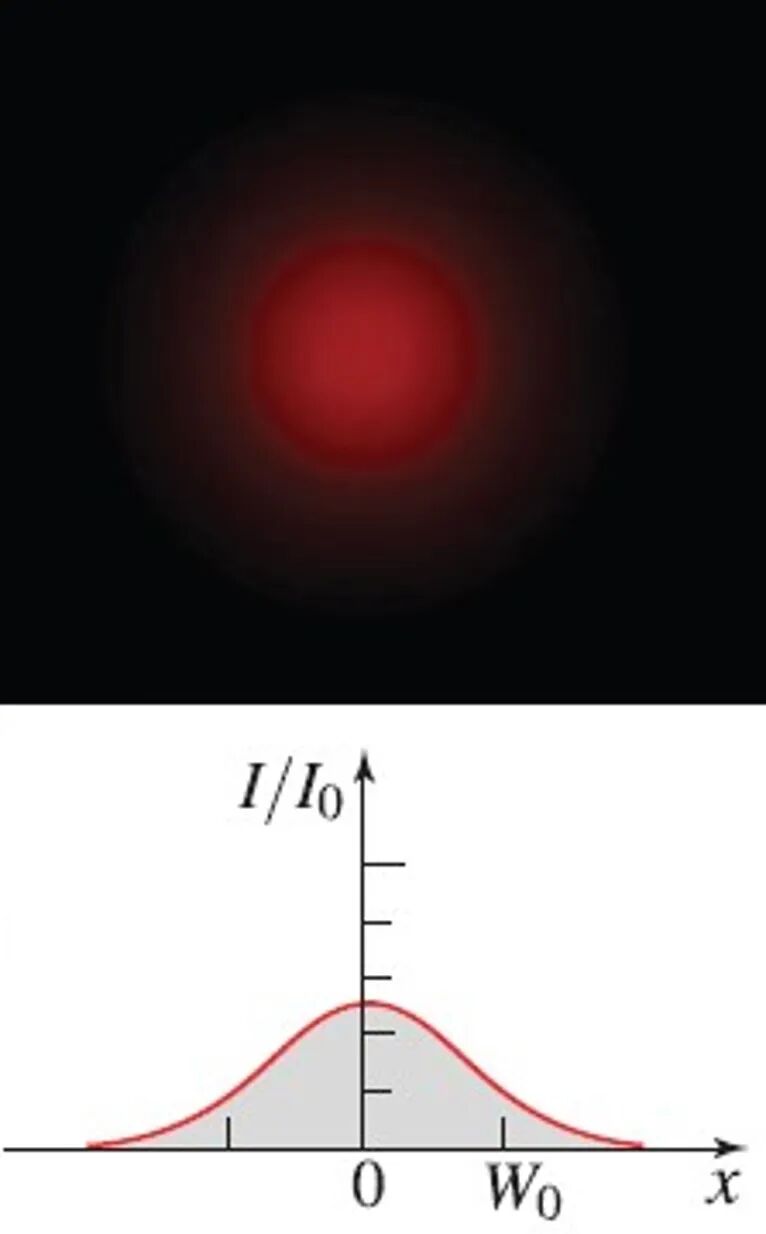
z = z₀
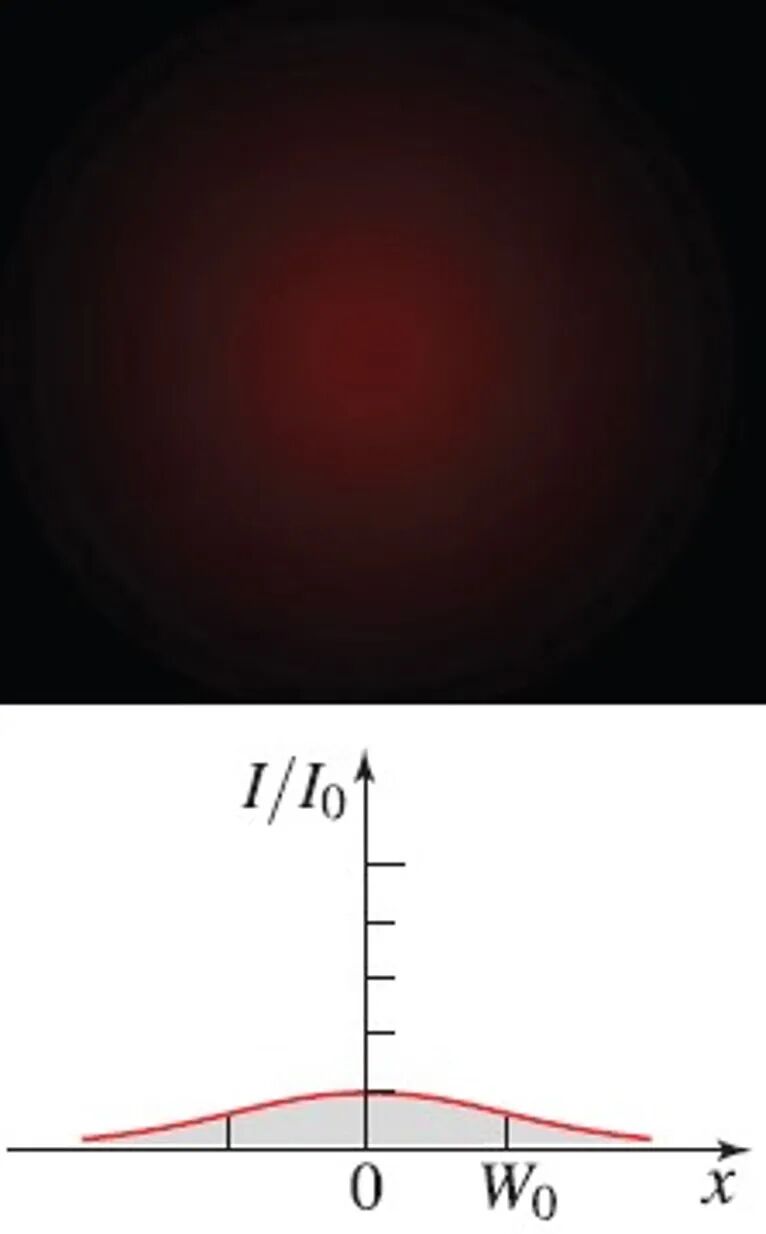
at z = 2z₀ the on-axis intensity (ρ = 0) simplifies to:

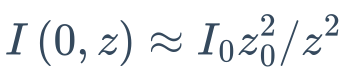
It reaches its maximum value I₀ at z = 0, then gradually decreases as z increases, falling to half of the maximum at ±z₀. When z is far larger than z₀, the on-axis intensity is inversely proportional to z²:
For the entire Gaussian beam, the center carries the maximum intensity:

Because of the non-uniform profile of a Gaussian beam (its peak intensity is about twice that of a uniform beam), when analyzing whether a laser could damage an optical component, the Gaussian intensity must be multiplied by 2 to obtain the maximum linear power density (W/cm), and the result must then be compared with the damage threshold of the component to make sure the actual value stays below the threshold.
Beam Power (P)
The total optical power is the integral of the intensity over any transverse plane:

The beam power is therefore one half of the product of the peak intensity and the waist area, and it is independent of the axial position. To measure the power of different light sources, a suitable optical power sensor head and power meter console are required.
Thorlabs offers a wide range of optical power sensor heads, energy sensor heads and power/energy meter consoles (such as the PM100D series, the PM160 wireless handheld power meter, and various photodiode/pyroelectric sensor heads); selection guides and technical specifications are available on the Thorlabs Chinese website: Optical Power and Energy Meters (Thorlabs Chinese website).
For a given value of z, the ratio of the power contained within a circle of radius ρ₀ to the total power is:

When ρ₀ = W(z) the circle contains about 86% of the power; when ρ₀ = 1.5W(z) it contains about 99%. In practice, therefore, the beam diameter should be far smaller than the clear aperture of the optical component; as a rule of thumb, the beam diameter is kept within one third of the mirror diameter.
Beam Radius (W)
In any transverse plane the beam intensity is maximal on the optical axis and falls to 1/e² of the maximum at ρ = W(z), while the circle of radius W(z) contains 86% of the total power; W(z) is therefore called the beam radius (or beam width) and can be calculated with the following formula:
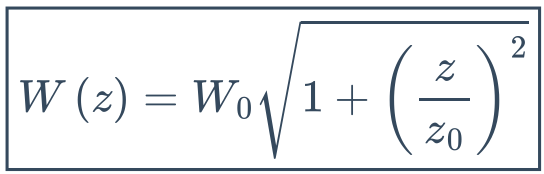
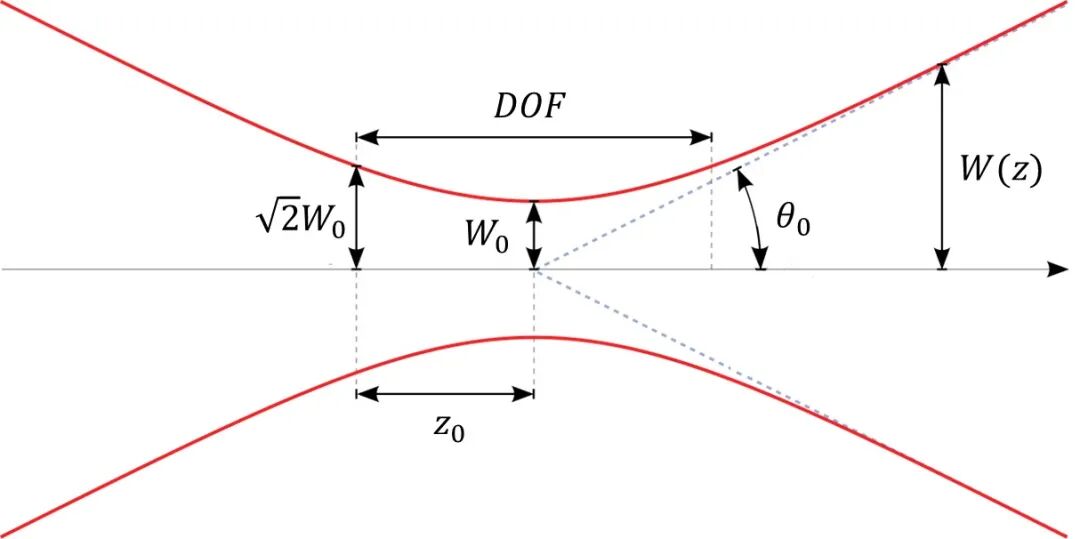
At z = 0 the beam radius reaches its minimum value W₀. This position is called the beam waist, and W₀ is the waist radius. As shown below, the beam radius grows with the axial distance z and reaches √2 times the waist radius at the Rayleigh distance; the figure also shows the DOF (depth of focus) and the half-divergence angle.
Beam Divergence
When z is far larger than z₀, the beam radius is approximately proportional to z:
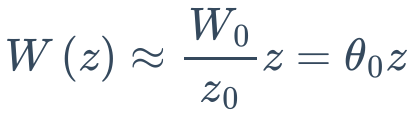
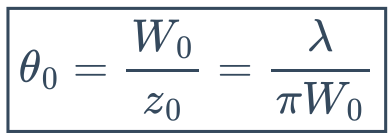
As shown above, the beam diverges within a cone of half-angle θ₀, and the power inside that cone is about 86% of the total. This angle is called the half-divergence angle; it is proportional to the wavelength and inversely proportional to the waist radius, so a beam with excellent directionality requires a short wavelength and a large waist. In engineering practice a laser beam expander is commonly used to magnify the waist and thereby compress the divergence angle.
Depth of Focus
Since the beam radius is smallest at z = 0, the best focus also lies in the corresponding plane; offset in either direction, the beam gradually goes out of focus. The axial distance over which the beam radius does not exceed √2 times the waist radius — i.e., the beam area does not exceed twice the waist area — is called the depth of focus.

The depth of focus is evidently twice the Rayleigh distance:
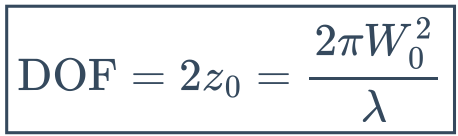
Because the depth of focus is proportional to the waist area and inversely proportional to the wavelength, only a short wavelength allows a small waist and a long depth of focus at the same time. For example, for a helium-neon laser at a wavelength of 633 nm the depth of focus is about 1000 m when the waist radius is 10 mm; when the waist radius is reduced to 10 µm the depth of focus is only 1 mm.
Below is a demonstration video on Gaussian beams from the MIT open course “Video Demonstrations in Lasers and Optics” (RES.6-006), which vividly demonstrates Gaussian beam divergence, spatial filtering, laser speckle and the Rayleigh distance.
Phase
From the complex amplitude, the phase of a Gaussian beam is:
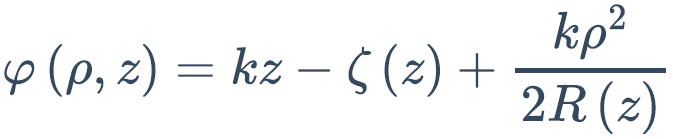
At ρ = 0 the phase contains only two terms:

The first term is the plane-wave phase, while the second term is a phase delay:
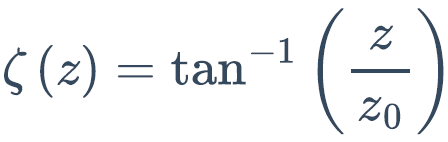
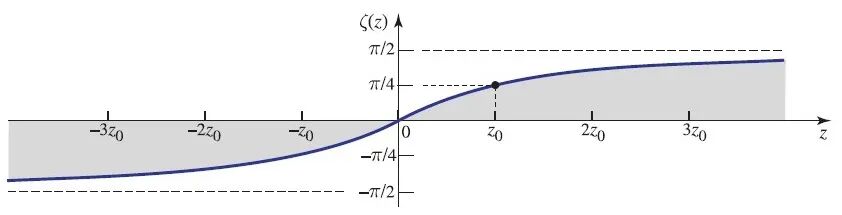
This phase (ζ) is called the Gouy phase and corresponds to the excess delay of the wavefront at the axial position relative to a plane wave. As shown below, the Gouy phase ranges from −π/2 to +π/2; as the light wave travels from negative infinity to positive infinity, the total accumulated delay equals π. The Gouy phase changes most noticeably within the depth of focus and very little in regions far outside the Rayleigh range.
Wavefront
In the Gaussian beam phase expression above, the third term is what bends the wavefront: it represents the phase deviation of an off-axis point relative to the on-axis point in a given transverse plane. At an axial point z, the wavefront radius of curvature of a Gaussian beam is:
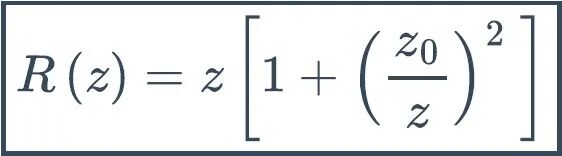
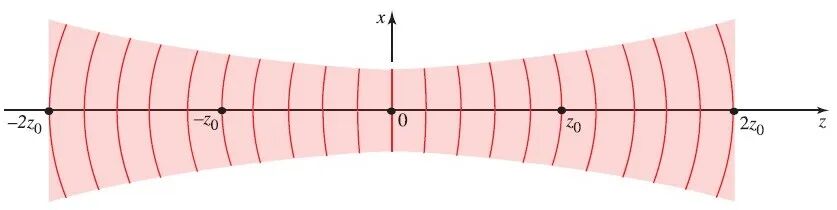
At z = 0, R is infinite, so the wavefront is planar and the whole wave points in the same direction. At z = z₀ the radius of curvature drops to its minimum value 2z₀ and then increases gradually with z. When z is far larger than z₀, the radius of curvature is approximately equal to z, so the wavefront is approximately spherical. The wavefront variation in the negative direction follows the same trend, but with the opposite sign.
Worked Examples with Complete Solutions
Example 1: Gaussian Beam Parameter Calculation (HeNe Laser)
1. Gaussian beam parameter example Assume a helium-neon laser outputs a Gaussian beam with a wavelength of 633 nm, a power of 1 mW and a waist radius of 0.05 mm. a. Determine the divergence angle, the depth of focus, and the beam diameter after propagating 350,000 kilometers (close to the distance from the Earth to the Moon). b. Determine the wavefront radius of curvature at z = 0, z₀ or 2z₀. c. Determine the on-axis intensity at z = 0 or z₀ and express it in W/cm². For a 100 W spherical wave emitted from z = 0, compare its intensity upon propagation to z = z₀ with the Gaussian beam intensities at the two points above. Solution a. Using the corresponding formulas and values: θ₀ = λ/(πW₀) = 4.03 mrad z₀ = W₀/θ₀ = 12.4 mm When the beam has propagated 350,000 kilometers, its diameter is: 2W = 2θ₀z = 2821 km b. Wavefront radii of curvature: R(z = 0) = ∞ R(z = z₀) = 2z₀ = 25 mm R(z = 2z₀) = z[(1+(z₀/z)²] = 31 mm c. Intensity at the beam center: I = I₀ = 2P/πW₀² = 25.46 W/cm² On-axis intensity at the Rayleigh distance: I = I₀[W₀/W]² = 0.5I₀ = 12.73 W/cm² When the 100 W spherical wave has propagated to z = z₀ = 12.4 mm:
I = P/4πz² = 5.169 W/cm²
Example 2: Deriving Parameters from Beam Radius and Wavefront Curvature
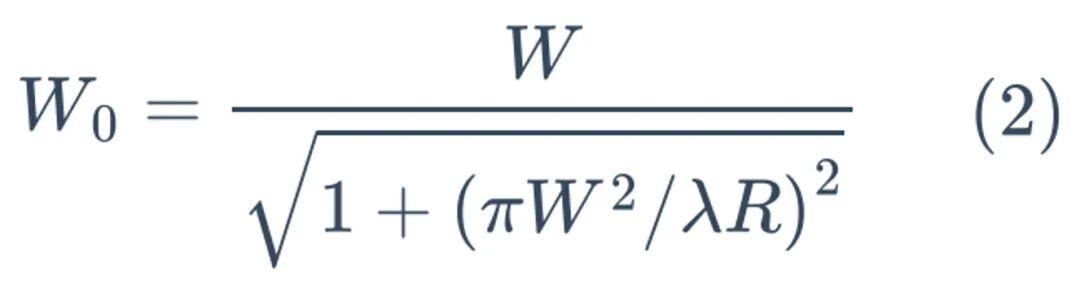
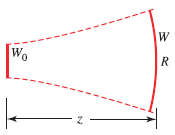
2. Determining other parameters from the beam radius and wavefront curvature Assume that at a certain point a Gaussian beam has a beam radius W and a wavefront radius of curvature R. Show that the distance from this point to the beam waist is:
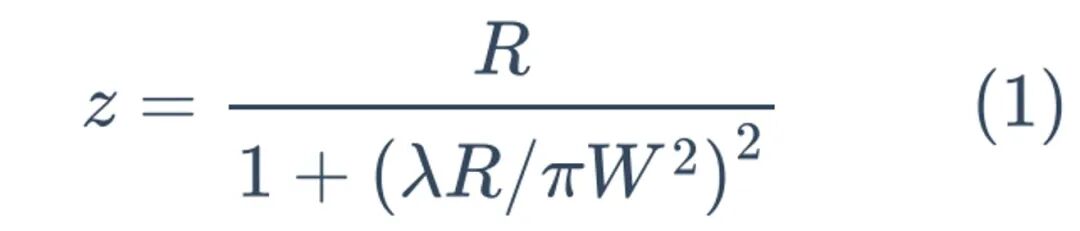
The waist radius is calculated from the following formula:
Proof From the formulas for the beam radius and the wavefront radius of curvature:
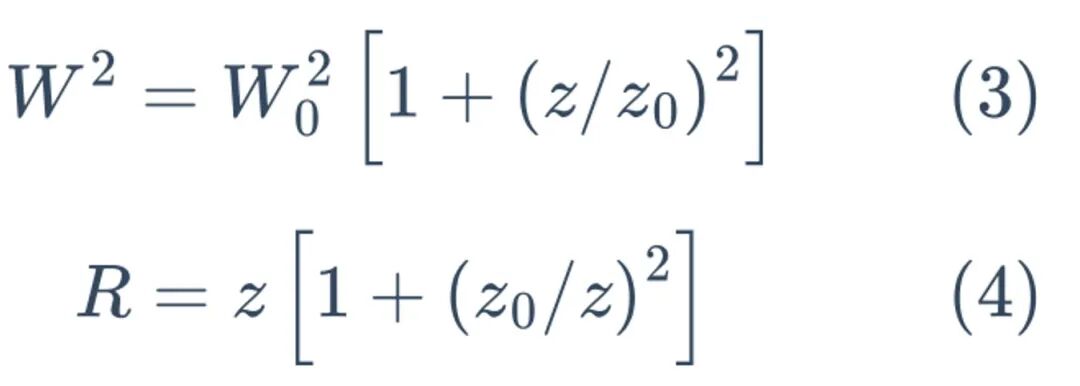
Dividing the two sides and rearranging gives:

Rewriting the expression above gives:

Substituting (5) into (4) and (3) respectively completes the proof.
Example 3: Determining the Waist Position and Rayleigh Length from Two Wavefront Curvatures
3. Determining other parameters from two curvatures Assume a Gaussian beam has wavefront radii of curvature R₁ and R₂ at two points, and the distance between the two points is d. Show that the position of the beam center and the Rayleigh distance are given respectively by the following two formulas.
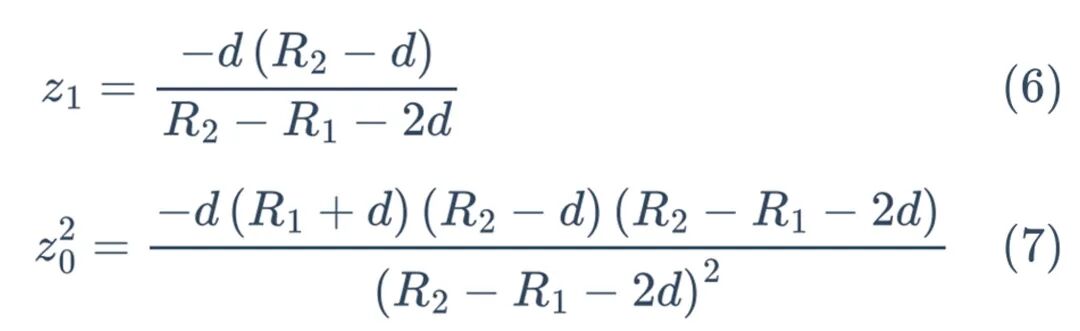
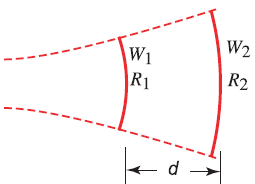
Proof Using z₂ = z₁ + d and the wavefront radii of curvature:
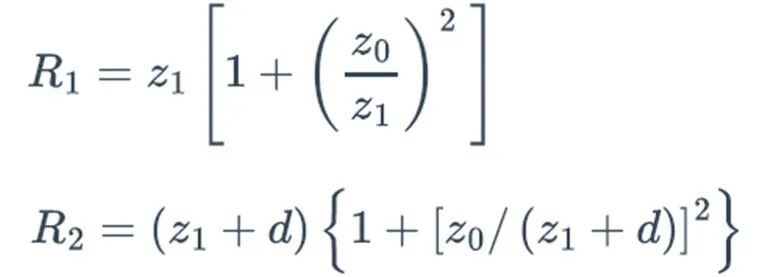
Writing this as a system of equations in the unknowns z₀ and z₁:

Solving the system of equations yields formulas (6) and (7).
Gaussian Beam FAQ
What is a Gaussian beam?
A Gaussian beam is a laser beam whose transverse electric field and intensity distribution approximately follow a Gaussian function, corresponding to the fundamental transverse mode TEM00 of the resonator. It is narrowest at the beam waist and diverges smoothly to both sides, and it is the ideal model of the output beam of the vast majority of single-mode lasers.
What are the beam waist and the waist radius w₀?
The beam waist is the position where the beam diameter is smallest, and the radius there is denoted w₀. At the waist the wavefront is planar and the intensity is maximal. w₀ and the wavelength λ are the only two independent parameters needed to describe a Gaussian beam.
What is the Rayleigh length (Rayleigh range)?
The Rayleigh length z₀ = πw₀²/λ is the distance from the waist to the point where the beam radius grows to √2·w₀ (the cross-sectional area doubles and the on-axis intensity halves). Within z₀ the beam is approximately parallel, which is why z₀ is also called the collimation range; the confocal length (depth of focus) = 2z₀.
Why does a smaller waist mean a larger divergence angle?
The far-field half-divergence angle θ₀ = λ/(πw₀) is inversely proportional to the waist radius and proportional to the wavelength. This is an inevitable consequence of diffraction: the finer you want to focus (small w₀), the faster the beam diverges; the product w₀θ₀=λ/π is a constant for a fixed wavelength. In engineering, a beam expander is used to magnify the waist first and thereby compress the divergence.
What does the 1/e² radius of a Gaussian beam mean?
w(z) is defined as the radius from the optical axis at which the intensity has fallen to 1/e² (about 13.5%) of the on-axis peak. The circle contains about 86.5% of the total power; a radius of 1.5w contains about 98.9% of the power.
How do you calculate the peak on-axis intensity of a Gaussian beam?
The peak on-axis intensity at the waist center is I₀ = 2P/(πw₀²), about twice that of a uniform spot of the same total power. When assessing whether an optical component will be damaged, compare this peak (not the average power density) against the damage threshold.
What is the Gouy phase?
The Gouy phase ζ=arctan(z/z₀) is the extra axial phase a Gaussian beam acquires relative to an ideal plane wave, varying smoothly from −π/2 before the waist to +π/2 after it and accumulating a total of π over the full propagation; it is the characteristic phase shift of a Gaussian beam passing through its focus.
How are a Gaussian beam and the M² beam quality factor related?
An ideal fundamental-mode Gaussian beam has M²=1; a real beam contains higher-order modes, so M²>1. The divergence angle, Rayleigh length and other properties of a real beam can be corrected with M²: θ=M²·λ/(πw₀). The closer M² is to 1, the closer the beam is to an ideal Gaussian beam and the easier it is to focus and collimate.
Further Reading and References
- What Is a Beam Expander? Principle, Types and Selection of Laser Beam Expanders (how to compress the divergence angle of a Gaussian beam with a beam expander)
- F-Theta Lens (Flat-Field Lens) Principle and Selection (focusing a Gaussian beam onto the marking work plane)
- Laser-Induced Damage Threshold (LIDT) Encyclopedia (peak power density and component selection)
- Iris Diaphragm Working Principle and Beam Diameter Matching
- Polarization-Maintaining Fiber Encyclopedia (fiber coupling of Gaussian beams and mode-field matching)
- Authoritative reference: RP Photonics Encyclopedia — Gaussian Beams
- Authoritative reference: Thorlabs — Gaussian Beam Optics Tutorial
- Demonstration video: MIT OCW “Video Demonstrations in Lasers and Optics, RES.6-006” (see the embedded player above)
Leave a Reply