


Laser Coherence and Coherence Length
I. Overview
When it comes to the characteristics of laser light, you have surely heard the phrase “good coherence.” But what is coherence, and what does coherence length mean?
Coherence, quite simply, is the degree to which the phases at different positions and different times in an optical field remain stably correlated. If two beams meet and produce clear, stable interference fringes, we say they are coherent; if the fringes are blurred or absent altogether, they are incoherent.
Ordinary incandescent lamps and sunlight have very poor coherence — shine two light bulbs at each other and you will see no interference at all. A laser is different: a good single-frequency solid-state laser can have a coherence length of several kilometres. This is why lasers can be used for applications ordinary light cannot manage, such as interferometry, holography and coherent communication.
A classic analogy: imagine a line of soldiers marching in step. If everyone’s pace is exactly the same, they will all lift their feet at the same moment when reaching the same position — that is “coherent.” If everyone walks their own way in a jumble, that is “incoherent.” The atoms in an ordinary light source emit like scattered individuals, each on its own; the stimulated emission in a laser is like a strictly trained army, moving in close step.
Coherence is mainly divided into two dimensions:
- Temporal coherence: the degree of phase correlation between light at different times at the same spatial point (related to monochromaticity / linewidth)
- Spatial coherence: the degree of phase correlation between light at different positions across the beam cross-section at the same moment (related to the mode)
Coherence length (Coherence Length, L_coh) is the most commonly used physical quantity for measuring temporal coherence. It is defined as the distance over which coherence significantly decays during propagation. In simple terms, it is the maximum propagation distance over which the light can still “keep in step.”
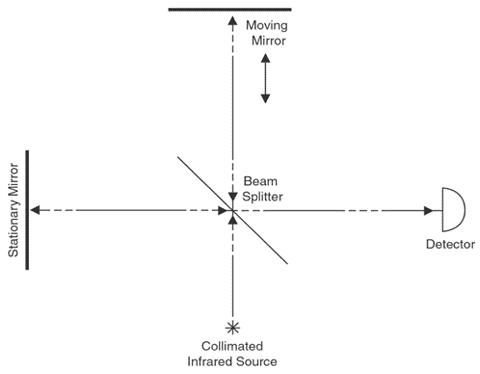
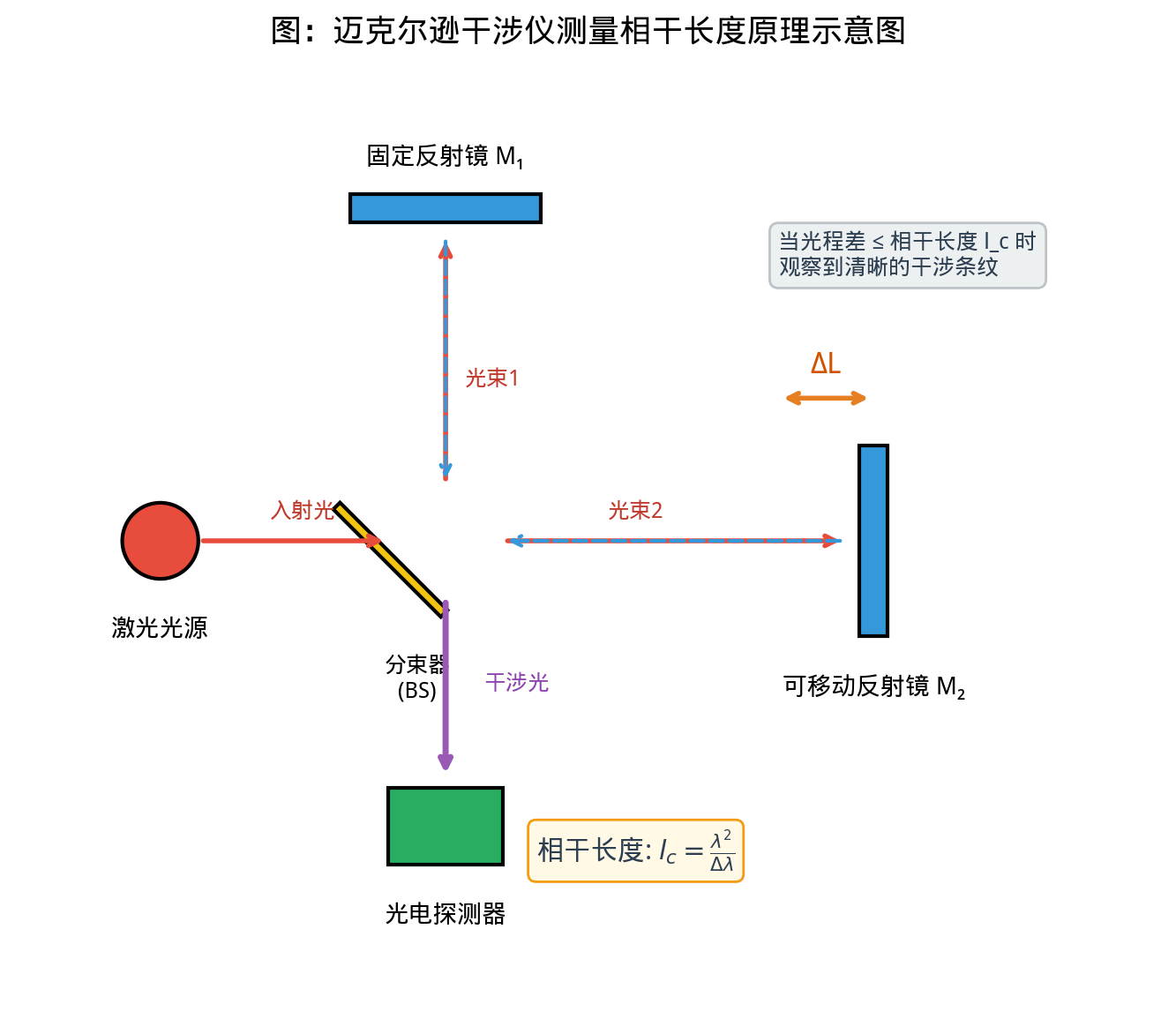
Figure 1: Schematic of a Michelson interferometer. The coherence length determines how large an optical path difference between the two arms can be while interference fringes are still observable.
II. Operating Principle
1. Temporal Coherence and Coherence Length
Basic definition
According to RP Photonics, coherence length is used to quantify temporal coherence (not spatial coherence!), representing the propagation length over which coherence decays significantly — in other words, the distance travelled over which the optical phase undergoes a noticeable random change.
Coherence length equals the coherence time multiplied by the speed of light in vacuum:
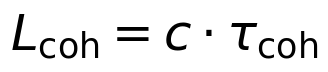
where  is the coherence time and c is the speed of light in vacuum.
Why is “coherence length” more commonly used than “coherence time”? Because in experiments optical path differences are usually measured in length. For example, the difference between the two arms of an interferometer, or the path difference between the reference and object beams in holography, are all lengths. Using coherence length allows direct comparison with these optical path differences, which is more intuitive.
Relationship between coherence length and linewidth
For light with a Lorentzian spectrum (arising from a random walk of the phase), the coherence length can be calculated from the linewidth:

where  is the spectral linewidth (full width at half maximum, FWHM). The coherence length given by this formula corresponds to the propagation distance at which the amplitude of the coherence function falls to
 .
Note: in many references the denominator of this formula has no
— it is generally used only for order-of-magnitude estimation, without a rigorously defined exact correspondence between linewidth and coherence length.
It should also be noted that this simple relationship applies only when the spectral shape is fairly regular. If the coherence function has a more complex shape (such as a frequency comb), the shape and width of the spectrum alone cannot fully determine the coherence properties.
Comparison of Coherence Lengths of Different Lasers
| Light source type | Typical linewidth | Coherence length (approx.) |
|---|---|---|
| Sunlight / white light | ~300 THz | on the order of ~1 μm |
| Light-emitting diode (LED) | ~tens of THz | ~tens of micrometres (depending on material and spectral width) |
| Multimode diode laser | ~nm scale | ~millimetre scale |
| Single-frequency diode laser | ~MHz scale | ~tens of metres |
| Single-frequency solid-state laser (un stabilized) | ~kHz scale | ~several kilometres |
| Frequency-stabilized single-frequency laser (for optical clocks) | <1 Hz | >300,000 km |
Reference Table of Coherence Lengths for Common Lasers
| Laser type | Typical linewidth | Typical coherence length | Notes |
|---|---|---|---|
| He-Ne laser | ~1 GHz (multiple longitudinal modes) | ~20~30 cm | standard type; can be longer after mode selection |
| FP diode laser | ~1~10 THz | ~0.1~1 mm | multiple longitudinal modes, very poor coherence |
| DFB diode laser | ~1~10 MHz | ~10~100 m | single longitudinal mode, but linewidth wider than solid-state lasers |
| Multimode solid-state laser | ~100 GHz | ~a few millimetres | unselected-mode Nd:YAG and similar |
| Narrow-linewidth solid-state laser | ~100 MHz~1 MHz | ~a few metres to a few hundred metres | after longitudinal-mode selection |
| Single-frequency fibre laser | ~kHz scale | ~tens to hundreds of kilometres | DFB/DBR type |
| Ultra-stable-cavity single-frequency laser | ~Hz or even mHz | ~tens of thousands to hundreds of thousands of kilometres | optical-clock level, top-tier frequency stabilization |
Note: the above are typical values; actual figures vary with the specific model, stabilization scheme and operating conditions. The coherence-length formula is based on the Lorentzian lineshape L_coh = c/(π·Δν).
2. Which Lasers Have Very Long Coherence Lengths?
Single-frequency solid-state lasers, especially frequency-stabilized ones, can reach very long coherence lengths. For example, a Lorentzian spectrum with a 10 kHz linewidth corresponds to a coherence length of about 9.5 km. The theoretical limit is set by the Schawlow–Townes linewidth (based on unavoidable quantum noise). When the circulating power inside the laser cavity is high, the loss per round trip low and the round-trip time long, the influence of quantum noise is weak and the coherence length is long. In practice, however, extra technical noise such as mechanical vibration is usually the dominant limiting factor.
Diode lasers (laser diodes), even when operating in single-frequency mode, usually have coherence lengths far shorter than diode-pumped solid-state lasers. The coherence length is limited by phase noise, which arises from factors such as spontaneous emission in the gain medium. This effect is especially pronounced for laser diodes with low power, short cavities and strong output coupling. The coupling between intensity noise and phase noise (the linewidth enhancement factor) further reduces temporal coherence.
Certain laser systems used for optical clocks have stabilized emission linewidths well below 1 Hz, corresponding to coherence lengths of more than 300,000 km. These systems are extremely precise, yet with proper engineering they can operate stably for long periods.
3. Spatial Coherence
Spatial coherence describes the degree of phase correlation between different points across the beam cross-section at the same moment.
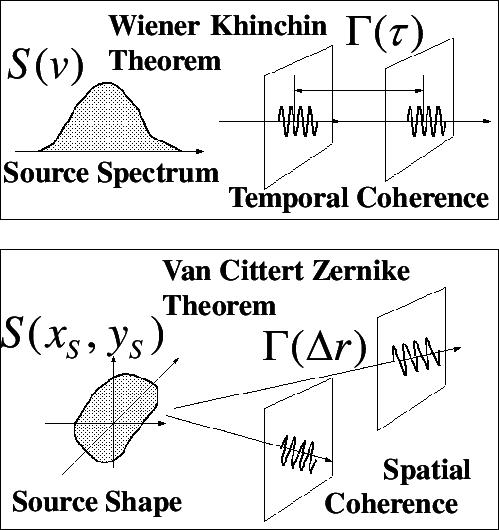
Figure 2: The physical correspondence between temporal and spatial coherence. The upper diagram shows the Wiener–Khinchin theorem (the relationship between the spectrum and temporal coherence); the lower diagram shows the van Cittert–Zernike theorem (the relationship between source shape and spatial coherence).
- Temporal coherence is determined by the optical spectrum → corresponding to the phase correlation of light in time
- Spatial coherence is determined by the spatial distribution of the source → corresponding to the phase correlation of light in space
Lasers have good spatial coherence because the optical resonator performs mode selection. For a laser in the fundamental transverse mode (TEM₀₀), the phase is highly uniform across the entire beam cross-section, giving very good spatial coherence.
4. “Coherence Length” in Nonlinear Optics
It is important to note that in nonlinear optics the term “coherence length” has a different meaning.
For example, in frequency doubling (second-harmonic generation), the coherence length is usually understood as the propagation distance over which the phase difference between the fundamental and the harmonic accumulates to . This is inconsistent with the usual concept of “coherence” — because beyond this length, the predictable phase relationship (strong phase correlation) clearly still exists; only the relative phase undergoes a systematic evolution.
Put simply: the ordinary coherence length is the distance over which “the phase becomes scrambled,” whereas the coherence length in nonlinear optics is the distance over which “the phase difference accumulates to π” — the former is random disorder, the latter a predictable offset; they are completely different things.
III. Key Parameters and Performance Metrics
| Parameter | Meaning | Unit | Notes |
|---|---|---|---|
Coherence length  |
propagation distance over which coherence decays significantly | m, km | the core metric of temporal coherence |
| Coherence time |
time difference over which coherence decays significantly | s, μs | 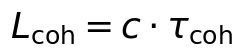
|
| Linewidth (frequency domain) |
full width at half maximum of the spectrum | Hz, kHz, MHz | inversely proportional to coherence length |
Linewidth  (wavelength domain) |
full width at half maximum in wavelength | nm, pm | can be converted to frequency linewidth via the centre wavelength |
| Degree of coherence | contrast of the interference fringes | 0~1 | 1 is fully coherent, 0 is fully incoherent |
Key Interpretations
Coherence length is a gradual concept, not a black-and-white “dividing line.” The degree of coherence decreases gradually as the optical path difference increases. Coherence length is usually defined as the optical path difference at which the degree of coherence falls to a certain value (such as or 50%).
Frequency drift does not affect coherence length. If a laser’s frequency drifts slowly due to temperature changes or other reasons (for example from the kHz to the MHz scale), as long as the drift is not too fast it will not affect the coherence length — the coherence length is still determined by short-term phase fluctuations.
IV. Main Types (Lasers Classified by Coherence)
1. Long-Coherence-Length Lasers
- Single-frequency solid-state lasers (especially Nd:YAG and similar): coherence length can reach several kilometres
- Frequency-stabilized lasers: used for optical clocks and precision metrology, coherence length can reach hundreds of thousands of kilometres
- Narrow-linewidth fibre lasers: single-frequency fibre lasers, coherence length can reach hundreds of metres to several kilometres
2. Medium-Coherence-Length Lasers
- Diode lasers (laser diodes): even in single-frequency operation, coherence length is far shorter than solid-state lasers, usually on the metre scale
- Multimode lasers: coherence length is usually on the millimetre-to-centimetre scale
3. Short-Coherence-Length Light Sources
- Supercontinuum sources: very short coherence length, commonly used in optical coherence tomography (OCT)
- Ultrashort-pulse lasers: the shorter the pulse, the broader the spectrum and the shorter the coherence length
- Multimode diode lasers: coherence length only a few hundred micrometres
- White light / LED: coherence length only on the micrometre scale
V. Typical Applications
1. Interferometry
This is the most classic application of coherence. Taking advantage of the laser’s long coherence length, various high-precision measurements can be made: laser interferometers measure length, displacement and vibration with nanometre-level precision; flat-field interferometers inspect the surface figure accuracy of optical components.
2. Holography
Holography requires highly coherent light — the optical path difference between the reference and object beams must be within the coherence length for interference fringes to form. Ordinary light simply cannot produce holograms; only the high coherence of a laser meets the requirement.
3. Coherent Optical Communication
In fibre-optic communication, coherent detection uses the phase and polarisation of light to carry information, greatly increasing communication capacity and sensitivity. This requires the light source to have a very narrow linewidth (good temporal coherence).
4. Laser Cooling and Atomic Physics
Cutting-edge research such as laser cooling and Bose–Einstein condensation places extremely high demands on laser frequency stability and coherence — typically requiring ultra-narrow-linewidth frequency-stabilized lasers with linewidths as low as the Hz or even sub-Hz level.
5. Optical Coherence Tomography (OCT)
Interestingly, OCT instead uses a low-coherence light source (a broadband source with a very short coherence length). By measuring the position of the interference envelope of the reflected light, cross-sectional imaging of biological tissue can be achieved — the axial resolution is inversely proportional to the coherence length; the shorter the coherence length, the higher the resolution.
6. Speckle and Coherent Imaging
The speckle effect brought by coherence is a drawback in some applications (such as laser projection), but an advantage in others (such as speckle interferometry and digital holography). Understanding coherence is the basis for making good use of these techniques.
VI. Common Misconceptions
Misconception 1: All Lasers Have Good Coherence
Not necessarily. Coherence varies enormously among lasers:
- Multimode diode lasers: coherence length may be only a few hundred micrometres
- Multimode lasers: coherence length usually only on the centimetre scale
- Single-frequency solid-state lasers: coherence length can reach hundreds of metres to several kilometres
- Ultrashort-pulse lasers: although they are lasers, their very broad spectra give them instead a short coherence length
So do not assume good coherence just because you hear “laser” — it depends on the type of laser.
Misconception 2: The Longer the Coherence Length, the Better
It depends on the application. A long coherence length can sometimes be a problem:
- OCT: requires a short coherence length (broadband source) for high axial resolution
- White-light interferometers: exploit the short coherence length of white light for absolute distance measurement
- Imaging systems: too-good coherence produces speckle noise, reducing image quality
Like tools, there is no absolute good or bad — only suitable or unsuitable.
Misconception 3: Spatial Coherence and Temporal Coherence Are the Same Thing
Not at all. They describe coherence in different dimensions:
- Temporal coherence = spectral purity → determined by the number of longitudinal modes and the linewidth
- Spatial coherence = mode purity → determined by the transverse mode structure
A light source can have good temporal coherence but poor spatial coherence, or good spatial coherence but poor temporal coherence.
Misconception 4: A Spectrometer Can Accurately Measure Coherence Length
A spectrometer can measure optical linewidth. If the linewidth is determined by the coherence length, you can estimate the coherence length using a formula — but you cannot use the spectrometer to verify whether that assumption holds. In other words, a narrow spectrum does not necessarily mean a long coherence length (other factors can affect coherence).
Misconception 5: “Coherence Length” in Nonlinear Optics Is the Same as the Usual One
Completely different. The “coherence length” in nonlinear optics describes the systematic phase accumulation between the fundamental and the harmonic (a difference of π), not the loss of coherence due to random fluctuations. Boyd’s nonlinear optics textbook calls it the “coherent interaction length,” but in speech people usually shorten it to “coherence length,” which easily confuses beginners.
VII. Selection Advice
1. Select by Application Requirements
- Interferometry / holography → need long coherence length; choose a single-frequency frequency-stabilized laser
- Fibre communication / coherent detection → choose a narrow-linewidth diode laser or single-frequency fibre laser
- OCT / low-coherence interferometry → need short coherence length; choose a broadband source (such as a superluminescent diode, SLD)
- Laser marking / cutting → no special coherence requirement; an ordinary multimode laser will do
2. Key Considerations
- How long a coherence length is needed? (determined by the maximum optical path difference in the system, with margin)
- What is the wavelength? (coherence length is determined by the frequency linewidth; mind the conversion between wavelength and frequency)
- Do you need temporal coherence or spatial coherence? (the two are independent)
- Short-term or long-term stability? (slow drift does not affect coherence length, but does affect some applications)
3. Measurement and Verification
If you need to confirm a laser’s coherence length, you can measure it directly with a Michelson interferometer — gradually increase the length of one arm and observe the change in interference fringe contrast; the optical path difference at which the contrast falls to a certain threshold is the coherence length.
VIII. Recommended Reading
- RP Photonics: Coherence Length (original)
- RP Photonics: Laser Light (characteristics of laser light)
- What Are Laser Modes? Transverse and Longitudinal Modes Explained
- What Is an Optical Resonator? How Two Mirrors Trap Light
- Single-Frequency Fibre Lasers
- Narrow-Linewidth Fibre Lasers
IX. References
- RP Photonics Encyclopedia – Coherence Length (https://www.rp-photonics.com/coherence_length.html)
- RP Photonics Encyclopedia – Laser Light (https://www.rp-photonics.com/laser_light.html)
- RP Photonics Encyclopedia – Coherence (https://www.rp-photonics.com/coherence.html)
- RP Photonics Encyclopedia – Coherence Time (https://www.rp-photonics.com/coherence_time.html)
Leave a Reply